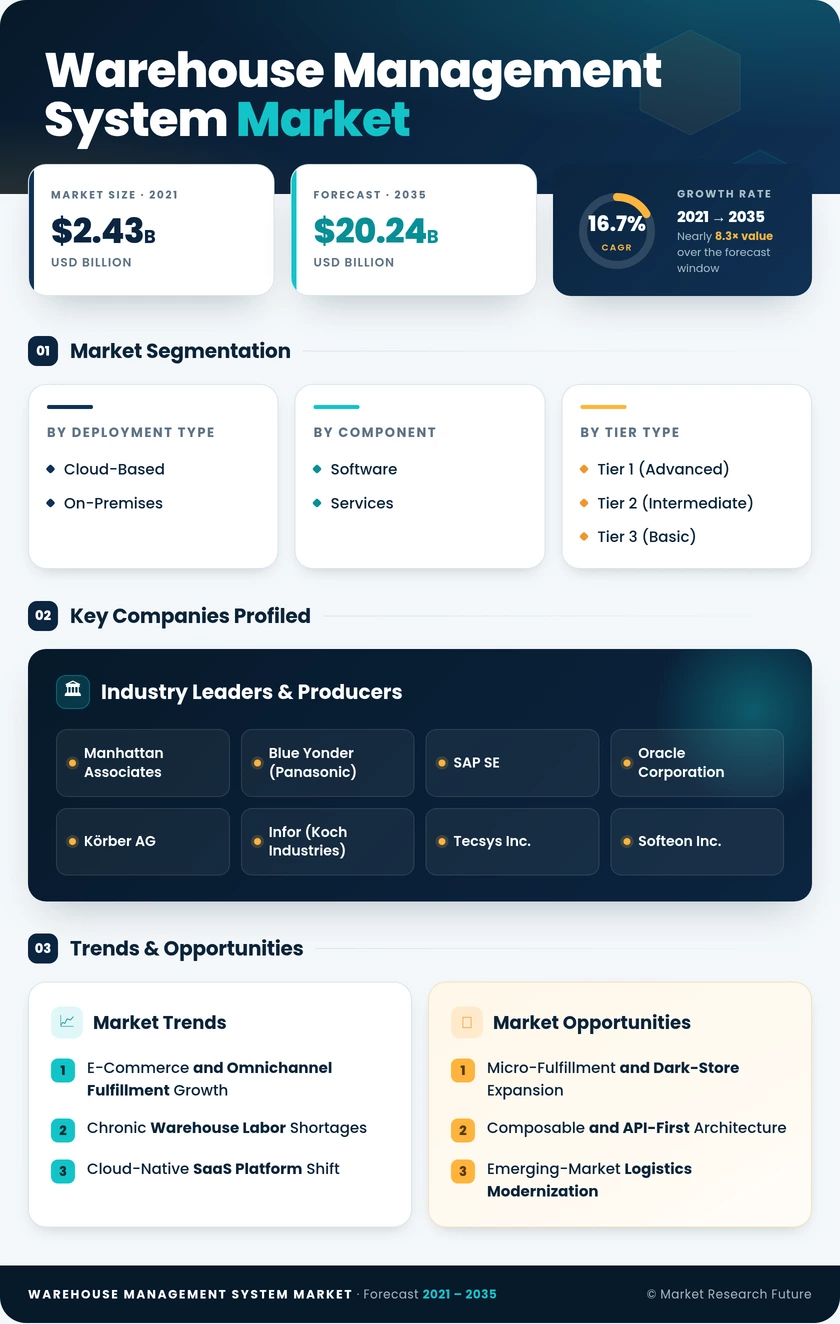
Warehouse management system Market

ID: MRFR/ICT/1496-HCR
200 Pages
Aarti Dhapte
Last Updated: June 17, 2026
Warehouse Management System Market Size, Share and Research Report By Deployment Type (Cloud-Based, On-Premises), By Component (Software, Services), By Tier Type (Tier 1 (Advanced), Tier 2 (Intermediate), Tier 3 (Basic)), By End-User Industry (Manufacturing, Retail & E-Commerce, Transportation & Logistics, Food & Beverages, Healthcare & Pharma, Automotive, Consumer Goods & Others) and By Regional (North America, Europe, South America, Asia Pacific, Middle East and Africa) - Industry Forecast to 2035
Download PDF ×

We do not share your information with anyone. However, we may send you emails based on your report interest from time to time. You may contact us at any time to opt-out.

  1. 1 Market Overview |
    1. 1.1 Study Assumptions & Market Definition |
    2. 1.2 Scope of the Study |
    3. 1.3 Research Methodology
  2. 2 Market Summary & Key Takeaways
  3. 3 Market Dynamics |
    1. 3.1 Market Drivers Analysis | |
      1. 3.1.1 E-Commerce and Omnichannel Fulfillment Growth | |
      2. 3.1.2 Chronic Warehouse Labor Shortages | |
      3. 3.1.3 Cloud-Native SaaS Platform Shift | |
      4. 3.1.4 AI and Machine-Learning Integration | |
      5. 3.1.5 Regulatory Traceability Mandates | |
      6. 3.1.6 Robotics and AMR Orchestration Integration | |
      7. 3.1.7 Emerging-Market Logistics Infrastructure Investment |
    2. 3.2 Market Restraints Analysis | |
      1. 3.2.1 High Implementation and Integration Costs | |
      2. 3.2.2 Data-Security and Sovereignty Concerns | |
      3. 3.2.3 Legacy ERP Lock-In and Migration Complexity | |
      4. 3.2.4 Shortage of Skilled WMS Implementation Consultants | |
      5. 3.2.5 Fragmented Vendor Landscape Creating Buyer Confusion |
    3. 3.3 Market Opportunity Analysis | |
      1. 3.3.1 Micro-Fulfillment and Dark-Store Expansion | |
      2. 3.3.2 Composable and API-First Architecture | |
      3. 3.3.3 Emerging-Market Logistics Modernization | |
      4. 3.3.4 Data-Monetization and Supply-Chain-as-a-Service Models | |
      5. 3.3.5 Robotics-Orchestration Layer |
    4. 3.4 Industry Value Chain Analysis |
    5. 3.5 Porter's Five Forces Analysis
  4. 4 Global Warehouse Management System Market Size & Forecast (2021–2035) |
    1. 4.1 Historical Market Size (2021–2025) |
    2. 4.2 Current & Forecast Market Size (2026–2035) |
    3. 4.3 Market Size by Revenue (USD Billion) |
    4. 4.4 Year-over-Year Growth Analysis
  5. 5 Segmentation Analysis |
    1. 5.1 By Deployment Type | |
      1. 5.1.1 Cloud-Based | |
      2. 5.1.2 On-Premises |
    2. 5.2 By Component | |
      1. 5.2.1 Software | |
      2. 5.2.2 Services |
    3. 5.3 By Tier Type | |
      1. 5.3.1 Tier 1 (Advanced) | |
      2. 5.3.2 Tier 2 (Intermediate) | |
      3. 5.3.3 Tier 3 (Basic) |
    4. 5.4 By End-User Industry | |
      1. 5.4.1 Manufacturing | |
      2. 5.4.2 Retail & E-Commerce | |
      3. 5.4.3 Transportation & Logistics | |
      4. 5.4.4 Food & Beverages | |
      5. 5.4.5 Healthcare & Pharma | |
      6. 5.4.6 Automotive | |
      7. 5.4.7 Consumer Goods & Others
  6. 6 Regional Analysis |
    1. 6.1 North America | |
      1. 6.1.1 United States | |
      2. 6.1.2 Canada | |
      3. 6.1.3 Mexico |
    2. 6.2 Europe | |
      1. 6.2.1 Germany | |
      2. 6.2.2 United Kingdom | |
      3. 6.2.3 France | |
      4. 6.2.4 Italy | |
      5. 6.2.5 Spain | |
      6. 6.2.6 Nordic Countries | |
      7. 6.2.7 Russia | |
      8. 6.2.8 Rest of Europe |
    3. 6.3 Asia-Pacific | |
      1. 6.3.1 China | |
      2. 6.3.2 India | |
      3. 6.3.3 Japan | |
      4. 6.3.4 South Korea | |
      5. 6.3.5 ASEAN | |
      6. 6.3.6 Rest of Asia-Pacific |
    4. 6.4 South America | |
      1. 6.4.1 Brazil | |
      2. 6.4.2 Argentina | |
      3. 6.4.3 Rest of South America |
    5. 6.5 Middle East & Africa | |
      1. 6.5.1 Saudi Arabia | |
      2. 6.5.2 UAE | |
      3. 6.5.3 South Africa | |
      4. 6.5.4 Egypt | |
      5. 6.5.5 Rest of MEA
  7. 7 Competitive Landscape |
    1. 7.1 Market Share Analysis (2025) |
    2. 7.2 Competitive Benchmarking Matrix |
    3. 7.3 Company Profiles | |
      1. 7.3.1 Manhattan Associates | |
      2. 7.3.2 Blue Yonder (Panasonic) | |
      3. 7.3.3 SAP SE | |
      4. 7.3.4 Oracle Corporation | |
      5. 7.3.5 Körber AG | |
      6. 7.3.6 Infor (Koch Industries) | |
      7. 7.3.7 Tecsys Inc. | |
      8. 7.3.8 Softeon Inc. | |
      9. 7.3.9 Made4net | |
      10. 7.3.10 Epicor Software
  8. 8 Future Outlook & Strategic Recommendations (2026–2035) |
    1. 8.1 AI-Autonomous Warehouse Operations |
    2. 8.2 Platform Economics and Ecosystem Aggregation |
    3. 8.3 Sustainability and ESG-Driven Supply-Chain Redesign |
    4. 8.4 Edge Computing and Real-Time Digital Twins
  9. 9 Recent Developments & News
  10. 10 Frequently Asked Questions (FAQs)
  11. 11 Report Scope & Methodology |
    1. 11.1 Study Period & Base Year |
    2. 11.2 Data Sources & Citations |
    3. 11.3 Abbreviations
  12. 1 LIST OF TABLES
  13. 2 LIST OF FIGURES

Segmentation Quick Reference

DimensionSub-SegmentsDominant SegmentFastest Growing Segment
Deployment TypeCloud-Based, On-PremisesCloud-Based (59.1% share, 2025)Cloud-Based
ComponentWarehouse management system Market, ServicesServices (85.6% share, 2025)Warehouse management system Market (18.1% CAGR)
Tier TypeTier 1 (Advanced), Tier 2 (Intermediate), Tier 3 (Basic)Tier 1 (38.5% share, 2025)Tier 2 (19.4% CAGR)
End-User IndustryManufacturing, Retail & E-Commerce, Transportation & Logistics, Food & Beverages, Healthcare & Pharma, Automotive, Consumer Goods & OthersManufacturing (32.3% share, 2025)Transportation & Logistics (19.6% CAGR)
GeographyNorth America, Europe, Asia-Pacific, South America, Middle East & AfricaNorth America (38.1% share, 2025)Asia-Pacific (20.1% CAGR)


Market Segmentation Overview

By Deployment Type

Sub-SegmentKey Trend
Cloud-BasedMulti-tenant SaaS models with continuous-release cycles replacing annual upgrade projects; elastic peak-season scaling
On-PremisesRetained in regulated verticals (defense, pharma) requiring on-site data residency; hybrid architectures emerging


Cloud adoption continues to accelerate as vendors invest in infrastructure resilience and compliance certifications (SOC 2, ISO 27001) that address enterprise security concerns, enabling even traditionally cautious industries to evaluate cloud WMS pathways.

By Component

Sub-SegmentKey Trend
Warehouse management system MarketSaaS licensing growth; AI/ML analytics embedded as standard features rather than premium add-ons
ServicesImplementation, customization, and managed-services engagements remain the majority of spend; consulting-led sales motions dominate Tier 1 deals


The balance is gradually shifting toward software revenue as recurring subscriptions replace one-time license fees, improving vendor revenue predictability and customer lifetime value.

By Tier Type

Sub-SegmentKey Trend
Tier 1 (Advanced)Multi-site orchestration, advanced labor management, wave/waveless planning for enterprise-scale operations
Tier 2 (Intermediate)Purpose-built platforms offering 80% of Tier 1 capability at significantly lower cost and faster go-live
Tier 3 (Basic)Entry-level cloud solutions for SMEs replacing manual spreadsheet-based inventory tracking


The Tier 2 segment is expanding rapidly as regional distributors and mid-market e-commerce operators seek a balance between functional depth and implementation simplicity.

By End-User Industry

Sub-SegmentKey Trend
ManufacturingJIT sequencing, parts-kit management, and line-side replenishment driving WMS sophistication
Retail & E-CommerceOmnichannel fulfillment, ship-from-store, and micro-fulfillment accelerating adoption
Transportation & LogisticsMulti-client 3PL operations demanding tenant-aware WMS configurations
Food & BeveragesCold-chain compliance, FEFO rotation, and batch traceability as regulatory table-stakes
Healthcare & PharmaDSCSA serialization, controlled-substance tracking, and temperature monitoring
AutomotiveEV battery-component warehousing and just-in-sequence delivery for assembly lines
Consumer Goods & OthersSeasonal demand variability and promotional-event fulfillment orchestration


Manufacturing and retail & e-commerce collectively account for the majority of current WMS deployments, though transportation & logistics is rapidly closing the gap as 3PL digitization intensifies globally.