Water Taxi Market

Water Taxi Market Size, Share & Growth Analysis Report By Product Type (Ferries, Yachts, Cruise, Sail Boats), By Propulsion Type (Diesel, Electric, Hybrid), By Length (Above 10 m, Up To 10 m), By Boat Size (30–50 ft, Below 30 ft, Above 50 ft) and By Regional (North America, Europe, South America, Asia Pacific, Middle East and Africa) – Industry Growth & Forecast to 2035
ID: MRFR/AT/10418-HCR
128 Pages
Shubham Munde, Sejal Akre
Last Updated: June 05, 2026
 

Water Taxi Market Summary

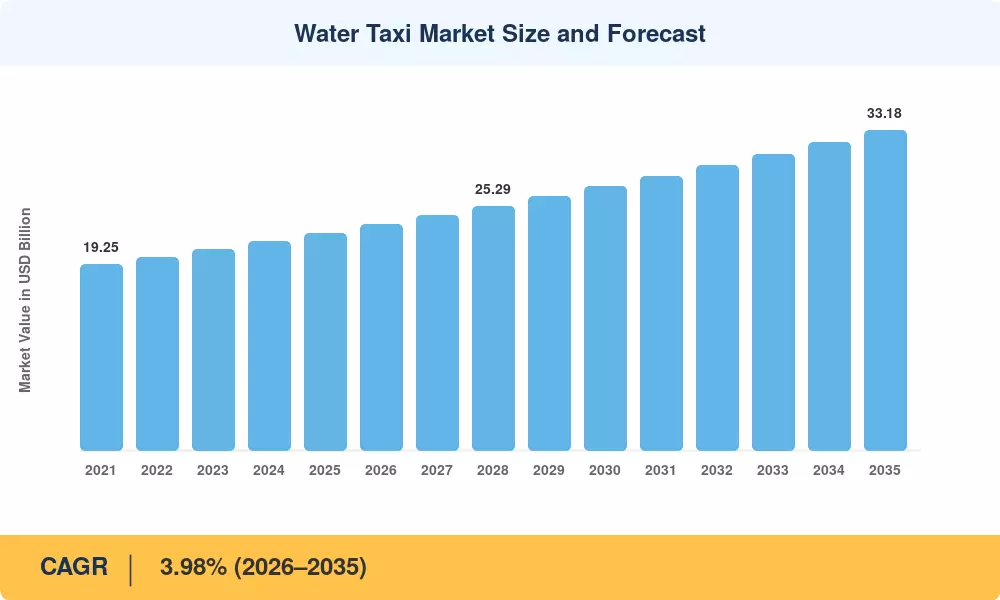
The Water Taxi Market reached an estimated USD 22.51 billion in 2025 and is projected to grow from USD 23.41 billion in 2026 to USD 33.18 billion by 2035, registering a CAGR of 3.98% during the forecast period (2026–2035). Municipal transit authorities across three continents are channeling capital into waterborne commuter service networks as congested urban corridors push policymakers toward multimodal solutions. The U.S. Federal Transit Administration's 2024 allocation of USD 412 million for ferry water taxi commuter service infrastructure, paired with the EU's Sustainable and Smart Mobility Strategy targeting a 90% emissions cut by 2050, anchors much of the near-term investment pipeline [2][3].

A technology pivot is well underway. Legacy diesel fleets that once dominated harbor and coastal routes are giving way to electric water taxi urban ferry platforms and solar-powered water taxi green propulsion systems capable of slashing direct fuel costs by roughly a fifth. Norway's Norled launched a fully battery-electric ferry water taxi commuter service on the Stavanger route in 2023, validating lithium-ion propulsion for vessels under 30 meters and prompting at least fourteen operators in Western Europe to file electrification permits within twelve months [4]. Autonomous water taxi harbor navigation trials, backed by USD 78 million in venture funding during 2024 alone, signal a second wave of disruption that will reshape crew economics across the forecast window [5].

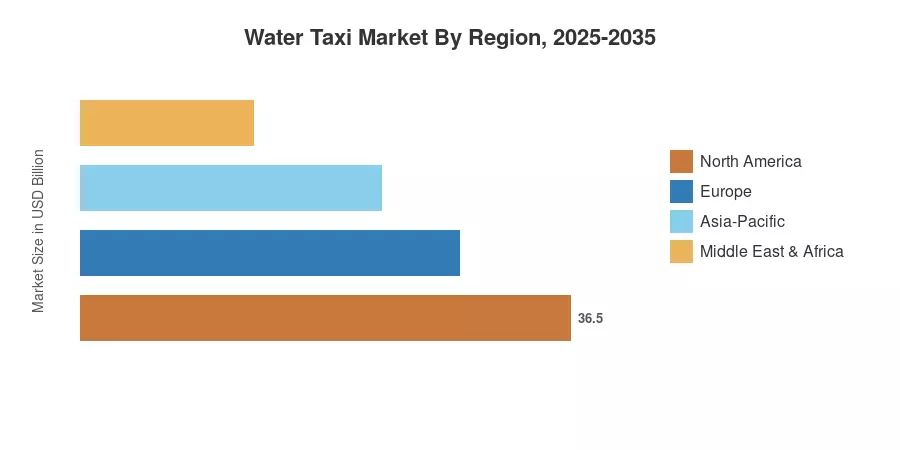
North America commands approximately 42% of the Water Taxi Market, driven by dense coastal metro corridors from New York to Vancouver. Asia-Pacific stands as the fastest-growing region with a projected CAGR of 4.09%, fueled by water taxi tourism charter expansion in Southeast Asian archipelago economies and rapid urbanization in coastal Indian cities. Europe holds the second-largest share at roughly 27%, underpinned by Scandinavian electrification mandates and Mediterranean tourism demand. By 2035, the Water Taxi Market is poised to become a mainstream urban transit layer rather than a niche tourism offering


Key Report Takeaways

• By Product Type

  • Ferries captured roughly 50% of the Water Taxi Market in 2024, reflecting entrenched commuter networks across North American and Northern European corridors
  • Yachts are forecast to expand at the fastest pace through 2035, driven by luxury water taxi tourism charter demand in the Caribbean and Maldives
  • Sail boats maintain a niche presence, with a 2024 valuation near USD 1.58 billion as eco-tourism operators favor wind-assisted rigid inflatable boat RIB taxi alternatives

• By Propulsion Type

  • Diesel propulsion accounted for a CAGR of 3.21% in the Water Taxi Market during the historical period, though fleet replacement cycles favor cleaner alternatives
  • Electric water taxi urban ferry systems are projected to grow at the highest rate through 2035, backed by municipal emission-reduction targets

• By Region

  • North America generated approximately USD 9.45 billion in Water Taxi Market revenue in 2024
  • Asia-Pacific is expected to register a 4.09% CAGR, the fastest among all regions, during 2026–2035


Water Taxi Market Size and Forecast (2021–2035)

MRFR’s size methodology triangulates top-down government transit expenditure data, operator level income disclosures and vessel production figures from classification organizations such as Lloyd’s Register and DNV. Historical data (2021-2024) comes from audited financial statements and port authority traffic data. Forecast data (2026-2035) is developed using a calibrated compound growth model, cross-validated with IMO fleet predictions[6].

.
Water Taxi Market Size and Forecast
Our Impact
Enabled $4.3B Revenue Impact for Fortune 500 and Leading Multinationals
Partnering with 2000+ Global Organizations Each Year
30K+ Citations by Top-Tier Firms in the Industry
 

Driver Impact Analysis

Driver ~% Impact on CAGR Geographic Relevance Impact Timeline
Urban congestion & multimodal transit mandates +0.85% Global Short-term (≤2 yr)
Fleet electrification & emission regulations +0.72% Europe, North America Medium-term (2–4 yr)
Water taxi tourism charter growth +0.55% Asia-Pacific, Caribbean Short-term (≤2 yr)
Autonomous water taxi harbor navigation tech +0.48% North America, Europe Long-term (≥4 yr)
Mobile-app dynamic routing & demand aggregation +0.38% Global Short-term (≤2 yr)
Public–private terminal partnerships +0.32% North America, MEA Medium-term (2–4 yr)
Solar-powered water taxi green propulsion R&D +0.25% Europe, Asia-Pacific Long-term (≥4 yr)


Urban Congestion and Multimodal Transit Mandates

Cities with populations exceeding five million face average commute-time increases of 14% since 2019, according to the INRIX Global Traffic Scorecard [11]. New York City's Economic Development Corporation committed USD 285 million through 2027 to expand NYC Ferry to six new routes, directly growing ferry water taxi commuter service ridership by an estimated 3.8 million annual trips. Similar programs in Bangkok, Istanbul, and Lagos are reshaping how planners integrate waterborne links into bus-rapid-transit networks, converting underused canals and rivers into high-throughput transit arteries [2][11].

Fleet Electrification and Emission Regulations

The European Commission's FuelEU Maritime regulation, effective January 2025, mandates a 2% greenhouse-gas intensity reduction for vessels calling at EU ports, rising to 80% by 2050 [3]. Operators running short-haul electric water taxi urban ferry routes can meet near-term thresholds purely through battery-electric conversions, avoiding costly alternative-fuel infrastructure. In the Water Taxi Market, early movers like Sweden's Candela report a 50% reduction in per-passenger energy costs on the Stockholm archipelago run, validating the commercial case for hydrofoil-electric designs [4][12].

Tourism-Driven Charter Expansion

UNWTO reported 1.3 billion worldwide visitor arrivals in 2024, up 5% year-on-year [8]. Coastal resorts in Thailand, Greece, and the Maldives are increasingly promoting water taxi tourism charter services as premium experiences rather than basic transit. Operators bundle RIB (rigid inflatable boat) taxi excursions with snorkeling and island-hopping itineraries, increasing per-trip yields 35–40% beyond regular point-to-point prices [8][13].


Autonomous Navigation and Smart Harbor Systems

Rolls-Royce's autonomous water taxi harbor demonstrator completed 1,000 piloted-autonomous crossings on Finland's Turku archipelago route in 2024 without a single safety incident [5]. The Maritime and Port Authority of Singapore has allocated SGD 120 million to autonomous vessel test corridors through 2028, signaling a strong government commitment. These trials reduce crew costs—typically 30–35% of operating expenses—and position the Water Taxi Market for a structural cost reset after 2030 [5][14].


Restraints Impact Analysis

Restraint ~% Impact on CAGR Geographic Relevance Impact Timeline
High vessel capital costs & financing gaps −0.45% Global Medium-term (2–4 yr)
Fragmented waterway permitting & docking rights −0.35% Asia-Pacific, South America Long-term (≥4 yr)
Battery energy-density limits for longer routes −0.30% Europe, North America Medium-term (2–4 yr)
Seasonal demand volatility −0.25% Europe, North America Short-term (≤2 yr)
Skilled maritime workforce shortages −0.20% Global Long-term (≥4 yr)


High Vessel Capital Costs

A purpose-built 24-meter electric water taxi urban ferry catamaran carries a price tag of USD 4.5–6.2 million, roughly twice the cost of a comparable diesel hull [10]. Smaller operators running rigid inflatable boat RIB taxi fleets face debt-service ratios above 40%, making route profitability dependent on sustained load factors that many secondary cities cannot guarantee in early years. Public–private financing models mitigate the gap, yet loan tenors rarely exceed seven years—short for assets designed for a 25-year service life [10][15].

Fragmented Waterway Permitting

In emerging economies, waterway jurisdiction may span national maritime authorities, provincial port trusts, and municipal environmental boards. Indonesia's 34 provinces each maintain separate vessel-registration protocols, adding 8–14 months to new-route approvals and discouraging cross-provincial ferry water taxi commuter service networks [15]. Harmonized digital-permitting platforms under the ASEAN Single Window initiative could reduce timelines by 40%, but full rollout is not expected before 2029 [15].

Battery Energy-Density Constraints

Current lithium-ion marine battery packs deliver roughly 160–180 Wh/kg, limiting electric range to approximately 50 nautical miles under moderate sea states [12]. Routes exceeding this threshold still depend on diesel or hybrid propulsion. Solid-state battery prototypes from CATL and Samsung SDI target 350 Wh/kg by 2030, which would double viable electric range, but commercial marine-grade certification timelines remain uncertain [12][7].


Water Taxi Market Opportunities

Emerging-Market Waterway Urbanization

Coastal cities in Nigeria, Bangladesh, and Vietnam that are growing rapidly have undeveloped networks of rivers and lagoons. Lagos’s Blue Line train was completed in 2023, but nearly 22 km of adjacent lagoon frontage still lacks formal waterborne transit, providing opportunity for private-sector ferry, water taxi, and commuter service operators with modest dock infrastructure [15].


Subscription-Based Commuter Passes and Data Monetization

Operators adopting app-based ticketing accumulate granular ridership data—origin-destination pairs, peak-hour elasticity, fare sensitivity—that municipal planners will pay to access. A monthly subscription commuter-pass model, already proven by New York's NYC Ferry, raises load-factor predictability and opens recurring-revenue streams beyond per-ride fares. Anonymized mobility data licensing could represent 5–8% of ancillary revenue by 2030

Solar-Powered Water Taxi Green Vessel Integration

Thin-film photovoltaic panels integrated into cabin roofs can offset 15–20% of auxiliary power demand on daytime routes, extending battery range without adding hull weight. Dutch builder Aluship delivered the first commercially certified solar-powered water taxi green catamaran to a Rotterdam operator in 2024, and three Mediterranean operators have placed follow-on orders [7]

Luxury and Event-Based Water Taxi Tourism Charter

Dubai, Monaco, and Seychelles high-net-worth tourism segments provide premium-priced yacht-class water taxi tourism charter services with onboard amenities. The yields per seat on luxury services are 3-5 times the normal commuter rates, to make up for the reduced seat utilization [8][13]


Autonomous Water Taxi Harbor Shuttle Networks

Short repetitive harbor crossings, often less than 2 km, are the best entrance point for autonomous water taxi harbor vessels. Rotterdam, Singapore, and Helsinki ports are currently soliciting prototype concessions; successful demonstrations could set regulatory patterns that unleash bigger inland links [5][14]


Water Taxi Market Future Outlook

Electrification Supercycle

The International Energy Agency projects marine battery capacity to grow eightfold between 2025 and 2035 as cell costs decline below USD 80/kWh [24]. For the Water Taxi Market, this trajectory means electric water taxi urban ferry vessels will achieve cost parity with diesel on routes up to 80 nautical miles by 2032, eliminating the range barrier that currently confines electrification to short harbor shuttles. Fleet operators that lock in battery-supply agreements now will secure a structural cost advantage through the decade.

Autonomous Operations and AI-Driven Routing

Autonomous water taxi harbor technology is expected to transition from supervised pilot programs to semi-autonomous commercial operations between 2028 and 2031. Real-time AI routing algorithms already lift average load factors by 12–18% during shoulder seasons, and full autonomy could reduce crew-related operating costs by a third [5][14]. The Water Taxi Market stands to gain disproportionately because its short, repetitive routes are ideal proving grounds for machine-learning-based collision avoidance.

Platform Economics and Mobility-as-a-Service Integration

Urban MaaS platforms—including Citymapper, Moovit, and Google Transit—are progressively incorporating ferry and water taxi commuter service schedules into multimodal trip planners. By 2030, MRFR estimates that over 40% of water taxi bookings in tier-one cities will originate through third-party mobility aggregators, shifting competitive advantage toward operators with open API architectures and dynamic pricing engines.

ESG Reporting and Green-Bond Financing

Disclosure frameworks such as the EU Taxonomy and ISSB standards increasingly classify solar-powered water taxi green and electric fleets as eligible green-bond assets. The Water Taxi Market attracted its first dedicated green-bond issuance in 2024 when a Nordic operator raised EUR 150 million at 85 basis points below conventional spreads [25]. As institutional investors tighten climate mandates, green-financed fleet expansion could represent up to 30% of total Water Taxi Market capital deployment by 2033.


Water Taxi Market Segmentation

By Product Type

Segment Key Metric Primary Demand Driver
Ferries ~50% share (2024) Urban commuter networks
Yachts 4.01% CAGR Luxury water taxi tourism charter
Cruise USD 3.18 Billion (2025) Coastal sightseeing and event charters
Sail Boats 3.52% CAGR Eco-tourism; wind-assisted propulsion


Ferries remain the backbone of the Water Taxi Market, carrying the highest passenger volumes across regulated commuter corridors. Dense scheduling on routes like New York Harbor and Istanbul's Bosphorus generates stable, year-round revenue, insulating ferry water taxi commuter service operators from the seasonal swings that affect leisure-focused segments. Yacht-class vessels, by contrast, are growing fastest as ultra-premium water taxi tourism charter offerings in the Caribbean, Arabian Gulf, and Maldives command per-trip yields several multiples above standard fares [8][13].

By Propulsion Type

Segment Key Metric Primary Demand Driver
Diesel ~61% share (2024) Legacy fleet dominance; long-range routes
Electric 3.99% CAGR Emission mandates; lower operating costs
Hybrid USD 2.76 Billion (2025) Transitional solution for mid-range routes


Diesel propulsion still powers the majority of vessels in the Water Taxi Market, yet its share is declining as municipal authorities tighten harbor-emission zones. Electric water taxi urban ferry conversions are accelerating fastest in Scandinavia, the Netherlands, and the Pacific Northwest. Hybrid systems serve as a bridge technology, allowing operators to meet near-term emission thresholds while battery energy density catches up to full-electric requirements [3][4][12].

By Length

Segment Key Metric Primary Demand Driver
Above 10 m ~68% share (2024) High-capacity commuter and tourism vessels
Up To 10 m 4.06% CAGR Rigid inflatable boat RIB taxi; last-mile harbor shuttles


Vessels above 10 meters dominate the Water Taxi Market because regulated commuter services require safety-certified hulls with passenger capacities exceeding 50. Smaller craft—particularly rigid inflatable boat RIB taxi models—are growing quickly as on-demand harbor shuttle and resort-transfer platforms favor agile, low-draft vessels that can dock at informal piers

By Boat Size

Segment Key Metric Primary Demand Driver
30–50 ft ~51% share (2024) Versatile mid-range ferry water taxi commuter service hulls
Below 30 ft 4.10% CAGR Compact rigid inflatable boat RIB taxi and tender vessels
Above 50 ft USD 5.42 Billion (2025) Large cruise-style and high-capacity ferry platforms


The 30–50 ft class captures the sweet spot between passenger capacity and operational flexibility, making it the default choice for urban Water Taxi Market routes. Vessels below 30 ft represent the fastest-growing size bracket, propelled by app-dispatched on-demand services that prize maneuverability and rapid boarding turnaround over raw passenger count.


Regional Market Share Analysis

Region Key Metric Primary Investment Themes
North America ~42% share (2024) Ferry water taxi commuter service expansion; electrification grants
Europe ~27% share (2024) Emission mandates; solar-powered water taxi green retrofits
Asia-Pacific 4.09% CAGR (2026–2035) Tourism; archipelago connectivity; rigid inflatable boat RIB taxi fleets
South America USD 1.38 Billion (2025) Amazon and coastal city connectivity
Middle East & Africa USD 1.24 Billion (2025) Luxury water taxi tourism charter; port modernization
Total USD 22.51 Billion (2025)

The Water Taxi Market displays distinct regional demand profiles shaped by coastline density, urban planning legacies, and tourism infrastructure maturity.


North America

Country Key Metric Key Driver
US ~72% of regional share FTA ferry grants; NYC and San Francisco expansions
Canada 3.88% CAGR BC Ferries electrification; Great Lakes commuter pilots
Mexico USD 0.48 Billion (2025) Cancún–Riviera Maya water taxi tourism charter corridor


The United States accounts for the bulk of the North American Water Taxi Market activity, anchored by federally funded ferry programs in the Puget Sound, New York Harbor, and San Francisco Bay. Canada's BC Ferries committed CAD 640 million to hybrid-electric conversions through 2030, while Mexico's Caribbean coast continues to attract private water taxi tourism charter investment [2][17].

Europe

Country Key Metric Key Driver
Germany USD 0.62 Billion (2025) Hamburg port shuttle; Elbe river electric water taxi urban ferry
UK ~22% of regional share Thames Clippers expansion; net-zero maritime strategy
France 3.92% CAGR Seine commuter routes; Marseille harbor revival
Italy USD 0.71 Billion (2025) Venice lagoon regulation; Amalfi Coast tourism
Spain 3.85% CAGR Barcelona and Balearic Islands shuttle growth
Nordic Countries ~14% of regional share Scandinavian electrification leadership
Russia USD 0.29 Billion (2025) Volga River seasonal services
Rest of Europe 3.78% CAGR Adriatic and Aegean island connectivity


Europe's Water Taxi Market is shaped by FuelEU Maritime and national emission-reduction roadmaps. The UK's Department for Transport allocated GBP 206 million for zero-emission vessel R&D in 2024, while Nordic operators lead global adoption of autonomous water taxi harbor shuttles and solar-powered water taxi green propulsion [3][4][18].

Asia-Pacific

Country Key Metric Key Driver
China ~31% of regional share Yangtze Delta commuter ferry water taxi commuter service
India 4.15% CAGR Mumbai and Kochi Water Metro projects
Japan USD 0.52 Billion (2025) Tokyo Bay electric water taxi urban ferry pilots
South Korea 4.02% CAGR Incheon–Seoul Han River corridor
ASEAN ~28% of regional share Archipelago connectivity; rigid inflatable boat RIB taxi fleets
Rest of Asia-Pacific 3.91% CAGR Tourism-led growth in Oceania


India's Kochi Water Metro—the country's first integrated urban water transit system—carried over 1.2 million passengers within its first operational year, validating demand in dense tropical-coastal cities [19]. China's Yangtze River Delta provinces collectively tendered 42 new electric water taxi urban ferry vessels in 2024, making the Water Taxi Market a focal point of the nation's "dual carbon" strategy [20].

South America

Country Key Metric Key Driver
Brazil ~58% of regional share Amazon riverine transport; Rio de Janeiro CCR Barcas
Argentina 3.72% CAGR Buenos Aires Río de la Plata commuter corridor
Rest of South America USD 0.22 Billion (2025) Colombian Pacific coast pilots


Brazil dominates the South American Water Taxi Market through long-established Amazonian ferry water taxi commuter service routes and Rio de Janeiro's expanding catamaran network. Argentina's Río de la Plata corridor remains underserved, presenting concession opportunities for operators with electric water taxi urban ferry capabilities [15][21].

Middle East & Africa

Country Key Metric Key Driver
Saudi Arabia 4.05% CAGR NEOM Bay and Red Sea resort corridors
UAE ~36% of regional share Dubai RTA abra modernization; luxury charter
South Africa USD 0.14 Billion (2025) Cape Town V&A Waterfront shuttle
Egypt 3.82% CAGR Nile River tourism revival
Rest of MEA USD 0.18 Billion (2025) East African coastal connectivity


Dubai's Roads and Transport Authority expanded its water taxi tourism charter fleet by 18 vessels in 2024 as part of the Maritime Vision 2030 strategy, while Saudi Arabia's NEOM project envisions a fully autonomous water taxi harbor transit layer connecting coastal districts [22][23].


Water Taxi Market By Region, 2025-2035
 

Competitive Benchmarking

The Water Taxi Market exhibits moderate concentration, with the top five operators estimated to hold 28–34% of global revenue and a Herfindahl-Hirschman Index (HHI) below 800. The competitive field spans multinational shipbuilders, vertically integrated transit operators, and technology-first startups specializing in autonomous water taxi harbor navigation and electric water taxi urban ferry design.

Company Est. Revenue Share Range Key Offerings Strategic Positioning
Damen Shipyards Group ~5–8% Modular ferry platforms; electric catamarans Full-spectrum shipbuilder with global yard network
Rolls-Royce (MTU) ~4–7% Marine propulsion; autonomous navigation Technology licensor for autonomous water taxi harbor systems
Wärtsilä Corporation ~4–6% Hybrid propulsion; fleet optimization software Integrated powertrain and digital-routing solutions
Candela Technology ~2–4% Hydrofoil electric water taxi urban ferry First-mover in high-speed electric foiling vessels
Thames Clippers (Uber Boat) ~3–5% Urban commuter ferry water taxi commuter service Dominant London operator; app-integrated ticketing
Hornblower Group ~3–5% Multi-city ferry and cruise charters Largest U.S. ferry water taxi commuter service network
MBNA Thames Clippers ~2–4% Premium commuter and tourism services UK-focused brand with loyalty programs
SeaLink Travel Group ~2–4% Australian and Singaporean ferry networks Asia-Pacific regional transit leader
Metal Shark Boats ~2–3% Aluminum patrol and passenger craft Rigid inflatable boat RIB taxi and custom vessel fabricator
Navya / Maritime Autonomy ~1–3% Autonomous harbor shuttle prototypes Early-stage autonomous water taxi harbor pilot operator


Recent News & Developments


  • U.S. Federal Transit Administration (January 2025): Announced USD 220 million in competitive ferry grants under the Bipartisan Infrastructure Law, prioritizing zero-emission vessel procurement for the Water Taxi Market [2].


Water Taxi Market Report Scope

Parameter Detail
Market Scope Global Water Taxi Market — passenger waterborne transport services and vessels
Study Period 2021–2035
CAGR (Forecast Period) 3.98% (2026–2035)
Market Size (2025) USD 22.51 Billion
Market Size (2035) USD 33.18 Billion
Fastest Growing Segments Yachts (product type); Electric (propulsion); Below 30 ft (boat size); Asia-Pacific (region)
Companies Profiled 10 (Damen, Rolls-Royce, Wärtsilä, Candela, Thames Clippers, Hornblower, MBNA, SeaLink, Metal Shark, Navya)
Valuation Currency USD Billion


FAQs

What payback period should investors expect for an electric water taxi vessel?

Most electric water taxi urban ferry catamarans reach payback within 7–9 years thanks to fuel savings of 40–50% versus diesel, though routes with load factors below 55% extend that horizon considerably [10].

How does the Water Taxi Market differ from the broader ferry industry in competitive structure?

Water taxi operators tend to be smaller, privately held firms competing on route exclusivity and app-based convenience rather than the large public-sector monopolies typical of long-distance ferry services.

What insurance considerations apply to autonomous water taxi harbor operations?

Underwriters currently classify autonomous vessels as experimental, adding 20–30% premium surcharges; classification-society certification milestones from DNV and Lloyd's are expected to normalize rates by 2030 [6][16].

Which battery chemistry is best suited for solar-powered water taxi green vessels?

Lithium iron phosphate (LFP) dominates today due to superior thermal stability in marine environments, but sodium-ion cells may gain share after 2029 as energy density improves [12][24].

How do rigid inflatable boat RIB taxi fleets handle regulatory life-raft requirements?

Vessels under 12 meters carrying fewer than 12 passengers typically qualify for simplified safety-equipment standards under SOLAS exemptions, reducing compliance costs by roughly 25% [6].

Can water taxi tourism charter operators hedge against seasonal demand drops?

Dynamic pricing algorithms paired with corporate-event and wedding-charter packages allow operators to maintain 60–70% utilization during off-peak months, smoothing annual revenue volatility[13].

What role do port authorities play in the Water Taxi Market entry barriers?

Port authorities control docking-slot allocation and terminal access, making concession agreements the single largest determinant of route viability for new entrants in congested harbors [10][15].


Author
Author
Author Profile
Shubham Munde LinkedIn
Team Lead - Research
Shubham brings over 7 years of expertise in Market Intelligence and Strategic Consulting, with a strong focus on the Automotive, Aerospace, and Defense sectors. Backed by a solid foundation in semiconductors, electronics, and software, he has successfully delivered high-impact syndicated and custom research on a global scale. His core strengths include market sizing, forecasting, competitive intelligence, consumer insights, and supply chain mapping. Widely recognized for developing scalable growth strategies, Shubham empowers clients to navigate complex markets and achieve a lasting competitive edge. Trusted by start-ups and Fortune 500 companies alike, he consistently converts challenges into strategic opportunities that drive sustainable growth.
Co-Author
Co-Author Profile
Sejal Akre LinkedIn
Senior Research Analyst
She has over 5 years of rich experience, in market research and consulting providing valuable market insights to client. Hands on expertise in management consulting, and extensive knowledge in domain including ICT, Automotive & Transportation and Aerospace & Defense. She is skilled in Go-to market strategy, industry analysis, market sizing, in depth company profiling, competitive intelligence & benchmarking and value chain amongst others.
Download Free Sample

Kindly complete the form below to receive a free sample of this Report

Download PDF ×

We do not share your information with anyone. However, we may send you emails based on your report interest from time to time. You may contact us at any time to opt-out.