×
Request Free Sample ×

Kindly complete the form below to receive a free sample of this Report

* Please use a valid business email

Leading companies partner with us for data-driven Insights

clients tt-cursor
Hero Background

Water Treatment Systems Market

ID: MRFR/CnM/1039-HCR
111 Pages
Chitranshi Jaiswal
October 2025

Water Treatment Systems Point of Entry Market Research Report: By Technology (Membrane Filtration, Granular Activated Carbon (GAC), Ion Exchange, Ultraviolet (UV) Disinfection, Distillation), By Application (Residential, Commercial, Industrial, Municipal), By Contaminant Removal (Chlorine, Fluoride, Heavy Metals, Bacteria, Viruses), By Capacity (= 100,000 liters per day (LPD), 100,000 - 500,000 LPD, 500,000 - 1,000,000 LPD, > 1,000,000 LPD), By Installation Type (Under-sink, Whole-house, Commercial, Industrial) and By Regional (North Amer... read more

Share:
Download PDF ×

We do not share your information with anyone. However, we may send you emails based on your report interest from time to time. You may contact us at any time to opt-out.

Water Treatment Systems Market Infographic
Purchase Options

Water Treatment Systems Market Summary

As per MRFR analysis, the Water Treatment Systems Market was estimated at 11.53 USD Billion in 2024. The Water Treatment Systems industry is projected to grow from 12.34 USD Billion in 2025 to 24.33 USD Billion by 2035, exhibiting a compound annual growth rate (CAGR) of 7.02 during the forecast period 2025 - 2035.

Key Market Trends & Highlights

The Water Treatment Systems Market is experiencing robust growth driven by technological advancements and increasing sustainability efforts.

  • North America remains the largest market for water treatment systems, driven by stringent regulatory compliance and technological integration.
  • Asia-Pacific is identified as the fastest-growing region, reflecting a surge in urbanization and industrial growth.
  • Municipal water treatment continues to dominate the market, while industrial water treatment is rapidly expanding due to rising demand.
  • Key market drivers include rising water scarcity and growing awareness of water quality, which are propelling investments in advanced treatment technologies.

Market Size & Forecast

2024 Market Size 11.53 (USD Billion)
2035 Market Size 24.33 (USD Billion)
CAGR (2025 - 2035) 7.02%

Major Players

Veolia Environnement (FR), Suez (FR), Xylem (US), Evoqua Water Technologies (US), Pentair (US), Danaher Corporation (US), Aquatech International (US), GE Water & Process Technologies (US)

Water Treatment Systems Market Trends

The Water Treatment Systems Market is currently experiencing a dynamic evolution, driven by increasing awareness regarding water quality and the necessity for sustainable practices. As global populations expand and industrial activities intensify, the demand for effective water treatment solutions appears to be on the rise. This market encompasses a variety of technologies, including filtration, disinfection, and chemical treatment, which are essential for ensuring safe drinking water and meeting regulatory standards. Furthermore, the integration of advanced technologies such as IoT and AI into water treatment processes suggests a shift towards more efficient and automated systems, potentially enhancing operational effectiveness and reducing costs. In addition to technological advancements, environmental concerns are prompting stakeholders to adopt eco-friendly practices. The Water Treatment Systems Market seems to be increasingly influenced by the need for compliance with stringent environmental regulations. This trend indicates a growing preference for systems that minimize waste and energy consumption. Moreover, the rising focus on recycling and reusing water resources highlights the importance of innovative treatment solutions. As the market continues to evolve, it is likely that collaboration among various sectors will play a crucial role in addressing the challenges associated with water scarcity and quality management.

Technological Integration

The incorporation of advanced technologies such as artificial intelligence and the Internet of Things is transforming the Water Treatment Systems Market. These innovations facilitate real-time monitoring and data analysis, leading to improved efficiency and reduced operational costs.

Sustainability Focus

There is a noticeable shift towards sustainable practices within the Water Treatment Systems Market. Stakeholders are increasingly prioritizing eco-friendly solutions that minimize environmental impact, aligning with global efforts to conserve water resources.

Regulatory Compliance

The Water Treatment Systems Market is heavily influenced by stringent regulations aimed at ensuring water quality and safety. This trend compels manufacturers to develop systems that not only meet but exceed compliance standards, fostering innovation.

Water Treatment Systems Market Drivers

Increasing Water Quality Standards

The Global Water Treatment Systems Market Point Of Entry Market Industry is experiencing a surge in demand driven by the rising water quality standards set by governments worldwide. Regulatory bodies are increasingly enforcing stringent guidelines to ensure safe drinking water, which necessitates the adoption of advanced water treatment systems. For instance, the U.S. Environmental Protection Agency has established regulations that require municipalities to improve water quality, thereby boosting the market for point-of-entry systems. This trend is expected to contribute significantly to the market's growth, with projections indicating a market value of 11.5 USD Billion in 2024.

Market Segment Insights

By Application: Municipal Water Treatment (Largest) vs. Industrial Water Treatment (Fastest-Growing)

The Application segment in the Water Treatment Systems Market is largely dominated by Municipal Water Treatment, which holds the largest market share among the various applications. This segment encompasses the treatment of water supplies for public use, ensuring safe drinking water is available for urban populations. Following Municipal Water Treatment, the Industrial Water Treatment segment is significant as it caters to various industries that require treated water for processes such as manufacturing and cooling operations, adding to the competitiveness of this market landscape.

Municipal Water Treatment (Dominant) vs. Industrial Water Treatment (Emerging)

Municipal Water Treatment stands as the dominant segment in the market, characterized by significant investments in infrastructure and technology aimed at enhancing water quality for public health. This segment benefits from governmental regulations and initiatives focused on providing safe drinking water, leading to widespread adoption of advanced treatment technologies. Conversely, Industrial Water Treatment is emerging rapidly, driven by the increasing industrial activities and stringent environmental regulations. Industries are compelled to adopt efficient water treatment solutions to minimize waste and ensure compliance, fostering innovation and the development of specialized treatment systems.

By Technology: Reverse Osmosis (Largest) vs. Membrane Filtration (Fastest-Growing)

In the Water Treatment Systems Market, various technologies play vital roles in ensuring the effective purification and treatment of water. Among these, Reverse Osmosis holds the largest share, attributed to its widespread adoption in both residential and industrial applications. Membrane Filtration follows closely, demonstrating significant potential due to its efficiency in removing particles and contaminants, capturing a growing segment of the market.

Membrane Filtration (Emerging) vs. Chemical Treatment (Dominant)

Membrane Filtration technology is rapidly emerging as a preferred choice for water treatment due to its ability to provide efficient filtration without the need for chemical additives. As environmental concerns grow, Membrane Filtration systems are being increasingly employed in various applications ranging from municipal waste treatment to industrial processes. On the other hand, Chemical Treatment remains a dominant method due to its established processes and effectiveness in various scenarios, employing chemicals to eliminate contaminants. Both technologies serve vital roles in the evolving landscape of water treatment, where sustainability and efficiency are paramount.

By End Use: Residential (Largest) vs. Industrial (Fastest-Growing)

The water treatment systems market is predominantly driven by the residential segment, which accounts for a considerable share owing to increasing household water quality concerns and regulatory mandates. The demand for residential water treatment solutions is propelled by consumer awareness regarding health and wellness, leading to significant investments in home filtration systems, softeners, and purification technologies.

Residential (Dominant) vs. Industrial (Emerging)

The residential end use dominates the water treatment systems market as more homeowners prioritize safe and clean drinking water. With a wide variety of solution offerings such as point-of-use filters and whole-house systems, this segment addresses the diverse needs of households. In contrast, the industrial segment is fast emerging as a critical player due to stringent environmental regulations and the need for efficient waste management. Industries are increasingly adopting advanced water treatment solutions to comply with legal standards and improve operational efficiency, indicating a strong growth trajectory.

Get more detailed insights about Water Treatment Systems Market

Regional Insights

North America : Market Leader in Water Treatment

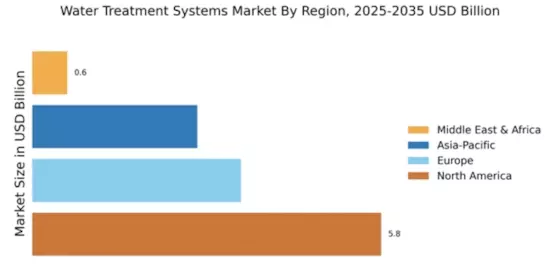
North America is poised to maintain its leadership in the Water Treatment Systems market, holding a significant market share of 5.77 in 2024. The region's growth is driven by stringent environmental regulations, increasing water scarcity, and a rising demand for advanced treatment technologies. Government initiatives aimed at improving water quality and sustainability further catalyze market expansion. The competitive landscape is robust, with key players like Xylem, Veolia Environnement, and Suez leading the charge. The U.S. is the primary market, supported by substantial investments in infrastructure and technology. The presence of major companies ensures innovation and a diverse range of solutions, catering to both municipal and industrial needs.

Europe : Regulatory-Driven Market Growth

Europe's Water Treatment Systems market, valued at 3.45, is characterized by a strong regulatory framework promoting sustainability and innovation. The European Union's directives on water quality and treatment standards drive demand for advanced systems. Increasing public awareness about water conservation and environmental protection further fuels market growth. Leading countries like Germany, France, and the UK are at the forefront, with companies such as Suez and Veolia Environnement dominating the landscape. The competitive environment is marked by a focus on sustainable technologies and partnerships, ensuring compliance with stringent regulations. The region's commitment to reducing water pollution and enhancing treatment efficiency positions it as a key player in the global market.

Asia-Pacific : Emerging Market Potential

The Asia-Pacific region, with a market size of 2.73, is witnessing rapid growth in the Water Treatment Systems sector. This surge is driven by urbanization, industrialization, and increasing water pollution levels. Governments are implementing policies to enhance water quality and availability, creating a favorable environment for market expansion. Countries like China, India, and Japan are leading the charge, with significant investments in water infrastructure. The competitive landscape features both local and international players, including Xylem and Pentair, focusing on innovative solutions to meet the rising demand. The region's diverse needs and challenges present ample opportunities for growth and technological advancement.

Middle East and Africa : Resource-Challenged Region

The Middle East and Africa, with a market size of 0.58, face unique challenges in water treatment due to arid climates and limited freshwater resources. The demand for efficient water treatment systems is growing as governments prioritize water security and sustainability. Initiatives aimed at improving water access and quality are driving investments in advanced treatment technologies. Leading countries like the UAE and South Africa are making strides in adopting innovative solutions. The competitive landscape includes key players such as Aquatech International and GE Water & Process Technologies, focusing on tailored solutions for the region's specific needs. The emphasis on desalination and wastewater treatment is crucial for addressing water scarcity issues.

Key Players and Competitive Insights

The Water Treatment Systems Market is characterized by a dynamic competitive landscape, driven by increasing regulatory pressures, rising water scarcity, and a growing emphasis on sustainability. Major players such as Veolia Environnement (FR), Suez (FR), and Xylem (US) are strategically positioned to leverage innovation and technological advancements. Veolia Environnement (FR) focuses on enhancing its digital capabilities, while Suez (FR) emphasizes sustainable solutions through its circular economy initiatives. Xylem (US) is actively pursuing partnerships to expand its product offerings and market reach, collectively shaping a competitive environment that prioritizes efficiency and environmental stewardship.

Key business tactics within the market include localizing manufacturing and optimizing supply chains to enhance responsiveness to regional demands. The competitive structure appears moderately fragmented, with several key players exerting influence over various segments. This fragmentation allows for niche players to thrive, while larger companies consolidate their market positions through strategic acquisitions and partnerships, thereby enhancing their operational capabilities and market share.

In November 2025, Veolia Environnement (FR) announced a significant investment in a new water treatment facility in Spain, aimed at improving water quality and increasing capacity. This strategic move underscores Veolia's commitment to expanding its operational footprint in Europe, aligning with the growing demand for advanced water treatment solutions. The facility is expected to utilize cutting-edge technologies, thereby enhancing efficiency and reducing environmental impact, which is crucial in a market increasingly focused on sustainability.

In October 2025, Suez (FR) launched a new digital platform designed to optimize water management processes for municipalities. This initiative reflects Suez's strategic focus on digital transformation, enabling clients to monitor and manage water resources more effectively. By integrating AI and IoT technologies, Suez aims to enhance operational efficiency and reduce costs, positioning itself as a leader in the digitalization of water treatment systems.

In September 2025, Xylem (US) entered into a partnership with a leading technology firm to develop innovative water treatment solutions utilizing AI and machine learning. This collaboration is indicative of Xylem's strategy to integrate advanced technologies into its product offerings, enhancing the effectiveness and efficiency of water treatment processes. The partnership is expected to yield significant advancements in predictive maintenance and operational optimization, further solidifying Xylem's competitive edge in the market.

As of December 2025, current competitive trends indicate a pronounced shift towards digitalization, sustainability, and AI integration within the Water Treatment Systems Market. Strategic alliances are increasingly shaping the landscape, fostering innovation and enhancing operational capabilities. The competitive differentiation is likely to evolve from traditional price-based competition to a focus on technological innovation, reliability of supply chains, and sustainable practices. Companies that can effectively navigate these trends will likely emerge as leaders in a rapidly changing market.

Key Companies in the Water Treatment Systems Market market include

Industry Developments

The Water Treatment Systems Market Point of Entry Market size was valued at USD 10.07 billion in 2023 and is projected to expand at a CAGR of 7.0% from 2024 to 2032. Growing concerns regarding waterborne diseases and increasing government regulations are driving market growth. Technological advancements, such as the development of smart water treatment systems, are further expected to propel market expansion. Key players in the market include 3M, Culligan, and Pentair. Recent developments include the launch of a new line of point-of-entry water treatment systems by 3M, designed to remove contaminants and improve water quality.

Future Outlook

Water Treatment Systems Market Future Outlook

The Water Treatment Systems Market is projected to grow at a 7.02% CAGR from 2024 to 2035, driven by increasing water scarcity, regulatory pressures, and technological advancements.

New opportunities lie in:

  • Expansion of smart water management systems
  • Development of decentralized water treatment solutions
  • Investment in advanced filtration technologies for industrial applications

By 2035, the market is expected to achieve substantial growth, reflecting evolving water treatment needs.

Market Segmentation

Water Treatment Systems Market End Use Outlook

  • Residential
  • Commercial
  • Industrial
  • Agricultural
  • Institutional

Water Treatment Systems Market Technology Outlook

  • Membrane Filtration
  • Reverse Osmosis
  • Ultraviolet Disinfection
  • Activated Carbon Filtration
  • Chemical Treatment

Water Treatment Systems Market Application Outlook

  • Municipal Water Treatment
  • Industrial Water Treatment
  • Wastewater Treatment
  • Desalination
  • Point of Use

Report Scope

MARKET SIZE 202411.53(USD Billion)
MARKET SIZE 202512.34(USD Billion)
MARKET SIZE 203524.33(USD Billion)
COMPOUND ANNUAL GROWTH RATE (CAGR)7.02% (2024 - 2035)
REPORT COVERAGERevenue Forecast, Competitive Landscape, Growth Factors, and Trends
BASE YEAR2024
Market Forecast Period2025 - 2035
Historical Data2019 - 2024
Market Forecast UnitsUSD Billion
Key Companies ProfiledVeolia Environnement (FR), Suez (FR), Xylem (US), Evoqua Water Technologies (US), Pentair (US), Danaher Corporation (US), Aquatech International (US), GE Water & Process Technologies (US)
Segments CoveredApplication, Technology, End Use
Key Market OpportunitiesIntegration of advanced filtration technologies to enhance water quality and sustainability in the Water Treatment Systems Market.
Key Market DynamicsRising regulatory pressures and technological advancements drive innovation and competition in the water treatment systems market.
Countries CoveredNorth America, Europe, APAC, South America, MEA

Market Highlights

Author
Chitranshi Jaiswal
Research Analyst Level I

In her 3 years of experience in the market research field, she has handled critical cross-domain projects. She has an in-depth knowledge of market estimation & analysis, problem-solving, primary as well as secondary research, and team management.She holds an engineering degree and is an MBA professional from a well-known university, capable of evaluating the market and competitive conditions. An exceptional strategist with excellent communication skills and a passion for delivering cutting-edge & practical insights for the market. Proficient in multi-tasking, and can successfully deal with competing demands, while maintaining complete confidentiality. Generated business through active client and project development, networking, and high-quality responses. Her knowledge and skills have helped in making solid business decisions, securing funding from investors, and avoiding business failures.

Leave a Comment

FAQs

What is the projected CAGR for the Water Treatment Systems Point of Entry Market from 2024 to 2035?

Water Treatment Systems Market is expected to grow with a CAGR of 7.02% in the period 2025-2035

Which region is expected to hold the largest market share in the Water Treatment Systems Point of Entry Market by 2035?

North America is expected to hold the largest market share in the Water Treatment Systems Point of Entry Market by being valued at 6.5 USD Billion in 2035.

What will be the market size of the Membrane Filtration segment by 2035?

The Membrane Filtration segment of the Water Treatment Systems Point of Entry Market is expected to be valued at 6.2 USD Billion by 2034.

Who are the major players in the Water Treatment Systems Point of Entry Market?

Major players in the Water Treatment Systems Point of Entry Market include Kinetico, General Electric, LG Electronics, Pentair, and EcoWater Systems.

What is the expected market size of the Granular Activated Carbon (GAC) segment by 2035?

The Granular Activated Carbon (GAC) segment is expected to be valued at 4.0 USD Billion by 2035.

How will the Ion Exchange segment's market size change from 2024 to 2035?

The Ion Exchange segment is projected to grow from 1.7 USD Billion in 2024 to 3.0 USD Billion by 2035.

What is the market size for the Asia Asia-Pacific region in 2035?

The market size for the Asia Asia-Pacific region is expected to reach 4.0 USD Billion by 2035.

What is the expected growth in the South America region from 2024 to 2035?

Water Treatment Systems Market crossed a valuation of USD 11.53 Billion in 2024

Download Free Sample

Kindly complete the form below to receive a free sample of this Report

Compare Licence

×
Features License Type
Single User Multiuser License Enterprise User
Price $4,950 $ $7,250
Maximum User Access Limit 1 User Upto 10 Users Unrestricted Access Throughout the Organization
Free Customization
Direct Access to Analyst
Deliverable Format
Platform Access
Discount on Next Purchase 10% 15% 15%
Printable Versions