Web Analytics Market (2026 - 2035)

ID: MRFR/ICT/8078-HCR
100 Pages
Ankit Gupta
Last Updated: July 02, 2026
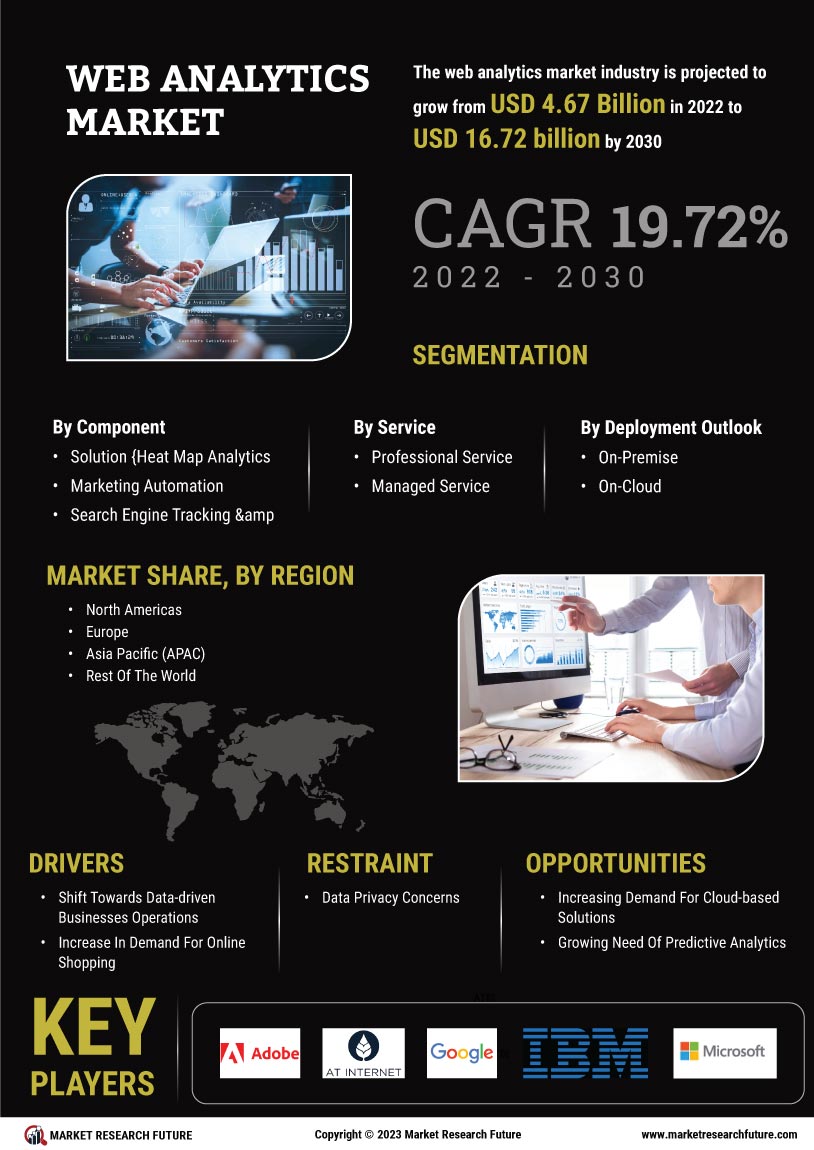
Web Analytics Market Size, Share and Research Report By Application (Online Marketing & Marketing Automation, Customer Journey Mapping, Mobile Analytics, Social Media Management, Content Marketing), By Offering (Solutions, Services), By Deployment Model (Cloud-Based, On-Premises), By Organization Size (Large Enterprises, Small and Medium Enterprises), By End-User Vertical (Retail & E-Commerce, Healthcare & Life Sciences, BFSI, Manufacturing, Media & Entertainment) and By Regional (North America, Europe, South America, Asia Pacific, Middle East and Africa) - Industry Forecast to 2035.
Web Analytics Market
Market Size
Forecast Period2026-2035
CAGR (2026-2035)16.10%
2025 Market SizeUSD 8.54 Billion
2035 Market SizeUSD 37.67 Billion
Key Players
Google
Adobe
Microsoft
Salesforce
Oracle
IBM
Opportunities
  • AI-Powered Predictive Analytics Platforms
  • Emerging Market Digital Adoption
  • Server-Side Analytics Monetization
  1. 1 Market Overview |
    1. 1.1 Study Assumptions & Market Definition |
    2. 1.2 Scope of the Study |
    3. 1.3 Research Methodology
  2. 2 Market Summary & Key Takeaways
  3. 3 Market Dynamics |
    1. 3.1 Market Drivers Analysis | |
      1. 3.1.1 Digital Commerce Expansion | |
      2. 3.1.2 Privacy Regulation and First-Party Data Mandates | |
      3. 3.1.3 AI/ML Integration in Analytics Platforms | |
      4. 3.1.4 Mobile-First Consumer Behavior Shift | |
      5. 3.1.5 Cloud Infrastructure Migration | |
      6. 3.1.6 Cross-Channel Attribution Demand | |
      7. 3.1.7 Personalization and CX Investment Cycles |
    2. 3.2 Market Restraints Analysis | |
      1. 3.2.1 Data Collection Restrictions and Consent Fatigue | |
      2. 3.2.2 Cookie Deprecation Uncertainty | |
      3. 3.2.3 Analytics Talent Shortage | |
      4. 3.2.4 Integration Complexity with Legacy Martech Stacks | |
      5. 3.2.5 Data Accuracy and Attribution Model Fragmentation |
    3. 3.3 Market Opportunity Analysis | |
      1. 3.3.1 AI-Powered Predictive Analytics Platforms | |
      2. 3.3.2 Emerging Market Digital Adoption | |
      3. 3.3.3 Server-Side Analytics Monetization | |
      4. 3.3.4 Healthcare and Public Sector Digitization | |
      5. 3.3.5 Edge Analytics and Real-Time Personalization |
    4. 3.4 Industry Value Chain Analysis |
    5. 3.5 Porter's Five Forces Analysis
  4. 4 Global Web Analytics Market Size & Forecast (2021–2035) |
    1. 4.1 Historical Market Size (2021–2025) |
    2. 4.2 Current & Forecast Market Size (2026–2035) |
    3. 4.3 Market Size by Revenue (USD Billion) |
    4. 4.4 Year-over-Year Growth Analysis
  5. 5 Segmentation Analysis |
    1. 5.1 By Application | |
      1. 5.1.1 Online Marketing & Marketing Automation | |
      2. 5.1.2 Customer Journey Mapping | |
      3. 5.1.3 Mobile Analytics | |
      4. 5.1.4 Social Media Management | |
      5. 5.1.5 Content Marketing |
    2. 5.2 By Offering | |
      1. 5.2.1 Solutions | |
      2. 5.2.2 Services |
    3. 5.3 By Deployment Model | |
      1. 5.3.1 Cloud-Based | |
      2. 5.3.2 On-Premises |
    4. 5.4 By Organization Size | |
      1. 5.4.1 Large Enterprises | |
      2. 5.4.2 Small and Medium Enterprises |
    5. 5.5 By End-User Vertical | |
      1. 5.5.1 Retail & E-Commerce | |
      2. 5.5.2 Healthcare & Life Sciences | |
      3. 5.5.3 BFSI | |
      4. 5.5.4 Manufacturing | |
      5. 5.5.5 Media & Entertainment
  6. 6 Regional Analysis |
    1. 6.1 North America | |
      1. 6.1.1 United States | |
      2. 6.1.2 Canada | |
      3. 6.1.3 Mexico |
    2. 6.2 Europe | |
      1. 6.2.1 Germany | |
      2. 6.2.2 United Kingdom | |
      3. 6.2.3 France | |
      4. 6.2.4 Italy | |
      5. 6.2.5 Spain | |
      6. 6.2.6 Nordic Countries | |
      7. 6.2.7 Russia | |
      8. 6.2.8 Rest of Europe |
    3. 6.3 Asia-Pacific | |
      1. 6.3.1 China | |
      2. 6.3.2 India | |
      3. 6.3.3 Japan | |
      4. 6.3.4 South Korea | |
      5. 6.3.5 ASEAN | |
      6. 6.3.6 Rest of Asia-Pacific |
    4. 6.4 South America | |
      1. 6.4.1 Brazil | |
      2. 6.4.2 Argentina | |
      3. 6.4.3 Rest of South America |
    5. 6.5 Middle East & Africa | |
      1. 6.5.1 Saudi Arabia | |
      2. 6.5.2 UAE | |
      3. 6.5.3 South Africa | |
      4. 6.5.4 Egypt | |
      5. 6.5.5 Rest of MEA
  7. 7 Competitive Landscape |
    1. 7.1 Market Share Analysis (2025) |
    2. 7.2 Competitive Benchmarking Matrix |
    3. 7.3 Company Profiles | |
      1. 7.3.1 Google | |
      2. 7.3.2 Adobe | |
      3. 7.3.3 Microsoft | |
      4. 7.3.4 Salesforce | |
      5. 7.3.5 Oracle | |
      6. 7.3.6 IBM | |
      7. 7.3.7 SAP | |
      8. 7.3.8 Amplitude | |
      9. 7.3.9 Mixpanel | |
      10. 7.3.10 SAS Institute
  8. 8 Future Outlook & Strategic Recommendations (2026–2035) |
    1. 8.1 AI-Native Analytics and Autonomous Optimization |
    2. 8.2 Privacy-First Measurement Architecture |
    3. 8.3 Platform Economics and Vertical Specialization |
    4. 8.4 Composable Data Stack Integration
  9. 9 Recent Developments & News
  10. 10 Frequently Asked Questions (FAQs)
  11. 11 Report Scope & Methodology |
    1. 11.1 Study Period & Base Year |
    2. 11.2 Data Sources & Citations |
    3. 11.3 Abbreviations
  12. 12 LIST OF TABLES |
  13. TABLE 1 Global Web Analytics Market Size & Forecast, by Revenue (USD Billion), 2021–2035 |
  14. TABLE 2 Global Web Analytics Market — Year-over-Year Growth Analysis, 2021–2035 |
  15. TABLE 3 Global Web Analytics Market — Driver Impact Analysis, 2026–2035 |
  16. TABLE 4 Global Web Analytics Market — Restraint Impact Analysis, 2026–2035 |
  17. TABLE 5 Global Web Analytics Market Size, by Application, 2021–2035 (USD Billion) |
  18. TABLE 6 Global Web Analytics Market Size, by Offering, 2021–2035 (USD Billion) |
  19. TABLE 7 Global Web Analytics Market Size, by Deployment Model, 2021–2035 (USD Billion) |
  20. TABLE 8 Global Web Analytics Market Size, by Organization Size, 2021–2035 (USD Billion) |
  21. TABLE 9 Global Web Analytics Market Size, by End-User Vertical, 2021–2035 (USD Billion) |
  22. TABLE 10 Global Web Analytics Market Size, by Region, 2021–2035 (USD Billion) |
  23. TABLE 11 North America Web Analytics Market Size, by Country, 2021–2035 (USD Billion) |
  24. TABLE 12 Europe Web Analytics Market Size, by Country, 2021–2035 (USD Billion) |
  25. TABLE 13 Asia-Pacific Web Analytics Market Size, by Country, 2021–2035 (USD Billion) |
  26. TABLE 14 South America Web Analytics Market Size, by Country, 2021–2035 (USD Billion) |
  27. TABLE 15 Middle East & Africa Web Analytics Market Size, by Country, 2021–2035 (USD Billion) |
  28. TABLE 16 Competitive Benchmarking Matrix — Global Web Analytics Market, 2025 |
  29. TABLE 17 Company Profiles — Key Players, Global Web Analytics Market |
  30. TABLE 18 Recent Developments & Strategic Announcements, 2023–2024 |
  31. TABLE 19 Report Scope & Methodology Summary |
  32. TABLE 20 Detailed Sources and Citations
  33. 13 LIST OF FIGURES |
  34. FIGURE 1 Web Analytics Market Dynamics — Drivers, Restraints, and Opportunities |
  35. FIGURE 2 Value Chain Analysis — Web Analytics Market |
  36. FIGURE 3 Porter's Five Forces Analysis — Web Analytics Market |
  37. FIGURE 4 Global Web Analytics Market Size Trend (USD Billion), 2021–2035 |
  38. FIGURE 5 Web Analytics Market Share, by Application (2025) |
  39. FIGURE 6 Web Analytics Market Share, by Offering (2025) |
  40. FIGURE 7 Web Analytics Market Share, by Deployment Model (2025) |
  41. FIGURE 8 Web Analytics Market Share, by Organization Size (2025) |
  42. FIGURE 9 Web Analytics Market Share, by End-User Vertical (2025) |
  43. FIGURE 10 Web Analytics Market Share, by Region (2025) |
  44. FIGURE 11 North America Web Analytics Market — Country Share (2025) |
  45. FIGURE 12 Europe Web Analytics Market — Country Share (2025) |
  46. FIGURE 13 Asia-Pacific Web Analytics Market — Country Share (2025) |
  47. FIGURE 14 South America Web Analytics Market — Country Share (2025) |
  48. FIGURE 15 Middle East & Africa Web Analytics Market — Country Share (2025) |
  49. FIGURE 16 Competitive Landscape — Market Share Distribution (2025)

Segmentation Quick Reference

DimensionSub-SegmentsDominant SegmentFastest Growing Segment
ApplicationOnline Marketing & Marketing Automation, Customer Journey Mapping, Mobile Analytics, Social Media Management, Content MarketingOnline Marketing & Marketing AutomationCustomer Journey Mapping
OfferingSolutions, ServicesSolutionsServices
Deployment ModelCloud-Based, On-PremisesCloud-BasedCloud-Based
Organization SizeLarge Enterprises, Small and Medium EnterprisesLarge EnterprisesSmall and Medium Enterprises
End-User VerticalRetail & E-Commerce, Healthcare & Web Analytics Market, BFSI, Manufacturing, Media & EntertainmentRetail & E-CommerceHealthcare & Web Analytics Market
GeographyNorth America, Europe, Asia-Pacific, South America, Middle East & AfricaNorth AmericaAsia-Pacific


Market Segmentation Overview

By Application

Sub-SegmentKey Trend
Online Marketing & Marketing AutomationDeep integration with campaign execution platforms and closed-loop ROI measurement
Customer Journey MappingShift from channel-level metrics to full-funnel, multi-touch attribution
Mobile AnalyticsApp-web hybrid measurement and cross-device identity resolution
Social Media ManagementSocial commerce tracking and influencer performance analytics
Content MarketingContent engagement scoring and SEO performance attribution


Application segmentation reflects the broadening scope of web analytics from basic traffic reporting to enterprise-wide intelligence. Online Marketing and Marketing Automation capture the largest share due to their direct connection to revenue outcomes, while Customer Journey Mapping grows fastest as organizations pursue holistic visibility across all digital touchpoints.

By Offering

Sub-SegmentKey Trend
SolutionsSelf-service platforms with embedded AI for automated insight generation
ServicesGrowing demand for implementation, managed analytics, and compliance consulting


The Solutions segment dominates as enterprises prefer scalable, self-service platforms. The Services segment accelerates as privacy regulation complexity and server-side migration drive demand for specialized implementation and managed analytics expertise.

By Deployment Model

Sub-SegmentKey Trend
Cloud-BasedElastic scaling, real-time processing, and lower infrastructure overhead
On-PremisesData sovereignty and regulatory compliance in BFSI and government


Cloud-Based deployment leads adoption due to the elastic compute capacity needed for real-time analytics at scale. On-Premises maintains relevance among regulated industries requiring strict data residency controls.

By Organization Size

Sub-SegmentKey Trend
Large EnterprisesMulti-property analytics consolidation and global compliance orchestration
Small and Medium EnterprisesProduct-led growth adoption and affordable cloud-native analytics platforms


Large Enterprises generate the majority of revenue through complex, multi-year platform engagements. SMEs grow faster as vendors reduce entry barriers through freemium models and self-onboarding experiences.

By End-User Vertical

Sub-SegmentKey Trend
Retail & E-CommerceReal-time transaction analytics, personalization engines, cart optimization
Healthcare & Web Analytics MarketPatient portal analytics, pharma digital marketing compliance
BFSIRegulatory reporting, digital banking funnel optimization
ManufacturingB2B distributor portal analytics and industrial e-commerce measurement
Media & EntertainmentSubscription optimization, content performance scoring, audience segmentation


Retail and E-Commerce leads by vertical share due to the direct revenue impact of analytics-driven checkout and personalization optimization. Healthcare and Web Analytics Market is the fastest-growing vertical, driven by digital health mandates and patient engagement measurement requirements.


 

Download PDF ×

We do not share your information with anyone. However, we may send you emails based on your report interest from time to time. You may contact us at any time to opt-out.