×
Request Free Sample ×

Kindly complete the form below to receive a free sample of this Report

* Please use a valid business email

Leading companies partner with us for data-driven Insights

clients tt-cursor
Hero Background

Welding Cutting Equipment Market

ID: MRFR/Equip/37279-HCR
100 Pages
Varsha More
October 2025

Welding and Cutting Equipment Market Research Report By Application (Manufacturing, Construction, Automotive, Shipbuilding, Aerospace), By Equipment Type (Welding Equipment, Cutting Equipment, Consumables, Automated Welding Systems), By Technology (Arc Welding, Gas Welding, Laser Welding, Plasma Cutting, Oxy-Fuel Cutting), By End Use (Industrial, Commercial, Residential) and By Regional (North America, Europe, South America, Asia Pacific, Middle East and Africa) - Forecast to 2035

Share:
Download PDF ×

We do not share your information with anyone. However, we may send you emails based on your report interest from time to time. You may contact us at any time to opt-out.

Welding Cutting Equipment Market Infographic
Purchase Options

Welding Cutting Equipment Market Summary

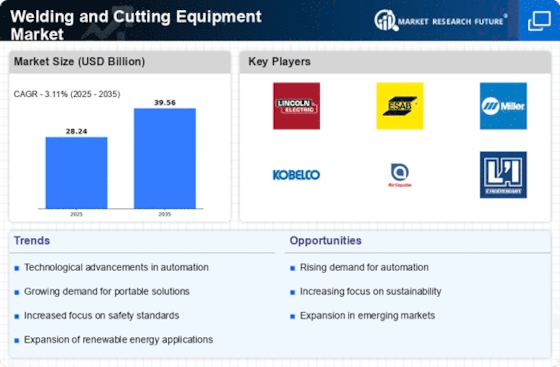
As per MRFR analysis, the Welding and Cutting Equipment Market was estimated at 28.24 USD Billion in 2024. The welding and cutting equipment industry is projected to grow from 29.12 USD Billion in 2025 to 39.56 USD Billion by 2035, exhibiting a compound annual growth rate (CAGR) of 3.11 during the forecast period 2025 - 2035.

Key Market Trends & Highlights

The Welding and Cutting Equipment Market is poised for substantial growth driven by technological advancements and increasing demand across various sectors.

  • Automation and robotics integration is transforming the welding landscape, enhancing efficiency and precision.
  • Sustainability and eco-friendly solutions are becoming increasingly prioritized, reflecting a shift towards greener practices in manufacturing.
  • Digital transformation and smart technologies are gaining traction, enabling real-time monitoring and improved operational efficiency.
  • Rising demand in construction and infrastructure, along with technological advancements in welding techniques, are key drivers propelling market growth.

Market Size & Forecast

2024 Market Size 28.24 (USD Billion)
2035 Market Size 39.56 (USD Billion)
CAGR (2025 - 2035) 3.11%

Major Players

Lincoln Electric (US), ESAB (SE), Miller Electric (US), Kobe Steel (JP), Air Liquide (FR), Linde (DE), Oerlikon (CH), Harris Products Group (US), Victor Technologies (US), Weldability Sif (GB)

Welding Cutting Equipment Market Trends

The Welding and Cutting Equipment Market is currently experiencing a dynamic evolution, driven by advancements in technology and increasing demand across various industries. The integration of automation and robotics into welding processes appears to enhance efficiency and precision, thereby attracting a broader range of applications. Furthermore, the growing emphasis on sustainability and energy efficiency is prompting manufacturers to innovate and develop eco-friendly solutions. This shift not only aligns with global environmental goals but also caters to the rising consumer preference for sustainable practices. In addition, the market is witnessing a surge in the adoption of digital technologies, such as IoT and AI, which facilitate real-time monitoring and predictive maintenance. These innovations seem to improve operational efficiency and reduce downtime, ultimately leading to cost savings for end-users. As industries continue to evolve, the Welding and Cutting Equipment Market is poised for substantial growth, driven by these transformative trends and the ongoing quest for enhanced productivity and sustainability.

Automation and Robotics Integration

The incorporation of automation and robotics into welding processes is reshaping the landscape of the Welding and Cutting Equipment Market. This trend enhances operational efficiency and precision, allowing for greater consistency in production. As industries seek to optimize their processes, the demand for automated solutions is likely to increase.

Sustainability and Eco-Friendly Solutions

A growing focus on sustainability is influencing the Welding and Cutting Equipment Market, as manufacturers strive to develop eco-friendly products. This trend aligns with global environmental initiatives and reflects the increasing consumer preference for sustainable practices. Companies are likely to invest in greener technologies to meet these demands.

Digital Transformation and Smart Technologies

The rise of digital technologies, including IoT and AI, is significantly impacting the Welding and Cutting Equipment Market. These innovations enable real-time monitoring and predictive maintenance, which can enhance operational efficiency and reduce downtime. As industries embrace digital transformation, the market is expected to evolve accordingly.

Welding Cutting Equipment Market Drivers

Increased Focus on Safety and Compliance

Safety and compliance regulations are becoming increasingly stringent across various industries, impacting the Welding and Cutting Equipment Market. Companies are compelled to invest in high-quality equipment that meets safety standards to protect workers and minimize liability. The implementation of advanced safety features in welding equipment, such as automatic shut-off systems and enhanced protective gear, is gaining traction. This trend is expected to drive market growth as organizations prioritize safety in their operations. Furthermore, compliance with environmental regulations is pushing manufacturers to develop eco-friendly welding solutions, thereby expanding the scope of the Welding and Cutting Equipment Market.

Growing Automotive Sector and Electric Vehicles

The automotive sector, particularly the rise of electric vehicles (EVs), significantly influences the Welding and Cutting Equipment Market. As manufacturers pivot towards EV production, the need for specialized welding techniques to assemble lightweight materials becomes increasingly critical. The automotive industry is projected to witness a growth rate of around 4% annually, with electric vehicle sales expected to double by 2030. This shift necessitates advanced welding equipment capable of handling new materials and designs. Consequently, the Welding and Cutting Equipment Market is likely to adapt, focusing on innovations that cater to the unique requirements of the evolving automotive landscape.

Rising Demand in Construction and Infrastructure

The Welding and Cutting Equipment Market experiences a notable surge in demand driven by the ongoing expansion in construction and infrastructure projects. As urbanization accelerates, the need for robust welding and cutting solutions becomes paramount. In 2025, the construction sector is projected to grow at a compound annual growth rate of approximately 5.5%, necessitating advanced welding technologies to ensure structural integrity and safety. This growth is further fueled by government investments in infrastructure, which are expected to reach unprecedented levels. Consequently, manufacturers in the Welding and Cutting Equipment Market are likely to innovate and enhance their product offerings to meet the evolving needs of this sector.

Technological Advancements in Welding Techniques

Technological advancements play a crucial role in shaping the Welding and Cutting Equipment Market. Innovations such as laser welding, plasma cutting, and automated welding systems are revolutionizing traditional practices. These technologies not only enhance precision and efficiency but also reduce operational costs. For instance, the adoption of laser welding has been shown to increase productivity by up to 30%, making it a preferred choice in various applications. As industries seek to optimize their processes, the demand for cutting-edge welding equipment is expected to rise, driving growth in the Welding and Cutting Equipment Market. This trend indicates a shift towards more sophisticated and efficient solutions.

Expansion of Manufacturing and Fabrication Industries

The expansion of manufacturing and fabrication industries serves as a significant driver for the Welding and Cutting Equipment Market. As these sectors grow, the demand for efficient and reliable welding solutions increases. In 2025, the manufacturing sector is anticipated to grow at a rate of approximately 3.5%, with a particular emphasis on sectors such as aerospace, shipbuilding, and heavy machinery. This growth necessitates the use of advanced welding technologies to ensure high-quality production standards. Consequently, the Welding and Cutting Equipment Market is likely to witness a surge in demand for innovative equipment that meets the rigorous requirements of modern manufacturing processes.


Market Segment Insights

By Application: Manufacturing (Largest) vs. Construction (Fastest-Growing)

The Welding and Cutting Equipment Market is primarily segmented into Manufacturing, Construction, Automotive, Shipbuilding, and Aerospace. Among these, Manufacturing holds the largest market share, driven by the high demand for efficient and precision welding processes in production lines. Construction follows closely, with a notably significant share, driven by infrastructure projects and ongoing urbanization trends that necessitate efficient welding solutions. In terms of growth trends, Construction has emerged as the fastest-growing segment due to increased investments in infrastructure development and building projects across various regions. Automotive and Aerospace are also witnessing growth, driven by technological advancements that enhance welding processes. However, Manufacturing remains the backbone of this market, continually innovating to increase productivity and reduce costs.

Manufacturing: Dominant vs. Construction: Emerging

Manufacturing is the dominant application within the Welding and Cutting Equipment Market, characterized by its extensive utilization in metal fabrications, manufacturing processes, and assembly lines. This sector requires advanced welding technologies like laser welding and arc welding to achieve high precision and productivity, catering to various industries including electronics and consumer goods. On the other hand, Construction represents an emerging segment, driven by significant project investments and innovations that enhance construction methodologies. Construction welding equipment often emphasizes portability and robustness, catering to a range of applications from structural support to prefabricated buildings. As these sectors evolve, the demands for tailored welding solutions continue to shape their market dynamics.

By Equipment Type: Welding Equipment (Largest) vs. Automated Welding Systems (Fastest-Growing)

In the Welding and Cutting Equipment Market, the equipment type segment is vividly represented by Welding Equipment, Cutting Equipment, Consumables, and Automated Welding Systems. Welding Equipment holds the largest share of the market, driven by traditional welding applications in various industries. Cutting Equipment also contributes significantly but remains overshadowed by the sheer demand for welding solutions. Automated Welding Systems, while currently a smaller segment, are gaining traction as industries look towards automation to enhance production efficiency.

Welding Equipment: Traditional (Dominant) vs. Automated Welding Systems (Emerging)

Welding Equipment, the dominant force in the welding and cutting market, encompasses a wide range of technologies and tools that are essential for various industrial applications. Its strong market presence is rooted in traditional sectors such as construction, automotive, and manufacturing, where manual and semi-automated processes are prevalent. Meanwhile, Automated Welding Systems represent an emerging segment, characterized by advanced robotic technologies that promise increased efficiency, accuracy, and labor cost savings. As industries increasingly adopt these systems for high-volume production, their growth potential is significant, making them a focal point for innovation and investment.

By Technology: Arc Welding (Largest) vs. Laser Welding (Fastest-Growing)

The Welding and Cutting Equipment Market is primarily dominated by Arc Welding, which holds the largest share among the various technologies available. Its widespread adoption across industries such as construction, automotive, and manufacturing enables manufacturers to achieve strong operational efficiencies. In contrast, the Laser Welding segment, while currently smaller, is experiencing rapid growth due to its precision and versatility in applications like aerospace and electronics, making it a compelling choice for advanced manufacturing processes.

Technology: Arc Welding (Dominant) vs. Laser Welding (Emerging)

Arc Welding is known for its robustness and versatility, making it the dominant technology in the welding and cutting equipment market. Its ability to operate effectively in diverse environments and its compatibility with various materials further enhances its appeal. On the other hand, Laser Welding represents an emerging trend driven by its ability to deliver high-quality welds with minimal thermal distortion. This technology is gaining traction in sectors that demand precision and productivity, leading to increased adoption and innovation.

By End Use: Industrial (Largest) vs. Residential (Fastest-Growing)

In the Welding and Cutting Equipment Market, the distribution of market share among end-use segments reveals a prominent dominance of the Industrial sector. This segment leverages high demand from construction, manufacturing, and maintenance activities, facilitating significant usage of welding equipment and cutting tools. Meanwhile, the Commercial sector also holds a considerable share, primarily driven by maintenance service providers and repair shops, albeit not as significant as Industrial applications. The Residential segment, while smaller in market share, is observed to be the fastest-growing segment in recent years, propelled by the rise in DIY projects and home renovations. The increasing adoption of lightweight and portable equipment caters to homeowners who are seeking to perform welding and cutting tasks independently, thus driving this growth trend even further.

Industrial (Dominant) vs. Residential (Emerging)

The Industrial segment in the Welding and Cutting Equipment Market stands out as the dominant player, characterized by its robust demand stemming from sectors like construction, shipbuilding, and pipeline manufacturing. Industrial users often require heavy-duty, reliable equipment capable of sustaining high workloads, leading to a steady preference for brands known for durability and efficiency. Meanwhile, the Residential segment is emerging quickly, fueled by the growing DIY culture among homeowners. This segment typically favors more compact, user-friendly equipment that is easier to handle for personal projects, as well as the availability of educational resources that attract new users to welding and cutting activities. As safety regulations are integrated into consumer awareness, the appeal of high-quality, portable tools grows, indicating potential for strong future market growth.

Get more detailed insights about Welding Cutting Equipment Market

Regional Insights

North America : Innovation and Demand Surge

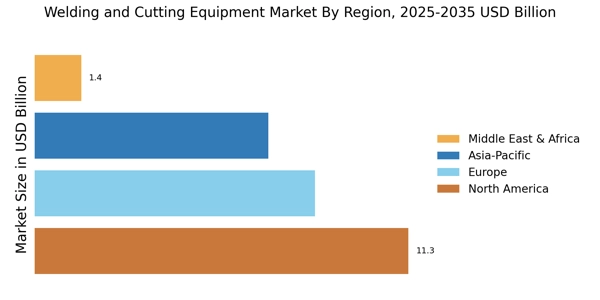
The North American welding and cutting equipment market is driven by robust industrial growth, particularly in manufacturing and construction sectors. The region holds the largest market share at approximately 40%, fueled by technological advancements and increasing automation. Regulatory support for safety standards and environmental compliance further catalyzes market expansion. Demand for advanced welding technologies is on the rise, particularly in the automotive and aerospace industries. The United States leads the market, accounting for the majority of the share, followed by Canada. Key players such as Lincoln Electric and Miller Electric dominate the landscape, focusing on innovation and quality. The competitive environment is characterized by significant investments in R&D and strategic partnerships. The presence of established companies ensures a steady supply of advanced welding solutions, catering to diverse industrial needs.

Europe : Regulatory Framework and Innovation

Europe's welding and cutting equipment market is characterized by stringent regulations and a strong emphasis on sustainability. The region holds the second-largest market share at around 30%, driven by increasing demand for energy-efficient solutions and compliance with environmental standards. The European Union's regulations on emissions and safety are significant catalysts for market growth, pushing manufacturers to innovate and adopt cleaner technologies. Germany and France are the leading countries in this market, with a strong presence of key players like ESAB and Linde. The competitive landscape is marked by a focus on technological advancements and product diversification. Companies are investing in smart welding solutions and automation to enhance productivity and reduce operational costs. The market is also witnessing a trend towards digitalization, with an increasing number of firms adopting Industry 4.0 practices.

Asia-Pacific : Emerging Markets and Growth Potential

The Asia-Pacific welding and cutting equipment market is experiencing rapid growth, driven by industrialization and urbanization. The region is projected to hold a market share of approximately 25%, with countries like China and India leading the charge. The demand for welding equipment is bolstered by the booming construction and automotive sectors, alongside government initiatives to enhance manufacturing capabilities. Regulatory frameworks are evolving to support safety and environmental standards, further stimulating market growth. China is the largest market in the region, followed by India and Japan. The competitive landscape features key players such as Kobe Steel and Oerlikon, who are focusing on innovation and expanding their product offerings. The presence of numerous local manufacturers also intensifies competition, leading to price competitiveness and technological advancements. The region's growth potential is significant, with increasing investments in infrastructure and manufacturing driving demand for advanced welding solutions.

Middle East and Africa : Resource-Rich and Growing Demand

The Middle East and Africa welding and cutting equipment market is on the rise, driven by increasing investments in infrastructure and energy sectors. The region holds a market share of around 5%, with significant growth potential due to ongoing industrialization and urban development. Regulatory frameworks are gradually improving, focusing on safety and environmental compliance, which is essential for attracting foreign investments and enhancing local manufacturing capabilities. Countries like South Africa and the UAE are leading the market, with a growing presence of key players such as Air Liquide and Harris Products Group. The competitive landscape is characterized by a mix of local and international companies, focusing on providing tailored solutions to meet regional demands. The market is also witnessing a trend towards adopting advanced technologies, which is crucial for improving efficiency and productivity in various industries.

Welding Cutting Equipment Market Regional Image

Key Players and Competitive Insights

The Welding and Cutting Equipment Market is characterized by a diverse and competitive landscape where numerous players strive for technological advancement and market share. The market has witnessed significant growth due to rising demand from various industries, including manufacturing, construction, automotive, and aerospace. 

Key trends shaping this market include the increasing adoption of automation and robotics in welding processes, the growing emphasis on energy-efficient and environmentally friendly solutions, and the need for advanced welding techniques that can offer high precision and lower operational costs. Companies within this space are constantly innovating, focusing on product differentiation and improving customer service to enhance their competitive positioning. Understanding the competitive dynamics in this sector is crucial for stakeholders to navigate challenges and seize growth opportunities.

Harris Products Group stands out in the Welding and Cutting Equipment Market due to its extensive product portfolio and commitment to research and development. The company has established a robust market presence by offering a wide range of innovative welding and cutting solutions that cater to various industrial applications. Known for its high-quality products and reliable performance, Harris Products Group has built a strong brand reputation among its customers and within the industry. Its focus on providing superior customer service and support has further strengthened its position in the market.

The company leverages its technical expertise to collaborate closely with customers, ensuring that their specific needs are met through tailored solutions. This commitment to excellence and customer-centric approach positions Harris Products Group as a formidable player in the competitive landscape of the Welding and Cutting Equipment Market.

Magmaweld has been making significant strides in the Welding and Cutting Equipment Market by focusing on innovation and quality. The company is recognized for its advanced welding equipment and solutions, which are favored for their reliability and efficiency in various applications. Magmaweld's commitment to developing cutting-edge technology has allowed it to stay ahead of the competition and meet the evolving needs of its customer base. 

The company's extensive experience in the industry empowers it to deliver products that are not only practical but also align with modern industry standards. Through continuous improvement and adherence to high-quality standards, Magmaweld has established a loyal customer base and reinforced its reputation as a trusted provider of welding solutions. Their strategic focus on market adaptation and innovation has enabled Magmaweld to enhance its competitive edge in the global welding and cutting equipment sector.

Key Companies in the Welding Cutting Equipment Market market include

Industry Developments

Recent developments in the Welding and Cutting Equipment Market show significant advancements in technology, reflecting a growing emphasis on automation and efficiency. Companies like ESAB and Miller Electric are focusing on integrating smart technologies into their equipment to improve precision and reduce errors. Additionally, Fronius has introduced innovative welding processes that enhance energy efficiency and quality. Current affairs, such as supply chain challenges and changing regulations, are impacting the market dynamics, with companies adapting to new environmental standards. 

In terms of mergers and acquisitions, Harris Products Group has announced strategic partnerships aimed at expanding its product offering and market reach. The valuation of companies in this sector is expected to rise as the demand for welding and cutting solutions across various industries, including construction and manufacturing, continues to increase. Notably, companies like Linde and ABB are investing heavily in research and development to stay competitive, further driving market growth. The competitive landscape remains dynamic as firms strive to leverage technological advancements to fulfill the evolving needs of customers.

Future Outlook

Welding Cutting Equipment Market Future Outlook

The Welding and Cutting Equipment Market is projected to grow at a 3.11% CAGR from 2024 to 2035, driven by technological advancements, increased automation, and rising demand in various industries.

New opportunities lie in:

  • Development of advanced robotic welding systems for precision applications.
  • Expansion into renewable energy sector with specialized cutting equipment.
  • Integration of IoT technology for real-time monitoring and predictive maintenance.

By 2035, the market is expected to exhibit robust growth, driven by innovation and diversification.

Market Segmentation

Welding Cutting Equipment Market End Use Outlook

  • Industrial
  • Commercial
  • Residential

Welding Cutting Equipment Market Technology Outlook

  • Arc Welding
  • Gas Welding
  • Laser Welding
  • Plasma Cutting
  • Oxy-Fuel Cutting

Welding Cutting Equipment Market Application Outlook

  • Manufacturing
  • Construction
  • Automotive
  • Shipbuilding
  • Aerospace

Welding Cutting Equipment Market Equipment Type Outlook

  • Welding Equipment
  • Cutting Equipment
  • Consumables
  • Automated Welding Systems

Report Scope

MARKET SIZE 202428.24(USD Billion)
MARKET SIZE 202529.12(USD Billion)
MARKET SIZE 203539.56(USD Billion)
COMPOUND ANNUAL GROWTH RATE (CAGR)3.11% (2024 - 2035)
REPORT COVERAGERevenue Forecast, Competitive Landscape, Growth Factors, and Trends
BASE YEAR2024
Market Forecast Period2025 - 2035
Historical Data2019 - 2024
Market Forecast UnitsUSD Billion
Key Companies ProfiledMarket analysis in progress
Segments CoveredMarket segmentation analysis in progress
Key Market OpportunitiesIntegration of automation and smart technologies in the Welding and Cutting Equipment Market enhances efficiency and precision.
Key Market DynamicsTechnological advancements and regulatory changes drive innovation and competition in the Welding and Cutting Equipment Market.
Countries CoveredNorth America, Europe, APAC, South America, MEA

Leave a Comment

FAQs

What is the projected market valuation of the Welding and Cutting Equipment Market by 2035?

The Welding and Cutting Equipment Market is projected to reach a valuation of 39.56 USD Billion by 2035.

What was the market valuation of the Welding and Cutting Equipment Market in 2024?

In 2024, the market valuation of the Welding and Cutting Equipment Market was 28.24 USD Billion.

What is the expected CAGR for the Welding and Cutting Equipment Market during the forecast period 2025 - 2035?

The expected CAGR for the Welding and Cutting Equipment Market during the forecast period 2025 - 2035 is 3.11%.

Which application segment is projected to have the highest valuation by 2035?

The Manufacturing application segment is projected to reach a valuation of 11.0 USD Billion by 2035.

What are the projected valuations for Welding Equipment and Cutting Equipment by 2035?

By 2035, Welding Equipment is projected to reach 14.0 USD Billion, while Cutting Equipment is expected to reach 11.0 USD Billion.

Which technology segment is anticipated to grow the most by 2035?

The Laser Welding technology segment is anticipated to grow to a valuation of 9.0 USD Billion by 2035.

What is the expected valuation for the Industrial end-use segment by 2035?

The Industrial end-use segment is expected to reach a valuation of 23.0 USD Billion by 2035.

Who are the key players in the Welding and Cutting Equipment Market?

Key players in the market include Lincoln Electric, ESAB, Miller Electric, and Kobe Steel, among others.

What is the projected valuation for the Automotive application segment by 2035?

The Automotive application segment is projected to reach a valuation of 7.0 USD Billion by 2035.

How does the projected growth of the Welding and Cutting Equipment Market compare to its 2024 valuation?

The market is expected to grow from 28.24 USD Billion in 2024 to 39.56 USD Billion by 2035, indicating robust growth.

Download Free Sample

Kindly complete the form below to receive a free sample of this Report

Compare Licence

×
Features License Type
Single User Multiuser License Enterprise User
Price $4,950 $5,950 $7,250
Maximum User Access Limit 1 User Upto 10 Users Unrestricted Access Throughout the Organization
Free Customization
Direct Access to Analyst
Deliverable Format
Platform Access
Discount on Next Purchase 10% 15% 15%
Printable Versions