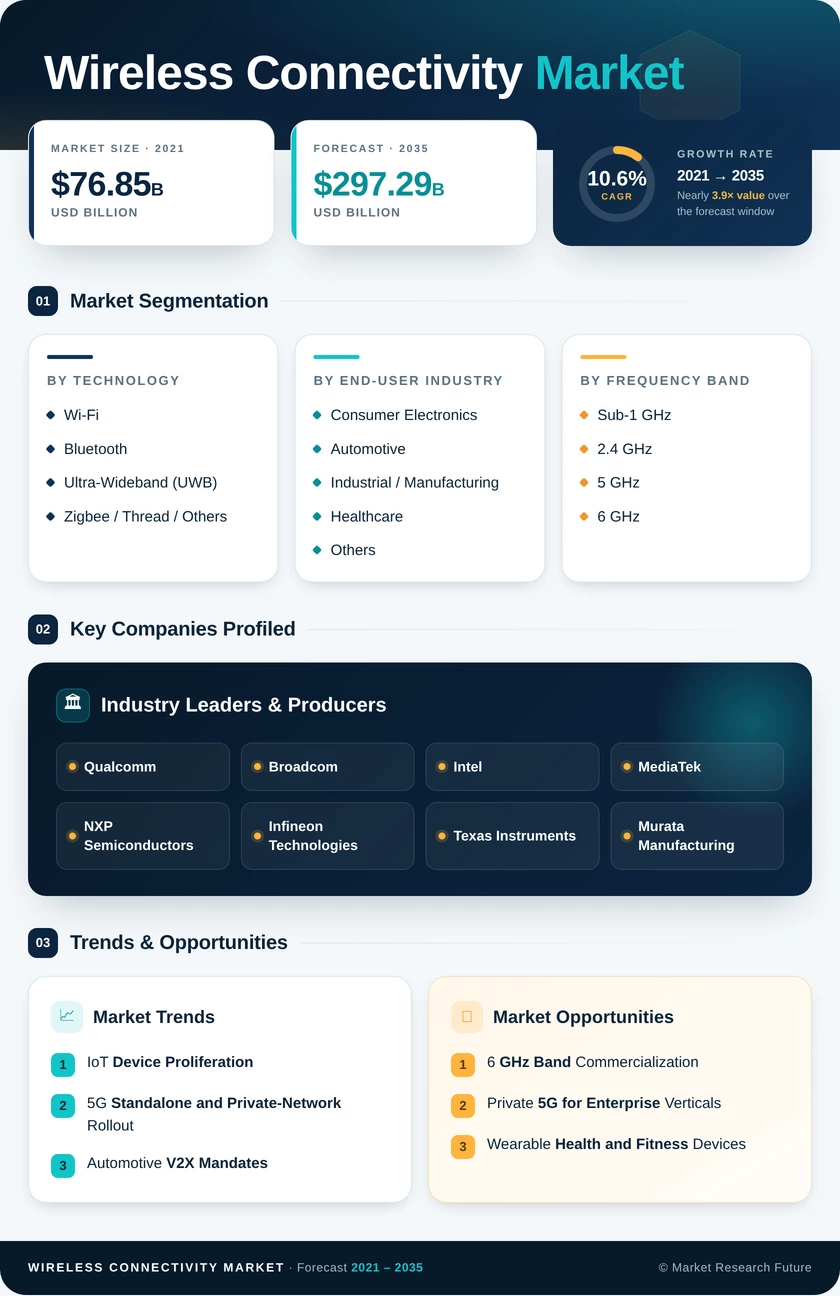
Wireless Connectivity Market (2026 - 2035)

ID: MRFR/SEM/1596-CR
144 Pages
Aarti Dhapte
Last Updated: July 16, 2026
Wireless Connectivity Market Size, Share and Research Report By Technology (Wi-Fi, Bluetooth, Ultra-Wideband (UWB), Zigbee / Thread / Others), By End-User Industry (Consumer Electronics, Automotive, Industrial / Manufacturing, Healthcare, Others (Retail, Energy, Defense)), By Frequency Band (Sub-1 GHz, 2.4 GHz, 5 GHz, 6 GHz), By Device Type (Smartphones & Tablets, Smart Home Devices, Wearables, Industrial Equipment, Others (PCs, Gaming, Automotive IVI)) and By Region (North America, Europe, Asia-Pacific, South America, Middle East & Africa) – Industry Forecast to 2035.
Wireless Connectivity Market
Market Size
Forecast Period2026-2035
CAGR (2026-2035)10.6%
2025 Market SizeUSD 108.50 Billion
2035 Market SizeUSD 297.29 Billion
Key Players
Qualcomm
Broadcom
Intel
MediaTek
NXP Semiconductors
Infineon Technologies
Opportunities
  • 6 GHz Band Commercialization
  • Private 5G for Enterprise Verticals
  • Wearable Health and Fitness Devices
  1. 1 Market Overview |
    1. 1.1 Study Assumptions & Market Definition |
    2. 1.2 Scope of the Study |
    3. 1.3 Research Methodology
  2. 2 Market Summary & Key Takeaways
  3. 3 Market Dynamics |
    1. 3.1 Market Drivers Analysis | |
      1. 3.1.1 IoT Device Proliferation | |
      2. 3.1.2 5G SA and Private-Network Rollout | |
      3. 3.1.3 Automotive V2X Mandates | |
      4. 3.1.4 Wi-Fi 7 Standard Adoption | |
      5. 3.1.5 Smart-City Infrastructure Investment | |
      6. 3.1.6 Healthcare Remote-Patient Monitoring | |
      7. 3.1.7 Government Spectrum Allocation Programs |
    2. 3.2 Market Restraints Analysis | |
      1. 3.2.1 Spectrum Fragmentation Across Jurisdictions | |
      2. 3.2.2 Foundry Capacity Constraints at Advanced Nodes | |
      3. 3.2.3 Cybersecurity Vulnerability Exposure | |
      4. 3.2.4 High Deployment Cost in Rural Emerging Markets | |
      5. 3.2.5 Protocol Interoperability Challenges |
    3. 3.3 Market Opportunity Analysis | |
      1. 3.3.1 6 GHz Band Commercialization | |
      2. 3.3.2 Private 5G for Enterprise Verticals | |
      3. 3.3.3 Wearable Health and Fitness Devices | |
      4. 3.3.4 Emerging-Market Digital Infrastructure | |
      5. 3.3.5 Connectivity-Data Monetization |
    4. 3.4 Industry Value Chain Analysis |
    5. 3.5 Porter's Five Forces Analysis
  4. 4 Global Wireless Connectivity Market Size & Forecast (2021–2035) |
    1. 4.1 Historical Market Size (2021–2025) |
    2. 4.2 Current & Forecast Market Size (2026–2035) |
    3. 4.3 Market Size by Revenue (USD Billion) |
    4. 4.4 Year-over-Year Growth Analysis
  5. 5 Segmentation Analysis |
    1. 5.1 By Technology | |
      1. 5.1.1 Wi-Fi | |
      2. 5.1.2 Bluetooth | |
      3. 5.1.3 Ultra-Wideband (UWB) | |
      4. 5.1.4 Zigbee / Thread / Others |
    2. 5.2 By End-User Industry | |
      1. 5.2.1 Consumer Electronics | |
      2. 5.2.2 Automotive | |
      3. 5.2.3 Industrial / Manufacturing | |
      4. 5.2.4 Healthcare | |
      5. 5.2.5 Others (Retail, Energy, Defense) |
    3. 5.3 By Frequency Band | |
      1. 5.3.1 Sub-1 GHz | |
    4. 2.4 GHz | |
      1. 5.3.3 5 GHz | |
      2. 5.3.4 6 GHz |
    5. 5.4 By Device Type | |
      1. 5.4.1 Smartphones & Tablets | |
      2. 5.4.2 Smart Home Devices | |
      3. 5.4.3 Wearables | |
      4. 5.4.4 Industrial Equipment | |
      5. 5.4.5 Others (PCs, Gaming, Automotive IVI)
  6. 6 Regional Analysis |
    1. 6.1 North America | |
      1. 6.1.1 United States | |
      2. 6.1.2 Canada | |
      3. 6.1.3 Mexico |
    2. 6.2 Europe | |
      1. 6.2.1 Germany | |
      2. 6.2.2 United Kingdom | |
      3. 6.2.3 France | |
      4. 6.2.4 Italy | |
      5. 6.2.5 Spain | |
      6. 6.2.6 Nordic Countries | |
      7. 6.2.7 Russia | |
      8. 6.2.8 Rest of Europe |
    3. 6.3 Asia-Pacific | |
      1. 6.3.1 China | |
      2. 6.3.2 India | |
      3. 6.3.3 Japan | |
      4. 6.3.4 South Korea | |
      5. 6.3.5 ASEAN | |
      6. 6.3.6 Rest of Asia-Pacific |
    4. 6.4 South America | |
      1. 6.4.1 Brazil | |
      2. 6.4.2 Argentina | |
      3. 6.4.3 Rest of South America |
    5. 6.5 Middle East & Africa | |
      1. 6.5.1 Saudi Arabia | |
      2. 6.5.2 UAE | |
      3. 6.5.3 South Africa | |
      4. 6.5.4 Egypt | |
      5. 6.5.5 Rest of MEA
  7. 7 Competitive Landscape |
    1. 7.1 Market Share Analysis (2025) |
    2. 7.2 Competitive Benchmarking Matrix |
    3. 7.3 Company Profiles | |
      1. 7.3.1 Qualcomm | |
      2. 7.3.2 Broadcom | |
      3. 7.3.3 Intel | |
      4. 7.3.4 MediaTek | |
      5. 7.3.5 NXP Semiconductors | |
      6. 7.3.6 Infineon Technologies | |
      7. 7.3.7 Texas Instruments | |
      8. 7.3.8 Murata Manufacturing | |
      9. 7.3.9 Nordic Semiconductor | |
      10. 7.3.10 Silicon Laboratories
  8. 8 Future Outlook & Strategic Recommendations (2026–2035) |
    1. 8.1 AI-at-the-Edge Wireless Architectures |
    2. 8.2 Satellite-Terrestrial Convergence |
    3. 8.3 Sustainability and Energy-Efficient Protocols |
    4. 8.4 6G Preparatory Standardization
  9. 9 Recent Developments & News
  10. 10 Frequently Asked Questions (FAQs)
  11. 11 Report Scope & Methodology |
    1. 11.1 Study Period & Base Year |
    2. 11.2 Data Sources & Citations |
    3. 11.3 Abbreviations
  12. 12 LIST OF TABLES |
  13. TABLE 1 Global Wireless Connectivity Market Size & Forecast, by Revenue (USD Billion), 2021–2035 |
  14. TABLE 2 Global Wireless Connectivity Market — Year-over-Year Growth Analysis, 2021–2035 |
  15. TABLE 3 Global Wireless Connectivity Market — Driver Impact Analysis |
  16. TABLE 4 Global Wireless Connectivity Market — Restraints Impact Analysis |
  17. TABLE 5 Global Wireless Connectivity Market Size, by Technology, 2021–2035 (USD Billion) |
  18. TABLE 6 Global Wireless Connectivity Market Size, by End-User Industry, 2021–2035 (USD Billion) |
  19. TABLE 7 Global Wireless Connectivity Market Size, by Frequency Band, 2021–2035 (USD Billion) |
  20. TABLE 8 Global Wireless Connectivity Market Size, by Device Type, 2021–2035 (USD Billion) |
  21. TABLE 9 Global Wireless Connectivity Market Size, by Region, 2021–2035 (USD Billion) |
  22. TABLE 10 North America Wireless Connectivity Market Size, by Country, 2021–2035 (USD Billion) |
  23. TABLE 11 Europe Wireless Connectivity Market Size, by Country, 2021–2035 (USD Billion) |
  24. TABLE 12 Asia-Pacific Wireless Connectivity Market Size, by Country, 2021–2035 (USD Billion) |
  25. TABLE 13 South America Wireless Connectivity Market Size, by Country, 2021–2035 (USD Billion) |
  26. TABLE 14 Middle East & Africa Wireless Connectivity Market Size, by Country, 2021–2035 (USD Billion) |
  27. TABLE 15 Competitive Benchmarking Matrix — Global Wireless Connectivity Market, 2025 |
  28. TABLE 16 Company Profiles — Key Players, Global Wireless Connectivity Market |
  29. TABLE 17 Recent Developments & Strategic Announcements, 2023–2025 |
  30. TABLE 18 Report Scope & Methodology Summary |
  31. TABLE 19 Detailed Sources and Citations |
  32. TABLE 20 North America Wireless Connectivity Market Size, by Technology, 2021–2035 (USD Billion) |
  33. TABLE 21 North America Wireless Connectivity Market Size, by End-User Industry, 2021–2035 (USD Billion) |
  34. TABLE 22 North America Wireless Connectivity Market Size, by Frequency Band, 2021–2035 (USD Billion) |
  35. TABLE 23 North America Wireless Connectivity Market Size, by Device Type, 2021–2035 (USD Billion) |
  36. TABLE 24 Europe Wireless Connectivity Market Size, by Technology, 2021–2035 (USD Billion) |
  37. TABLE 25 Europe Wireless Connectivity Market Size, by End-User Industry, 2021–2035 (USD Billion) |
  38. TABLE 26 Europe Wireless Connectivity Market Size, by Frequency Band, 2021–2035 (USD Billion) |
  39. TABLE 27 Europe Wireless Connectivity Market Size, by Device Type, 2021–2035 (USD Billion) |
  40. TABLE 28 Asia-Pacific Wireless Connectivity Market Size, by Technology, 2021–2035 (USD Billion) |
  41. TABLE 29 Asia-Pacific Wireless Connectivity Market Size, by End-User Industry, 2021–2035 (USD Billion) |
  42. TABLE 30 Asia-Pacific Wireless Connectivity Market Size, by Frequency Band, 2021–2035 (USD Billion) |
  43. TABLE 31 Asia-Pacific Wireless Connectivity Market Size, by Device Type, 2021–2035 (USD Billion) |
  44. TABLE 32 South America Wireless Connectivity Market Size, by Technology, 2021–2035 (USD Billion) |
  45. TABLE 33 South America Wireless Connectivity Market Size, by End-User Industry, 2021–2035 (USD Billion) |
  46. TABLE 34 South America Wireless Connectivity Market Size, by Frequency Band, 2021–2035 (USD Billion) |
  47. TABLE 35 South America Wireless Connectivity Market Size, by Device Type, 2021–2035 (USD Billion) |
  48. TABLE 36 Middle East & Africa Wireless Connectivity Market Size, by Technology, 2021–2035 (USD Billion) |
  49. TABLE 37 Middle East & Africa Wireless Connectivity Market Size, by End-User Industry, 2021–2035 (USD Billion) |
  50. TABLE 38 Middle East & Africa Wireless Connectivity Market Size, by Frequency Band, 2021–2035 (USD Billion) |
  51. TABLE 39 Middle East & Africa Wireless Connectivity Market Size, by Device Type, 2021–2035 (USD Billion)
  52. 13 LIST OF FIGURES |
  53. FIGURE 1 Wireless Connectivity Market Dynamics — Drivers, Restraints, and Opportunities |
  54. FIGURE 2 Value Chain Analysis — Global Wireless Connectivity Market |
  55. FIGURE 3 Porter's Five Forces Analysis — Wireless Connectivity Market |
  56. FIGURE 4 Global Wireless Connectivity Market Size Trend (USD Billion), 2021–2035 |
  57. FIGURE 5 Wireless Connectivity Market Share, by Technology, 2025 (%) |
  58. FIGURE 6 Wireless Connectivity Market Share, by End-User Industry, 2025 (%) |
  59. FIGURE 7 Wireless Connectivity Market Share, by Frequency Band, 2025 (%) |
  60. FIGURE 8 Wireless Connectivity Market Share, by Device Type, 2025 (%) |
  61. FIGURE 9 Wireless Connectivity Market Share, by Region, 2025 (%) |
  62. FIGURE 10 North America Wireless Connectivity Market Size Trend (USD Billion), 2021–2035 |
  63. FIGURE 11 Europe Wireless Connectivity Market Size Trend (USD Billion), 2021–2035 |
  64. FIGURE 12 Asia-Pacific Wireless Connectivity Market Size Trend (USD Billion), 2021–2035 |
  65. FIGURE 13 South America Wireless Connectivity Market Size Trend (USD Billion), 2021–2035 |
  66. FIGURE 14 Middle East & Africa Wireless Connectivity Market Size Trend (USD Billion), 2021–2035 |
  67. FIGURE 15 Competitive Landscape — Market Share Analysis, 2025

Segmentation Quick Reference

DimensionSub-SegmentsDominant SegmentFastest Growing Segment
TechnologyWi-Fi, Bluetooth, Ultra-Wideband (UWB), Zigbee / Thread / OthersWi-Fi (46.2% share, 2025)Ultra-Wideband (13.4% CAGR)
End-User IndustryConsumer Electronics, Automotive, Industrial / Manufacturing, Healthcare, OthersConsumer Electronics (39.8% share, 2025)Automotive (12.6% CAGR)
Frequency BandSub-1 GHz, 2.4 GHz, 5 GHz, 6 GHz2.4 GHz (54.8% share, 2025)6 GHz (13.8% CAGR)
Device TypeSmartphones & Tablets, Smart Home Devices, Wearables, Industrial Equipment, OthersSmartphones & Tablets (49.2% share, 2025)Wearables (12.7% CAGR)
GeographyNorth America, Europe, Asia-Pacific, South America, Middle East & AfricaAsia-Pacific (36.8% share, 2025)Middle East & Africa (12.9% CAGR)


Market Segmentation Overview

By Technology

Sub-SegmentKey Trend
Wi-FiRapid migration from Wi-Fi 6E to Wi-Fi 7 with 320 MHz channel adoption in enterprise and consumer routers
BluetoothBluetooth 5.4 periodic advertising with responses enabling push-model smart-retail and indoor navigation
Ultra-Wideband (UWB)Automotive digital-key and precision asset-tracking driving double-digit growth
Zigbee / Thread / OthersMatter standard unification is accelerating smart-home interoperability across Thread and Wi-Fi.


Wi-Fi remains the revenue anchor across the technology landscape, benefiting from a massive installed base of access points and client devices that ensures recurring upgrade demand. Ultra-wideband is transitioning from a premium automotive feature to a mainstream component in smartphones and industrial logistics.

By End-User Industry

Sub-SegmentKey Trend
Consumer ElectronicsMulti-radio SoC integration is pushing wireless content value per device above USD 12
AutomotiveV2X regulatory mandates and ADAS connectivity are creating new module categories
Industrial / ManufacturingPrivate 5G and Wi-Fi 6E replacing wired Ethernet on factory floors
HealthcareCMS reimbursement codes for remote patient monitoring are expanding wearable radio demand
Others (Retail, Energy, Defense)Smart-grid AMI and tactical mesh radios are opening specialized connectivity niches


Consumer electronics absorbs the highest volume of wireless chipsets, while automotive is emerging as the highest-value-per-unit vertical due to the number of radios embedded per vehicle platform.

By Frequency Band

Sub-SegmentKey Trend
Sub-1 GHzNB-IoT and LoRa deployments for smart-metering and agriculture
2.4 GHzPersistent dominance through Bluetooth, Zigbee, and legacy Wi-Fi coexistence
5 GHzSteady enterprise backbone demand, gradually yielding share to 6 GHz.
6 GHzGreenfield Wi-Fi 7 channel allocation is fueling the fastest growth trajectory.


The 2.4 GHz band retains the largest share due to its ubiquitous protocol support. However, the 6 GHz band is absorbing an increasing proportion of new design starts as regulatory clearance expands globally.

By Device Type

Sub-SegmentKey Trend
Smartphones & TabletsTri-band Wi-Fi 7 and UWB integration in flagship platforms
Smart Home DevicesMatter certification driving cross-brand interoperability
WearablesHealth-monitoring reimbursement and fitness tracking sustaining double-digit growth
Industrial EquipmentRuggedized Wi-Fi 6E and private 5G gateway modules
Others (PCs, Gaming, Automotive IVI)Wi-Fi 7 laptop refresh and cloud-gaming latency requirements


Smartphones and tablets dominate unit volumes, though wearables represent the fastest-growing device category as healthcare, fitness, and enterprise-badge applications expand the addressable base.

By Geography

Sub-SegmentKey Trend
North AmericaFull 6 GHz release and enterprise Wi-Fi 7 adoption
EuropeAutomotive OEM connectivity and campus-network licensing


Download PDF ×

We do not share your information with anyone. However, we may send you emails based on your report interest from time to time. You may contact us at any time to opt-out.