Wireless Connectivity Market Summary
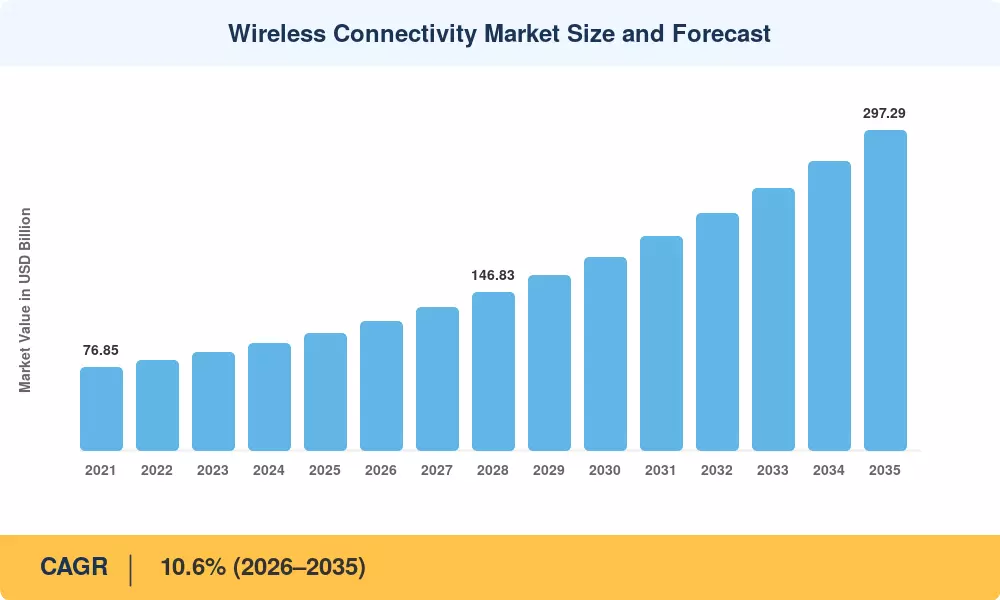
The global Wireless Connectivity Market stood at USD 108.50 Billion in 2025 and is projected to climb from USD 120.00 Billion in 2026 to USD 297.29 Billion by 2035, registering a CAGR of 10.6% across the forecast window. Two structural forces anchor this trajectory: the full release of the 6 GHz band across North America and parts of Europe, which has unlocked roughly 1,200 MHz of contiguous spectrum for next-generation Wi-Fi, and the parallel densification of private 5G networks inside manufacturing campuses, where deterministic latency justifies premium module pricing.
Wafer manufacturing for the 3 nm and 5 nm process nodes that support contemporary wireless SoCs continues to be de-risked by government investment packages, such as the U.S. CHIPS and Science Act allocations exceeding USD 52 billion and the EU Chips Act aiming at EUR 43 billion [1][2].
The market for wireless connectivity is undergoing a significant technological shift. Multi-radio modules that integrate Wi-Fi 7, Bluetooth 5.4, and ultra-wideband on a single die are replacing legacy single-radio designs based on standalone Bluetooth or 2.4 GHz Wi-Fi. These modules reduce board area by up to 40% and reduce power budgets below 1.5 W per module [3]. Due to V2X regulations and in-cabin experience platforms, automakers alone are predicted to integrate an average of 18 wireless endpoints per car by 2028, up from 11 in 2024 [4].
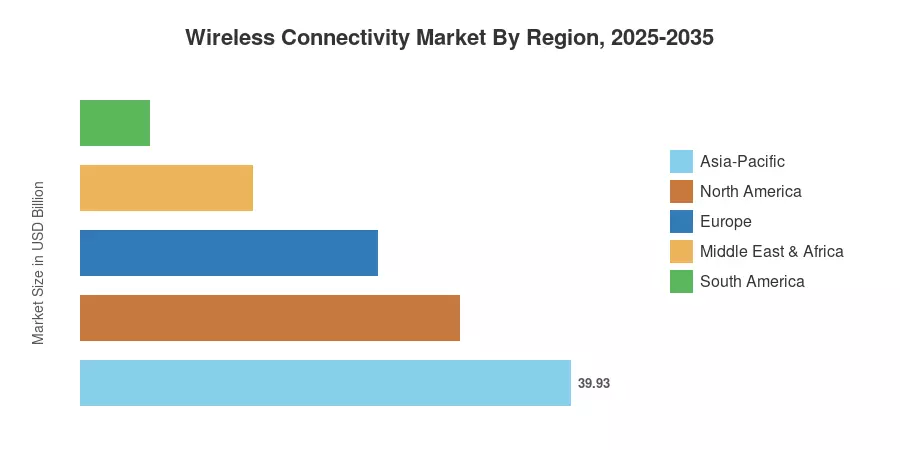
Driven by contract electronics manufacturing clusters in China, Vietnam, and India, the Asia-Pacific region holds the highest share of the Wireless Connectivity Market, accounting for around 36.8% of 2025 revenue. As 5G fixed-wireless-access deployments spread smart-city backhaul throughout the Gulf Cooperation Council states, the Middle East and Africa area is expected to record the fastest CAGR of 12.9% through 2035. Europe has the second-largest proportion, at about 22.3%, due to Industry 4.0 initiatives in the Nordic countries and automobile OEM demand in Germany. How soon foundry capacity, regulatory harmonization, and silicon roadmaps converge will determine the course of the next ten years.
Key Report Takeaways
• By Technology
- Wi-Fi commanded a 46.2% revenue share of the Wireless Connectivity Market in 2025, driven by enterprise access-point refresh cycles and consumer router upgrades to Wi-Fi 6E and Wi-Fi 7 standards.
- Ultra-wideband is on track for a 13.4% CAGR through 2035, underpinned by precision-location use cases in automotive digital-key and industrial asset-tracking applications.
• By End-User Industry
- Consumer electronics accounted for 39.8% of 2025 spending in the Wireless Connectivity Market, reflecting embedded connectivity in smartphones, tablets, smart speakers, and gaming peripherals.
- The automotive vertical is forecast to expand at a 12.6% CAGR through 2035 as connected and autonomous driving platforms proliferate.
• By Region
- Asia-Pacific captured 36.8% of the 2025 Wireless Connectivity Market revenue, anchored by contract manufacturing hubs and domestic OEM demand.
- The Middle East & Africa are projected to register a 12.9% CAGR through 2035, led by Saudi Arabia and UAE smart-city infrastructure programs.
Wireless Connectivity Market Size and Forecast (2021–2035)
Market Research Future's estimates draw on a combination of primary trade-channel interviews, OEM shipment databases, semiconductor revenue disclosures, and regulatory spectrum-auction records. Historical values (2021–2024) are validated against published annual reports from Qualcomm, Broadcom, and MediaTek, while forecast projections apply a bottom-up, segment-weighted model calibrated to GDP growth, device-attach rates, and spectrum-licensing timelines.






















.webp?v=1787579602)
