×
Hero Background
English
Chinese
French
Japanese
Korean
German
Spanish

Wireless Power Receiver Market Size

ID: MRFR/SEM/1151-HCR
108 Pages
Aarti Dhapte
October 2025

Wireless Power Receiver Market Research Report Information By Technology (Inductive Coupling, Capacitive Coupling), By Application (Consumer Electronics, Healthcare, Automotive, Aerospace and Defense, Industrial) And By Region (North America, Europe, Asia-Pacific, And Rest Of The World) –Market Forecast Till 2035.

Share:
Download PDF ×

We do not share your information with anyone. However, we may send you emails based on your report interest from time to time. You may contact us at any time to opt-out.

Wireless Power Receiver Market Infographic
Purchase Options

Wireless Power Receiver Size

Wireless Power Receiver Market Growth Projections and Opportunities

The dynamics and growth trajectory of the Wireless Power Receiver Market are significantly influenced by factors that shape it. One such crucial determinant is an increase in demand for convenient and efficient charging solutions across a range of electronic devices. The need for hassle-free charging options becomes increasingly important as consumers depend more on smartphones, smartwatches, and other portable gadgets. Moreover, the technology development rate significantly affects the wireless power receiver market. The new wireless charging standards like Qi and Powermat are driving its growth. The regulatory landscape also affects the wireless power receiver market apart from technological advances. The introduction and adoption of technologies for wireless charging are affected by government policies as well as regulations on safety standards plus energy efficiency. To ensure their products are reliable and safe, manufacturers must follow those instructions. Furthermore, the competitive environment and market trends play a significant role in shaping the wireless power receiver market. Innovation is driven by the presence of key players as well as competition between them, which also impacts pricing strategies. In addition to this, trends such as the integration of wireless charging in public places or the automotive sector contribute towards overall growth and sustainability in the market. Thus, aligning their strategies with these trends allows firms to be ahead of others within this dynamic environment. Consumer behavior, together with preferences, also affects the wireless power receiver market. As more people become aware of wireless charging solutions available today, they tend to buy products that fit these features. Consumer taste shift prompts manufacturers to add Wi-Fi capabilities into their product lines so that they can meet their targeted markets' demands. In order to get a significant share of this market, companies must know what consumers want from them. Additionally, economic factors, such as the health of various regions or countries, determine how markets perform. Worldwide patterns of consumption depend upon levels of economic stability accompanied by individual incomes, which influence buying decisions regarding Wi-Fi-enabled chargers. Market players have to check economic conditions since they should create suitable marketing strategies as well as prices that resonate with consumers on different economic backdrops.
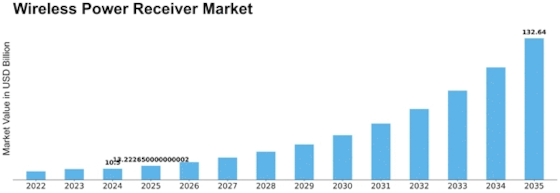

Wireless Power Receiver Market Size Graph
Author
Aarti Dhapte
Team Lead - Research

She holds an experience of about 6+ years in Market Research and Business Consulting, working under the spectrum of Information Communication Technology, Telecommunications and Semiconductor domains. Aarti conceptualizes and implements a scalable business strategy and provides strategic leadership to the clients. Her expertise lies in market estimation, competitive intelligence, pipeline analysis, customer assessment, etc.

Leave a Comment

FAQs

What is the projected market valuation of the Wireless Power Receiver Market by 2035?

The Wireless Power Receiver Market is projected to reach a valuation of 132.64 USD Billion by 2035.

What was the market valuation of the Wireless Power Receiver Market in 2024?

In 2024, the Wireless Power Receiver Market had a valuation of 10.5 USD Billion.

What is the expected CAGR for the Wireless Power Receiver Market during the forecast period 2025 - 2035?

The expected CAGR for the Wireless Power Receiver Market during the forecast period 2025 - 2035 is 25.93%.

Which technology segments are included in the Wireless Power Receiver Market?

The Wireless Power Receiver Market includes technology segments such as Inductive Coupling and Capacitive Coupling.

What are the key application segments for the Wireless Power Receiver Market?

Key application segments for the Wireless Power Receiver Market include Consumer Electronics, Healthcare, Automotive, Aerospace, Defense, and Industrial.

How much is the Consumer Electronics segment valued at in 2035?

The Consumer Electronics segment is projected to be valued at 39.12 USD Billion in 2035.

Market Summary

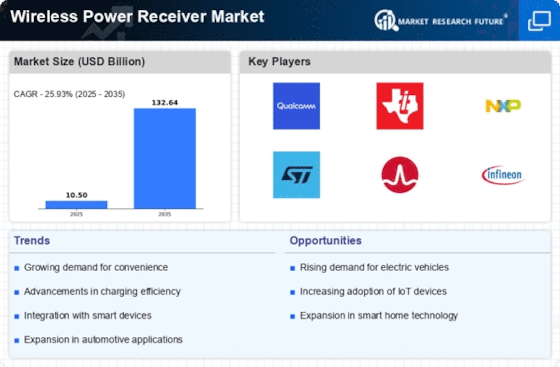
As per MRFR analysis, the Wireless Power Receiver Market Size was estimated at 10.5 USD Billion in 2024. The Wireless Power Receiver industry is projected to grow from 13.22 USD Billion in 2025 to 132.64 USD Billion by 2035, exhibiting a compound annual growth rate (CAGR) of 25.93 during the forecast period 2025 - 2035.

Key Market Trends & Highlights

The Wireless Power Receiver Market is experiencing robust growth driven by technological advancements and increasing adoption across various sectors.

  • The market is witnessing increased adoption in consumer electronics, particularly in North America, which remains the largest market. Expansion into electric vehicles is notable, especially in the Asia-Pacific region, recognized as the fastest-growing market. Innovations in healthcare applications are emerging, with the healthcare segment showing rapid growth potential. Rising demand for wireless charging solutions and integration with smart home technologies are key drivers propelling market expansion.

Market Size & Forecast

2024 Market Size 10.5 (USD Billion)
2035 Market Size 132.64 (USD Billion)
CAGR (2025 - 2035) 25.93%
Largest Regional Market Share in 2024 North America

Major Players

<p>Qualcomm (US), Texas Instruments (US), NXP Semiconductors (NL), STMicroelectronics (CH), Broadcom (US), Infineon Technologies (DE), Renesas Electronics (JP), Powercast Corporation (US), Energous Corporation (US)</p>

Market Trends

The Wireless Power Receiver Market is currently experiencing a transformative phase, driven by advancements in technology and increasing consumer demand for convenience. As more devices become compatible with wireless charging, the market appears poised for substantial growth. This trend is further supported by the rising adoption of electric vehicles, which necessitate efficient charging solutions. Additionally, the integration of wireless power receivers in various sectors, including consumer electronics and healthcare, suggests a broadening application landscape. Companies are investing in research and development to enhance the efficiency and safety of wireless charging systems, which may lead to innovative products that cater to diverse consumer needs. Moreover, the competitive landscape of the Wireless Power Receiver Market is evolving, with numerous players striving to establish their presence. Collaborations and partnerships among technology firms are becoming increasingly common, as they seek to leverage each other's strengths. This collaborative approach could potentially accelerate the development of new technologies and expand market reach. As the market continues to mature, it is likely that regulatory frameworks will also adapt to ensure safety and standardization, further influencing market dynamics. Overall, the Wireless Power Receiver Market is on a promising trajectory, characterized by innovation and a growing array of applications across various industries.

Increased Adoption in Consumer Electronics

The Wireless Power Receiver Market is witnessing a surge in adoption within the consumer electronics sector. As smartphones, tablets, and wearables increasingly incorporate wireless charging capabilities, consumer preference for convenience is driving this trend. Manufacturers are focusing on enhancing compatibility and efficiency, which may lead to a wider acceptance of wireless charging solutions.

Expansion into Electric Vehicles

The integration of wireless power receivers in electric vehicles is emerging as a significant trend. As the automotive industry shifts towards electrification, the demand for efficient charging solutions is rising. Wireless charging technology offers the potential for seamless charging experiences, which could enhance user convenience and promote the adoption of electric vehicles.

Innovations in Healthcare Applications

The Wireless Power Receiver Market is also expanding into the healthcare sector, where innovative applications are being developed. Wireless charging solutions for medical devices, such as implants and wearables, are gaining traction. This trend suggests a growing recognition of the benefits of wireless power in enhancing patient care and operational efficiency in healthcare settings.

Wireless Power Receiver Market Market Drivers

Advancements in Healthcare Technology

The Wireless Power Receiver Market is benefiting from advancements in healthcare technology, particularly in the realm of medical devices. The increasing reliance on portable and wearable health monitoring devices necessitates efficient power solutions. Wireless power receivers are being utilized in devices such as pacemakers, insulin pumps, and health trackers, allowing for continuous operation without the need for frequent battery replacements. The healthcare sector is projected to invest heavily in wireless charging technologies, with estimates suggesting a market growth of over 15% annually through 2028. This trend underscores the critical role of wireless power receivers in enhancing patient care and device functionality.

Integration with Smart Home Technologies

The Wireless Power Receiver Market is witnessing a significant integration of wireless power technology with smart home devices. As the Internet of Things (IoT) continues to expand, the demand for seamless connectivity and power solutions is increasing. Wireless power receivers are being embedded in smart home appliances, such as smart speakers, security systems, and home automation devices, facilitating a more streamlined user experience. This integration not only enhances the functionality of smart devices but also promotes energy efficiency. Market analysts suggest that the smart home segment could account for over 40% of the wireless power receiver market by 2027, indicating a robust growth trajectory.

Rising Demand for Wireless Charging Solutions

The Wireless Power Receiver Market is experiencing a notable surge in demand for wireless charging solutions, driven by the increasing proliferation of portable electronic devices. As consumers seek convenience and efficiency, the adoption of wireless charging technology in smartphones, tablets, and wearables is becoming more prevalent. According to recent data, the market for wireless charging is projected to reach USD 30 billion by 2026, indicating a compound annual growth rate of approximately 25%. This trend is further fueled by advancements in charging efficiency and the integration of wireless power receivers in various consumer electronics, enhancing user experience and driving market growth.

Growth in Electric Vehicle Charging Infrastructure

The Wireless Power Receiver Market is poised for growth due to the expansion of electric vehicle (EV) charging infrastructure. As governments and private sectors invest in EV technology, the need for efficient and convenient charging solutions is becoming paramount. Wireless power receivers are being developed for use in EV charging stations, allowing for hassle-free charging experiences. Recent estimates indicate that the EV market is expected to grow at a CAGR of 22% through 2030, which will likely drive the demand for wireless charging solutions. This trend not only supports the transition to sustainable transportation but also positions wireless power technology as a key player in the automotive sector.

Emergence of Standardization in Wireless Charging Technologies

The Wireless Power Receiver Market is experiencing a shift towards standardization in wireless charging technologies, which is likely to enhance market growth. As various industries adopt wireless power solutions, the establishment of universal standards is becoming increasingly important. This standardization facilitates interoperability among devices, making it easier for consumers to adopt wireless charging solutions across different platforms. Industry expert's indicate that the move towards standardized wireless charging could potentially increase market penetration by up to 30% by 2026. This trend not only simplifies the user experience but also encourages manufacturers to invest in wireless power receiver technologies, further driving market expansion.

Market Segment Insights

By Technology: Inductive Coupling (Largest) vs. Capacitive Coupling (Fastest-Growing)

<p>In the Wireless Power Receiver Market, the segment analysis reveals that Inductive Coupling holds a significant share, making it the largest segment. Widely adopted in various consumer electronics, such as smartphones and <a href="https://www.marketresearchfuture.com/reports/electric-vehicles-mlcc-market-42358">electric vehicles</a>, this technology leverages magnetic fields to transfer energy efficiently over short distances. In contrast, Capacitive Coupling, while currently smaller in market share, is gaining traction in specific applications, including wearables and IoT devices, due to its advantages in size and flexibility. The growth trends indicate that Capacitive Coupling is emerging swiftly, driven by the increasing demand for compact and lightweight devices. Factors such as advancements in capacitor technology and the need for more efficient charging solutions contribute to its rapid adoption. As wireless charging becomes more prevalent, both segments will witness growth, driven by innovation and evolving consumer preferences in the technology landscape.</p>

<p>Technology: Inductive Coupling (Dominant) vs. Capacitive Coupling (Emerging)</p>

<p>Inductive Coupling has established itself as the dominant technology in the Wireless Power Receiver Market due to its mature applications and robust infrastructure. It typically excels in powering larger devices across various industries, utilizing magnetic fields for effective energy transfer. Conversely, Capacitive Coupling represents an emerging technology that is rapidly adapting to market needs, characterized by its ability to support lightweight and compact designs. This technology is increasingly being integrated into futuristic applications, such as smart home products and sensor-driven solutions, making it a focal point for innovation. As manufacturers explore newer applications, Capacitive Coupling is positioning itself to capture a growing segment of the market, appealing to tech-savvy consumers seeking modern charging solutions.</p>

By Application: Consumer Electronics (Largest) vs. Healthcare (Fastest-Growing)

<p>The Wireless Power Receiver Market showcases significant share distribution across various applications, with Consumer Electronics leading the way. This segment is primarily driven by the widespread adoption of wireless charging technologies in smartphones, wearables, and home appliances. Healthcare is closely following, capturing substantial interest due to the potential of wireless power solutions in medical devices, enabling uninterrupted operation and reducing the complexities of wired connections.</p>

<p>Consumer Electronics (Dominant) vs. Healthcare (Emerging)</p>

<p>In the Wireless Power Receiver Market, Consumer Electronics stands out as the dominant application segment, thanks to its established market presence and robust demand. The penetration of wireless charging pads, smartphones, and personal electronics has cemented its position, providing ease of use and increasing convenience for consumers. On the other hand, the Healthcare segment is emerging rapidly as a potential game-changer. This segment harnesses the advantages of wireless power in medical devices, allowing for safer, more reliable, and less intrusive operations in patient care. The ability to charge devices wirelessly in critical environments enhances usability and patient outcomes, positioning healthcare as a crucial growth area.</p>

Get more detailed insights about Global Wireless Power Receiver Market Research Report- Global Forecast 2035

Regional Insights

North America : Innovation and Market Leadership

North America is the largest market for wireless power receivers, holding approximately 45% of the global market share. The region's growth is driven by increasing adoption of wireless charging technologies in consumer electronics, automotive, and healthcare sectors. Regulatory support for energy efficiency and safety standards further catalyzes market expansion, with initiatives promoting sustainable energy solutions. The United States leads the market, followed by Canada, with major players like Qualcomm, Texas Instruments, and Broadcom driving innovation. The competitive landscape is characterized by significant investments in R&D and strategic partnerships. The presence of established tech companies and startups fosters a vibrant ecosystem, enhancing the region's position as a hub for wireless power technology.

Europe : Emerging Market with Regulations

Europe is witnessing significant growth in the wireless power receiver market, accounting for about 30% of the global share. The region's demand is fueled by increasing consumer electronics usage and regulatory frameworks promoting energy-efficient technologies. The European Union's directives on energy consumption and sustainability are pivotal in shaping market dynamics, encouraging innovation and adoption of wireless charging solutions. Leading countries include Germany, France, and the UK, where companies like NXP Semiconductors and Infineon Technologies are prominent. The competitive landscape is marked by collaborations between tech firms and automotive manufacturers, enhancing product offerings. The presence of stringent regulations ensures high safety and efficiency standards, further driving market growth.

Asia-Pacific : Rapid Growth and Adoption

Asia-Pacific is rapidly emerging as a key player in the wireless power receiver market, holding around 20% of the global market share. The region's growth is driven by rising smartphone penetration, increasing demand for electric vehicles, and a growing focus on smart home technologies. Government initiatives promoting technological advancements and energy efficiency are also significant growth catalysts, enhancing market dynamics. China, Japan, and South Korea are the leading countries in this region, with major companies like Renesas Electronics and STMicroelectronics contributing to market expansion. The competitive landscape is characterized by aggressive pricing strategies and innovation, with local players increasingly entering the market. The region's focus on research and development is expected to further boost its market position in the coming years.

Middle East and Africa : Untapped Potential and Growth

The Middle East and Africa represent an emerging market for wireless power receivers, holding approximately 5% of the global market share. The region's growth is primarily driven by increasing smartphone adoption and the expansion of the automotive sector. Additionally, government initiatives aimed at enhancing technological infrastructure and energy efficiency are expected to catalyze market growth in the coming years. Leading countries include South Africa and the UAE, where there is a growing interest in smart technologies and renewable energy solutions. The competitive landscape is still developing, with opportunities for both local and international players. As the region invests in technological advancements, the wireless power receiver market is poised for significant growth, attracting investments and fostering innovation.

Key Players and Competitive Insights

The Wireless Power Receiver Market is currently characterized by a dynamic competitive landscape, driven by rapid technological advancements and increasing consumer demand for wireless charging solutions. Key players such as Qualcomm (US), Texas Instruments (US), and NXP Semiconductors (NL) are strategically positioning themselves through innovation and partnerships. Qualcomm (US) has been focusing on enhancing its product offerings in the realm of wireless charging technologies, while Texas Instruments (US) emphasizes the integration of its power management solutions with wireless charging systems. NXP Semiconductors (NL) is leveraging its expertise in secure connectivity to develop advanced wireless power solutions, thereby shaping a competitive environment that prioritizes technological differentiation and strategic collaborations.

In terms of business tactics, companies are increasingly localizing manufacturing and optimizing supply chains to enhance operational efficiency. The market structure appears moderately fragmented, with several key players exerting influence over various segments. This fragmentation allows for niche players to emerge, yet the collective strength of major companies like Broadcom (US) and Infineon Technologies (DE) ensures that competition remains robust. The interplay between established firms and emerging innovators is likely to drive further advancements in wireless power technologies.

In August 2025, Qualcomm (US) announced a partnership with a leading smartphone manufacturer to integrate its latest wireless power receiver technology into upcoming devices. This collaboration is expected to enhance the efficiency and speed of wireless charging, positioning Qualcomm as a frontrunner in the market. The strategic importance of this partnership lies in its potential to capture a larger market share by aligning with a major player in the consumer electronics sector, thereby reinforcing Qualcomm's competitive edge.

In September 2025, Texas Instruments (US) unveiled a new line of wireless power receivers designed specifically for automotive applications. This move signifies a strategic pivot towards the burgeoning electric vehicle market, where efficient wireless charging solutions are becoming increasingly critical. By targeting this sector, Texas Instruments aims to diversify its product portfolio and tap into new revenue streams, which could significantly bolster its market position.

In July 2025, NXP Semiconductors (NL) launched an innovative wireless power receiver that incorporates advanced security features, catering to the growing demand for secure charging solutions. This development not only enhances the functionality of their products but also addresses consumer concerns regarding safety and data protection. The introduction of such features is likely to resonate well with both manufacturers and end-users, further solidifying NXP's reputation as a leader in secure wireless power technologies.

As of October 2025, the competitive trends in the Wireless Power Receiver Market are increasingly defined by digitalization, sustainability, and the integration of artificial intelligence. Strategic alliances are becoming more prevalent, as companies recognize the need to collaborate in order to innovate and meet evolving consumer expectations. Looking ahead, competitive differentiation is expected to shift from traditional price-based competition towards a focus on innovation, technological advancements, and supply chain reliability. This evolution suggests that companies that prioritize these aspects will likely emerge as leaders in the wireless power receiver landscape.

Key Companies in the Wireless Power Receiver Market market include

Industry Developments

March 2019: Samsung released its new S10 and S10plus smartphones, which have a wireless power share feature that lets you use the back of the phone to Qi charge another phone. This idea was taken from the Huawei Mate 20 pro phone, but this phone was not available in certain territories, including the US. This has helped the sales of the Samsung S10 worldwide.

February 2019: Rohm announced the development of an automotive wireless-charging solution with an integrated near-field communication system. This has led to merging Rohm's automotive grade (AEC- Q100Qualified) IC with STMicro.

Future Outlook

Wireless Power Receiver Market Future Outlook

<p>The Wireless Power Receiver Market is projected to grow at a 25.93% CAGR from 2024 to 2035, driven by advancements in technology, increasing demand for convenience, and the proliferation of electric vehicles.</p>

New opportunities lie in:

  • <p>Development of wireless charging solutions for electric vehicle fleets.</p><p>Integration of wireless power receivers in smart home devices.</p><p>Expansion of wireless charging infrastructure in public spaces.</p>

<p>By 2035, the market is expected to be robust, reflecting substantial growth and innovation.</p>

Market Segmentation

Wireless Power Receiver Market Technology Outlook

  • Inductive Coupling
  • Capacitive Coupling

Wireless Power Receiver Market Application Outlook

  • Consumer Electronics
  • Healthcare
  • Automotive
  • Aerospace
  • Defense
  • Industrial

Report Scope

MARKET SIZE 202410.5(USD Billion)
MARKET SIZE 202513.22(USD Billion)
MARKET SIZE 2035132.64(USD Billion)
COMPOUND ANNUAL GROWTH RATE (CAGR)25.93% (2024 - 2035)
REPORT COVERAGERevenue Forecast, Competitive Landscape, Growth Factors, and Trends
BASE YEAR2024
Market Forecast Period2025 - 2035
Historical Data2019 - 2024
Market Forecast UnitsUSD Billion
Key Companies ProfiledMarket analysis in progress
Segments CoveredMarket segmentation analysis in progress
Key Market OpportunitiesIntegration of advanced wireless charging solutions in electric vehicles enhances the Wireless Power Receiver Market potential.
Key Market DynamicsTechnological advancements and regulatory changes drive innovation and competition in the Wireless Power Receiver Market.
Countries CoveredNorth America, Europe, APAC, South America, MEA

FAQs

What is the projected market valuation of the Wireless Power Receiver Market by 2035?

The Wireless Power Receiver Market is projected to reach a valuation of 132.64 USD Billion by 2035.

What was the market valuation of the Wireless Power Receiver Market in 2024?

In 2024, the Wireless Power Receiver Market had a valuation of 10.5 USD Billion.

What is the expected CAGR for the Wireless Power Receiver Market during the forecast period 2025 - 2035?

The expected CAGR for the Wireless Power Receiver Market during the forecast period 2025 - 2035 is 25.93%.

Which technology segments are included in the Wireless Power Receiver Market?

The Wireless Power Receiver Market includes technology segments such as Inductive Coupling and Capacitive Coupling.

What are the key application segments for the Wireless Power Receiver Market?

Key application segments for the Wireless Power Receiver Market include Consumer Electronics, Healthcare, Automotive, Aerospace, Defense, and Industrial.

How much is the Consumer Electronics segment valued at in 2035?

The Consumer Electronics segment is projected to be valued at 39.12 USD Billion in 2035.

  1. SECTION I: EXECUTIVE SUMMARY AND KEY HIGHLIGHTS
    1. EXECUTIVE SUMMARY
      1. Market Overview
      2. Key Findings
      3. Market Segmentation
      4. Competitive Landscape
      5. Challenges and Opportunities
      6. Future Outlook
  2. SECTION II: SCOPING, METHODOLOGY AND MARKET STRUCTURE
    1. MARKET INTRODUCTION
      1. Definition
      2. Scope of the study
    2. RESEARCH METHODOLOGY
      1. Overview
      2. Data Mining
      3. Secondary Research
      4. Primary Research
      5. Forecasting Model
      6. Market Size Estimation
      7. Data Triangulation
      8. Validation
  3. SECTION III: QUALITATIVE ANALYSIS
    1. MARKET DYNAMICS
      1. Overview
      2. Drivers
      3. Restraints
      4. Opportunities
    2. MARKET FACTOR ANALYSIS
      1. Value chain Analysis
      2. Porter's Five Forces Analysis
      3. COVID-19 Impact Analysis
  4. SECTION IV: QUANTITATIVE ANALYSIS
    1. Semiconductor & Electronics, BY Technology (USD Billion)
      1. Inductive Coupling
      2. Capacitive Coupling
    2. Semiconductor & Electronics, BY Application (USD Billion)
      1. Consumer Electronics
      2. Healthcare
      3. Automotive
      4. Aerospace
      5. Defense
      6. Industrial
    3. Semiconductor & Electronics, BY Region (USD Billion)
      1. North America
      2. Europe
      3. APAC
      4. South America
      5. MEA
  5. SECTION V: COMPETITIVE ANALYSIS
    1. Competitive Landscape
      1. Overview
      2. Competitive Analysis
      3. Market share Analysis
      4. Major Growth Strategy in the Semiconductor & Electronics
      5. Competitive Benchmarking
      6. Leading Players in Terms of Number of Developments in the Semiconductor & Electronics
      7. Key developments and growth strategies
      8. Major Players Financial Matrix
    2. Company Profiles
      1. Qualcomm (US)
      2. Texas Instruments (US)
      3. NXP Semiconductors (NL)
      4. STMicroelectronics (CH)
      5. Broadcom (US)
      6. Infineon Technologies (DE)
      7. Renesas Electronics (JP)
      8. Powercast Corporation (US)
      9. Energous Corporation (US)
    3. Appendix
      1. References
      2. Related Reports
  6. LIST OF FIGURES
    1. MARKET SYNOPSIS
    2. NORTH AMERICA MARKET ANALYSIS
    3. US MARKET ANALYSIS BY TECHNOLOGY
    4. US MARKET ANALYSIS BY APPLICATION
    5. CANADA MARKET ANALYSIS BY TECHNOLOGY
    6. CANADA MARKET ANALYSIS BY APPLICATION
    7. EUROPE MARKET ANALYSIS
    8. GERMANY MARKET ANALYSIS BY TECHNOLOGY
    9. GERMANY MARKET ANALYSIS BY APPLICATION
    10. UK MARKET ANALYSIS BY TECHNOLOGY
    11. UK MARKET ANALYSIS BY APPLICATION
    12. FRANCE MARKET ANALYSIS BY TECHNOLOGY
    13. FRANCE MARKET ANALYSIS BY APPLICATION
    14. RUSSIA MARKET ANALYSIS BY TECHNOLOGY
    15. RUSSIA MARKET ANALYSIS BY APPLICATION
    16. ITALY MARKET ANALYSIS BY TECHNOLOGY
    17. ITALY MARKET ANALYSIS BY APPLICATION
    18. SPAIN MARKET ANALYSIS BY TECHNOLOGY
    19. SPAIN MARKET ANALYSIS BY APPLICATION
    20. REST OF EUROPE MARKET ANALYSIS BY TECHNOLOGY
    21. REST OF EUROPE MARKET ANALYSIS BY APPLICATION
    22. APAC MARKET ANALYSIS
    23. CHINA MARKET ANALYSIS BY TECHNOLOGY
    24. CHINA MARKET ANALYSIS BY APPLICATION
    25. INDIA MARKET ANALYSIS BY TECHNOLOGY
    26. INDIA MARKET ANALYSIS BY APPLICATION
    27. JAPAN MARKET ANALYSIS BY TECHNOLOGY
    28. JAPAN MARKET ANALYSIS BY APPLICATION
    29. SOUTH KOREA MARKET ANALYSIS BY TECHNOLOGY
    30. SOUTH KOREA MARKET ANALYSIS BY APPLICATION
    31. MALAYSIA MARKET ANALYSIS BY TECHNOLOGY
    32. MALAYSIA MARKET ANALYSIS BY APPLICATION
    33. THAILAND MARKET ANALYSIS BY TECHNOLOGY
    34. THAILAND MARKET ANALYSIS BY APPLICATION
    35. INDONESIA MARKET ANALYSIS BY TECHNOLOGY
    36. INDONESIA MARKET ANALYSIS BY APPLICATION
    37. REST OF APAC MARKET ANALYSIS BY TECHNOLOGY
    38. REST OF APAC MARKET ANALYSIS BY APPLICATION
    39. SOUTH AMERICA MARKET ANALYSIS
    40. BRAZIL MARKET ANALYSIS BY TECHNOLOGY
    41. BRAZIL MARKET ANALYSIS BY APPLICATION
    42. MEXICO MARKET ANALYSIS BY TECHNOLOGY
    43. MEXICO MARKET ANALYSIS BY APPLICATION
    44. ARGENTINA MARKET ANALYSIS BY TECHNOLOGY
    45. ARGENTINA MARKET ANALYSIS BY APPLICATION
    46. REST OF SOUTH AMERICA MARKET ANALYSIS BY TECHNOLOGY
    47. REST OF SOUTH AMERICA MARKET ANALYSIS BY APPLICATION
    48. MEA MARKET ANALYSIS
    49. GCC COUNTRIES MARKET ANALYSIS BY TECHNOLOGY
    50. GCC COUNTRIES MARKET ANALYSIS BY APPLICATION
    51. SOUTH AFRICA MARKET ANALYSIS BY TECHNOLOGY
    52. SOUTH AFRICA MARKET ANALYSIS BY APPLICATION
    53. REST OF MEA MARKET ANALYSIS BY TECHNOLOGY
    54. REST OF MEA MARKET ANALYSIS BY APPLICATION
    55. KEY BUYING CRITERIA OF SEMICONDUCTOR & ELECTRONICS
    56. RESEARCH PROCESS OF MRFR
    57. DRO ANALYSIS OF SEMICONDUCTOR & ELECTRONICS
    58. DRIVERS IMPACT ANALYSIS: SEMICONDUCTOR & ELECTRONICS
    59. RESTRAINTS IMPACT ANALYSIS: SEMICONDUCTOR & ELECTRONICS
    60. SUPPLY / VALUE CHAIN: SEMICONDUCTOR & ELECTRONICS
    61. SEMICONDUCTOR & ELECTRONICS, BY TECHNOLOGY, 2024 (% SHARE)
    62. SEMICONDUCTOR & ELECTRONICS, BY TECHNOLOGY, 2024 TO 2035 (USD Billion)
    63. SEMICONDUCTOR & ELECTRONICS, BY APPLICATION, 2024 (% SHARE)
    64. SEMICONDUCTOR & ELECTRONICS, BY APPLICATION, 2024 TO 2035 (USD Billion)
    65. BENCHMARKING OF MAJOR COMPETITORS
  7. LIST OF TABLES
    1. LIST OF ASSUMPTIONS
    2. North America MARKET SIZE ESTIMATES; FORECAST
      1. BY TECHNOLOGY, 2025-2035 (USD Billion)
      2. BY APPLICATION, 2025-2035 (USD Billion)
    3. US MARKET SIZE ESTIMATES; FORECAST
      1. BY TECHNOLOGY, 2025-2035 (USD Billion)
      2. BY APPLICATION, 2025-2035 (USD Billion)
    4. Canada MARKET SIZE ESTIMATES; FORECAST
      1. BY TECHNOLOGY, 2025-2035 (USD Billion)
      2. BY APPLICATION, 2025-2035 (USD Billion)
    5. Europe MARKET SIZE ESTIMATES; FORECAST
      1. BY TECHNOLOGY, 2025-2035 (USD Billion)
      2. BY APPLICATION, 2025-2035 (USD Billion)
    6. Germany MARKET SIZE ESTIMATES; FORECAST
      1. BY TECHNOLOGY, 2025-2035 (USD Billion)
      2. BY APPLICATION, 2025-2035 (USD Billion)
    7. UK MARKET SIZE ESTIMATES; FORECAST
      1. BY TECHNOLOGY, 2025-2035 (USD Billion)
      2. BY APPLICATION, 2025-2035 (USD Billion)
    8. France MARKET SIZE ESTIMATES; FORECAST
      1. BY TECHNOLOGY, 2025-2035 (USD Billion)
      2. BY APPLICATION, 2025-2035 (USD Billion)
    9. Russia MARKET SIZE ESTIMATES; FORECAST
      1. BY TECHNOLOGY, 2025-2035 (USD Billion)
      2. BY APPLICATION, 2025-2035 (USD Billion)
    10. Italy MARKET SIZE ESTIMATES; FORECAST
      1. BY TECHNOLOGY, 2025-2035 (USD Billion)
      2. BY APPLICATION, 2025-2035 (USD Billion)
    11. Spain MARKET SIZE ESTIMATES; FORECAST
      1. BY TECHNOLOGY, 2025-2035 (USD Billion)
      2. BY APPLICATION, 2025-2035 (USD Billion)
    12. Rest of Europe MARKET SIZE ESTIMATES; FORECAST
      1. BY TECHNOLOGY, 2025-2035 (USD Billion)
      2. BY APPLICATION, 2025-2035 (USD Billion)
    13. APAC MARKET SIZE ESTIMATES; FORECAST
      1. BY TECHNOLOGY, 2025-2035 (USD Billion)
      2. BY APPLICATION, 2025-2035 (USD Billion)
    14. China MARKET SIZE ESTIMATES; FORECAST
      1. BY TECHNOLOGY, 2025-2035 (USD Billion)
      2. BY APPLICATION, 2025-2035 (USD Billion)
    15. India MARKET SIZE ESTIMATES; FORECAST
      1. BY TECHNOLOGY, 2025-2035 (USD Billion)
      2. BY APPLICATION, 2025-2035 (USD Billion)
    16. Japan MARKET SIZE ESTIMATES; FORECAST
      1. BY TECHNOLOGY, 2025-2035 (USD Billion)
      2. BY APPLICATION, 2025-2035 (USD Billion)
    17. South Korea MARKET SIZE ESTIMATES; FORECAST
      1. BY TECHNOLOGY, 2025-2035 (USD Billion)
      2. BY APPLICATION, 2025-2035 (USD Billion)
    18. Malaysia MARKET SIZE ESTIMATES; FORECAST
      1. BY TECHNOLOGY, 2025-2035 (USD Billion)
      2. BY APPLICATION, 2025-2035 (USD Billion)
    19. Thailand MARKET SIZE ESTIMATES; FORECAST
      1. BY TECHNOLOGY, 2025-2035 (USD Billion)
      2. BY APPLICATION, 2025-2035 (USD Billion)
    20. Indonesia MARKET SIZE ESTIMATES; FORECAST
      1. BY TECHNOLOGY, 2025-2035 (USD Billion)
      2. BY APPLICATION, 2025-2035 (USD Billion)
    21. Rest of APAC MARKET SIZE ESTIMATES; FORECAST
      1. BY TECHNOLOGY, 2025-2035 (USD Billion)
      2. BY APPLICATION, 2025-2035 (USD Billion)
    22. South America MARKET SIZE ESTIMATES; FORECAST
      1. BY TECHNOLOGY, 2025-2035 (USD Billion)
      2. BY APPLICATION, 2025-2035 (USD Billion)
    23. Brazil MARKET SIZE ESTIMATES; FORECAST
      1. BY TECHNOLOGY, 2025-2035 (USD Billion)
      2. BY APPLICATION, 2025-2035 (USD Billion)
    24. Mexico MARKET SIZE ESTIMATES; FORECAST
      1. BY TECHNOLOGY, 2025-2035 (USD Billion)
      2. BY APPLICATION, 2025-2035 (USD Billion)
    25. Argentina MARKET SIZE ESTIMATES; FORECAST
      1. BY TECHNOLOGY, 2025-2035 (USD Billion)
      2. BY APPLICATION, 2025-2035 (USD Billion)
    26. Rest of South America MARKET SIZE ESTIMATES; FORECAST
      1. BY TECHNOLOGY, 2025-2035 (USD Billion)
      2. BY APPLICATION, 2025-2035 (USD Billion)
    27. MEA MARKET SIZE ESTIMATES; FORECAST
      1. BY TECHNOLOGY, 2025-2035 (USD Billion)
      2. BY APPLICATION, 2025-2035 (USD Billion)
    28. GCC Countries MARKET SIZE ESTIMATES; FORECAST
      1. BY TECHNOLOGY, 2025-2035 (USD Billion)
      2. BY APPLICATION, 2025-2035 (USD Billion)
    29. South Africa MARKET SIZE ESTIMATES; FORECAST
      1. BY TECHNOLOGY, 2025-2035 (USD Billion)
      2. BY APPLICATION, 2025-2035 (USD Billion)
    30. Rest of MEA MARKET SIZE ESTIMATES; FORECAST
      1. BY TECHNOLOGY, 2025-2035 (USD Billion)
      2. BY APPLICATION, 2025-2035 (USD Billion)
    31. PRODUCT LAUNCH/PRODUCT DEVELOPMENT/APPROVAL
    32. ACQUISITION/PARTNERSHIP

Wireless Power Receiver Market Segmentation

Wireless Power Receiver Technology Outlook (USD Billion, 2018-2032)

Inductive Coupling

Capacitive Coupling

Wireless Power Receiver Application Outlook (USD Billion, 2018-2032)

Consumer Electronics

Healthcare

Automotive

Aerospace

Defense

Industrial

Wireless Power Receiver Regional Outlook (USD Billion, 2018-2032)

North America Outlook (USD Billion, 2018-2032)

North America Wireless Power Receiver by Technology

Inductive Coupling

Capacitive Coupling

North America Wireless Power Receiver by Application

Consumer Electronics

Healthcare

Automotive

Aerospace

Defense

Industrial

US Outlook (USD Billion, 2018-2032)

US Wireless Power Receiver by Technology

Inductive Coupling

Capacitive Coupling

US Wireless Power Receiver by Application

Consumer Electronics

Healthcare

Automotive

Aerospace

Defense

Industrial

CANADA Outlook (USD Billion, 2018-2032)

CANADA Wireless Power Receiver by Technology

Inductive Coupling

Capacitive Coupling

CANADA Wireless Power Receiver by Application

Consumer Electronics

Healthcare

Automotive

Aerospace

Defense

Industrial

Europe Outlook (USD Billion, 2018-2032)

Europe Wireless Power Receiver by Technology

Inductive Coupling

Capacitive Coupling

Europe Wireless Power Receiver by Application

Consumer Electronics

Healthcare

Automotive

Aerospace

Defense

Industrial

Germany Outlook (USD Billion, 2018-2032)

Germany Wireless Power Receiver by Technology

Inductive Coupling

Capacitive Coupling

Germany Wireless Power Receiver by Application

Consumer Electronics

Healthcare

Automotive

Aerospace

Defense

Industrial

France Outlook (USD Billion, 2018-2032)

France Wireless Power Receiver by Technology

Inductive Coupling

Capacitive Coupling

France Wireless Power Receiver by Application

Consumer Electronics

Healthcare

Automotive

Aerospace

Defense

Industrial

UK Outlook (USD Billion, 2018-2032)

UK Wireless Power Receiver by Technology

Inductive Coupling

Capacitive Coupling

UK Wireless Power Receiver by Application

Consumer Electronics

Healthcare

Automotive

Aerospace

Defense

Industrial

ITALY Outlook (USD Billion, 2018-2032)

ITALY Wireless Power Receiver by Technology

Inductive Coupling

Capacitive Coupling

ITALY Wireless Power Receiver by Application

Consumer Electronics

Healthcare

Automotive

Aerospace

Defense

Industrial

SPAIN Outlook (USD Billion, 2018-2032)

Spain Wireless Power Receiver by Technology

Inductive Coupling

Capacitive Coupling

Spain Wireless Power Receiver by Application

Consumer Electronics

Healthcare

Automotive

Aerospace

Defense

Industrial

Rest Of Europe Outlook (USD Billion, 2018-2032)

Rest Of Europe Wireless Power Receiver by Technology

Inductive Coupling

Capacitive Coupling

REST OF EUROPE Wireless Power Receiver by Application

Consumer Electronics

Healthcare

Automotive

Aerospace

Defense

Industrial

Asia-Pacific Outlook (USD Billion, 2018-2032)

Asia-Pacific Wireless Power Receiver by Technology

Inductive Coupling

Capacitive Coupling

Asia-Pacific Wireless Power Receiver by Application

Consumer Electronics

Healthcare

Automotive

Aerospace

Defense

Industrial

China Outlook (USD Billion, 2018-2032)

China Wireless Power Receiver by Technology

Inductive Coupling

Capacitive Coupling

China Wireless Power Receiver by Application

Consumer Electronics

Healthcare

Automotive

Aerospace

Defense

Industrial

Japan Outlook (USD Billion, 2018-2032)

Japan Wireless Power Receiver by Technology

Inductive Coupling

Capacitive Coupling

Japan Wireless Power Receiver by Application

Consumer Electronics

Healthcare

Automotive

Aerospace

Defense

Industrial

India Outlook (USD Billion, 2018-2032)

India Wireless Power Receiver by Technology

Inductive Coupling

Capacitive Coupling

India Wireless Power Receiver by Application

Consumer Electronics

Healthcare

Automotive

Aerospace

Defense

Industrial

Australia Outlook (USD Billion, 2018-2032)

Australia Wireless Power Receiver by Technology

Inductive Coupling

Capacitive Coupling

Australia Wireless Power Receiver by Application

Consumer Electronics

Healthcare

Automotive

Aerospace

Defense

Industrial

Rest of Asia-Pacific Outlook (USD Billion, 2018-2032)

Rest of Asia-Pacific Wireless Power Receiver by Technology

Inductive Coupling

Capacitive Coupling

Rest of Asia-Pacific Wireless Power Receiver by Application

Consumer Electronics

Healthcare

Automotive

Aerospace

Defense

Industrial

Rest of the World Outlook (USD Billion, 2018-2032)

Rest of the World Wireless Power Receiver by Technology

Inductive Coupling

Capacitive Coupling

Rest of the World Wireless Power Receiver by Application

Consumer Electronics

Healthcare

Automotive

Aerospace

Defense

Industrial

Middle East Outlook (USD Billion, 2018-2032)

Middle East Wireless Power Receiver by Technology

Inductive Coupling

Capacitive Coupling

Middle East Wireless Power Receiver by Application

Consumer Electronics

Healthcare

Automotive

Aerospace

Defense

Industrial

Africa Outlook (USD Billion, 2018-2032)

Africa Wireless Power Receiver by Technology

Inductive Coupling

Capacitive Coupling

Africa Wireless Power Receiver by Application

Consumer Electronics

Healthcare

Automotive

Aerospace

Defense

Industrial

Latin America Outlook (USD Billion, 2018-2032)

Latin America Wireless Power Receiver by Technology

Inductive Coupling

Capacitive Coupling

Latin America Wireless Power Receiver by Application

Consumer Electronics

Healthcare

Automotive

Aerospace

Defense

Industrial

Infographic

Free Sample Request

Kindly complete the form below to receive a free sample of this Report

Get Free Sample

Customer Strories

Compare Licence

×
Features License Type
Single User Multiuser License Enterprise User
Price $4,950 $5,950 $7,250
Maximum User Access Limit 1 User Upto 10 Users Unrestricted Access Throughout the Organization
Free Customization
Direct Access to Analyst
Deliverable Format
Platform Access
Discount on Next Purchase 10% 15% 15%
Printable Versions