Wound Dressing Market Summary
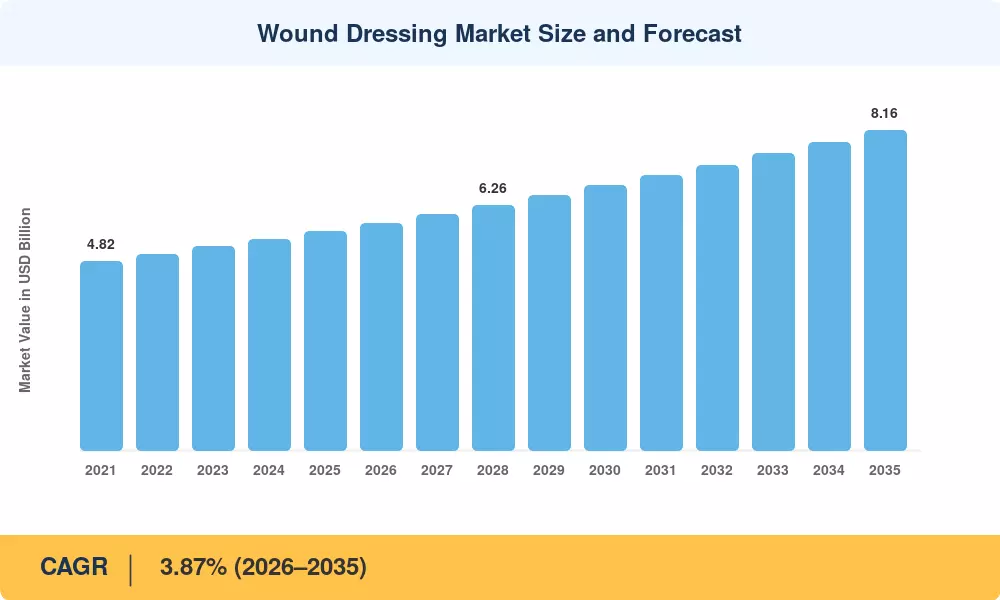
The Wound Dressing Market was valued at USD 5.59 billion in 2025 and opens its forecast run at USD 5.80 billion in 2026, climbing to USD 8.16 billion by 2035 at a 3.87% CAGR. Two catalysts anchor that trajectory. The first is the 2024 U.S. Centers for Medicare & Medicaid Services decision to grant separate payment for disposable negative pressure therapy, which unlocked roughly USD 210 million in annual outpatient spending that previously sat bundled and invisible [1]. The second is the International Diabetes Federation's count of 589 million adults living with diabetes, a population that generates lower-limb ulceration at rates of 19–34% over a lifetime [2]. Neither catalyst is cyclical, and both feed the Wound Dressing Market steadily rather than in bursts.
Product substitution is the quiet story underneath the headline growth. Plain gauze, cotton rolls, and simple adhesive pads still move enormous unit volume, but they are losing clinical share to foams, hydrocolloids, alginates, and silver- or PHMB-loaded barriers that hold a moist healing environment and cut dressing-change frequency by half. Mölnlycke committed EUR 55 million to a Belgian foam manufacturing expansion in 2024, while Smith+Nephew directed roughly 5.5% of revenue into R&D concentrated on bioactive and sensor-enabled formats [3][4]. Hospitals are buying fewer dressings per patient and paying more for each one — a mix shift that lifts value even where volumes flatten. The Wound Dressing Market rewards that trade.
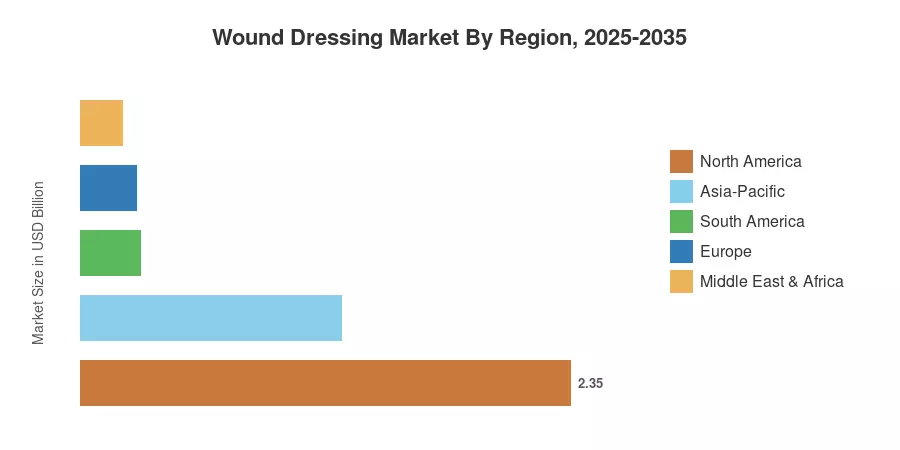
Geographically, North America holds 42.0% of 2025 revenue on the strength of Medicare wound-care spending that exceeds USD 28 billion annually across all settings [1]. Europe grows fastest at a 4.87% CAGR through 2035, propelled by NHS pressure-ulcer reduction targets and hospital decarbonization procurement that favors bio-derived and compostable substrates. Asia-Pacific ranks second by absolute revenue at USD 1.25 billion, where China's volume-based procurement program compresses unit pricing even as diabetic caseloads expand. Expect the next decade to reward manufacturers who can prove healing-time economics, not just product performance.
Key Report Takeaways
• By Type
- Advanced formats — foams, hydrocolloids, films, alginates, and hydrogels — accounted for 61.0% of Wound Dressing Market revenue in 2025
- Traditional gauze, bandages, and cotton products posted the faster type-level growth at a 4.88% CAGR through 2035, driven by tender volume in emerging economies.
- Foam dressings alone generated USD 1.22 billion in 2025
• By Application
- Surgical and traumatic wounds commanded 33.1% of the Wound Dressing Market in 2025
- Diabetic foot ulcers register the fastest application growth at a 5.24% CAGR to 2035
• By End User
- Hospitals and surgical centers held 52.7% of end-user revenue in 2025, while home healthcare advances at a 4.50% CAGR.
• By Region
- North America led with 42.0% Wound Dressing Market share in 2025
- Europe delivers the fastest regional CAGR at 4.87% through 2035
- Asia-Pacific contributed USD 1.25 billion in 2025 revenue
Market Size and Forecast (2021–2035)
Figures below blend manufacturer revenue disclosures, hospital group purchasing organization tender data, national reimbursement claim volumes, and distributor channel checks across 34 countries. Historical years are reconciled against audited segment reporting from the eight largest suppliers; forecast years apply epidemiological ulcer-incidence modeling layered onto procedural volume projections. Wound Dressing Market values are expressed in USD billion at manufacturer selling price, excluding clinician labor and ancillary consumables. Where national tender pricing diverges sharply from list pricing, the Wound Dressing Market estimate uses realized contract value.