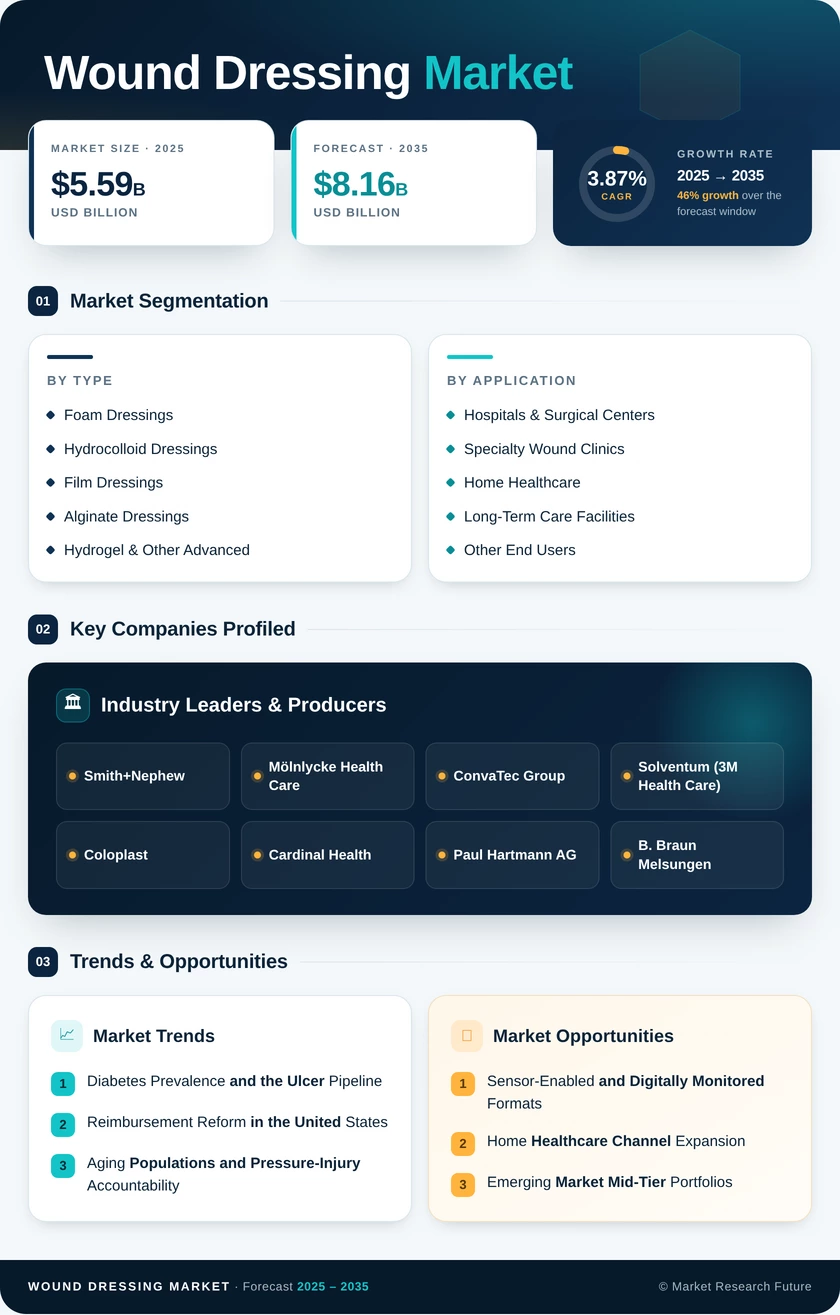
Segmentation Quick Reference
| Dimension | Sub-Segments | Dominant Segment | Fastest Growing Segment |
| By Type | Advanced Wound Dressings (Foams, Hydrocolloids, Films, Alginates, Hydrogel & Other Advanced); Traditional Wound Dressings (Gauze & Sponges, Bandages, Cotton & Other Traditional) | Foam Dressings | Traditional Wound Dressings |
| By Application | Surgical & Traumatic Wounds; Diabetic Foot Ulcers; Pressure Ulcers; Venous Leg Ulcers; Burns; Other Chronic & Acute Wounds | Surgical & Traumatic Wounds | Diabetic Foot Ulcers |
| By End User | Hospitals & Surgical Centers; Specialty Wound Clinics; Home Healthcare; Long-Term Care Facilities; Other End Users | Hospitals & Surgical Centers | Home Healthcare |
| By Geography | North America; Europe; Asia-Pacific; South America; Middle East & Africa | North America | Europe |
Market Segmentation Overview
By Type
| Sub-Segment | Key Trend |
| Foam Dressings | Prophylactic silicone application embedded in critical care and orthopedic protocols |
| Hydrocolloid Dressings | Preferred format for outpatient and caregiver-applied chronic wound management |
| Film Dressings | Standard for surgical site protection and secondary fixation |
| Alginate Dressings | Selected for high-exudate cavity wounds where packing is required |
| Hydrogel & Other Advanced | Used to support autolytic debridement in dry necrotic wounds |
| Gauze & Sponges | High-volume tender demand across public health systems in emerging economies |
| Bandages | Anchored to compression therapy protocols for venous ulceration |
| Cotton & Other Traditional | Low-cost primary care and first-aid supply with limited pricing power |
Value is migrating toward advanced formats while units continue to concentrate in traditional products. Suppliers who maintain both tiers can defend tender share while protecting blended margin, but the operational complexity of running commodity and premium manufacturing side by side has pushed several mid-sized players to specialize.
By Application
| Sub-Segment | Key Trend |
| Surgical & Traumatic Wounds | Procedural volume recovery paired with surgical site infection prevention bundles |
| Diabetic Foot Ulcers | Expanding patient pool and long episode duration driving highest product consumption per case |
| Pressure Ulcers | Regulatory reporting converting prevention from optional to protocolized. |
| Venous Leg Ulcers | Aging demographics sustaining steady compression and absorbent dressing demand |
| Burns | Concentrated demand in specialized centers with premium product mix |
| Other Chronic & Acute Wounds | Dermatological, oncology, and radiation-related wound care niches |
Chronic applications consume disproportionate product volume relative to their patient counts because episodes run for months rather than days. That dynamic makes diabetic foot ulcers and venous leg ulcers the most attractive commercial targets despite surgical wounds holding the larger revenue share today.
By End User
| Sub-Segment | Key Trend |
| Hospitals & Surgical Centers | Formulary decisions cascade outward to affiliated clinics and referral networks. |
| Specialty Wound Clinics | Evidence-driven purchasing with faster adoption cycles for premium products |
| Home Healthcare | Reimbursement changes enabling advanced therapy delivery outside institutional settings. |
| Long-Term Care Facilities | Prevention-focused purchasing tied to quality reporting and liability exposure |
| Other End Users | Ambulatory surgical, primary care, and community nursing channels |
Institutional buyers still set the standard, but the growth is in the home. Suppliers that build training, packaging, and remote support around the caregiver rather than the clinician will capture the share shift; those that simply ship hospital SKUs into home channels tend to see application errors and reorder attrition.
By Region
| Sub-Segment | Key Trend |
| North America | Reimbursement architecture driving single-use and outcome-linked adoption |
| Europe | Prevention mandates and sustainability-weighted tender scoring |
| Asia-Pacific | Volume-based procurement compressing price while caseloads expand |
| South America | Public system tender volume with currency-driven import exposure |
| Middle East & Africa | Hospital capacity build-out and expanding universal coverage schemes |
Regional strategy diverges sharply. Winning in North America requires reimbursement fluency; winning in Europe requires evidence and carbon documentation; winning in Asia-Pacific requires local cost structure. Few suppliers execute all three well, which is why regional specialists continue to hold defensible positions despite consolidation pressure.