×
Hero Background
English
Chinese
French
Japanese
Korean
German
Spanish

Xylene Market Size

ID: MRFR/CnM/0495-CR
128 Pages
Chitranshi Jaiswal
October 2023

Xylene Market Research Report Information By Product (P-Xylene, O-Xylene, M-Xylene, Mixed Xylene) By End Use (Automotive, Textile, Chemical, Oil and Gas, Leather, Paints and Coating, Other End User) and By Region -Global Forecast to 2035

Share:
Download PDF ×

We do not share your information with anyone. However, we may send you emails based on your report interest from time to time. You may contact us at any time to opt-out.

Xylene Market Infographic
Purchase Options

Xylene Size

Xylene Market Growth Projections and Opportunities

The Xylene market is influenced by various market factors that shape its dynamics and performance. One significant factor is the demand-supply balance within the industry. Xylene, primarily used as a solvent in various applications such as paints, coatings, adhesives, and plastics, experiences fluctuations in demand based on the overall economic conditions and specific sectors' performance. For instance, during periods of economic growth, the construction and automotive industries typically witness an increase in activity, consequently driving up the demand for xylene as a key ingredient in paint and coating formulations. Conversely, economic downturns can lead to reduced construction and automotive activity, dampening the demand for xylene.

Wondering what xylene is xylene is an organic compound. This organic compound is obtained by catalytic reforming and coal carbonization processes. Xylene is a hydrocarbon with properties such as greasiness and colorlessness in nature. In addition to these properties, it quickly evaporates and has good dissolving power. Its demand is increasing in all the major industries. This is the reason the xylene market is increasing globally. Hence xylene production automatically increases with this increases the xylene market production.

Moreover, the price of crude oil, from which xylene is derived as a byproduct during the refining process, significantly impacts the xylene market. Since xylene production is closely tied to the refining of crude oil, any fluctuations in crude oil prices can directly influence xylene prices. When crude oil prices rise, production costs for xylene increase, leading to higher prices for end-users. Conversely, a decrease in crude oil prices can result in lower production costs and subsequently lower prices for xylene.

Additionally, geopolitical factors play a crucial role in shaping the xylene market. Political instability or conflicts in regions that are major producers or consumers of xylene can disrupt the supply chain and affect market prices. For example, tensions in oil-producing regions can lead to supply disruptions, impacting the availability of crude oil and, consequently, xylene production. Similarly, trade policies and agreements between countries can affect the flow of xylene and its derivatives across borders, influencing market dynamics.

Furthermore, environmental regulations and sustainability initiatives have become increasingly important market factors for the xylene industry. As concerns over environmental pollution and climate change continue to rise, there is growing pressure on industries to adopt eco-friendly practices and reduce emissions. This has led to the development and adoption of alternative solvents and processes that offer lower environmental impact compared to traditional xylene-based products. Consequently, manufacturers in the xylene market are compelled to innovate and invest in sustainable solutions to meet regulatory requirements and consumer preferences.

Moreover, technological advancements and innovations play a significant role in shaping the xylene market. Continuous research and development efforts aimed at improving production processes, enhancing product performance, and reducing costs drive innovation within the industry. Advancements in catalyst technologies, process efficiencies, and recycling methods contribute to increased productivity and competitiveness in the xylene market.

Lastly, market competition and industry consolidation impact the xylene market landscape. Intense competition among key players and the presence of numerous small and medium-sized enterprises create a dynamic market environment characterized by price competition and product differentiation. Mergers, acquisitions, and strategic alliances among companies are common strategies employed to gain market share, expand product portfolios, and enhance competitiveness in the xylene market.
Xylene Market Size Graph
Author
Chitranshi Jaiswal
Research Analyst Level I

In her 3 years of experience in the market research field, she has handled critical cross-domain projects. She has an in-depth knowledge of market estimation & analysis, problem-solving, primary as well as secondary research, and team management.She holds an engineering degree and is an MBA professional from a well-known university, capable of evaluating the market and competitive conditions. An exceptional strategist with excellent communication skills and a passion for delivering cutting-edge & practical insights for the market. Proficient in multi-tasking, and can successfully deal with competing demands, while maintaining complete confidentiality. Generated business through active client and project development, networking, and high-quality responses. Her knowledge and skills have helped in making solid business decisions, securing funding from investors, and avoiding business failures.

Leave a Comment

FAQs

How much is the Xylene Market?

US$ 52754.91 Mn

What is the growth rate of the Xylene Market?

9.00%

Which region held the largest market share in the Xylene Market?

Asia Pacific

Who are the key players in the Xylene Market?

Exxon Mobil Corporation, Chevron Phillips Chemical Company LLC, TotalEnergies, LOTTE Chemical CORPORATION, Idemitsu Kosan Co.,Ltd., Toray Industries, Inc, LG Chem, Mitsui & Co., Ltd., Reliance Industries Limited, INEOS

Which Product had the largest market share in the Xylene Market?

P-Xylene

Which End Use had the largest market share in the Xylene Market?

Chemicals

Market Summary

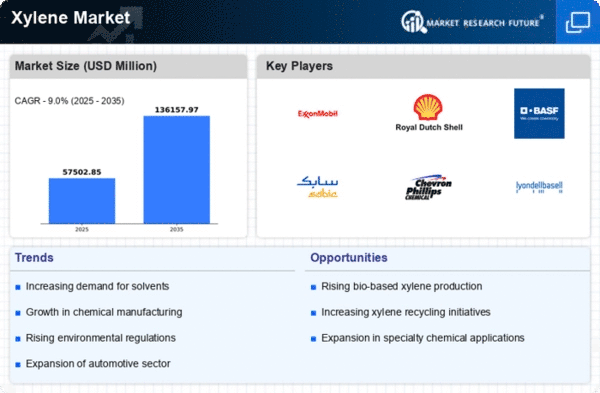
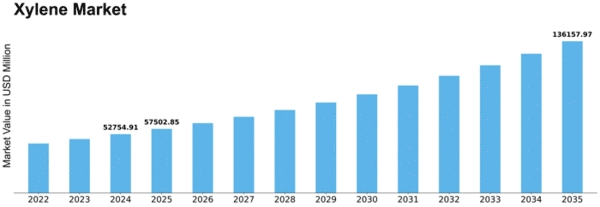
As per MRFR analysis, the Xylene Market Size was estimated at 52754.91 USD Million in 2024. The Xylene industry is projected to grow from 57503.92 in 2025 to 136157.97 by 2035, exhibiting a compound annual growth rate (CAGR) of 9.0 during the forecast period 2025 - 2035.

Key Market Trends & Highlights

The Xylene Market is currently experiencing robust growth driven by diverse applications and regional dynamics.

  • North America remains the largest market for xylene, primarily due to its extensive chemical manufacturing base.
  • The Asia-Pacific region is recognized as the fastest-growing market, fueled by increasing industrialization and urbanization.
  • In the solvent segment, xylene continues to dominate, while the chemical intermediate segment is witnessing rapid expansion.
  • Key market drivers include rising demand from the automotive sector and the growth of the paints and coatings industry.

Market Size & Forecast

2024 Market Size 52754.91 (USD Million)
2035 Market Size 136157.97 (USD Million)
CAGR (2025 - 2035) 9.0%
Largest Regional Market Share in 2024 Asia-Pacific

Major Players

<p>ExxonMobil (US), Royal Dutch Shell (NL), BP (GB), SABIC (SA), TotalEnergies (FR), LyondellBasell (US), Mitsubishi Chemical (JP), Formosa Plastics (TW), Reliance Industries (IN)</p>

Market Trends

The Xylene Market is currently experiencing a dynamic phase characterized by evolving demand patterns and shifting production dynamics. The increasing utilization of xylene in various applications, particularly in the production of solvents, paints, and coatings, appears to be driving growth. Additionally, the rise in the automotive and construction sectors is likely contributing to the heightened consumption of xylene derivatives. As industries seek to enhance product performance and sustainability, the Xylene Market is adapting to these changing requirements, indicating a potential for innovation and diversification in product offerings. Moreover, environmental regulations and sustainability initiatives are influencing the Xylene Market landscape. Manufacturers are increasingly focusing on developing eco-friendly xylene production methods and exploring bio-based alternatives. This shift not only aligns with global sustainability goals but also caters to the growing consumer preference for greener products. As the market evolves, stakeholders must remain vigilant to emerging trends and adapt strategies accordingly to maintain competitiveness in this rapidly changing environment.

Sustainability Initiatives

The Xylene Market is witnessing a notable shift towards sustainability, with manufacturers exploring eco-friendly production methods. This trend is driven by increasing regulatory pressures and consumer demand for greener products, prompting companies to innovate in their processes.

Technological Advancements

Technological innovations are playing a crucial role in the Xylene Market, enhancing production efficiency and product quality. Advancements in refining and extraction techniques are likely to improve yield and reduce costs, thereby benefiting market players.

Growing Demand in Emerging Markets

Emerging markets are exhibiting a rising demand for xylene, particularly in the automotive and construction sectors. This trend suggests a potential for market expansion as these regions continue to industrialize and urbanize, creating new opportunities for xylene applications.

Xylene Market Market Drivers

Market Growth Projections

The Global Xylene Market Industry is projected to experience substantial growth over the next decade. With a market value anticipated to reach 52.8 USD Billion by 2024 and 136.1 USD Billion by 2035, the industry is expected to witness a compound annual growth rate of 9.0% from 2025 to 2035. This growth trajectory reflects the increasing demand across various sectors, including automotive, paints, coatings, and pharmaceuticals. The market's expansion is indicative of the broader trends in industrial growth and innovation, suggesting a robust future for xylene applications globally.

Growth in Paints and Coatings

The Global Xylene Market Industry is significantly influenced by the growth in the paints and coatings sector. Xylene Market serves as a solvent and thinner in various paint formulations, enhancing the application properties and drying times. The increasing demand for decorative and protective coatings across residential, commercial, and industrial applications is likely to drive market expansion. With the global paints and coatings market projected to grow substantially, the xylene market is expected to benefit from this trend. By 2035, the market could potentially reach 136.1 USD Billion, reflecting a robust compound annual growth rate of 9.0% from 2025 to 2035.

Increasing Use in Pharmaceuticals

The Global Xylene Market Industry is also witnessing growth due to its increasing use in the pharmaceutical sector. Xylene Market is utilized as a solvent in the formulation of various pharmaceutical products, including ointments and creams. The ongoing advancements in drug development and the rising demand for innovative healthcare solutions are likely to bolster the market. As pharmaceutical companies seek to enhance product efficacy and stability, the role of xylene as a solvent becomes increasingly critical. This trend may contribute to the overall growth of the xylene market, aligning with the broader healthcare industry's expansion.

Rising Demand in Automotive Sector

The Global Xylene Market Industry is experiencing a notable surge in demand driven by the automotive sector. Xylene Market is extensively utilized in the production of automotive coatings, adhesives, and sealants. As the automotive industry continues to evolve, particularly with the rise of electric vehicles, the need for high-performance materials is increasing. This trend is expected to contribute significantly to the market's growth, with projections indicating that the market could reach 52.8 USD Billion in 2024. The automotive sector's shift towards lightweight materials and advanced coatings further underscores the potential for xylene applications in enhancing vehicle performance and sustainability.

Expansion of Chemical Manufacturing

The Global Xylene Market Industry is poised for growth due to the expansion of chemical manufacturing processes. Xylene Market is a critical intermediate in the production of various chemicals, including phthalic anhydride and dimethyl terephthalate, which are essential for producing plastics and fibers. As global chemical production ramps up to meet increasing consumer demand, the need for xylene as a feedstock is likely to rise. This trend is indicative of a broader shift towards more sustainable and efficient chemical processes, which may further enhance the market's growth prospects in the coming years.

Emerging Applications in Renewable Energy

The Global Xylene Market Industry is beginning to explore emerging applications in the renewable energy sector. Xylene Market is being investigated for its potential use in the production of biofuels and other renewable energy sources. As global energy policies shift towards sustainability and reduced carbon emissions, the demand for alternative energy solutions is likely to increase. This could lead to new avenues for xylene applications, potentially driving market growth. The exploration of xylene in renewable energy aligns with global efforts to transition towards greener energy sources, indicating a promising future for the xylene market.

Market Segment Insights

By Application: Solvent (Largest) vs. Chemical Intermediate (Fastest-Growing)

<p>In the Xylene Market, the application segment demonstrates diverse uses with Solvent applications leading significantly, dominating the market share due to its widespread use in paints, varnishes, and other industrial products. Following Solvent, Chemical Intermediate emerges as a key player, utilized in the production of numerous chemicals, contributing to its substantial share. Other applications like Fuel Additive, Coating, and Adhesive also play crucial roles but are comparatively smaller in market presence.</p>

<p>Solvent (Dominant) vs. Chemical Intermediate (Emerging)</p>

<p>The Solvent application of xylene stands out as dominant in the market, recognized for its versatility and efficiency in dissolving various substances, making it indispensable in numerous industries including automotive and construction. Concurrently, the Chemical Intermediate sector is emerging rapidly, fueled by manufacturing demand for specialty chemicals derived from xylenes. This segment benefits from innovations in chemical synthesis and a push for more sustainable processes. The market is witnessing increased use of xylenes in the production of plastics, resins, and other advanced materials, suggesting robust growth potential in the coming years.</p>

By End Use: Automotive (Largest) vs. Pharmaceutical (Fastest-Growing)

<p>In the Xylene Market, the end-use segment showcases significant diversity, with notable contributions from automotive, construction, pharmaceutical, agriculture, and textile industries. The automotive sector holds the largest share, driven by its demand for products such as automotive coatings and adhesives that utilize Xylene. Following closely, the pharmaceutical sector, while smaller in total share compared to automotive, is rapidly gaining traction due to its essential applications in drug formulation and synthesis processes. The growth pattern within the end-use segment is influenced by several key factors—particularly sustainability initiatives and technological advancements. The pharmaceutical industry, in particular, is emerging as the fastest-growing sector, propelled by increasing healthcare needs and ongoing research in drug development. In contrast, despite its strong presence, the automotive sector faces challenges due to shifts towards electric vehicles, leading to a re-assessment of Xylene's role within that market.</p>

<p>Automotive (Dominant) vs. Pharmaceutical (Emerging)</p>

<p>Within the end-use segment of the Xylene Market, the automotive industry stands out as a dominant force, primarily utilizing Xylene in paints, coatings, and adhesives, which are integral to vehicle production and maintenance. As consumers prioritize durability and performance, the demand for high-quality automotive coatings incorporating Xylene is expected to remain robust. Conversely, the pharmaceutical industry is emerging as a significant and growing sector. It strategically leverages Xylene for essential roles in the formulation of drugs and chemical processes. The increasing focus on research and development, along with a rising global demand for advanced pharmaceuticals, positions the pharmaceutical sector as a vital area for growth. As a result, while the automotive segment remains dominant, pharmaceutical applications are rapidly evolving, marking a pivotal shift in the overall end-use landscape.</p>

By Type: Para-Xylene (Largest) vs. Ortho-Xylene (Fastest-Growing)

<p>In the Xylene Market, Para-Xylene holds the largest share among the three segment values: Ortho-Xylene, Meta-Xylene, and Para-Xylene. This dominance can be attributed to its extensive use in the production of purified terephthalic acid (PTA), a key component in polyester manufacturing. Ortho-Xylene, while smaller in market share, is experiencing a rapid rise due to its applications in coatings, adhesives, and the production of phthalic anhydride. Meta-Xylene occupies a middle ground, serving specific niche roles in the industry, which keeps its presence stable but unremarkable compared to the other two.</p>

<p>Ortho-Xylene (Emerging) vs. Meta-Xylene (Stable)</p>

<p>Ortho-Xylene is emerging as a significant player in the Xylene Market, driven by its growing application in industrial coatings and adhesives, which are seeing increasing demand in several sectors. Simultaneously, it is becoming a favored choice due to its relatively lower production costs. In contrast, Meta-Xylene remains a stable component of the Xylene Market, primarily utilized in the fragrance and polymer production industries. While it does not have the rapid growth pace of Ortho-Xylene, its consistent demand ensures that it maintains a stable market position, catering to loyal sectors that rely on its chemical properties.</p>

By Distribution Channel: Direct Sales (Largest) vs. Distributors (Fastest-Growing)

<p>In the Xylene Market, the distribution channel landscape is primarily dominated by direct sales, which capture a significant portion of market shares due to their ability to offer lower prices and build strong relationships with end-users. Distributors also play a vital role, contributing to market reach and ensuring the availability of xylene products in various regions. Their share is progressively gaining ground as they leverage local knowledge to meet specific customer needs more effectively.</p>

<p>Direct Sales (Dominant) vs. Distributors (Emerging)</p>

<p>Direct sales have emerged as the dominant distribution channel in the Xylene Market due to their efficiency and cost-effectiveness for manufacturers and buyers alike. This method enables companies to have better control over pricing and inventory management, thus fostering stronger customer loyalty. Conversely, distributors are becoming an important emerging channel, driven by the increasing complexity of market dynamics and the need for specialized knowledge in handling xylene products. They add value by offering localized support and facilitating access to a wider network of customers, thereby optimizing the supply chain.</p>

By Form: Liquid (Largest) vs. Solid (Fastest-Growing)

<p>In the Xylene Market, the distribution of forms is a crucial aspect, with Liquid Xylene holding the largest share. This is primarily due to its extensive use in various applications, including solvents and chemical intermediates. Solid Xylene, on the other hand, is increasingly gaining attention, particularly in specific niche applications, which contribute to its growing market presence. This contrast highlights the dynamics of consumer preferences and industrial usage patterns within the sector. Growth trends in the Xylene Market show a significant upward trajectory for Solid Xylene, as it is being recognized for its potential in advanced applications such as specialty chemicals and high-performance materials. The expansion of manufacturing capabilities and the adoption of innovative technologies are key drivers behind this growth, alongside increasing demand from various industries looking for reliable and efficient xylene forms. The rising focus on sustainability and eco-friendly solutions also plays a role in promoting emerging forms like Solid Xylene.</p>

<p>Liquid (Dominant) vs. Solid (Emerging)</p>

<p>Liquid Xylene remains the dominant form in the Xylene Market, primarily due to its versatility and widespread application in chemical processes and solvent formulations. Its liquid nature allows for easy handling and transportation, making it a preferred choice for manufacturers and consumers alike. On the other hand, Solid Xylene represents an emerging segment, gaining traction for its unique properties and applications in fields such as pharmaceuticals and specialty chemicals. This transition to Solid Xylene is fueled by the need for innovative solutions that meet stringent environmental and efficiency standards. Overall, while Liquid Xylene continues to lead the market, Solid Xylene is positioned for growth, catering to evolving customer demands.</p>

Get more detailed insights about Xylene Market Research Report - Forecast to 2035

Regional Insights

North America : Established Market with Growth Potential

The North American xylene market is projected to grow steadily, driven by increasing demand from the petrochemical sector and the automotive industry. With a market size of $10,500.0 million, the region is witnessing a shift towards sustainable practices, prompting regulatory support for cleaner production methods. The focus on reducing emissions and enhancing energy efficiency is expected to further stimulate market growth in the coming years. Leading countries such as the US and Canada dominate the market, with key players like ExxonMobil and LyondellBasell driving innovation and competition. The presence of advanced manufacturing facilities and a robust supply chain enhances the region's competitive landscape. As companies invest in R&D for xylene derivatives, the market is set to benefit from technological advancements and increased production capacities.

Europe : Diverse Market with Regulatory Support

Europe's xylene market, valued at $15,000.0 million, is characterized by stringent environmental regulations that promote sustainable practices. The demand for xylene is driven by its applications in the production of solvents, paints, and coatings. Regulatory bodies are increasingly focusing on reducing VOC emissions, which is catalyzing innovation in xylene production processes and enhancing market growth. Countries like Germany, France, and the Netherlands are leading the market, with major players such as Royal Dutch Shell and TotalEnergies actively participating. The competitive landscape is marked by collaborations and partnerships aimed at improving production efficiency and sustainability. As the region transitions towards greener alternatives, the xylene market is expected to adapt and thrive under evolving regulations.

Asia-Pacific : Emerging Powerhouse in Xylene Production

Asia-Pacific holds the largest share of the xylene market, valued at $25,000.0 million, driven by rapid industrialization and urbanization. The region's growth is fueled by increasing demand from the automotive and electronics sectors, alongside a rising focus on petrochemical production. Regulatory initiatives aimed at enhancing environmental standards are also contributing to market expansion, as companies adapt to new compliance requirements. China, Japan, and India are the leading countries in this market, with significant contributions from key players like Mitsubishi Chemical and Reliance Industries. The competitive landscape is vibrant, with numerous local and international companies vying for market share. Investments in infrastructure and technology are expected to bolster production capabilities, further solidifying Asia-Pacific's position as a global leader in xylene production.

Middle East and Africa : Resource-Rich Frontier for Xylene

The Middle East and Africa xylene market, valued at $2,254.91 million, is emerging as a resource-rich frontier with significant growth potential. The region's abundant oil reserves and increasing investments in petrochemical projects are driving demand for xylene. Regulatory frameworks are evolving to support sustainable practices, which is expected to enhance market dynamics in the coming years. Countries like Saudi Arabia and the UAE are at the forefront of this market, with key players such as SABIC leading the charge. The competitive landscape is characterized by a mix of local and international companies, all aiming to capitalize on the region's resources. As infrastructure development progresses, the xylene market in the Middle East and Africa is poised for substantial growth, attracting further investments and partnerships.

Key Players and Competitive Insights

The Xylene Market is currently characterized by a competitive landscape that is both dynamic and multifaceted. Key growth drivers include the increasing demand for xylene derivatives in the production of plastics, solvents, and chemicals, alongside a growing emphasis on sustainability and innovation. Major players such as ExxonMobil (US), Royal Dutch Shell (NL), and SABIC (SA) are strategically positioned to leverage their extensive operational capabilities and technological advancements. ExxonMobil (US) focuses on enhancing its refining processes to improve xylene yield, while Royal Dutch Shell (NL) emphasizes partnerships aimed at sustainable sourcing. SABIC (SA) is investing in innovative chemical processes that align with environmental regulations, collectively shaping a competitive environment that prioritizes efficiency and sustainability.

In terms of business tactics, companies are increasingly localizing manufacturing to reduce transportation costs and optimize supply chains. The market structure appears moderately fragmented, with a mix of large multinational corporations and regional players. This fragmentation allows for competitive pricing strategies, yet the influence of key players remains substantial, as they set industry standards and drive technological advancements.

In November 2025, ExxonMobil (US) announced a significant investment in a new xylene production facility in Texas, aimed at increasing its output by 15%. This strategic move is expected to enhance its market share and meet the rising demand for xylene derivatives in North America. The facility's advanced technology is likely to improve operational efficiency and reduce environmental impact, aligning with the company's sustainability goals.

In October 2025, Royal Dutch Shell (NL) entered a strategic partnership with a leading technology firm to develop AI-driven solutions for optimizing xylene production processes. This collaboration is anticipated to enhance operational efficiency and reduce costs, positioning Shell as a leader in digital transformation within the sector. The integration of AI technologies could potentially revolutionize production methodologies, offering a competitive edge in a rapidly evolving market.

In September 2025, SABIC (SA) launched a new line of bio-based xylene products, marking a significant step towards sustainable chemical production. This initiative not only caters to the growing demand for eco-friendly products but also reinforces SABIC's commitment to sustainability. The introduction of bio-based alternatives may reshape consumer preferences and drive further innovation in the xylene market.

As of December 2025, current competitive trends indicate a strong shift towards digitalization, sustainability, and the integration of advanced technologies such as AI. Strategic alliances are increasingly shaping the landscape, enabling companies to pool resources and expertise to tackle complex challenges. Looking ahead, competitive differentiation is likely to evolve from traditional price-based competition to a focus on innovation, technological advancements, and supply chain reliability. This shift underscores the importance of adaptability and forward-thinking strategies in maintaining a competitive edge in the Xylene Market.

Key Companies in the Xylene Market market include

Industry Developments

2018

: Idemitsu Kosan Co, Ltd. commenced mixed xylene production At its Aichi Refinery. Under its Fifth Consolidated Medium-term Management Plan, which calls for the promotion of the fuel-to-chemical business, Idemitsu has made progress on the installation of new equipment at the Aichi Refinery. Recent completion and commercial operation of mixed xylene equipment at the Aichi Refinery*2. With a production capacity of 170,000 t/year, this equipment will not only contribute to the expansion of the petrochemical business. Still, it will also allow us to respond flexibly to the fluctuating supply and demand trends for petroleum products and petrochemical raw materials.

Future Outlook

Xylene Market Future Outlook

<p>The Xylene Market is projected to grow at a 9.0% CAGR from 2024 to 2035, driven by increasing demand in the automotive and chemical industries.</p>

New opportunities lie in:

  • <p>Expansion of xylene production facilities in emerging markets.</p>
  • <p>Development of bio-based xylene alternatives for sustainability.</p>
  • <p>Investment in advanced refining technologies to enhance yield efficiency.</p>

<p>By 2035, the Xylene Market is expected to achieve robust growth, solidifying its position in the global chemical landscape.</p>

Market Segmentation

Xylene Market Form Outlook

  • Liquid
  • Solid
  • Gas

Xylene Market Type Outlook

  • Ortho-Xylene
  • Meta-Xylene
  • Para-Xylene

Xylene Market End Use Outlook

  • Automotive
  • Construction
  • Pharmaceutical
  • Agriculture
  • Textile

Xylene Market Application Outlook

  • Solvent
  • Chemical Intermediate
  • Fuel Additive
  • Coating
  • Adhesive

Xylene Market Distribution Channel Outlook

  • Direct Sales
  • Distributors
  • Online Sales

Report Scope

MARKET SIZE 202452754.91(USD Million)
MARKET SIZE 202557503.92(USD Million)
MARKET SIZE 2035136157.97(USD Million)
COMPOUND ANNUAL GROWTH RATE (CAGR)9.0% (2024 - 2035)
REPORT COVERAGERevenue Forecast, Competitive Landscape, Growth Factors, and Trends
BASE YEAR2024
Market Forecast Period2025 - 2035
Historical Data2019 - 2024
Market Forecast UnitsUSD Million
Key Companies ProfiledExxonMobil (US), Royal Dutch Shell (NL), BP (GB), SABIC (SA), TotalEnergies (FR), LyondellBasell (US), Mitsubishi Chemical (JP), Formosa Plastics (TW), Reliance Industries (IN)
Segments CoveredApplication, End Use, Type, Distribution Channel, Form
Key Market OpportunitiesGrowing demand for eco-friendly solvents and coatings drives innovation in the Xylene Market.
Key Market DynamicsRising demand for xylene in petrochemical applications drives competitive dynamics and influences supply chain strategies.
Countries CoveredNorth America, Europe, APAC, South America, MEA

FAQs

How much is the Xylene Market?

US$ 52754.91 Mn

What is the growth rate of the Xylene Market?

9.00%

Which region held the largest market share in the Xylene Market?

Asia Pacific

Who are the key players in the Xylene Market?

Exxon Mobil Corporation, Chevron Phillips Chemical Company LLC, TotalEnergies, LOTTE Chemical CORPORATION, Idemitsu Kosan Co.,Ltd., Toray Industries, Inc, LG Chem, Mitsui &amp; Co., Ltd., Reliance Industries Limited, INEOS

Which Product had the largest market share in the Xylene Market?

P-Xylene

Which End Use had the largest market share in the Xylene Market?

Chemicals

  1. EXECUTIVE SUMMARY
    1. MARKET ATTRACTIVENESS
    2. ANALYSIS
  2. GLOBAL XYLENE MARKET, BY PRODUCT
  3. GLOBAL XYLENE MARKET, BY END USE
  4. GLOBAL XYLENE MARKET, BY REGION
  5. MARKET INTRODUCTION
    1. DEFINITION
    2. SCOPE OF THE STUDY
    3. MARKET STRUCTURE
    4. KEY IMPLEMENTATION
    5. CRITERIA
  6. RESEARCH METHODOLOGY
  7. MARKET DYNAMICS
    1. INTRODUCTION
    2. DRIVERS
    3. GROWTH OF CONSTRUCTION SECTOR
    4. CRUDE OIL PRICES DUE TO STRINGENT RELATIONS BETWEEN IMPORTER AND EXPORTER
    5. IN AUTOMOTIVE INDUSTRY
  8. INCREASING GROWTH AND USAGE IN DOWNSTREAM INDUSTRY
    1. RESTRAINTS
      1. UNCERTAINTY IN
    2. OPPORTUNITIES
      1. CHANGING DYNAMICS
  9. MARKET FACTOR ANALYSIS
  10. SUPPLY/VALUE CHAIN ANALYSIS
    1. PORTER FIVE FORCES
      1. THREAT OF NEW ENTRANTS
      2. BARGAINING POWER OF SUPPLIERS
      3. BARGAINING POWER OF BUYERS
      4. THREAT OF SUBSTITUTES:
      5. COMPETITIVE RIVALRY
    2. IMPACT OF CORONAVIRUS
  11. OUTBREAK ON THE GLOBAL XYLENE MARKET
  12. OVERVIEW OF SUPPLY AND DEMAND SCENARIO
  13. IMPACT OF COVID-19 ON SUPPLY
  14. CHAIN ANALYSIS
  15. GLOBAL XYLENE MARKET, BY TYPE
    1. INTRODUCTION
    2. P-XYLENE
    3. O-XYLENE
    4. M-XYLENE
    5. MIXED XYLENE
  16. GLOBAL XYLENE MARKET, BY END USE
    1. INTRODUCTION
    2. AUTOMOTIVE
    3. TEXTILE
    4. CHEMICAL
    5. OIL & GAS
    6. LEATHER
    7. PAINTS & COATING
    8. OTHER
  17. GLOBAL XYLENE MARKET, BY REGION
    1. OVERVIEW
    2. NORTH AMERICA
      1. U.S.
      2. CANADA
    3. EUROPE
      1. GERMANY
      2. U.K.
      3. FRANCE
      4. ITALY
      5. SPAIN
      6. RUSSIA
      7. REST OF EUROPE
    4. ASIA-PACIFIC
      1. CHINA
      2. INDIA
      3. JAPAN
      4. SOUTH KOREA
      5. REST OF APAC
    5. MEA (MIDDLE EAST AND AFRICA)
      1. GCC
      2. SOUTH AFRICA
      3. ROMEA
    6. LATIN AMERICA
      1. BRAZIL
      2. MEXICO
      3. ARGENTINA
      4. ROLA (REST OF LATIN AMERICA)
  18. COMPETITIVE LANDSCAPE
    1. MARKET SHARE ANALYSIS
    2. COMPETITIVE BENCHMARKING
  19. COMPANY PROFILES
    1. EXXON MOBIL CORPORATION
      1. COMPANY OVERVIEW
      2. FINANCIAL OVERVIEW
      3. PRODUCTS AND SERVICES
      4. SWOT ANALYSIS
      5. KEY STRATEGIES
    2. CHEVRON PHILLIPS
    3. CHEMICAL COMPANY LLC
    4. COMPANY OVERVIEW
    5. FINANCIAL OVERVIEW
    6. PRODUCTS AND SERVICES
  20. SWOT ANALYSIS
    1. KEY STRATEGIES
    2. TOTALENERGIES
    3. COMPANY OVERVIEW
    4. FINANCIAL OVERVIEW
    5. PRODUCTS AND SERVICES
    6. NEELKANTH FINECHEM LLP: SWOT ANALYSIS
    7. INC
    8. COMPANY OVERVIEW
    9. FINANCIAL OVERVIEW
    10. PRODUCTS AND SERVICES
  21. KEY STRATEGIES
    1. LOTTE CHEMICAL CORPORATION
      1. COMPANY OVERVIEW
      2. FINANCIAL OVERVIEW
      3. PRODUCTS AND SERVICES
      4. SWOT ANALYSIS
      5. KEY STRATEGIES
    2. IDEMITSU KOSAN CO.,LTD
      1. COMPANY OVERVIEW
      2. FINANCIAL OVERVIEW
      3. PRODUCTS AND SERVICES
      4. SWOT ANALYSIS
      5. KEY STRATEGIES
    3. TORAY INDUSTRIES,
  22. SWOT ANALYSIS
    1. KEY STRATEGIES
    2. LG CHEM.
    3. COMPANY OVERVIEW
    4. FINANCIAL OVERVIEW
    5. PRODUCTS AND SERVICES
  23. SWOT ANALYSIS
    1. KEY STRATEGIES
    2. MITSUI & CO.
    3. COMPANY OVERVIEW
    4. FINANCIAL OVERVIEW
    5. PRODUCTS AND SERVICES
  24. SWOT ANALYSIS
    1. KEY STRATEGIES
    2. RELIANCE INDUSTRIES LIMITED.
  25. COMPANY OVERVIEW
  26. FINANCIAL OVERVIEW
  27. PRODUCTS AND SERVICES
  28. SWOT ANALYSIS
  29. KEY STRATEGIES
    1. INEOS.
      1. COMPANY OVERVIEW
      2. FINANCIAL OVERVIEW
      3. PRODUCTS AND SERVICES
      4. SWOT ANALYSIS
      5. KEY STRATEGIES
  30. LIST OF TABLES
  31. GLOBAL XYLENE MARKET, BY PRODUCT, 2019–2030
    1. (USD MILLION)
    2. TABLE
  32. GLOBAL NATURAL XYLENE MARKET, BY REGION, 2019–2030 (USD MILLION)
  33. GLOBAL SYNTHETIC
  34. XYLENE MARKET, BY REGION, 2019–2030 (USD MILLION)
  35. GLOBAL XYLENE MARKET, AS P-XYLENE, BY REGION,
  36. GLOBAL XYLENE MARKET, AS O-XYLENE, BY REGION, 2019–2030
    1. (USD MILLION)
    2. TABLE
  37. GLOBAL XYLENE MARKET, AS M-XYLENE, BY REGION, 2019–2030 (USD MILLION)
  38. GLOBAL XYLENE
  39. MARKET, AS MIXED XYLENE, BY REGION, 2019–2030 (USD MILLION)
  40. GLOBAL XYLENE MARKET,
    1. BY END USE, 2019–2030 (USD MILLION)
  41. GLOBAL XYLENE MARKET, FOR AUTOMOTIVE, BY
    1. REGION, 2019–2030 (USD MILLION)
  42. GLOBAL XYLENE MARKET, FOR TEXTILE, BY REGION, 2019–2030
    1. (USD MILLION)
    2. TABLE
  43. GLOBAL XYLENE MARKET, FOR CHEMICAL, BY REGION, 2019–2030 (USD MILLION)
  44. GLOBAL XYLENE
  45. MARKET, FOR OIL & GAS, BY REGION, 2019–2030 (USD MILLION)
  46. GLOBAL XYLENE MARKET,
    1. FOR LEATHER, BY REGION, 2019–2030 (USD MILLION)
  47. GLOBAL XYLENE MARKET, FOR PAINTS & COATING,
    1. BY REGION, 2019–2030 (USD MILLION)
  48. GLOBAL XYLENE MARKET, BY REGION, 2019–2030
    1. (USD MILLION)
    2. TABLE
  49. NORTH AMERICA: XYLENE MARKET, BY COUNTRY, 2019-2030 (USD MILLION)
  50. NORTH AMERICA: XYLENE
  51. MARKET, BY TYPE, 2019–2030 (USD MILLION)
  52. NORTH AMERICA: XYLENE MARKET, BY END USE,
  53. U.S.: XYLENE MARKET, BY TYPE, 2019–2030 (USD MILLION)
  54. U.S.: XYLENE
  55. MARKET, BY END USE, 2019–2030 (USD MILLION)
  56. CANADA: XYLENE MARKET, BY TYPE, 2019–2030
    1. (USD MILLION)
    2. TABLE
  57. CANADA: XYLENE MARKET, BY END USE, 2019–2030 (USD MILLION)
  58. EUROPE: XYLENE MARKET,
    1. BY COUNTRY, 2019-2030 (USD MILLION)
  59. EUROPE: XYLENE MARKET, BY TYPE, 2019–2030
    1. (USD MILLION)
    2. TABLE
  60. EUROPE: XYLENE MARKET, BY END USE, 2019–2030 (USD MILLION)
  61. GERMANY: XYLENE MARKET,
    1. BY TYPE, 2019–2030 (USD MILLION)
  62. GERMANY: XYLENE MARKET, BY END USE, 2019–2030
    1. (USD MILLION)
    2. TABLE
  63. U.K.: XYLENE MARKET, BY TYPE, 2019–2030 (USD MILLION)
  64. U.K.: XYLENE MARKET,
    1. BY END USE, 2019–2030 (USD MILLION)
  65. FRANCE: XYLENE MARKET, BY TYPE, 2019–2030
    1. (USD MILLION)
    2. TABLE
  66. FRANCE: XYLENE MARKET, BY END USE, 2019–2030 (USD MILLION)
  67. ITALY: XYLENE MARKET,
    1. BY TYPE, 2019–2030 (USD MILLION)
  68. ITALY: XYLENE MARKET, BY END USE, 2019–2030
    1. (USD MILLION)
    2. TABLE
  69. SPAIN: XYLENE MARKET, BY TYPE, 2019–2030 (USD MILLION)
  70. SPAIN: XYLENE MARKET,
    1. BY END USE, 2019–2030 (USD MILLION)
  71. RUSSIA: XYLENE MARKET, BY TYPE, 2019–2030
    1. (USD MILLION)
    2. TABLE
  72. RUSSIA: XYLENE MARKET, BY END USE, 2019–2030 (USD MILLION
  73. ROE: XYLENE MARKET,
    1. BY TYPE, 2019–2030 (USD MILLION)
  74. ROE: XYLENE MARKET, BY END USE, 2019–2030
    1. (USD MILLION)
    2. TABLE
  75. ASIA PACIFIC: XYLENE MARKET, BY COUNTRY, 2019-2030 (USD MILLION)
  76. ASIA PACIFIC: XYLENE
  77. MARKET, BY TYPE, 2019–2030 (USD MILLION)
  78. ASIA PACIFIC: XYLENE MARKET, BY END USE,
  79. CHINA: XYLENE MARKET, BY TYPE, 2019–2030 (USD MILLION)
  80. CHINA: XYLENE
  81. MARKET, BY END USE, 2019–2030 (USD MILLION)
  82. INDIA: XYLENE MARKET, BY TYPE, 2019–2030
    1. (USD MILLION)
    2. TABLE
  83. INDIA: XYLENE MARKET, BY END USE, 2019–2030 (USD MILLION)
  84. JAPAN: XYLENE MARKET,
    1. BY TYPE, 2019–2030 (USD MILLION)
  85. JAPAN: XYLENE MARKET, BY END USE, 2019–2030
    1. (USD MILLION)
    2. TABLE
  86. SOUTH KOREA: XYLENE MARKET, BY TYPE, 2019–2030 (USD MILLION)
  87. SOUTH KOREA:
  88. XYLENE MARKET, BY END USE, 2019–2030 (USD MILLION)
  89. REST OF APAC: XYLENE MARKET, BY TYPE, 2019–2030
    1. (USD MILLION)
    2. TABLE
  90. REST OF APAC: XYLENE MARKET, BY END USE, 2019–2030 (USD MILLION)
  91. MEA: XYLENE
  92. MARKET, BY COUNTRY, 2019-2030 (USD MILLION)
  93. MEA: XYLENE MARKET, BY TYPE, 2019–2030
    1. (USD MILLION)
    2. TABLE
  94. MEA: XYLENE MARKET, BY END USE, 2019–2030 (USD MILLION)
  95. GCC: XYLENE MARKET,
    1. BY TYPE, 2019–2030 (USD MILLION)
  96. GCC: XYLENE MARKET, BY END USE, 2019–2030
    1. (USD MILLION)
    2. TABLE
  97. SOUTH AFRICA: XYLENE MARKET, BY TYPE, 2019–2030 (USD MILLION)
  98. SOUTH AFRICA:
  99. XYLENE MARKET, BY END USE, 2019–2030 (USD MILLION)
  100. ROMEA: XYLENE MARKET, BY TYPE, 2019–2030
    1. (USD MILLION)
    2. TABLE
  101. ROMEA: XYLENE MARKET, BY END USE, 2019–2030 (USD MILLION)
  102. LATIN AMERICA: XYLENE
  103. MARKET, BY COUNTRY, 2019-2030 (USD MILLION)
  104. LATIN AMERICA: XYLENE MARKET, BY TYPE, 2019–2030
    1. (USD MILLION)
    2. TABLE
  105. LATIN AMERICA: XYLENE MARKET, BY END USE, 2019–2030 (USD MILLION)
  106. BRAZIL: XYLENE
  107. MARKET, BY TYPE, 2019–2030 (USD MILLION)
  108. BRAZIL: XYLENE MARKET, BY END USE, 2019–2030
    1. (USD MILLION)
    2. TABLE
  109. MEXICO: XYLENE MARKET, BY TYPE, 2019–2030 (USD MILLION)
  110. MEXICO: XYLENE MARKET,
    1. BY END USE, 2019–2030 (USD MILLION)
  111. ARGENTINA: XYLENE MARKET, BY TYPE, 2019–2030
    1. (USD MILLION)
    2. TABLE
  112. ARGENTINA: XYLENE MARKET, BY END USE, 2019–2030 (USD MILLION)
  113. ROLA: XYLENE
  114. MARKET, BY TYPE, 2019–2030 (USD MILLION)
  115. ROLA: XYLENE MARKET, BY END USE, 2019–2030
    1. (USD MILLION)
  116. LIST OF FIGURES
  117. MARKET SYNOPSIS
  118. MARKET ATTRACTIVENESS
    1. ANALYSIS: GLOBAL XYLENE
  119. GLOBAL XYLENE ANALYSIS BY PRODUCT, % SHARE, 2022, MARKET SIZE,
    1. FIGURE
  120. GLOBAL XYLENE ANALYSIS BY END USE, % SHARE, 2022, MARKET SIZE, 2019-2030
  121. GLOBAL XYLENE
    1. ANALYSIS BY REGION, 2022
  122. GLOBAL XYLENE MARKET: MARKET STRUCTURE
  123. KEY BUYING CRITERIA OF XYLENE REPORT
  124. BOTTOM-UP AND
    1. TOP-DOWN APPROACHES
    2. FIGURE
  125. MARKET DYNAMIC ANALYSIS OF THE GLOBAL XYLENE MARKET
  126. SUPPLY / VALUE CHAIN: GLOBAL XYLENE MARKET
  127. GLOBAL XYLENE
  128. MARKET, BY PRODUCT, 2022 (% SHARE), 2022 VS 2030 (USD MILLION)
  129. GLOBAL XYLENE MARKET,
    1. BY TECHNOLOGY, 2022 (% SHARE), 2022 VS 2030 (USD MILLION)
  130. GLOBAL XYLENE MARKET, BY REGION, 2021 (%
    1. SHARE) 2021 VS 2030 (USD MILLION)
  131. NORTH AMERICA: XYLENE MARKET, BY COUNTRY, 2022 (USD BILLION)
  132. EUROPE: XYLENE
  133. MARKET, BY COUNTRY, 2022 (REVENUE % SHARE)
  134. ASIA PACIFIC: XYLENE MARKET, BY COUNTRY,
    1. FIGURE
  135. MEA: XYLENE MARKET, BY COUNTRY, 2022 (REVENUE % SHARE)
  136. LATIN AMERICA: XYLENE MARKET, BY COUNTRY,
    1. FIGURE
  137. MARKET SHARE ANALYSIS (2022, %) *
  138. GLOBAL XYLENE MARKET: COMPETITIVE BENCHMARKING
  139. CHEVRON PHILLIPS
    1. CHEMICAL COMPANY: SWOT ANALYSIS
  140. TOTALENERGIES: SWOT ANALYSIS
  141. SWOT ANALYSIS
  142. LOTTE CHEMICAL CORPORATION: SWOT ANALYSIS
  143. IDEMITSU KOSAN
    1. CO.,LTD: SWOT ANALYSIS
    2. FIGURE
  144. TORAY INDUSTRIES, INC.: SWOT ANALYSIS
  145. LG CHEM: SWOT ANALYSIS
  146. MITSUI & CO., LTD..: SWOT ANALYSIS
  147. RELIANCE INDUSTRIES
    1. LIMITED: SWOT ANALYSIS

Xylene Market Segmentation

Xylene Product Outlook (USD Million, 2019-2032)

  • P-Xylene
  • O-Xylene
  • M-Xylene
  • Mixed Xylene

Xylene End Use Outlook (USD Million, 2019-2032)

  • Automotive
  • Textile
  • Chemical
  • Oil and Gas
  • Leather
  • Paints and Coating
  • Other End User

Xylene Regional Outlook (USD Million, 2019-2032)

  • North America Outlook (USD Million, 2019-2032)
    • North America Xylene by Product
      • P-Xylene
      • O-Xylene
      • M-Xylene
      • Mixed Xylene
    • North America Xylene by End Use
      • Automotive
      • Textile
      • Chemical
      • Oil and Gas
      • Leather
      • Paints and Coating
      • Other End User
    • US Outlook (USD Million, 2019-2032)
    • US Xylene by Product
      • P-Xylene
      • O-Xylene
      • M-Xylene
      • Mixed Xylene
    • US Xylene by End Use
      • Automotive
      • Textile
      • Chemical
      • Oil and Gas
      • Leather
      • Paints and Coating
      • Other End User
    • Canada Outlook (USD Million, 2019-2032)
    • Canada Xylene by Product
      • P-Xylene
      • O-Xylene
      • M-Xylene
      • Mixed Xylene
    • Canada Xylene by End Use
      • Automotive
      • Textile
      • Chemical
      • Oil and Gas
      • Leather
      • Paints and Coating
      • Other End User
    • Europe Outlook (USD Million, 2019-2032)
      • Europe Xylene by Product
        • P-Xylene
        • O-Xylene
        • M-Xylene
        • Mixed Xylene
      • Europe Xylene by End Use
        • Automotive
        • Textile
        • Chemical
        • Oil and Gas
        • Leather
        • Paints and Coating
        • Other End User
      • Germany Outlook (USD Million, 2019-2032)
      • Germany Xylene by Product
        • P-Xylene
        • O-Xylene
        • M-Xylene
        • Mixed Xylene
      • Germany Xylene by End Use
        • Automotive
        • Textile
        • Chemical
        • Oil and Gas
        • Leather
        • Paints and Coating
        • Other End User
      • UK Outlook (USD Million, 2019-2032)
      • UK Xylene by Product
        • P-Xylene
        • O-Xylene
        • M-Xylene
        • Mixed Xylene
      • UK Xylene by End Use
        • Automotive
        • Textile
        • Chemical
        • Oil and Gas
        • Leather
        • Paints and Coating
        • Other End User


  • France Outlook (USD Million, 2019-2032)
  • France Xylene by Product
    • P-Xylene
    • O-Xylene
    • M-Xylene
    • Mixed Xylene
  • France Xylene by End Use
    • Automotive
    • Textile
    • Chemical
    • Oil and Gas
    • Leather
    • Paints and Coating
    • Other End User
  • Spain Outlook (USD Million, 2019-2032)
  • Spain Xylene by Product
    • P-Xylene
    • O-Xylene
    • M-Xylene
    • Mixed Xylene
  • Spain Xylene by End Use
    • Automotive
    • Textile
    • Chemical
    • Oil and Gas
    • Leather
    • Paints and Coating
    • Other End User
  • Italy Outlook (USD Million, 2019-2032)
  • Italy Xylene by Product
    • P-Xylene
    • O-Xylene
    • M-Xylene
    • Mixed Xylene
  • Italy Xylene by End Use
    • Automotive
    • Textile
    • Chemical
    • Oil and Gas
    • Leather
    • Paints and Coating
    • Other End User
  • Russia Outlook (USD Million, 2019-2032)
  • Russia Xylene by Product
    • P-Xylene
    • O-Xylene
    • M-Xylene
    • Mixed Xylene
  • Russia Xylene by End Use
    • Automotive
    • Textile
    • Chemical
    • Oil and Gas
    • Leather
    • Paints and Coating
    • Other End User
  • Rest Of Europe Outlook (USD Million, 2019-2032)
  • Rest Of Europe Xylene by Product
    • P-Xylene
    • O-Xylene
    • M-Xylene
    • Mixed Xylene
  • Rest Of Europe Xylene by End Use
    • Automotive
    • Textile
    • Chemical
    • Oil and Gas
    • Leather
    • Paints and Coating
    • Other End User
  • Asia-Pacific Outlook (USD Million, 2019-2032)
    • Asia-Pacific Xylene by Product
      • P-Xylene
      • O-Xylene
      • M-Xylene
      • Mixed Xylene
    • Asia-Pacific Xylene by End Use
      • Automotive
      • Textile
      • Chemical
      • Oil and Gas
      • Leather
      • Paints and Coating
      • Other End User
    • China Outlook (USD Million, 2019-2032)
    • China Xylene by Product
      • P-Xylene
      • O-Xylene
      • M-Xylene
      • Mixed Xylene
    • China Xylene by End Use
      • Automotive
      • Textile
      • Chemical
      • Oil and Gas
      • Leather
      • Paints and Coating
      • Other End User
    • India Outlook (USD Million, 2019-2032)
    • India Xylene by Product
      • P-Xylene
      • O-Xylene
      • M-Xylene
      • Mixed Xylene
    • India Xylene by End Use
      • Automotive
      • Textile
      • Chemical
      • Oil and Gas
      • Leather
      • Paints and Coating
      • Other End User
    • Japan Outlook (USD Million, 2019-2032)
    • Japan Xylene by Product
      • P-Xylene
      • O-Xylene
      • M-Xylene
      • Mixed Xylene
    • Japan Xylene by End Use
      • Automotive
      • Textile
      • Chemical
      • Oil and Gas
      • Leather
      • Paints and Coating
      • Other End User
    • South Korea Outlook (USD Million, 2019-2032)
    • South Korea Xylene by Product
      • P-Xylene
      • O-Xylene
      • M-Xylene
      • Mixed Xylene
    • South KOrea Xylene by End Use
      • Automotive
      • Textile
      • Chemical
      • Oil and Gas
      • Leather
      • Paints and Coating
      • Other End User
    • Rest of Asia-Pacific Outlook (USD Million, 2019-2032)
    • Rest of Asia-Pacific Xylene by Product
      • P-Xylene
      • O-Xylene
      • M-Xylene
      • Mixed Xylene
    • Rest of Asia-Pacific Xylene by End Use
      • Automotive
      • Textile
      • Chemical
      • Oil and Gas
      • Leather
      • Paints and Coating
      • Other End User
    • Latin America Outlook (USD Million, 2019-2032)
      • Latin America Xylene by Product
        • P-Xylene
        • O-Xylene
        • M-Xylene
        • Mixed Xylene
      • Latin America Xylene by End Use
        • Automotive
        • Textile
        • Chemical
        • Oil and Gas
        • Leather
        • Paints and Coating
        • Other End User
      • Brazil Outlook (USD Million, 2019-2032)
      • Brazil Xylene by Product
        • P-Xylene
        • O-Xylene
        • M-Xylene
        • Mixed Xylene
      • Brazil Xylene by End Use
        • Automotive
        • Textile
        • Chemical
        • Oil and Gas
        • Leather
        • Paints and Coating
        • Other End User
      • Mexico Outlook (USD Million, 2019-2032)
      • Mexico Xylene by Product
        • P-Xylene
        • O-Xylene
        • M-Xylene
        • Mixed Xylene
      • Mexico Xylene by End Use
        • Automotive
        • Textile
        • Chemical
        • Oil and Gas
        • Leather
        • Paints and Coating
        • Other End User
      • Argentina Outlook (USD Million, 2019-2032)
      • Argentina Xylene by Product
        • P-Xylene
        • O-Xylene
        • M-Xylene
        • Mixed Xylene
      • Argentina Xylene by End Use
        • Automotive
        • Textile
        • Chemical
        • Oil and Gas
        • Leather
        • Paints and Coating
        • Other End User
      • Rest of Latin America Outlook (USD Million, 2019-2032)
      • Rest of Latin America Xylene by Product
        • P-Xylene
        • O-Xylene
        • M-Xylene
        • Mixed Xylene
      • Rest of Latin America Xylene by End Use
        • Automotive
        • Textile
        • Chemical
        • Oil and Gas
        • Leather
        • Paints and Coating
        • Other End User
      • Middle East & Africa Outlook (USD Million, 2019-2032)
        • Middle East & Africa Xylene by Product
          • P-Xylene
          • O-Xylene
          • M-Xylene
          • Mixed Xylene
        • Middle East & Africa Xylene by End Use
          • Automotive
          • Textile
          • Chemical
          • Oil and Gas
          • Leather
          • Paints and Coating
          • Other End User
        • GCC Countries Outlook (USD Million, 2019-2032)
        • GCC Countries Xylene by Product
          • P-Xylene
          • O-Xylene
          • M-Xylene
          • Mixed Xylene
        • GCC Countries Xylene by End Use
          • Automotive
          • Textile
          • Chemical
          • Oil and Gas
          • Leather
          • Paints and Coating
          • Other End User
        • South Africa Outlook (USD Million, 2019-2032)
        • South Africa Xylene by Product
          • P-Xylene
          • O-Xylene
          • M-Xylene
          • Mixed Xylene
        • South Africa Xylene by End Use
          • Automotive
          • Textile
          • Chemical
          • Oil and Gas
          • Leather
          • Paints and Coating
          • Other End User
        • Rest of Middle East & Africa Outlook (USD Million, 2019-2032)
        • Rest of Middle East & Africa Xylene by Product
          • P-Xylene
          • O-Xylene
          • M-Xylene
          • Mixed Xylene
        • Rest of Middle East & Africa Xylene by End Use
          • Automotive
          • Textile
          • Chemical
          • Oil and Gas
          • Leather
          • Paints and Coating
          • Other End User


Infographic

Free Sample Request

Kindly complete the form below to receive a free sample of this Report

Get Free Sample

Customer Strories

Compare Licence

×
Features License Type
Single User Multiuser License Enterprise User
Price $4,950 $5,950 $7,250
Maximum User Access Limit 1 User Upto 10 Users Unrestricted Access Throughout the Organization
Free Customization
Direct Access to Analyst
Deliverable Format
Platform Access
Discount on Next Purchase 10% 15% 15%
Printable Versions