Xylene Market

ID: MRFR/CnM/0495-CR
128 Pages
Chitranshi Jaiswal
Last Updated: June 16, 2026
Xylene Market Research Report Information By Product (P-Xylene, O-Xylene, M-Xylene, Mixed Xylene) By End Use (Automotive, Textile, Chemical, Oil and Gas, Leather, Paints and Coating, Other End User) and By Region -Global Forecast to 2035
Download PDF ×

We do not share your information with anyone. However, we may send you emails based on your report interest from time to time. You may contact us at any time to opt-out.

  1. 1 Market Overview |
    1. 1.1 Study Assumptions & Market Definition |
    2. 1.2 Scope of the Study |
    3. 1.3 Research Methodology
  2. 2 Market Summary & Key Takeaways |
    1. 2.1 By Type |
    2. 2.2 By Grade & Source |
    3. 2.3 By Geography
  3. 3 Market Dynamics |
    1. 3.1 Market Drivers Analysis | |
      1. 3.1.1 PET & Polyester Fibre Demand Growth | |
      2. 3.1.2 Crude-to-Chemicals Complex Integration | |
      3. 3.1.3 India Refinery Aromatics Capacity Expansion | |
      4. 3.1.4 Industrial Solvent Chemicals Demand Recovery | |
      5. 3.1.5 Paraxylene Production Expansion Programmes | |
      6. 3.1.6 Bio-Based Xylene Offtake Agreements | |
      7. 3.1.7 Chemical Intermediates Demand in Specialty Polymers |
    2. 3.2 Market Restraints Analysis | |
      1. 3.2.1 Volatile Naphtha Feedstock Prices | |
      2. 3.2.2 Tightening VOC Regulations (EU & U.S.) | |
      3. 3.2.3 Overcapacity in the Chinese PX Sector | |
      4. 3.2.4 Substitution by Non-Aromatic Solvents | |
      5. 3.2.5 Logistics and Storage Hazard Compliance Costs |
    3. 3.3 Market Opportunity Analysis | |
      1. 3.3.1 Bio-Based Xylene Scale-Up | |
      2. 3.3.2 Specialty Chemical Intermediates in Electronics | |
      3. 3.3.3 Middle East & Africa Downstream Expansion | |
      4. 3.3.4 Emerging Market Solvent Demand in South & Southeast Asia | |
      5. 3.3.5 Chemical Recycling and Circular Xylene Models |
    4. 3.4 Industry Value Chain Analysis |
    5. 3.5 Porter's Five Forces Analysis
  4. 4 Global Xylene Market Size & Forecast (2021–2035) |
    1. 4.1 Historical Market Size (2021–2025) |
    2. 4.2 Current & Forecast Market Size (2026–2035) |
    3. 4.3 Market Size by Value (USD Million) |
    4. 4.4 Year-over-Year Growth Analysis
  5. 5 Segmentation Analysis |
    1. 5.1 By Type | |
      1. 5.1.1 Para-Xylene | |
      2. 5.1.2 Ortho-Xylene | |
      3. 5.1.3 Meta-Xylene | |
      4. 5.1.4 Mixed Xylene |
    2. 5.2 By Grade | |
      1. 5.2.1 Technical Grade | |
      2. 5.2.2 High-Purity Grade |
    3. 5.3 By Source | |
      1. 5.3.1 Petroleum-Based | |
      2. 5.3.2 Bio-Based |
    4. 5.4 By Application | |
      1. 5.4.1 Solvents | |
      2. 5.4.2 Monomers | |
      3. 5.4.3 Other Applications |
    5. 5.5 By End-User Industry | |
      1. 5.5.1 Plastics & Polymers | |
      2. 5.5.2 Paints & Coatings | |
      3. 5.5.3 Printing Inks & Adhesives | |
      4. 5.5.4 Pharmaceuticals & Others
  6. 6 Regional Analysis |
    1. 6.1 North America | |
      1. 6.1.1 United States | |
      2. 6.1.2 Canada | |
      3. 6.1.3 Mexico |
    2. 6.2 Europe | |
      1. 6.2.1 Germany | |
      2. 6.2.2 United Kingdom | |
      3. 6.2.3 France | |
      4. 6.2.4 Italy | |
      5. 6.2.5 Spain | |
      6. 6.2.6 Nordic Countries | |
      7. 6.2.7 Russia | |
      8. 6.2.8 Rest of Europe |
    3. 6.3 Asia-Pacific | |
      1. 6.3.1 China | |
      2. 6.3.2 India | |
      3. 6.3.3 Japan | |
      4. 6.3.4 South Korea | |
      5. 6.3.5 ASEAN | |
      6. 6.3.6 Rest of Asia-Pacific |
    4. 6.4 South America | |
      1. 6.4.1 Brazil | |
      2. 6.4.2 Argentina | |
      3. 6.4.3 Rest of South America |
    5. 6.5 Middle East & Africa | |
      1. 6.5.1 Saudi Arabia | |
      2. 6.5.2 UAE | |
      3. 6.5.3 South Africa | |
      4. 6.5.4 Egypt | |
      5. 6.5.5 Rest of Middle East & Africa
  7. 7 Competitive Landscape |
    1. 7.1 Market Concentration Analysis (2025) |
    2. 7.2 Competitive Benchmarking Matrix |
    3. 7.3 Company Profiles | |
      1. 7.3.1 Sinopec (China Petroleum & Chemical Corporation) | |
      2. 7.3.2 Saudi Aramco / SABIC | |
      3. 7.3.3 ExxonMobil Chemical | |
      4. 7.3.4 CNPC (PetroChina) | |
      5. 7.3.5 BP Chemicals | |
      6. 7.3.6 CEPSA | |
      7. 7.3.7 Reliance Industries Limited | |
      8. 7.3.8 Toray Industries | |
      9. 7.3.9 GS Caltex | |
      10. 7.3.10 Flint Hills Resources
  8. 8 Future Outlook & Strategic Recommendations (2026–2035) |
    1. 8.1 Circular Economy and Chemical Recycling Integration |
    2. 8.2 AI-Driven Refinery Optimisation for Aromatics Yields |
    3. 8.3 ESG-Driven Supply Chain Transparency |
    4. 8.4 Geopolitical Supply Chain Reconfiguration
  9. 9 Recent Developments & News
  10. 10 Frequently Asked Questions (FAQs)
  11. 11 Report Scope & Methodology |
    1. 11.1 Study Period & Base Year |
    2. 11.2 Data Sources & Citations |
    3. 11.3 Abbreviations
  12. 1 LIST OF TABLES
  13. 2 LIST OF FIGURES

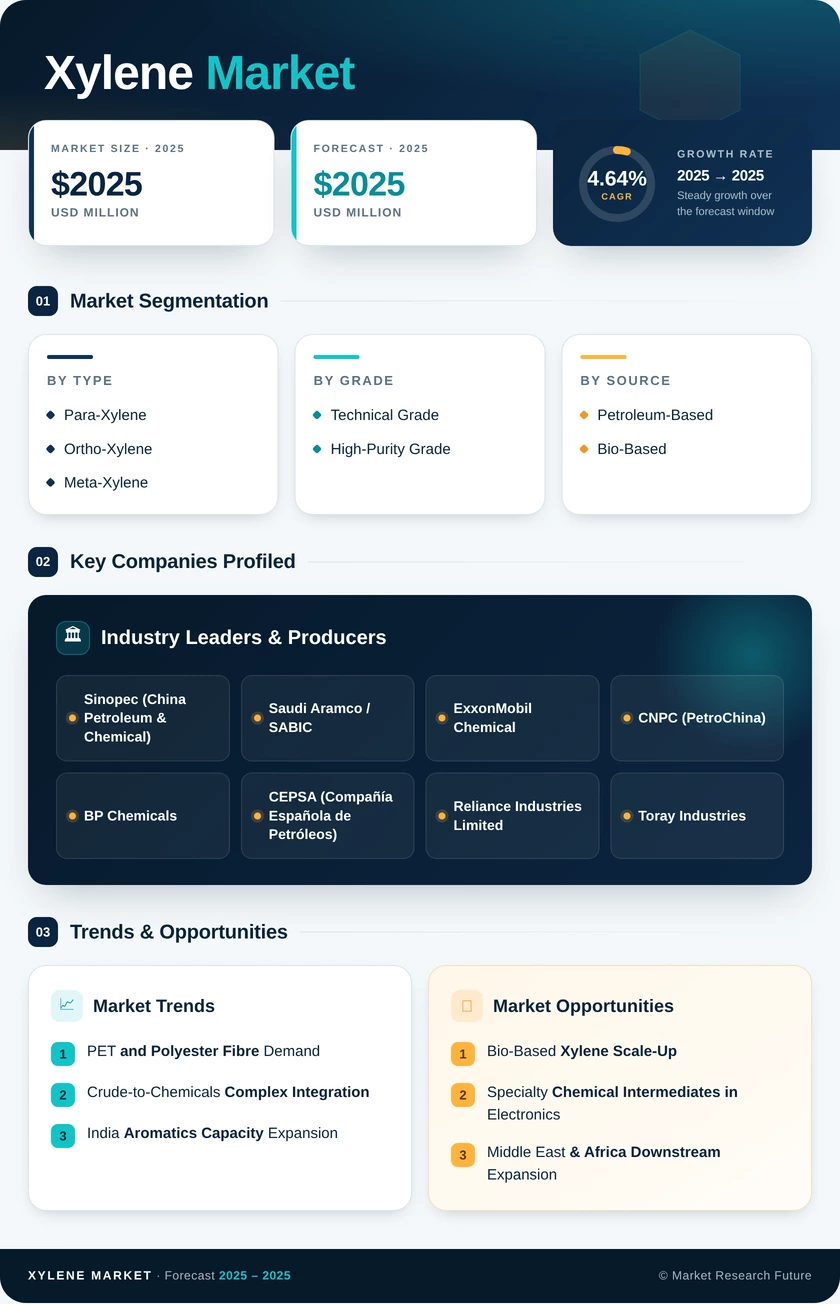
Segmentation Quick Reference

DimensionSub-SegmentsDominant SegmentFastest Growing Segment
By TypePara-Xylene; Ortho-Xylene; Meta-XylenePara-Xylene (91.0% share)Ortho-Xylene (4.52% CAGR)
By GradeTechnical Grade; High-Purity GradeTechnical GradeHigh-Purity Grade (5.10% CAGR)
By SourcePetroleum-Based; Bio-BasedPetroleum-Based (96.0% share)Bio-Based (~6.10% CAGR)
By ApplicationSolvents; Monomers; Other ApplicationsSolventsMonomers (4.80% CAGR)
By End-User IndustryPlastics & Polymers; Paints & Coatings; Printing Inks & Adhesives; Pharmaceuticals & OthersPlastics & Polymers (71.5% share)Plastics & Polymers (4.66% CAGR)
By RegionAsia-Pacific; North America; Europe; South America; Middle East & AfricaAsia-Pacific (53.0% share)Asia-Pacific (4.90% CAGR)


Market Segmentation Overview

By Type

Sub-SegmentKey Trend
Para-XyleneCaptive consumption in PET resin and polyester fibre; integrated PX-PTA complexes dominating new capacity
Ortho-XyleneGrowth in alkyd resin demand for paint solvent materials; phthalate-free plasticiser substitution driving formulation shifts
Meta-XyleneNiche but growing isophthalic acid demand for specialty packaging and glass fibre composites


Para-xylene's dominance of the Xylene Market by type is structural rather than cyclical, anchored by the global PET packaging megatrend. Ortho-xylene occupies a resilient niche in coatings intermediates, while meta-xylene benefits from specialty polymer growth in engineered materials applications.

By Grade

Sub-SegmentKey Trend
Technical GradeFeedstock for paraxylene production units; industrial solvent chemicals bulk applications
High-Purity GradeRising demand from electronics and pharmaceutical sectors; premium pricing supports margin expansion


Technical-grade volumes dominate the Xylene Market by sheer scale, but high-purity grade is where margin and growth opportunities intersect. Producers investing in purification infrastructure can access specification-driven markets largely insulated from commodity price cycles.

By Source

Sub-SegmentKey Trend
Petroleum-BasedCatalytic reformate and coal-tar-based streams; integrated refinery chemicals are still cost-advantaged
Bio-BasedScaling via long-term offtake agreements; ISCC PLUS certification enabling brand ESG claims


The transition from petroleum to bio-based aromatic hydrocarbon solvents will be gradual. Bio-based xylene cannot displace petroleum feedstocks on economics alone within the forecast window, but regulatory carbon pricing and consumer brand commitments create commercially viable niches for certified bio-content supply.

By Application

Sub-SegmentKey Trend
SolventsMature in developed markets; strong growth in ASEAN and South Asia paints a solvent materials demand
MonomersPET-driven paraxylene production dominates; fastest-growing sub-category by value
Other ApplicationsStable pharmaceutical and fuel-blending volumes; low growth outlook


Solvent applications remain commercially significant and diverse, spanning paint solvent materials, industrial cleaning solvents, and specialty printing inks. The monomer sub-category, however, commands the investment attention of the global Xylene Market given its scale and tie to the high-growth PET packaging industry.

By End-User Industry

Sub-SegmentKey Trend
Plastics & PolymersDominant demand pool; PET, polyester fibre, PBT engineering plastics, driving volumes
Paints & CoatingsVOC pressure in developed markets is offset by strong emerging market coatings growth
Printing Inks & AdhesivesStable; gradual reformulation to lower-aromatic alternatives in the EU
Pharmaceuticals & OthersNiche; high-purity specifications create margin opportunity


The plastics and polymers end-user segment defines the trajectory of the global Xylene Market more than any other demand driver. Its growth rate, geographic concentration in Asia-Pacific, and direct linkage to consumer packaging trends make it the primary lens through which investors, producers, and buyers should analyse market dynamics through 2035.