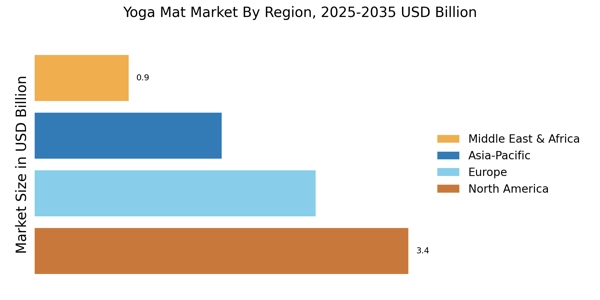
As per Market Research Future analysis, the Yoga Mat Market Size was estimated at 8.56 USD Billion in 2024. The Yoga Mat industry is projected to grow from 9.033 USD Billion in 2025 to 15.46 USD Billion by 2035, exhibiting a compound annual growth rate (CAGR) of 5.52% during the forecast period 2025 - 2035. North America holds the largest share of the global Yoga Mat Market at approximately 38%, reflecting a strong consumer base focused on health and wellness, high yoga participation rates, and significant investment in premium fitness products. The United States is the leading country within North America, capturing approximately 32% of the global Yoga Mat Market share, driven by the widespread adoption of yoga as a lifestyle practice, strong demand for eco-friendly and premium mats from brands like Manduka and Lululemon, and high consumer spending on wellness and fitness products. Polyvinyl Chloride (PVC) Yoga Mats dominate the Yoga Mat Market as the largest material segment, accounting for an estimated 38% of the global market share, owing to their durability, affordability, excellent traction, and widespread availability across both mass-market and specialty fitness retail channels.
Key Market Trends & Highlights
The Yoga Mat Market is experiencing a dynamic shift towards sustainability and innovation, driven by health-conscious consumers.
- The North American region remains the largest market for yoga mats, reflecting a strong consumer base focused on health and wellness.
- Asia-Pacific is identified as the fastest-growing region, indicating a rising interest in yoga and fitness practices among diverse populations.
- Polyvinyl Chloride (PVC) mats dominate the market, while natural rubber mats are emerging as the fastest-growing segment due to increasing sustainability concerns.
- Health and wellness trends, along with the rise of online retailing, are key drivers propelling the growth of both individual and commercial yoga mat segments.
Market Size & Forecast
| 2024 Market Size | 8.56 (USD Billion) |
| 2035 Market Size | 15.46 (USD Billion) |
| CAGR (2025 - 2035) | 5.52% |
Major Players
Liforme (DE), Manduka (US), Jade Yoga (US), Gaiam (US), Alo Yoga (US), PrAna (US), Yoga Design Lab (US), Sundried (GB), B Yoga (CA)