×
Request Free Sample ×

Kindly complete the form below to receive a free sample of this Report

* Please use a valid business email

Leading companies partner with us for data-driven Insights

clients tt-cursor
Hero Background

Zinc Chemicals Market

ID: MRFR/CnM/3785-HCR
138 Pages
Anshula Mandaokar
October 2025

Zinc Chemicals Market Research Report Information Product Type (Zinc Oxide, Zinc Sulfate, Zinc Carbonate, Zinc Chloride), Application (Rubber Compounding, Agriculture, Glass & Ceramics, Paints & Coatings, Food and Pharmaceuticals) & Forecast till 2035

Share:
Download PDF ×

We do not share your information with anyone. However, we may send you emails based on your report interest from time to time. You may contact us at any time to opt-out.

Zinc Chemicals Market Infographic
Purchase Options

Zinc Chemicals Market Summary

As per MRFR analysis, the Zinc Chemicals Market Size was estimated at 11.71 USD Billion in 2024. The Zinc Chemicals industry is projected to grow from 12.94 USD Billion in 2025 to 35.28 USD Billion by 2035, exhibiting a compound annual growth rate (CAGR) of 10.55 during the forecast period 2025 - 2035.

Key Market Trends & Highlights

The Zinc Chemicals Market is poised for robust growth driven by sustainability and technological advancements.

  • Sustainable practices in production are increasingly shaping the Zinc Chemicals Market, particularly in North America.
  • Technological innovations are enhancing the efficiency and applications of zinc chemicals across various industries.
  • The coatings segment remains the largest market, while agriculture is emerging as the fastest-growing segment in the Asia-Pacific region.
  • Rising demand in agriculture and growth in construction and infrastructure are key drivers propelling market expansion.

Market Size & Forecast

2024 Market Size 11.71 (USD Billion)
2035 Market Size 35.28 (USD Billion)
CAGR (2025 - 2035) 10.55%

Major Players

Zinc Nacional (MX), American Zinc Recycling (US), Korea Zinc (KR), Nyrstar (BE), Teck Resources (CA), Hindustan Zinc (IN), Boliden (SE), Southern Copper Corporation (US), Zinc Oxide LLC (US)

Zinc Chemicals Market Trends

The Zinc Chemicals Market is currently experiencing a dynamic phase characterized by evolving applications and increasing demand across various industries. This market encompasses a wide range of products, including zinc oxide, zinc sulfate, and zinc carbonate, which are utilized in sectors such as agriculture, pharmaceuticals, and construction. The growing awareness of the benefits of zinc compounds in enhancing product performance and sustainability appears to drive market expansion. Furthermore, the rising focus on environmental regulations and the need for eco-friendly alternatives may contribute to the development of innovative zinc-based solutions. In addition, the Zinc Chemicals Market seems to be influenced by technological advancements that enhance production processes and product quality. The integration of advanced manufacturing techniques and research initiatives indicates a potential for improved efficiency and reduced costs. As industries increasingly prioritize sustainability, the demand for zinc chemicals that align with green practices is likely to rise. Overall, the market appears poised for growth, driven by diverse applications and a commitment to innovation in response to changing consumer preferences and regulatory landscapes.

Sustainable Practices in Production

The Zinc Chemicals Market is witnessing a shift towards sustainable production methods. Manufacturers are increasingly adopting eco-friendly practices to minimize environmental impact. This trend reflects a broader commitment to sustainability across industries, as companies seek to align with regulatory requirements and consumer expectations.

Technological Innovations

Advancements in technology are playing a crucial role in the Zinc Chemicals Market. New manufacturing techniques and research developments are enhancing product quality and production efficiency. This trend suggests that companies are investing in innovation to meet the evolving demands of various sectors.

Diverse Applications

The applications of zinc chemicals are expanding across multiple industries. From agriculture to pharmaceuticals, the versatility of zinc compounds is becoming more recognized. This trend indicates a growing awareness of the benefits of zinc in enhancing product performance and addressing specific industry needs.

Zinc Chemicals Market Drivers

Growing Demand in Agriculture

The Global Zinc Chemicals Market Industry experiences a robust demand surge from the agricultural sector, primarily due to the increasing use of zinc-based fertilizers. Zinc is an essential micronutrient that enhances crop yield and quality. As global food production needs escalate, the market for zinc fertilizers is projected to grow significantly. In 2024, the market value is estimated at 8.55 USD Billion, driven by the need for sustainable agricultural practices. This trend is expected to continue, with the market potentially reaching 15.4 USD Billion by 2035, indicating a compound annual growth rate of 5.51% from 2025 to 2035.

Market Segment Insights

By Application: Coatings (Largest) vs. Agriculture (Fastest-Growing)

In the Zinc Chemicals Market, the application segment is primarily dominated by coatings, driven by their extensive use in construction, automotive, and consumer goods. Coatings hold the largest market share due to their protective properties and aesthetic appeal, which are integral in various industries. Following coatings, agriculture plays a significant role, as zinc is essential for soil health and crop production, contributing to its emerging market position. The growth trends indicate that while coatings remain the dominant application, agriculture is rapidly gaining traction as the fastest-growing segment. This growth is fueled by the increasing awareness of micronutrient deficiencies in soils and the rising demand for sustainable agricultural practices. Innovative zinc products tailored for agricultural applications are emerging, further propelling this sector.

Coatings (Dominant) vs. Agriculture (Emerging)

Coatings are a dominant force within the Zinc Chemicals Market, serving as vital materials used primarily for corrosion protection and aesthetics in various industries including automotive, construction, and consumer goods. The chemical properties of zinc enhance durability and improve the longevity of coated surfaces. On the other hand, agriculture is an emerging sector that capitalizes on zinc's crucial role as an essential micronutrient for plant growth. The increasing focus on sustainable agricultural practices and the necessity for soil enhancement drive the adoption of zinc-based products in agriculture. This growth is supported by advancements in formulation technology that optimize zinc's bioavailability, ensuring healthier crops and improved yield.

By End Use Industry: Construction (Largest) vs. Automotive (Fastest-Growing)

The zinc chemicals market shows a diverse distribution across various end-use industries. The construction sector dominates this market, driven by the extensive use of zinc in building materials and protective coatings. In contrast, the automotive industry is rapidly gaining traction, propelled by the growing demand for zinc-based components and materials that enhance vehicle durability and performance. Both sectors contribute significantly to the overall market dynamics, with unique requirements and applications that underline their importance. In terms of growth trends, the construction segment is expected to maintain its leading position, supported by ongoing infrastructure projects and urbanization. Meanwhile, the automotive industry is experiencing robust growth, fueled by innovation in electric and hybrid vehicles that incorporate zinc compounds for sustainable solutions. The diverse applications in healthcare, electronics, and agriculture further enrich the market landscape, fostering competition and innovation among manufacturers.

Construction: Dominant vs. Automotive: Emerging

The construction sector remains the dominant force in the zinc chemicals market, characterized by its reliance on zinc for corrosion resistance and longevity in various building applications. Its robust demand is fueled by infrastructural investments, particularly in emerging economies where urban development is on the rise. On the other hand, the automotive sector is emerging as a critical player, driven by advancements in automotive technology and the increasing focus on lightweight materials. Zinc's role in enhancing structural integrity and reducing vehicle weight makes it a sought-after material in automotive manufacturing. As vehicle electrification trends grow, the automotive industry's demand for zinc is anticipated to expand, integrating it into new technologies. Both sectors not only showcase distinct characteristics but also reflect the shifting paradigms in industry priorities and sustainability goals.

By Product Type: Zinc Oxide (Largest) vs. Zinc Sulfate (Fastest-Growing)

In the Zinc Chemicals Market, the product type segment exhibits diverse offerings led by Zinc Oxide, which holds the largest share due to its widespread applications in rubber, ceramics, and personal care products. Following closely is Zinc Sulfate, which, while holding a smaller market share, is rapidly gaining traction in the agricultural sector for its essential role in micronutrient fertilizers. The other segments, including Zinc Chloride, Zinc Carbonate, and Zinc Acetate, cater to niche applications but contribute to the overall market dynamics significantly.

Zinc Oxide (Dominant) vs. Zinc Sulfate (Emerging)

Zinc Oxide is the dominant player in the Zinc Chemicals Market, primarily utilized for its wide range of industrial applications and essential properties such as UV absorption and anti-microbial benefits. This product type is particularly preferred in the electronics and healthcare industries. Conversely, Zinc Sulfate, emerging as a significant contender, has found its niche in fertilizers, animal feeds, and water treatment, driving its robust growth. The increasing demand for micronutrient-rich fertilizers in agriculture sectors, paired with its environmentally friendly profile, positions Zinc Sulfate as an emerging growth opportunity in the market, attracting investment and innovation.

By Form: Powder (Largest) vs. Liquid (Fastest-Growing)

In the Zinc Chemicals Market, the segmentation by form reveals that Powder holds the largest market share among its counterparts, including Granules, Liquid, Paste, and Crystals. This form is highly favored for its versatility in various applications, particularly in coating and construction materials. Meanwhile, Liquid has emerged as the fastest-growing segment, gaining traction due to its ease of application and compatibility with industrial processes, thus appealing to sectors such as agriculture and manufacturing.

Powder (Dominant) vs. Liquid (Emerging)

Powdered zinc chemicals dominate the market owing to their widespread usage in protective coatings and as a dietary supplement. Their fineness allows for easy incorporation into various formulations, making them a preferred choice among manufacturers in automotive and construction industries. On the other hand, Liquid zinc chemicals represent an emerging and increasingly popular choice, particularly in agricultural applications, where they are used in fertilizers and pest control. Liquid forms provide advantages such as ease of use and better absorption, driving their adoption in modern farming practices. Both segment values are critical in addressing the diverse needs of the end-user industries, highlighting the importance of adaptability in this dynamic market.

By Purity Level: High Purity (Largest) vs. Pharmaceutical Grade (Fastest-Growing)

The Zinc Chemicals Market exhibits a diverse distribution across various purity levels, with High Purity zinc chemicals holding the largest market share. This segment appeals to high-end applications across industries such as electronics and batteries. Standard Purity and Technical Grade follow, serving mid-tier industries, while Industrial and Pharmaceutical Grade offer specific functionalities for industrial uses and health applications respectively. Together, these segments create a layered market structure with distinct demands. Growth trends in the purity level segments are driven by increasing industrialization and technological advancements. High Purity continues to thrive in sectors demanding superior quality and performance. Notably, the Pharmaceutical Grade segment is emerging rapidly, fueled by advancements in healthcare applications and stringent regulations, paving the way for innovative product developments and larger investments in the sector.

High Purity (Dominant) vs. Pharmaceutical Grade (Emerging)

The High Purity segment of the Zinc Chemicals Market is characterized by its essential role in high-technology applications, where product performance is paramount. This segment caters predominantly to electronics, batteries, and specialized industrial needs, where even minor impurities can affect functionality. Conversely, the Pharmaceutical Grade segment, while currently smaller, is experiencing rapid growth. This segment is driven by the increasing demand for high-quality zinc compounds in healthcare, particularly in drug formulation and nutraceuticals. The stringent purity requirements for pharmaceuticals necessitate advanced production methods, providing significant opportunities for growth and innovation within the market. As more companies invest in developing pharmaceutical-grade products, the segment is poised for expansion.

Get more detailed insights about Zinc Chemicals Market

Regional Insights

North America : Stable Growth Environment

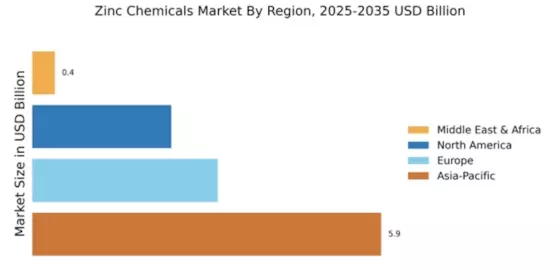
The North American zinc chemicals market is projected to grow steadily, driven by increasing demand in various sectors such as construction, automotive, and electronics. With a market size of $2.34 billion, the region benefits from robust regulatory frameworks that promote sustainable practices and recycling initiatives. The focus on reducing environmental impact is expected to further boost market growth as industries seek eco-friendly alternatives. Leading countries like the US and Canada dominate the market, with key players such as American Zinc Recycling and Southern Copper Corporation driving innovation and competition. The presence of established companies ensures a competitive landscape, fostering advancements in zinc chemical applications. As the market evolves, collaboration among industry stakeholders will be crucial for maintaining growth and addressing emerging challenges.

Europe : Innovation and Sustainability Focus

Europe's zinc chemicals market, valued at €3.51 billion, is characterized by a strong emphasis on innovation and sustainability. Regulatory frameworks, such as the European Green Deal, are driving demand for eco-friendly zinc products, particularly in the automotive and construction sectors. The region's commitment to reducing carbon emissions and promoting circular economy practices is expected to enhance market growth and attract investments. Countries like Germany, Belgium, and the UK are at the forefront of this market, with key players including Nyrstar and Boliden leading the charge. The competitive landscape is marked by a focus on research and development, enabling companies to introduce advanced zinc chemical solutions. As the market matures, collaboration between public and private sectors will be essential for fostering innovation and meeting regulatory requirements.

Asia-Pacific : Dominant Market Leader

Asia-Pacific is the largest market for zinc chemicals, with a market size of $5.88 billion, driven by rapid industrialization and urbanization. The region's growth is fueled by increasing demand from sectors such as construction, automotive, and electronics. Regulatory support for sustainable practices and investments in infrastructure are key catalysts for market expansion, positioning Asia-Pacific as a dominant player in the global zinc chemicals landscape. Leading countries like China, India, and South Korea are pivotal in this market, with major companies such as Korea Zinc and Hindustan Zinc contributing to the competitive environment. The presence of numerous manufacturers and suppliers enhances market dynamics, fostering innovation and efficiency. As the region continues to grow, strategic partnerships and technological advancements will play a crucial role in maintaining its leadership in the zinc chemicals sector.

Middle East and Africa : Emerging Market Potential

The Middle East and Africa (MEA) zinc chemicals market, valued at $0.98 billion, is emerging as a potential growth area, driven by increasing industrial activities and infrastructure development. The region's demand for zinc chemicals is expected to rise as governments invest in construction and manufacturing sectors. Regulatory initiatives aimed at promoting sustainable practices are also anticipated to catalyze market growth, making MEA an attractive destination for investment. Countries like South Africa and the UAE are leading the charge in this market, with a growing number of local and international players entering the scene. The competitive landscape is evolving, with companies focusing on innovation and sustainability to capture market share. As the region develops, collaboration among stakeholders will be essential for overcoming challenges and maximizing growth opportunities.

Key Players and Competitive Insights

The Zinc Chemicals Market is characterized by a dynamic competitive landscape, driven by increasing demand across various sectors such as agriculture, automotive, and electronics. Key players are actively pursuing strategies that emphasize innovation, sustainability, and regional expansion. For instance, in November 2025, Hindustan Zinc (IN) announced a significant investment in green technologies aimed at reducing carbon emissions in its production processes. This move not only positions the company as a leader in sustainable practices but also enhances its competitive edge in a market increasingly focused on environmental responsibility. Similarly, Teck Resources (CA) has been focusing on digital transformation initiatives to optimize its operations and improve efficiency, which could potentially lead to cost reductions and enhanced product quality.

The business tactics employed by these companies often include localizing manufacturing and optimizing supply chains to respond swiftly to market demands. The competitive structure of the Zinc Chemicals Market appears moderately fragmented, with several key players exerting considerable influence. This fragmentation allows for a diverse range of products and innovations, fostering a competitive environment where companies must continuously adapt to maintain their market positions.

In October 2025, Nyrstar (BE) unveiled a new zinc recycling facility aimed at enhancing its sustainability profile and reducing raw material dependency. This strategic move is indicative of a broader trend within the industry, where companies are increasingly recognizing the importance of circular economy principles. By investing in recycling capabilities, Nyrstar not only addresses environmental concerns but also positions itself to capitalize on the growing demand for recycled materials in various applications.

In September 2025, Korea Zinc (KR) expanded its operations by acquiring a local zinc processing plant in Southeast Asia. This acquisition is likely to bolster its market presence in the region, allowing for improved supply chain efficiencies and better access to emerging markets. Such strategic expansions are crucial as they enable companies to tap into new customer bases and enhance their competitive positioning.

As of December 2025, the Zinc Chemicals Market is witnessing trends that emphasize digitalization, sustainability, and the integration of advanced technologies such as AI. Strategic alliances are becoming increasingly prevalent, as companies seek to leverage each other's strengths to enhance their market offerings. The competitive differentiation is likely to evolve from traditional price-based competition to a focus on innovation, technology, and supply chain reliability. This shift suggests that companies that prioritize these aspects will be better positioned to thrive in an ever-evolving market landscape.

Key Companies in the Zinc Chemicals Market market include

Industry Developments

November 2021:


One of the leading market players, Gelion Plc has been involved in the research and development of storage products, especially Zinc bromide batteries. These batteries are gaining momentum in recent times, as Zinc bromide gels are considered safer and last longer compared to other storage options. Zinc bromide gels are also cheaper compared to the lithium batteries that are dominant in the industry. Moreover, they are highly environmentally sustainable and significantly eliminate a large part of engineering works and temperature control elements to control fire hazards. 


 October 2021:


Zinc Nacional which is a leading provider of Zinc compounds globally, has declared its plans regarding expanding its production capacity and aims to develop the existing facility in Mexico by building a French process whose capacity is 7000 tons per year. The company targets applications from the end-user industries like tire, rubber, lubricant, and chemical industries. 

Intended Audience

    • Zinc Chemicals Market  market manufacturers
    • Traders and Distributors of Zinc chemicals market
    • Production Process Industries
    • Potential Investors
    • Raw Material Suppliers
    • Nationalized Laboratory 

Future Outlook

Zinc Chemicals Market Future Outlook

The Zinc Chemicals Market is projected to grow at a 10.55% CAGR from 2024 to 2035, driven by increasing demand in agriculture, construction, and automotive sectors.

New opportunities lie in:

  • Expansion into emerging markets with tailored zinc products.
  • Development of eco-friendly zinc compounds for sustainable applications.
  • Investment in advanced manufacturing technologies to enhance production efficiency.

By 2035, the Zinc Chemicals Market is expected to achieve robust growth, solidifying its global position.

Market Segmentation

Zinc Chemicals Market Form Outlook

  • Powder
  • Granules
  • Liquid
  • Paste
  • Crystals

Zinc Chemicals Market Application Outlook

  • Coatings
  • Plating
  • Rubber
  • Agriculture
  • Pharmaceuticals

Zinc Chemicals Market Product Type Outlook

  • Zinc Oxide
  • Zinc Sulfate
  • Zinc Chloride
  • Zinc Carbonate
  • Zinc Acetate

Zinc Chemicals Market Purity Level Outlook

  • High Purity
  • Standard Purity
  • Technical Grade
  • Industrial Grade
  • Pharmaceutical Grade

Zinc Chemicals Market End Use Industry Outlook

  • Construction
  • Automotive
  • Electronics
  • Healthcare
  • Agriculture

Report Scope

MARKET SIZE 202411.71(USD Billion)
MARKET SIZE 202512.94(USD Billion)
MARKET SIZE 203535.28(USD Billion)
COMPOUND ANNUAL GROWTH RATE (CAGR)10.55% (2024 - 2035)
REPORT COVERAGERevenue Forecast, Competitive Landscape, Growth Factors, and Trends
BASE YEAR2024
Market Forecast Period2025 - 2035
Historical Data2019 - 2024
Market Forecast UnitsUSD Billion
Key Companies ProfiledZinc Nacional (MX), American Zinc Recycling (US), Korea Zinc (KR), Nyrstar (BE), Teck Resources (CA), Hindustan Zinc (IN), Boliden (SE), Southern Copper Corporation (US), Zinc Oxide LLC (US)
Segments CoveredApplication, End Use Industry, Product Type, Form, Purity Level
Key Market OpportunitiesGrowing demand for sustainable zinc chemicals in renewable energy applications presents significant market opportunities.
Key Market DynamicsRising demand for zinc chemicals in agriculture and construction sectors drives market growth and innovation.
Countries CoveredNorth America, Europe, APAC, South America, MEA

Market Highlights

Author
Anshula Mandaokar
Team Lead - Research

Anshula Mandaokar holds an academic degree in Chemical Engineering and has been contributing to the field for more than 5 years. She has expertise in Market Research and Business Consulting and serves as a Team Lead for a reputed Market Research firm under the Chemicals and Materials domain spectrum. She has worked on multiple projects, generating explicit results in a quick turnaround time. Her understanding of data interpretation justifies her role as a leader.

Leave a Comment

FAQs

What are the top players listed for the zinc chemicals market growth?

Several companies like Weifang Longda Zinc Industry (China), U.S. Zinc (U.S.), GHC (Canada), American Chemet Corporation (U.S.), Hakusuitech co. Ltd (Japan), Zinc Oxide LLC (US), Rubamin (India), American Chemet Corporation (U.S), Akrochem corporation (U.S.), and BrüggemannGruppe (Germany) are set to inspire change in the zinc chemicals market.

What all industries are expected to transform the zinc chemicals market?

Industries like agriculture, glass & ceramics, rubber compounding, chemicals, paints & coatings, textiles, food & pharmaceuticals, and others can ensure strong growth for the zinc chemicals market.

What are the strategies taken by the zinc chemicals market players?

Players are going to use tactical moves like innovation, merger, acquisition, product launch, collaboration, and other marketing strategies to inspire better growth for the zinc chemicals market.

North American growth would be dominated by which industry?

The automobile sector would have a substantial impact on the North American zinc chemicals market.

Which product segment is dominating the zinc chemicals market?

The zinc sulfate segment has the potential to dominate the zinc chemicals market.

Download Free Sample

Kindly complete the form below to receive a free sample of this Report

Compare Licence

×
Features License Type
Single User Multiuser License Enterprise User
Price $4,950 $5,950 $7,250
Maximum User Access Limit 1 User Upto 10 Users Unrestricted Access Throughout the Organization
Free Customization
Direct Access to Analyst
Deliverable Format
Platform Access
Discount on Next Purchase 10% 15% 15%
Printable Versions