×
Request Free Sample ×

Kindly complete the form below to receive a free sample of this Report

* Please use a valid business email

Leading companies partner with us for data-driven Insights

clients tt-cursor
Hero Background

Zinc Dust Market

ID: MRFR/CnM/23356-HCR
111 Pages
Chitranshi Jaiswal
October 2025

Zinc Dust Market Research Report: By Application (Paint and Coatings, Batteries, Galvanizing and Electroplating, Chemicals, Others), By Grade (Coarse, Fine, Ultrafine), By Purity (95-99%, >99%, 99.9%), By End-Use Industry (Automotive, Construction, Electronics, Chemical, Others) and By Regional (North America, Europe, South America, Asia Pacific, Middle East and Africa) - Forecast to 2035.

Share:
Download PDF ×

We do not share your information with anyone. However, we may send you emails based on your report interest from time to time. You may contact us at any time to opt-out.

Zinc Dust Market Infographic
Purchase Options

Zinc Dust Market Summary

As per MRFR analysis, the Zinc Dust Market Size was estimated at 14.86 USD Billion in 2024. The Zinc Dust industry is projected to grow from 15.17 USD Billion in 2025 to 18.72 USD Billion by 2035, exhibiting a compound annual growth rate (CAGR) of 2.12 during the forecast period 2025 - 2035.

Key Market Trends & Highlights

The Zinc Dust Market is experiencing robust growth driven by diverse applications and technological advancements.

  • The demand for zinc dust in coatings and paints remains strong, particularly in North America, which is the largest market.
  • Asia-Pacific is emerging as the fastest-growing region, fueled by increasing industrialization and urbanization.
  • The paint and coatings segment dominates the market, while the battery segment is witnessing rapid growth due to rising electric vehicle production.
  • Key market drivers include the increasing use of zinc dust in battery manufacturing and the expansion of construction applications.

Market Size & Forecast

2024 Market Size 14.86 (USD Billion)
2035 Market Size 18.72 (USD Billion)
CAGR (2025 - 2035) 2.12%

Major Players

Zinc Nacional (MX), American Zinc Recycling (US), Mitsubishi Materials Corporation (JP), Hindustan Zinc Limited (IN), Nyrstar (BE), Zinc Oxide LLC (US), Korea Zinc Co., Ltd. (KR), Teck Resources Limited (CA), Boliden AB (SE)

Zinc Dust Market Trends

The Zinc Dust Market is currently experiencing a dynamic phase characterized by evolving applications and increasing demand across various industries. This market is primarily driven by the growing need for corrosion-resistant coatings, particularly in the automotive and construction sectors. As industries seek to enhance the durability and longevity of their products, zinc dust emerges as a preferred choice due to its protective properties. Furthermore, the rising awareness regarding environmental sustainability is prompting manufacturers to explore eco-friendly alternatives, thereby influencing the market landscape. In addition to the aforementioned factors, the Zinc Dust Market is also witnessing advancements in production technologies, which may lead to improved quality and efficiency. Innovations in processing methods could potentially reduce costs and enhance the performance of zinc dust in various applications. Moreover, the increasing focus on research and development activities suggests that new applications may emerge, further expanding the market's reach. Overall, the Zinc Dust Market appears poised for growth, driven by a combination of industrial demand, technological advancements, and a shift towards sustainable practices.

Growing Demand in Coatings and Paints

The Zinc Dust Market is seeing heightened interest in its use within coatings and paints. This trend is largely attributed to the material's ability to provide excellent corrosion resistance, making it ideal for protective coatings in various sectors, including marine and industrial applications.

Shift Towards Eco-Friendly Solutions

There is a noticeable shift towards environmentally friendly products within the Zinc Dust Market. Manufacturers are increasingly focusing on sustainable practices, which may lead to the development of zinc dust variants that align with green chemistry principles, appealing to environmentally conscious consumers.

Technological Innovations in Production

Technological advancements in the production of zinc dust are likely to enhance efficiency and quality. Innovations in processing techniques may result in finer particle sizes and improved performance characteristics, thereby expanding the potential applications of zinc dust in diverse industries.

Zinc Dust Market Drivers

Rising Awareness of Health Benefits

The Zinc Dust Market is also benefiting from rising awareness of the health benefits associated with zinc. Zinc is recognized for its essential role in various biological functions, including immune system support and skin health. As consumers become more health-conscious, there is a growing demand for dietary supplements and topical products containing zinc. This trend is reflected in the increasing sales of zinc-based health products, which are projected to grow at a steady rate. Consequently, the demand for zinc dust as a raw material in the production of these health products is likely to rise. The Zinc Dust Market stands to gain from this heightened focus on health and wellness, as manufacturers seek to meet consumer needs for effective and safe zinc formulations.

Growing Demand in Agriculture Sector

The Zinc Dust Market is experiencing growing demand in the agriculture sector, particularly in the formulation of fertilizers and soil amendments. Zinc is an essential micronutrient for plant growth, and its deficiency can lead to reduced crop yields. As agricultural practices evolve towards more sustainable and efficient methods, the incorporation of zinc dust in fertilizers is becoming increasingly common. Reports indicate that the global market for zinc fertilizers is expected to grow significantly, driven by the need to enhance soil health and crop productivity. This trend is likely to bolster the Zinc Dust Market, as manufacturers respond to the agricultural sector's demand for effective zinc-based solutions.

Expansion in Construction Applications

The Zinc Dust Market is witnessing expansion in construction applications, particularly in the production of corrosion-resistant coatings and galvanization processes. Zinc dust is widely utilized in protective coatings for steel structures, which are essential in preventing rust and extending the lifespan of buildings and infrastructure. The construction sector is projected to grow steadily, with investments in infrastructure development and renovation projects driving the demand for zinc-based products. Reports indicate that the protective coatings market, which includes zinc dust, is expected to reach several billion dollars by the end of the decade. This growth in construction applications is likely to bolster the Zinc Dust Market, as manufacturers increasingly incorporate zinc dust into their formulations.

Increasing Use in Battery Manufacturing

The Zinc Dust Market is experiencing a notable surge in demand due to the increasing use of zinc dust in battery manufacturing, particularly in zinc-air batteries. These batteries are gaining traction as a viable alternative to traditional lithium-ion batteries, primarily due to their lower environmental impact and cost-effectiveness. The market for zinc-air batteries is projected to grow significantly, with estimates suggesting a compound annual growth rate of over 20% in the coming years. This trend indicates a shift in consumer preferences towards more sustainable energy solutions, thereby driving the demand for zinc dust in the battery sector. As manufacturers seek to enhance battery performance and sustainability, the Zinc Dust Market is likely to benefit from this growing trend.

Technological Advancements in Production Processes

The Zinc Dust Market is poised for growth due to technological advancements in production processes. Innovations in manufacturing techniques, such as improved methods for producing high-purity zinc dust, are enhancing product quality and efficiency. These advancements not only reduce production costs but also enable manufacturers to meet stringent quality standards required in various applications, including electronics and pharmaceuticals. As industries increasingly demand high-quality zinc dust, the market is likely to see a shift towards more sophisticated production technologies. This trend suggests that the Zinc Dust Market will continue to evolve, driven by the need for enhanced product performance and sustainability in manufacturing.
Market Segment Insights

Zinc Dust Market Application Insights

In the Zinc Dust Market, the application segment of paint and coatings is expected to occupy the largest share of the market in 2023 and will continue to exhibit a positive dynamic of growth. This trend is associated with an increase in the demand for zinc-rich paints and coatings in the automotive, construction and marine industries. The batteries segment will also demonstrate the high rate of growth due to the strengthening of the demand for zinc-air and zinc-ion batteries in the E-vehicle and renewable energy applications.

The segment galvanizing and electroplating is expected to remain dormant, while growth will be due to the increased demand for zinc-coated steel in the automotive and construction industries.The segment chemicals will show a moderate rate of growth, with the demand for zinc dust in the production of chemicals such as zinc oxide and zinc sulfate. The segment includes a variety of applications, such as pharmaceuticals, cosmetics, and agrochemicals, and will demonstrate a moderate rate of growth.

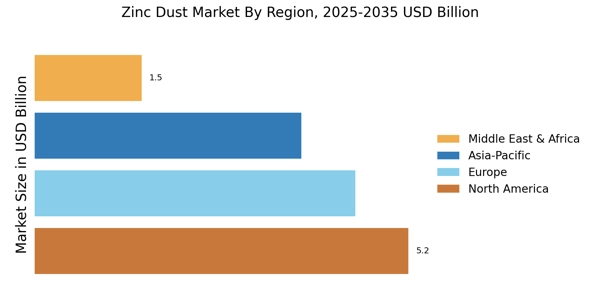
The Asia-Pacific region will become the largest market of zinc dust, followed by North America and Europe, due to the increasing demand for zinc-rich paints and coatings, batteries, and galvanized steel.

Source: Primary Research, Secondary Research, Market Research Future Database and Analyst Review

Zinc Dust Market Grade Insights

The Grade segment of the Zinc Dust Market is categorized into Coarse, Fine, and Ultrafine. Among these, the Coarse grade held the largest market share in 2023, accounting for around 55% of the Zinc Dust Market revenue. This dominance is attributed to its extensive use in the production of zinc-rich primers, paints, and coatings, which offer superior corrosion protection and durability. The Fine grade is projected to exhibit a steady growth rate during the forecast period, owing to its increasing demand in the manufacturing of zinc oxide, a versatile material used in various applications such as rubber, ceramics, and cosmetics.

The Ultrafine grade, characterized by its exceptional purity and small particle size, is gaining traction in high-tech industries, including electronics and pharmaceuticals. Its unique properties make it suitable for applications requiring high precision and performance. Overall, the Grade segment offers diverse options for various industries, catering to specific performance and application requirements.

Zinc Dust Market Purity Insights

The Purity segment is a crucial aspect of the Zinc Dust Market segmentation, influencing market growth and industry dynamics. In 2023, the 95-99% purity segment held a significant market share due to its wide range of applications in the automotive, construction, and electronics industries. The >99% purity segment is projected to witness substantial growth, driven by the increasing demand for high-purity zinc dust in the production of zinc-air batteries and other advanced materials. The 99.9% purity segment is expected to maintain a strong market presence throughout the forecast period, catering to specialized applications in the chemical and pharmaceutical industries.

The Zinc Dust Market revenue is anticipated to grow significantly in the coming years, with the Purity segment playing a vital role in shaping market dynamics and driving industry growth.

Zinc Dust Market End-Use Industry Insights

The Zinc Dust Market is segmented by End-Use Industry into Automotive, Construction, Electronics, Chemical, and Others. Automotive: The automotive industry is a major consumer of zinc dust, which is used in the production of galvanized steel. Galvanized steel is used in the manufacturing of car bodies, chassis, and other components. The demand for zinc dust in the automotive industry is expected to grow in the coming years, driven by the increasing production of vehicles. Construction: Zinc dust is also used in the construction industry, primarily for the galvanization of steel structures.

Galvanized steel is used in the construction of bridges, buildings, and other structures. The demand for zinc dust in the construction industry is expected to remain stable in the coming years. Electronics: Zinc dust is used in the electronics industry for the production of semiconductors and other electronic components. The demand for zinc dust in the electronics industry is expected to grow in the coming years, driven by the increasing demand for electronic devices.

Chemical: Zinc dust is used in the chemical industry for the production of zinc salts and other chemicals.Zinc salts are used in a variety of applications, including the production of fertilizers, paints, and pharmaceuticals. The demand for zinc dust in the chemical industry is expected to grow in the coming years, driven by the increasing demand for zinc salts. Others: Zinc dust is also used in a variety of other applications, including the production of batteries, pigments, and cosmetics. The market growth is attributed to the increasing demand for zinc dust from the automotive, construction, and electronics industries.

Get more detailed insights about Zinc Dust Market

Regional Insights

North America : Innovation and Sustainability Focus

North America is witnessing significant growth in the zinc dust market, driven by increasing demand in the automotive and construction sectors. The region holds approximately 35% of the global market share, making it the largest market for zinc dust. Regulatory support for sustainable practices and the push for eco-friendly materials are further propelling market expansion. The rise in infrastructure projects and automotive manufacturing is expected to sustain this growth trajectory. The United States and Canada are the leading countries in this region, with major players like American Zinc Recycling and Teck Resources Limited dominating the market. The competitive landscape is characterized by innovation in production techniques and a focus on recycling. Companies are investing in advanced technologies to enhance product quality and reduce environmental impact, ensuring a robust market presence in North America.

Europe : Regulatory Framework and Innovation

Europe is emerging as a key player in the zinc dust market, holding approximately 30% of the global share, making it the second-largest market. The region's growth is driven by stringent environmental regulations and a shift towards sustainable construction materials. The European Union's commitment to reducing carbon emissions is catalyzing demand for zinc dust in various applications, including coatings and galvanization, which are essential for corrosion resistance. Leading countries such as Germany, Belgium, and the Netherlands are at the forefront of this market, with companies like Nyrstar and Boliden AB playing significant roles. The competitive landscape is marked by innovation in product development and a focus on recycling initiatives. The presence of established players and a strong regulatory framework are fostering a conducive environment for market growth in Europe.

Asia-Pacific : Emerging Markets and Growth Potential

Asia-Pacific is rapidly becoming a significant player in the zinc dust market, driven by industrialization and urbanization. The region holds approximately 25% of the global market share, with countries like India and China leading the charge. The demand for zinc dust in construction and automotive applications is on the rise, supported by government initiatives to boost infrastructure development and manufacturing capabilities. China and India are the primary markets in this region, with key players such as Hindustan Zinc Limited and Mitsubishi Materials Corporation actively expanding their operations. The competitive landscape is evolving, with local manufacturers increasing their market presence. The focus on sustainable practices and technological advancements in production processes is expected to further enhance market growth in Asia-Pacific.

Middle East and Africa : Resource-Rich and Growing Demand

The Middle East and Africa region is witnessing a gradual increase in the zinc dust market, holding approximately 10% of the global share. The growth is primarily driven by the rising demand for zinc in construction and automotive sectors, alongside the region's rich mineral resources. Countries like South Africa and the UAE are focusing on infrastructure development, which is expected to boost the demand for zinc dust in various applications. South Africa is the leading market in this region, with companies like Zinc Nacional and local players contributing to the competitive landscape. The presence of abundant natural resources and a growing industrial base are key factors supporting market growth. As the region continues to develop, the demand for zinc dust is anticipated to rise, driven by both local consumption and export opportunities.

Zinc Dust Market Regional Image

Key Players and Competitive Insights

Major players in the Zinc Dust Market industry are focusing on expanding their production capacities to meet the growing demand from various end-use industries. Leading Zinc Dust Market players are also investing in research and development to develop new and innovative products. The Zinc Dust Market industry is expected to witness significant growth in the coming years, driven by the increasing demand from the automotive, construction, and electronics industries. The competitive landscape of the Zinc Dust Market is characterized by the presence of a few large players and a number of small and medium-sized enterprises.

The leading players in the Zinc Dust Market include Nyrstar, Korea Zinc, Glencore, and Boliden. These companies have a strong global presence and account for a significant share of the market.Nyrstar is a leading global producer of zinc and lead. The company has a strong presence in the Zinc Dust Market and offers a wide range of products to meet the needs of its customers. Nyrstar has a global network of production facilities and sales offices, which allows it to serve customers in all major markets.

The company is committed to providing high-quality products and services to its customers and is focused on maintaining its position as a leading player in the Zinc Dust Market.Boliden is another leading player in the Zinc Dust Market. The company is a global producer of metals, including zinc, lead, copper, and gold. Boliden has a strong presence in the Zinc Dust Market and offers a wide range of products to meet the needs of its customers. The company has a global network of production facilities and sales offices, which allows it to serve customers in all major markets.

Boliden is committed to providing high-quality products and services to its customers and is focused on maintaining its position as a leading player in the Zinc Dust Market.

Key Companies in the Zinc Dust Market market include

Industry Developments

The Zinc Dust Market is poised to grow steadily over the coming years, driven by increasing demand from the automotive, construction, and chemical industries. In 2023, the market was valued at approximately USD 14.25 billion and is projected to reach USD 17.2 billion by 2032, exhibiting a CAGR of 2.12%.Recent developments in the market include the growing adoption of zinc dust as a corrosion-resistant coating in the automotive industry, particularly for underbody components. Additionally, the increasing use of zinc dust in construction materials, such as paints and primers, is contributing to market growth.

The chemical industry also represents a significant consumer of zinc dust, primarily for use as a reducing agent in various chemical processes.Key players in the Zinc Dust Market include Teck Resources, Nyrstar, Korea Zinc, and Zinifex. These companies are focused on expanding their production capacities and developing new applications for zinc dust to meet the growing demand.

Future Outlook

Zinc Dust Market Future Outlook

The Zinc Dust Market is projected to grow at a 2.12% CAGR from 2024 to 2035, driven by increasing demand in coatings, batteries, and agriculture.

New opportunities lie in:

  • Expansion into emerging markets with tailored zinc dust formulations.
  • Development of eco-friendly zinc dust products to meet sustainability demands.
  • Investment in advanced manufacturing technologies to enhance production efficiency.

By 2035, the Zinc Dust Market is expected to achieve a robust position, reflecting steady growth and innovation.

Market Segmentation

Zinc Dust Market Grade Outlook

  • Coarse
  • Fine
  • Ultrafine

Zinc Dust Market Purity Outlook

  • 95-99%
  • >99%
  • 99.9%

Zinc Dust Market Application Outlook

  • Paint and Coatings
  • Batteries
  • Galvanizing and Electroplating
  • Chemicals
  • Others

Zinc Dust Market End-Use Industry Outlook

  • Automotive
  • Construction
  • Electronics
  • Chemical
  • Others

Report Scope

MARKET SIZE 202414.86(USD Billion)
MARKET SIZE 202515.17(USD Billion)
MARKET SIZE 203518.72(USD Billion)
COMPOUND ANNUAL GROWTH RATE (CAGR)2.12% (2024 - 2035)
REPORT COVERAGERevenue Forecast, Competitive Landscape, Growth Factors, and Trends
BASE YEAR2024
Market Forecast Period2025 - 2035
Historical Data2019 - 2024
Market Forecast UnitsUSD Billion
Key Companies ProfiledMarket analysis in progress
Segments CoveredMarket segmentation analysis in progress
Key Market OpportunitiesGrowing demand for eco-friendly coatings and corrosion-resistant materials in the Zinc Dust Market.
Key Market DynamicsRising demand for zinc dust in coatings and batteries drives innovation and competitive dynamics in the market.
Countries CoveredNorth America, Europe, APAC, South America, MEA

Leave a Comment

FAQs

What is the projected market valuation of the Zinc Dust Market by 2035?

The Zinc Dust Market is projected to reach a valuation of 18.72 USD Billion by 2035.

What was the market valuation of the Zinc Dust Market in 2024?

In 2024, the Zinc Dust Market was valued at 14.86 USD Billion.

What is the expected CAGR for the Zinc Dust Market during the forecast period 2025 - 2035?

The expected CAGR for the Zinc Dust Market during the forecast period 2025 - 2035 is 2.12%.

Which application segment is expected to have the highest valuation in 2025?

The Paint and Coatings application segment is expected to reach a valuation of 6.0 USD Billion in 2025.

How does the Fine grade of Zinc Dust compare to other grades in terms of market valuation?

The Fine grade of Zinc Dust is projected to achieve a valuation of 7.56 USD Billion in 2025, surpassing both Coarse and Ultrafine grades.

What are the projected valuations for the Automotive end-use industry segment in 2025?

The Automotive end-use industry segment is projected to reach a valuation of 3.7 USD Billion in 2025.

Which key player is involved in the Zinc Dust Market and what is their geographical base?

Hindustan Zinc Limited, based in India, is one of the key players in the Zinc Dust Market.

What is the expected valuation for the Chemicals application segment in 2025?

The Chemicals application segment is expected to reach a valuation of 2.5 USD Billion in 2025.

What is the projected market valuation for the >99% purity segment in 2025?

The >99% purity segment is projected to achieve a valuation of 5.45 USD Billion in 2025.

How does the projected valuation of the Galvanizing and Electroplating segment in 2025 compare to 2024?

The Galvanizing and Electroplating segment is expected to grow from 4.0 USD Billion in 2024 to 5.0 USD Billion in 2025.

Download Free Sample

Kindly complete the form below to receive a free sample of this Report

Compare Licence

×
Features License Type
Single User Multiuser License Enterprise User
Price $4,950 $5,950 $7,250
Maximum User Access Limit 1 User Upto 10 Users Unrestricted Access Throughout the Organization
Free Customization
Direct Access to Analyst
Deliverable Format
Platform Access
Discount on Next Purchase 10% 15% 15%
Printable Versions