Accelerator Card Market

加速卡市场规模、份额和研究报告,按处理器类型(中央处理单元(CPU)、图形处理单元(GPU)、现场可编程门阵列(FPGA)和专用集成电路(ASIC))、按加速器类型(高性能计算加速器和云加速器)、按应用(视频和图像处理、机器学习、数据分析、手机和其他)以及按地区(北美、欧洲、亚太和其他地区)–行业预测至2035年
ID: MRFR/SEM/8092-CR
153 Pages
Ankit Gupta
Last Updated: July 21, 2026
Accelerator Card Market
Market Size
Forecast Period2025 - 2035
CAGR (2025 - 2035)34.66%
2024 Market Size$ 19.79 Billion
2025 Market Size$ 26.65 Billion
2035 Market Size$ 522.57 Billion
Key Players
Visa Inc
Mastercard Inc
American Express Company
Discover Financial Services
JCB Co Ltd
UnionPay International
Opportunities
  • Increased Focus on Financial Inclusion
  • Regulatory Support for Fintech Innovations
  • Technological Innovations in Card Security

Accelerator Card Market 摘要

根据市场研究未来的分析,加速卡市场规模在2024年估计为197.9亿美元。预计加速卡行业将从2025年的266.5亿美元增长到2035年的5225.7亿美元,在预测期2025 - 2035内展现出34.66%的复合年增长率(CAGR)

主要市场趋势和亮点

加速卡市场因技术进步和不断变化的消费者偏好而有望实现显著增长。

  • 技术进步正在重塑加速卡市场,特别是在北美,仍然是最大的市场。
  • 可持续发展倡议正在获得关注,影响亚太地区(增长最快的市场)的产品开发和消费者选择。
  • 个性化和定制化变得越来越重要,尤其是在图形处理单元领域,该领域占据了最大的市场份额。
  • 对数字支付解决方案的需求上升以及对金融包容性的关注增加是推动市场扩展的关键因素。

市场规模与预测

2024市场规模 197.9(十亿美元)
2035市场规模 5225.7(十亿美元)
年均增长率(2025 - 2035) 34.66%

主要参与者

Visa Inc(美国)、Mastercard Inc(美国)、美国运通公司(美国)、Discover Financial Services(美国)、JCB Co Ltd(日本)、银联国际(中国)、Diners Club International Ltd(美国)、RuPay(印度)

Accelerator Card Market Drivers

对金融包容性的关注增加

加速卡市场可能会因对金融包容性的关注增加而实现增长。各国政府和组织正在认识到为服务不足的人群提供金融服务的重要性。旨在促进金融素养和银行服务获取的倡议正在获得关注。例如,针对低收入人群推出的加速卡可以促进更容易获取金融资源。这种方法不仅赋予消费者权力,还扩大了金融机构的客户基础。最近的统计数据显示,近17亿成年人仍然没有银行账户,这突显了加速卡市场解决这一差距的重大机会。通过提供负担得起且可获取的金融产品,该行业可以为更广泛的经济发展和社会公平做出贡献。

对金融科技创新的监管支持

加速卡市场正在受益于旨在促进金融科技创新的监管支持。各国政府越来越认识到金融科技在提升金融服务和促进竞争方面的潜力。正在建立监管框架,以便新参与者进入市场,这可能导致创新加速卡解决方案的发展。例如,简化金融科技公司许可流程的倡议可以鼓励新产品的推出。这种支持性环境可能导致满足多样化消费者需求的加速卡的激增。此外,监管机构还专注于消费者保护,确保新产品保持高标准的安全性和透明度。因此,加速卡市场可能会经历加速增长,受到创新浪潮和竞争加剧的推动。

卡片安全技术的技术创新

加速卡市场正在见证卡片安全技术的进步,这对消费者信任和市场增长至关重要。生物识别认证、令牌化和先进加密方法等创新正在被整合到加速卡中。这些技术增强了安全性,降低了欺诈风险,而这在金融行业中日益成为一个关注点。数据显示,到2027年,卡片欺诈损失预计将达到350亿美元,突显了强大安全措施的必要性。随着消费者对安全问题的认识提高,对配备尖端安全功能的加速卡的需求可能会增加。金融机构正在投资这些技术,以在竞争激烈的加速卡市场中区分其产品,从而吸引更多客户并促进忠诚度。

对数字支付解决方案的需求上升

加速卡市场正在经历对数字支付解决方案的显著需求激增。随着消费者越来越倾向于无现金交易,加速卡的采用可能会增加。根据最近的数据,数字支付行业预计在未来五年内将以约13%的年复合增长率增长。这一趋势表明消费者行为的转变,便利性和速度被优先考虑。加速卡市场准备从这一转变中受益,因为这些卡提供增强的安全功能和与移动钱包的无缝集成。金融机构也在投资技术以支持这一需求,进一步推动加速卡细分市场的增长。因此,市场可能会见证旨在迎合消费者不断变化的偏好的创新产品的涌入。

对奖励计划的消费者偏好演变

加速卡市场正在适应不断变化的消费者偏好,特别是在奖励计划方面。消费者越来越寻求金融产品的增值福利,提供吸引人奖励的加速卡正在获得人气。最近的调查显示,超过60%的消费者认为奖励计划是他们选择卡片过程中的一个重要因素。这一趋势表明金融机构必须创新其产品以保持竞争力。通过提供个性化奖励、现金返还选项和旅行激励,加速卡可以吸引更广泛的受众。数据分析的整合使发行人能够根据个人消费习惯量身定制奖励,从而提高客户满意度。因此,加速卡市场可能会看到向更动态和吸引人的奖励结构的转变,以契合消费者的愿望。

市场细分洞察

按处理器类型:图形处理单元(最大)与现场可编程门阵列(增长最快)

加速卡市场展示了多样化的处理器类型,图形处理单元(GPU)因其在图形渲染和复杂计算中的重要作用而占据最大份额。尽管中央处理单元(CPU)仍然重要,但逐渐被满足高性能计算需求的GPU所超越,尤其是在游戏、人工智能和数据分析领域。另一方面,现场可编程门阵列(FPGA)正在获得关注;它们的适应性使其在专业市场中的定制处理任务中尤为吸引人。

中央处理单元(主导)与应用特定集成电路(新兴)

中央处理单元(CPU)长期以来一直是计算的基石,提供了在各种应用中的多功能性和性能。尽管它们在传统计算任务中仍然占主导地位,但专用处理的兴起催生了应用特定集成电路(ASIC),后者正在成为高效处理特定应用的有价值选择。ASIC针对特定任务进行定制,从而实现更高的性能和能效,吸引了加密货币挖掘和深度学习等领域。随着组织继续寻求最佳处理解决方案,CPU与ASIC之间的竞争突显了向专用技术的转变,挑战了通用处理器长期以来的主导地位。

按加速器类型:高性能计算加速器(最大)与云加速器(增长最快)

加速卡市场正在见证高性能计算(HPC)加速器与云加速器之间市场份额的显著分布。目前,高性能计算加速器因其在复杂模拟、数据分析和人工智能工作负载中的广泛应用而主导市场。该细分市场受益于高度依赖计算能力的行业,确保其在技术进步和投资中的持续领导地位。

高性能计算加速器:主导与云加速器:新兴

高性能计算加速器的特点是其卓越的处理能力,服务于研究和能源等领域,在这些领域,大量数据需要快速处理。它们的架构经过优化以实现并行处理,使其在气候建模和大规模模拟等任务中至关重要。另一方面,云加速器正在迅速成为企业转向云环境的必要工具,提供可扩展性和灵活的资源管理。随着对高效云计算解决方案的需求增加,该细分市场预计将看到显著增长,推动因素包括虚拟化技术的进步和各个行业对云服务的广泛采用。

按应用:视频和图像处理(最大)与机器学习(增长最快)

加速卡市场展示了多样化的应用格局,视频和图像处理占据最大份额。由于高定义视频和实时图像应用在游戏和娱乐等各个行业中的需求不断增加,该细分市场获得了显著关注。机器学习紧随其后,迅速获得关注,组织正在投资于需要强大处理能力的人工智能驱动解决方案。这两个细分市场共同展示了塑造市场发展的动态互动。增长趋势表明,加速卡市场正朝着机器学习应用的强劲转变,推动因素包括人工智能和大数据分析的进步。随着公司寻求提升AI算法的处理速度,对专用加速卡的需求预计将蓬勃发展。同时,视频和图像处理继续受益于技术增强,使得视觉效果改善和渲染时间加快,巩固了其在市场中的既定地位。

视频和图像处理(主导)与机器学习(新兴)

在加速卡市场中,视频和图像处理作为主导应用,服务于媒体、娱乐和虚拟现实等领域,在这些领域,高分辨率图形和快速处理至关重要。其既定存在得益于图形渲染技术的持续进步和用户对高质量内容的期望增加。相比之下,机器学习代表了一个快速发展的新兴细分市场。它依赖于专为AI工作负载设计的处理器的创新实施,支持实时数据分析和自动决策过程。这一增长受到科技企业的需求推动,旨在开发需要高性能计算能力的尖端AI应用。

获取关于Accelerator Card Market的更多详细见解

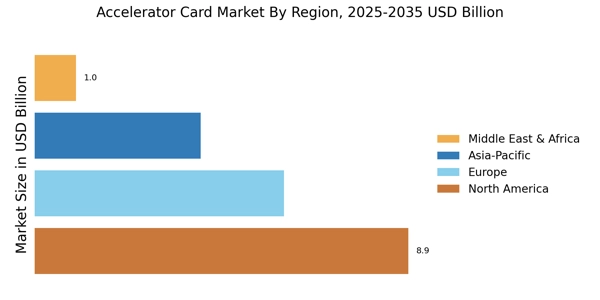
区域洞察

北美:创新市场领导者

北美是加速卡的最大市场,占全球市场份额的约45%。该地区的增长受到高消费支出、技术进步和鼓励数字支付的强大监管框架的推动。无接触支付和移动钱包的日益采用进一步推动了需求,使其成为金融科技领域的关键参与者。美国是该地区的领先国家,主要参与者如Visa Inc、Mastercard Inc和美国运通公司主导市场。竞争格局的特点是持续的创新和与金融科技公司的合作。加拿大也发挥了重要作用,随着其对数字支付解决方案的接受度提高,推动了整体增长。

欧洲:监管框架促进增长

欧洲是加速卡的第二大市场,占全球市场份额的约30%。该地区受益于强大的监管环境,包括支付服务指令(PSD2),促进支付领域的竞争和创新。电子商务和数字交易的增长趋势推动了对加速卡的需求,尤其是在西欧。该地区的主要国家包括德国、法国和英国,主要参与者如JCB Co Ltd和Diners Club International Ltd正在取得显著进展。竞争格局的特点是传统银行和新兴金融科技公司混合竞争,争夺市场份额。欧洲中央银行增强支付系统的举措进一步增强了市场的增长潜力。

亚太地区:新兴市场潜力

亚太地区的加速卡市场正在快速增长,占全球市场份额的约20%。该地区的增长受到城市化加速、中产阶级崛起和无现金交易转变的推动。中国和印度等国在这一转型中处于领先地位,政府倡导数字支付和金融包容性。中国是一个重要参与者,银联国际在市场中占据领先地位,而印度则见证了RuPay作为竞争替代品的崛起。竞争格局多样化,既有成熟的参与者,也有新进入者专注于创新解决方案,以捕捉不断增长的消费者基础。随着数字支付的采用持续上升,该地区的进一步增长潜力仍然巨大。

中东和非洲:未开发的市场机会

中东和非洲地区是加速卡的新兴市场,占全球市场份额的约5%。增长受到智能手机普及、年轻人口和政府倡议的推动,旨在增强金融包容性。南非和阿联酋等国处于前沿,数字支付解决方案的需求不断上升。在南非,当地参与者正在创新以满足多样化消费者基础的需求,而阿联酋则吸引国际参与者,试图利用其先进的金融基础设施。竞争格局正在演变,传统银行和金融科技初创公司混合竞争,争夺市场份额。随着数字支付的采用加速,该地区呈现出显著的增长机会。

Accelerator Card Market Regional Image

主要参与者和竞争洞察

领先的市场参与者正在大力投资研发,以扩展其产品线,这将进一步推动加速卡市场的增长。市场参与者还采取多种战略活动以扩大其全球足迹,重要的市场发展包括新产品发布、合同协议、并购、增加投资以及与其他组织的合作。为了在竞争激烈和不断增长的市场环境中扩展和生存,加速卡行业必须提供具有成本效益的产品。制造本地化以降低运营成本是制造商用来惠及客户和增加市场份额的关键商业策略之一。近年来,加速卡行业为医学提供了一些最重要的优势。加速卡市场的主要参与者,包括NVIDIA公司、英特尔公司、Leap Motion、Ditto Labs、Cypress Semiconductor Corporation、IBM、Alphabet Inc.、超威半导体公司、Achronix半导体公司、联想、SiliconBlue Technologies、Microsemi、Algolux、Oracle、Xilinx、Mad Street Den Inc、Lattice Semiconductor和Vantis PLC等,正试图通过投资研发活动来增加市场需求。创建和开发系统级芯片、中央计算和图形处理单元的公司称为NVIDIA公司(NVIDIA)。该公司的产品在游戏、数据中心、汽车和专业可视化行业销售。它还提供设计和可视化、边缘计算、高性能计算、自动驾驶汽车、数据中心、人工智能和数据科学的解决方案。对于消费者、专业人士、研究人员和开发人员,NVIDIA提供GeForce NOW、Quadro、GeForce、SHIELD、vGPU、DOCA、JESTON和Bluefield品牌下的产品。该公司的服务覆盖广泛的行业,包括建筑、工程、建筑、互联网、网络安全、能源、金融服务、医疗保健和生命科学,以及教育、游戏、制造、媒体和娱乐、零售、机器人技术、电信和运输。它在美洲、亚太和欧洲开展业务。NVIDIA总部位于美国加利福尼亚州圣克拉拉。联想集团有限公司是一家消费、商业和企业技术制造商。该公司制造和销售IT相关产品,包括服务器、大型机、个人计算机、移动设备和配件。其产品线包括游戏PC、手机、服务器、笔记本电脑和超极本、平板电脑、台式机、存储系统和配件。联想通过ThinkPad、ThinkBook、IdeaPad、Yoga、摩托罗拉和Legion品牌销售其设备。还提供一系列软件和服务。该公司服务于K-12教育、高等教育、健康、中小企业、大型组织和商业合作伙伴。它在墨西哥、印度和中国设有生产设施,并在美国、中国和日本设有研究设施。该公司在美洲、欧洲、中东、非洲和亚太地区开展业务。联想总部位于中国香港的鲗鱼涌。

Accelerator Card Market市场的主要公司包括

行业发展

在2020年: 一家技术行业领导者和半导体设计专家Arm被NVIDIA收购。凭借NVIDIA在GPU方面的经验和Arm的芯片设计及生态系统的结合,这一收购有可能彻底改变加速卡市场。

未来展望

Accelerator Card Market 未来展望

预计加速卡市场将在2025年至2035年期间以34.66%的年均增长率增长,推动因素包括技术进步、对数字支付解决方案的需求增加以及改善的消费者体验。

到2035年,加速卡市场预计将实现显著增长,巩固其在数字支付解决方案中的领导地位。

市场细分

加速卡市场应用前景

  • 视频和图像处理
  • 机器学习
  • 数据分析
  • 手机
  • 其他

加速卡市场处理器类型前景

  • 中央处理单元 (CPU)
  • 图形处理单元 (GPU)
  • 现场可编程门阵列 (FPGA)
  • 特定应用集成电路 (ASIC)

加速卡市场加速器类型前景

  • 高性能计算加速器
  • 云加速器

报告范围

FAQs

What is the current valuation of the Accelerator Card Market as of 2024?

The Accelerator Card Market was valued at 19.79 USD Billion in 2024.

What is the projected market valuation for the Accelerator Card Market in 2035?

The market is projected to reach a valuation of 522.57 USD Billion by 2035.

What is the expected CAGR for the Accelerator Card Market during the forecast period 2025 - 2035?

The expected CAGR for the Accelerator Card Market during 2025 - 2035 is 34.66%.

Which companies are considered key players in the Accelerator Card Market?

Key players include Visa Inc, Mastercard Inc, American Express Company, and Discover Financial Services.

What segment of the Accelerator Card Market had the highest valuation in 2024?

The Graphics Processing Units (GPU) segment had the highest valuation at 180.0 USD Billion.

How does the valuation of High-performance Computing Accelerators compare to Cloud Accelerators?

In 2024, High-performance Computing Accelerators were valued at 215.0 USD Billion, while Cloud Accelerators were valued at 307.57 USD Billion.

What applications are driving growth in the Accelerator Card Market?
Key applications include Mobile Phones, valued at 150.0 USD Billion, and Machine Learning, valued at 120.0 USD Billion.
What is the valuation of the Application-specific Integrated Circuit (ASIC) segment in 2024?
The Application-specific Integrated Circuit (ASIC) segment was valued at 132.57 USD Billion in 2024.
What is the projected growth trend for the Accelerator Card Market in the coming years?
The market is expected to experience substantial growth, driven by a CAGR of 34.66% from 2025 to 2035.
Which segment is expected to see the most growth in the Accelerator Card Market?
The Cloud Accelerator segment is likely to see significant growth, with a valuation of 307.57 USD Billion projected for 2035.
作者
Author
Author Profile
Ankit Gupta LinkedIn
Team Lead - Research
Ankit Gupta is a seasoned market intelligence and strategic research professional with over six plus years of experience in the ICT and Semiconductor industries. With academic roots in Telecom, Marketing, and Electronics, he blends technical insight with business strategy. Ankit has led 200+ projects, including work for Fortune 500 clients like Microsoft and Rio Tinto, covering market sizing, tech forecasting, and go-to-market strategies. Known for bridging engineering and enterprise decision-making, his insights support growth, innovation, and investment planning across diverse technology markets.

Research Approach

Research Methodology on Accelerator Card Market

The research methodology adopted for analysing the Accelerator Card market is a combination of primary and secondary research. To understand the dynamics of the market, in-depth secondary research was conducted using sources such as Annual reports, Product literature, press releases, research papers, investor presentations of the companies, white papers, government documents, statistical databases, trend reports and webcasts. The information thus gathered was utilized to deduce market estimates, which were further validated through primary interviews with company members and industry experts.

The period of the estimated forecast is 2023-2030. The research approach is qualitative and quantitative in nature.

I. Secondary Research:

In-depth secondary research was conducted to extract data from sources such as the Market Research Future Database, internal & external proprietary databases, white papers, annual & financial reports, industry magazines, business journals, investor presentations, government & industry associations, online paid databases/research portals, websites & directories.

The secondary research helps to identify & understand the overall scope & size of the market and the technologies associated with its segments. Secondary sources include press releases, company magazines, & shareholder presentations of the respective companies. The secondary data includes the demand for accelerator cards, the proposed product launches, developments in technology, increase in research activities and the income derived from the selling of accelerator cards to the end-users.

II. Primary Research:

In primary research, numerous in-depth interviews and discussions were conducted with many industry experts and opinion leaders on both the supply and demand side for collecting information and validating the market size and forecasts.

The interviews and discussions were conducted with experts such as C-level executives (CEOs, CFOs, COOs), regulatory authorities, industry experts and consultants from both the demand and supply side. For further validation, the cumulative data from these interviews was analysed.

III. Approaches Used:

The research approaches used in analysing the Accelerator Card market for the forecasting period 2023-2030 are bottom-up approach, top-down approach, factor analysis, and time-series analysis.

The bottom-up approach involves assessing the market’s multiplier effects by studying the most basic building blocks, i.e. the sales information about each product/service segment and their market size.

The top-down approach begins with a complete market outlook and prognosis, which is then segmented into various products/services under the study.

Data triangulation is used which involves verifying the data obtained from both primary and secondary sources, and then consolidating it to produce a proper market estimation. Market estimates derived from different data sources are gained and analysed.

IV. Demand Side and Supply Side Data Triangulation:

The demand-side triangulation approach refers to the study of the demand dynamics of the accelerator card market by analysing factors such as changes in prices of accelerator cards, availability of new products, and consumer preferences, and ultimately comparing the data obtained through the interviews. The supply-side triangulation approach is done to understand the expectations and needs of the producers such as manufacturers, suppliers, etc.

The demand-side data triangulation primarily focuses on analyzing the volume and value sales data of accelerator cards, which are divided into various end-user verticals and by various regions. The product and technology trends in accelerator cards are also being studied.

The supply side triangulation involves conducting primary interviews with industry experts to gain an insight into their views about the industry at large, their product offerings, product pricing and strategies and to validate the data obtained at the demand side.

V. Market Estimation:

The data collated and validated through various means was verified by conducting various independent surveys. The surveys also assist with analytic triangulation, which ultimately validates the accuracy of the market size and forecast of the Accelerator Card industry.

Data points that were considered to arrive at the market estimates include:

  • Historical data about the products and their commercialization
  • Problem-solving and demand-creation strategies adopted by the vendors
  • Key population sources and key stakeholders in the eco-system
  • Testimonials and reviews
  • Content captured from key industry experts, market participants, and opinion leaders
  • Demand and supply side triangulation
  • Estimated market sizes and forecast

VI. Market Breakdown and Data Triangulation:

As a part of the market breakdown, the ecosystem was analyzed to understand the potential segments. The market is split up into various criteria using both the bottom-up and top-down approaches and the data is validated using further triangulation techniques such as PESTEL analysis, Porter’s Five Forces Model, and Supply Chain Analysis.

The PESTEL analysis assesses the different macro-environmental factors such as political, economic, social, technological, environmental, and legal, which form potential opportunities and threats. Porter’s Five Forces model helps in analysing the competition in the accelerators card market by focusing on the bargaining power of buyers, the bargaining power of suppliers, the threat from new entrants or substitutes, the intensity of rivalry, and the threat of forward integration. The supply chain analysis is used to study the dependence of the industry’s supply chain on various participants and activities in the market.

VII. Assumptions:

The following assumptions are made in arriving at the market size:

  • Technology penetration and adoption rates of accelerator cards in the marketplace.
  • Demand and supply status of each product type
  • Macro-economic factors and legal & regulatory scenarios
  • Currency exchange rates
  • Regional splits
  • Growth profiles of the overall global and regional markets
  • Manufacturing cost structure

Conclusion:

To conclude, while making the market estimates and forecasts, different data sources, models, and mathematical algorithms were used to enhance the accuracy and confidence of the market estimates. The final numbers were triangulated using top-down analysis, bottom-up analysis, and involvement from different stakeholders across the value chain. This process triangulates the accuracy of the market size and also provides a better understanding of the global Accelerator Card market and its future outlook till 2030.

下载免费样本

请填写以下表格以获取本报告的免费样本

Download PDF ×

We do not share your information with anyone. However, we may send you emails based on your report interest from time to time. You may contact us at any time to opt-out.