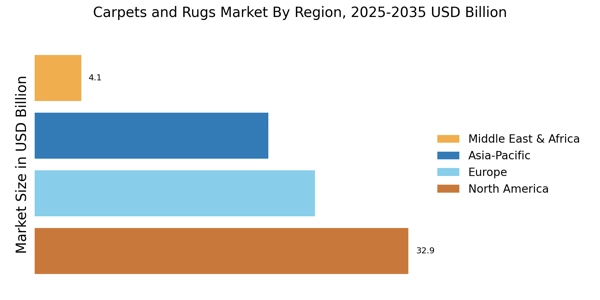
What is the current valuation of the Carpets and Rugs Market?
The Carpets and Rugs Market was valued at 82.12 USD Billion in 2024.

来源:二手资料研究、一手资料研究、MRFR 数据库和分析师评论
地毯和地垫市场趋势
例如,宜家系统于2020年8月推出了一个泰国街头风格系列,这些系列价格实惠且功能多样,其灵感来自回收、再利用和创意再利用。该系列融合了泰国街头风格和家居装饰专业知识,包括由PET瓶制成的靠垫和地毯。
此外,人们对地毯和地毯的需求不断增长,这归因于城市化率的提高和生活水平的提高。此外,消费者对由竹子、羊毛等材料制成的环保地毯的需求转变推动了市场的增长。
2022年4月:由Gossamer和艺术家Alex Proba共同打造的手工簇绒地毯系列,以创意和触感为理念。这款地毯将Proba的色彩设计与Gossamer的纹理配色方案相得益彰。这些色彩缤纷的定制地毯采用天然染色,共有四种主要颜色可供选择,例如粉色和红色、蓝色和薄荷绿、点缀着白色线条的质朴棕色、淡紫色圆点以及其他图案。这些地毯的纹理画布包含醒目的图案、曲线和 Proba 的标志性图案。
图 2:地毯和地垫市场,按材料划分,2021 年和2030 年(十亿美元)
来源:二手资料研究、一手资料研究、MRFR 数据库和分析师评论
此外,研究的主要国家包括美国、加拿大、德国、法国、英国、意大利、西班牙、中国、日本、印度、澳大利亚、韩国和巴西。
图 3:2021 年各地区地毯和地垫市场份额 (%)

来源:二手资料研究、一手资料研究、MRFR 数据库和分析师评论
亚太地区地毯和地垫市场占全球第二大市场份额的提升得益于该地区建筑活动的增多以及住宅和商业领域对不同类型地毯和地垫的需求不断增长。例如,2020 年 8 月,宜家推出了使用稻草的“印度制造”系列,即 FORANDRING。这是一个环保产品系列,包括地毯、灯罩和其他装饰品。该公司的主要重点是鼓励环保农业和减少污染。
地毯行业制造商为使客户受益并扩大地毯市场而采取的主要商业策略之一是本地生产,以降低运营成本。近年来,地毯和地毯为产品带来了一些最显著的优势。
地毯和地垫市场的主要公司包括
2022年1月:Tarkett 与 Reader's 批发分销商宣布合作。Reader's 将为德克萨斯州南部、路易斯安那州南部以及密西西比州中南部地区的商业和住宅客户提供公司丰富的产品系列。通过扩展分销网络,得嘉将能够更好地满足这些重要地区的住宅和商业客户的需求。得嘉和Reader强强联手,我们将能够通过强大而广泛的分销网络继续推动长期可持续发展,同时在所有市场提供一流的客户服务。
2022年6月:今天,Mannington Commercial宣布,所有将于2022年推出的全新和升级版地毯、豪华乙烯基地砖 (LVT)、橡胶和弹性片材产品都将实现105%的碳补偿。因此,顾客将能够安心购物,因为他们知道他们选择的商品将是碳负性的,或者至少是碳中性的。从原材料开采到制造,这些产品不会向环境中排放二氧化碳,而二氧化碳是温室气体排放的主要因素。为了加速公司运营和供应链的脱碳进程,这一举措至关重要。此外,它还解决了地板覆盖行业面临的三个最紧迫的环境问题:温室气体排放、可持续能源和废物转化。
The Carpets and Rugs Market was valued at 82.12 USD Billion in 2024.
The secondary research process involved comprehensive analysis of industry databases, trade publications, government construction statistics, and authoritative flooring industry organizations. Key sources included the US Census Bureau (Construction Spending & Building Permits), US Bureau of Labor Statistics (Producer Price Indices), Environmental Protection Agency (EPA) Carpet and Rug Industry Guidelines, US Consumer Product Safety Commission (CPSC) Federal Flammability Standards, European Chemicals Agency (ECHA) REACH Regulations, European Carpet and Rug Association (ECRA), Carpet and Rug Institute (CRI) Industry Statistics, World Floor Covering Association (WFCA), International Interior Design Association (IIDA), American Society of Interior Designers (ASID), National Association of Home Builders (NAHB), US International Trade Commission (USITC) Trade Database, UN Comtrade Database, International Trade Centre (ITC) Trade Map, ASTM International Standards (D-13 Textiles Committee), International Organization for Standardization (ISO 2424 Textile Floor Coverings), Food and Agriculture Organization (FAO) Wool and Natural Fiber Statistics, national statistics offices from key markets (China National Bureau of Statistics, Eurostat Construction Database, India Ministry of Textiles), and peer-reviewed journals including Textile Research Journal, Journal of Industrial Textiles, and Floor Covering Weekly reports. These sources were used to collect production volumes, trade flow data, raw material pricing trends, building construction metrics, sustainability certification data, and regulatory compliance standards across woven, tufted, knotted, and needle-punched carpet categories.
During the initial research process, both supply-side and demand-side stakeholders were interviewed to gather both qualitative and quantitative data. The supply-side sources were CEOs, VPs of Manufacturing, heads of Sustainability and Innovation, and commercial directors from carpet and rug makers, raw material suppliers (fiber producers, dye makers), and OEMs. Demand-side sources included interior designers, architects, commercial facility managers, procurement leads from the hotel and retail sectors, flooring contractors, and buying managers from specialty rug stores, home improvement chains, and e-commerce sites. Primary research established market segmentation across residential and commercial end-use sectors, confirmed sustainable product pipeline timescales, and gathered insights on specification patterns, commercial project bidding dynamics, and raw material substitution trends.
Primary Respondent Breakdown:
By Designation: C-level Primaries (40%), Director Level (25%), Others (35%)
By Region: North America (32%), Europe (30%), Asia-Pacific (28%), Rest of World (10%)
Global market valuation was derived through revenue mapping and production volume analysis. The methodology included:
Identification of 50+ key manufacturers across North America, Europe, Asia-Pacific, Middle East, and Latin America
Product mapping across woven, tufted, knotted, needle-punched, and other construction types
Material segmentation analysis covering nylon, polyester, polypropylene, wool, cotton, silk, jute, and emerging bio-based fibers
Analysis of reported and modeled annual revenues specific to carpet and rug portfolios, including residential versus commercial application splits
Coverage of manufacturers representing 75-80% of global market share in 2024
Extrapolation using bottom-up (square meter volume × ASP by country/region) and top-down (manufacturer revenue validation) approaches to derive segment-specific valuations, cross-referenced with construction spending data and housing starts metrics
请填写以下表格以获取本报告的免费样本
“This is really good guys. Excellent work on a tight deadline. I will continue to use you going forward and recommend you to others. Nice job”
“Thanks. It’s been a pleasure working with you, please use me as reference with any other Intel employees.”
“Thanks for sending the report it gives us a good global view of the Betaïne market.”
“Thank you, this will be very helpful for OQS.”
“We found the report very insightful! we found your research firm very helpful. I'm sending this email to secure our future business.”
“I am very pleased with how market segments have been defined in a relevant way for my purposes (such as "Portable Freezers & refrigerators" and "last-mile"). In general the report is well structured. Thanks very much for your efforts.”
“I have been reading the first document or the study, ,the Global HVAC and FP market report 2021 till 2026. Must say, good info! I have not gone in depth at all parts, but got a good indication of the data inside!”
“We got the report in time, we really thank you for your support in this process. I also thank to all of your team as they did a great job.”