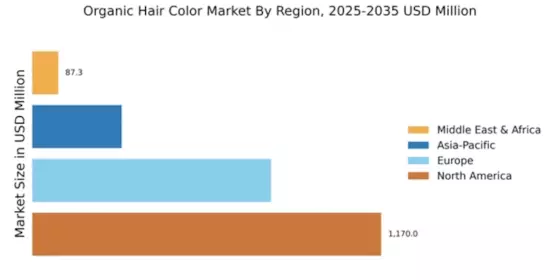
亚太地区的市场规模为0.45,正在见证有机染发细分市场的快速增长。这一激增归因于可支配收入的增加、城市化以及对有机产品益处的日益认识。日本和澳大利亚等国正在引领潮流,消费者越来越倾向于选择天然替代品,以避免传统染发剂中常见的刺激性化学物质。竞争格局正在演变,本地和国际品牌都在争夺市场份额。Naturtint和Tints of Nature等公司正在扩大其市场份额,以满足对有机选择日益增长的需求。该地区多样化的消费者基础带来了独特的挑战和机遇,因为品牌必须适应不同的偏好和监管环境。随着市场的成熟,创新和质量将是成功的关键驱动因素。
有机染发市场目前的特点是动态竞争格局,受到消费者对天然和可持续美容产品需求增加的推动。主要参与者积极参与创新策略,以获取市场份额并增强品牌忠诚度。例如,Herbatint(意大利)通过强调其对天然成分和环保实践的承诺,确立了自己在有机细分市场的领导地位。同样,Aveda(美国)继续利用其在可持续性方面的强大品牌遗产,专注于产品创新和道德采购,以吸引环保意识强的消费者。这些策略共同促成了一个优先考虑质量和可持续性的竞争环境,而不是传统的营销策略。在商业战术方面,公司越来越多地本地化生产,以减少碳足迹并优化供应链。这种方法不仅提高了运营效率,还与消费者对本地采购产品日益增长的偏好相一致。市场结构似乎适度分散,几个主要参与者影响着趋势和消费者选择。这些公司的集体行动表明,行业正在向更集成和可持续的运营模式转变,这可能会重新定义该行业的竞争动态。2025年11月,Madison Reed(美国)宣布推出一系列专为敏感肌肤设计的有机染发产品。这一战略举措表明该公司关注包容性和满足多样化消费者需求。通过扩展产品范围,Madison Reed旨在吸引更广泛的受众,特别是那些在有机染发细分市场中之前未得到充分服务的消费者。这一举措不仅增强了品牌忠诚度,还使公司在快速发展的市场中成为一个响应迅速的参与者。2025年10月,Naturtint(西班牙)与一家领先的有机成分供应商建立了合作关系,以提高其产品的质量和可持续性。这一合作在战略上具有重要意义,因为它强调了Naturtint对透明度和质量的承诺,这对消费者来说越来越重要。通过确保其成分的负责任来源,该公司可能会加强其市场地位,并吸引越来越多优先考虑道德消费的人群。2025年9月,Tints of Nature(英国)推出了一项数字营销活动,旨在教育消费者有关有机染发的好处。这一举措反映了美容行业向数字化的更广泛趋势,企业正在利用在线平台直接与消费者互动。通过关注教育和意识,Tints of Nature不仅增强了品牌的可见性,还培养了一个更有信息的消费者基础,重视有机产品的好处。截至2025年12月,有机染发市场的竞争趋势越来越多地由数字化、可持续性和先进技术的整合所定义。主要参与者之间的战略联盟正在塑造市场格局,促进创新并增强供应链的可靠性。从基于价格的竞争转向关注创新和技术的转变是显而易见的,这表明公司需要通过独特的产品供应和可持续实践来区分自己,以在这一不断发展的市场中蓬勃发展。
关键参与者包括Herbatint、Naturtint、Tints of Nature、Madison Reed、Oway、EcoColors、Sante、Aveda和Logona。
染发市场细分在估值方面表现如何?
染发细分预计将从94万美元增长到295万美元,到2035年。
到2035年,染发高光细分的预计估值是多少?
染发高光细分预计将从71万美元增长到225万美元,到2035年。
有机染发市场在线零售分销渠道的预期增长是多少?
在线零售渠道预计将从71万美元增长到238万美元,到2035年。
年龄组的人口细分在有机染发市场的表现如何?
年龄组人口细分预计将从75万美元增长到250万美元,到2035年。
市场上半永久配方类型的估值趋势是什么?
半永久配方类型预计将从71万美元增长到230万美元,到2035年。
到2035年,美发沙龙分销渠道的预计估值是多少?
美发沙龙渠道预计将从59万美元增长到193万美元,到2035年。
作者
Author
Pradeep Nandi
Senior Research Analyst
I have a bachelor's degree in mechanical engineering and an MBA. I have more than two years of expertise in the retail, food, and beverage, chemical, and material industries, and hence have developed a sound cross-domain expertise. A firm believer in lifelong learning and sharing of knowledge. Having a proclivity for hatching ideas and trying to absorb as much information as possible in a short amount of time. Introducing corporates to the data and insight, which enables them to move from probability to possibility, has been my key areas of interest.
The secondary research process involved comprehensive analysis of regulatory databases, peer-reviewed clinical journals, cosmetic chemistry publications, and authoritative health and safety organizations. Key sources included the US Food & Drug Administration (FDA) Center for Food Safety and Applied Nutrition (CFSAN), European Chemicals Agency (ECHA) CosIng Database, European Commission Health and Consumers Directorate-General (DG SANTE) Cosmetics Regulation (EC) No 1223/2009, USDA National Organic Program (NOP), ECOCERT and COSMOS-standard AISBL organic certification databases, Personal Care Products Council (PCPC), Cosmetics Europe, Health Canada Cosmetics Program, ASEAN Cosmetics Directive regulatory frameworks, National Center for Biotechnology Information (NCBI/PubMed) toxicology and dermatology studies regarding p-phenylenediamine (PPD) alternatives, Soil Association (UK) organic beauty standards, Environmental Working Group (EWG) Skin Deep Database, Mintel Global New Products Database (GNPD), Euromonitor International Beauty and Personal Care Statistics, and national cosmetic safety bureaus from key markets. These sources were used to collect formulation data, organic certification compliance matrices, clinical safety studies on botanical dye sensitivities (henna, indigo, cassia), consumer allergen reporting, import-export trade data for organic cosmetic ingredients, and competitive intelligence on plant-based formulation innovations.
Primary Research
During the initial research phase, we talked to both supply-side and demand-side players to get both qualitative and quantitative information about formulation chemistry, clean beauty positioning, and channel dynamics. Supply-side sources included CEOs, Chief Sustainability Officers, VPs of Product Development (formulation chemists who work with oxidative and non-oxidative plant-based dyes), heads of Regulatory Affairs (who work with COSMOS/ECOCERT/USDA organic certification), and commercial directors from companies that make organic hair color, contract manufacturers (OEM/ODM), and raw material suppliers (botanical extract providers, henna/indigo cultivators, bio-based surfactant suppliers). Demand-side sources included professional trichologists, board-certified dermatologists who specialize in contact dermatitis, master hair colorists and salon owners in high-end, eco-friendly markets, procurement leads from specialty beauty retailers (Sephora, Ulta, Detox Market), e-commerce platform beauty category buyers, and medical spa directors.
Primary research validated market segmentation across formulation permanency categories, confirmed product pipeline timelines for ammonia-free and PPD-free innovations, gathered insights on clinical adoption patterns in professional salon versus at-home DIY segments, analyzed pricing strategies comparing premium organic positioning to conventional colorants, and assessed omnichannel distribution dynamics between professional beauty supply and direct-to-consumer wellness platforms.
Primary Respondent Breakdown:
By Designation: C-level Primaries (32%), Director Level (30%), Others (38%)
By Region: North America (32%), Europe (30%), Asia-Pacific (28%), Rest of World (10%)
Market Size Estimation
Global market valuation was derived through revenue mapping and unit sales analysis across professional salon and consumer retail channels. The methodology included:
Identification of 40+ key manufacturers across North America, Europe, Asia-Pacific, and Latin America, spanning dedicated organic/natural brands and clean beauty divisions of multinational personal care corporations
Product mapping across permanent oxidative (low-ammonia/ammonia-free), semi-permanent botanical, temporary color conditioners, and demi-permanent deposit-only formulations
Analysis of reported and modeled annual revenues specific to organic-certified and naturally-derived hair color portfolios, distinguishing from conventional synthetic product lines
Coverage of manufacturers representing 75-80% of global market share in 2024, accounting for the fragmented nature of artisanal and regional organic formulators
Extrapolation using bottom-up (channel-specific unit volume × blended ASP by country, adjusted for professional salon service markups versus retail direct-to-consumer pricing) and top-down (manufacturer revenue validation against trade import data for organic cosmetic dye precursors) approaches to derive segment-specific valuations by formulation type, application method, and distribution channel
“This is really good guys. Excellent work on a tight deadline. I will continue to use you going forward and recommend you to others. Nice job”
Noah MalgeriCo-Founder
“Thanks. It’s been a pleasure working with you, please use me as reference with any other Intel employees.”
Joseph AguayoSales Operations & Pricing Manager
“Thanks for sending the report it gives us a good global view of the Betaïne market.”
Peter Groot koerkampAccount and Business Manager
“Thank you, this will be very helpful for OQS.”
La Terria DoddProgram Support Specialist
“We found the report very insightful! we found your research firm very helpful. I'm sending this email to secure our future business.”
Younghwan ChoiSenior Retail Manager
“I am very pleased with how market segments have been defined in a relevant way for my purposes (such as "Portable Freezers & refrigerators" and "last-mile").
In general the report is well structured. Thanks very much for your efforts.”
Mark IrwinManagement Consultant
“I have been reading the first document or the study, ,the Global HVAC and FP market report 2021 till 2026. Must say, good info! I have not gone in depth at all parts, but got a good indication of the data inside!”
Rob KooikerGroup Product Manager HVAC & Fire Protection GMA
“We got the report in time, we really thank you for your support in this process. I also thank to all of your team as they did a great job.”
Akif MorogluStrategy & Business Development Director
“The Automotive 48V ECU Components Procurement Intelligence Study” was a complex project, but the Market Research Future (MRFR) team handled it with quality, agility, and customer-centricity. They delivered all requested data on time and within the agreed scope. The team, including Shubhendra Anand and Rahul Gotadki, was always readily available to clarify questions and swiftly implement necessary adjustments, driving the project to a successful conclusion within a very demanding timeframe.
I would also like to specifically commend Akshay Agarwal for his responsiveness and support at every stage—from our initial inquiry on May 6th through to final delivery on June 18th. His dedication made the entire process seamless.”
Guilherme Gomes MartinsProduct Management Director