Digital Twin Market Summary
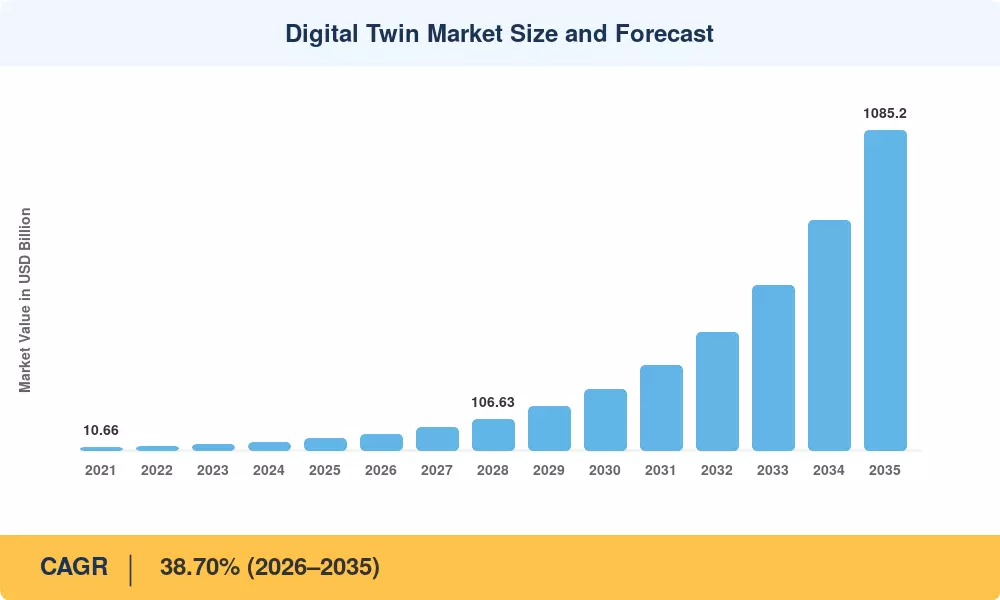
Der Markt für digitale Zwillinge wurde 2025 auf 39,45 Milliarden USD geschätzt und soll 2026 53,60 Milliarden USD erreichen, bevor er bis 2035 auf 1.085,20 Milliarden USD ansteigt, was einer CAGR von 38,70 % im Prognosezeitraum 2026–2035 entspricht. Diese Beschleunigung beruht auf zwei zusammenlaufenden Kräften: der weit verbreiteten Reifung von industriellen IoT-Plattformen und einer Welle von staatlichen Vorgaben, die einen digitalen Zwilling in Echtzeit für das Management von Energienetzen in sicherheitskritischen Infrastrukturen in den USA, der EU und China vorschreiben. Die Zuweisung des US-Energieministeriums von 1,2 Milliarden USD im Jahr 2024 für Programme zur Modernisierung von Netzen sieht speziell digitale Nachbildungskapazitäten für die Überwachung von Übertragungen vor [2].
Physik-informierte, cloud-native Simulationsumgebungen, die Sensordaten, KI-Inferenz und 3D-Visualisierung kombinieren, ersetzen veraltete, isolierte SCADA- und CAD-basierte Designverfahren. Die globalen Ausgaben für IoT-basierte digitale Zwillinge für intelligente Fertigung überstiegen 2024 8 Milliarden USD, angeführt von Automobil-OEMs und Halbleiterfabriken, die 12–18 % Ertragssteigerungen durch virtuelle Prozessoptimierung anstreben [3]. Der industrielle digitale Zwilling für prädiktive Wartung liegt bereits mehr als 40 % der neuen Verträge zur Zustandsüberwachung zugrunde, die von Tier-1-Ausrüstungsanbietern unterzeichnet wurden [4].
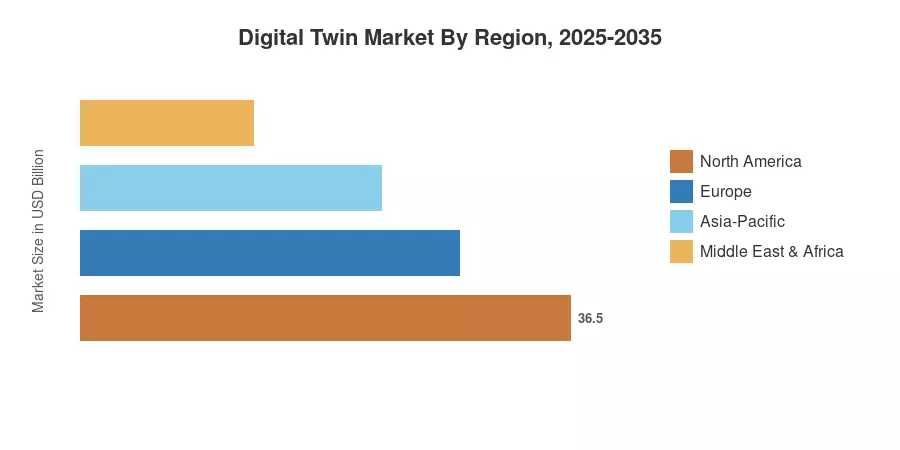
Nordamerika hält über 41,0 % des Marktes für digitale Zwillinge, angetrieben von digitalen Fadenprogrammen im Verteidigungssektor und Ausgaben für Hyperscaler-Clouds. Der asiatisch-pazifische Raum ist das am schnellsten wachsende Gebiet mit einer erwarteten CAGR von 28,10 %, gefördert durch Chinas Vision "Digital China 2035" und Indiens Smart Cities Mission. Europa hat den zweithöchsten Anteil mit etwa 26,5 %, wobei Deutschland und Frankreich in der Übernahme in den Bereichen Automobil und Luftfahrt führend sind. Der Markt für digitale Zwillinge wird die Art und Weise verändern, wie Unternehmen physische Vermögenswerte aller Größen im nächsten Jahrzehnt entwickeln, betreiben und stilllegen.
Wichtige Erkenntnisse aus dem Bericht
• Nach Anwendung
- Die Fertigung machte 2025 37,90 % des Marktanteils der digitalen Zwillinge aus, was auf etablierte Smart-Factory-Implementierungen in der Automobil-, Elektronik- und Schwerindustrie hinweist.
- Öl & Gas wird voraussichtlich mit einer CAGR von 30,20 % bis 2035 wachsen, da Produzenten digitale Zwillinge zur Sicherstellung der Anlagenintegrität übernehmen, um ungeplante Ausfallzeiten in Offshore- und Raffineriebetrieben zu reduzieren.
• Nach Komponente
- Lösungen und Plattformen erfassten 2025 einen Umsatzanteil von 67,50 % im Markt für digitale Zwillinge, angeführt von Simulationssoftware-Suiten und IoT-Middleware.
- Dienstleistungen werden voraussichtlich mit einer CAGR von 32,40 % bis 2035 wachsen, da Unternehmen Systemintegration und Expertise im Bereich Managed Twin suchen.
• Nach Region
- Nordamerika führte 2025 mit 41,0 % des Marktes für digitale Zwillinge.
- Der asiatisch-pazifische Raum wird voraussichtlich mit einer CAGR von 28,10 % bis 2035 steigen, angetrieben von öffentlichen Digitalisierungsprogrammen in China, Indien und Japan.
Das proprietäre Größenbestimmungsframework von MRFR trianguliert die Einnahmen der Anbieter von unten nach oben, makroökonomische Variablen von oben nach unten und primäre Interviews mit über 120 Branchenakteuren, um sowohl historische als auch prognostizierte Schätzungen zu erhalten. Alle Beträge sind in aktuellen USD-Milliarden und stellen Werte zum Jahresende dar.