Erweiterter Realität Markt

Marktforschungsbericht zur erweiterten Realität (XR) nach Anwendung (Gaming, Bildung, Gesundheitswesen, Immobilien, Militär), nach Technologie (Virtuelle Realität, Augmented Reality, Mischrealität), nach Endnutzung (Verbraucher, Gewerbe, Industrie), nach Gerätetyp (Head-Mounted Displays, Smartphones, Tablets, tragbare Geräte) und nach Region (Nordamerika, Europa, Südamerika, Asien-Pazifik, Naher Osten und Afrika) - Prognose bis 2035.
ID: MRFR/ICT/7080-CR
111 Pages
Ankit Gupta
Last Updated: July 29, 2026
Extended Reality (XR) Market
Market Size
Forecast Period2025 - 2035
CAGR (2025 - 2035)17.41%
2024 Market Size$ 51.32 Billion
2025 Market Size$ 60.25 Billion
2035 Market Size$ 299.95 Billion
Key Players
Meta Platforms
Microsoft
Apple
Google
Sony
NVIDIA
Opportunities
  • Advancements in Hardware Technology
  • Integration of Artificial Intelligence
  • Rising Investment in Augmented Reality

Erweiterter Realität Markt Zusammenfassung

Laut der Analyse von MRFR wurde die Größe des Marktes für erweiterte Realität im Jahr 2024 auf 51,32 Milliarden USD geschätzt. Die Branche der erweiterten Realität wird voraussichtlich von 60,25 Milliarden USD im Jahr 2025 auf 299,95 Milliarden USD bis 2035 wachsen, was einer durchschnittlichen jährlichen Wachstumsrate (CAGR) von 17,41 während des Prognosezeitraums 2025 - 2035 entspricht.

Wichtige Markttrends & Highlights

Der Markt für erweiterte Realität erlebt ein robustes Wachstum, das durch vielfältige Anwendungen in verschiedenen Sektoren vorangetrieben wird.

  • Der Markt verzeichnet eine zunehmende Akzeptanz im Gesundheitswesen, was die Patientenversorgung und die Schulungsmethoden verbessert.\r\nRemote-Zusammenarbeitstools erweitern sich und ermöglichen nahtlose Kommunikation und Teamarbeit über geografische Grenzen hinweg.\r\nGaming bleibt das größte Segment, während Bildung als der am schnellsten wachsende Sektor im Bereich der erweiterten Realität hervorgeht.\r\nWichtige Markttreiber sind ein Anstieg der Nachfrage nach Schulungen und Simulationen sowie steigende Investitionen in Technologien der erweiterten Realität.

Marktgröße & Prognose

2024 Market Size 51.32 (USD Billion)
2035 Market Size 299.95 (USD Billion)
CAGR (2025 - 2035) 17.41%

Hauptakteure

Meta Platforms (US), Microsoft (US), Apple (US), Google (US), Sony (JP), NVIDIA (US), HTC (TW), Samsung (KR), Unity Technologies (US)

Erweiterter Realität Markt Treiber

Advancements in Hardware Technology

Advancements in hardware technology are playing a crucial role in shaping the Extended Reality Market. The development of more powerful and affordable devices, such as headsets and smart glasses, is making extended reality experiences more accessible to a broader audience. Innovations in display technology, such as higher resolution screens and improved field of view, enhance the overall user experience, making applications more immersive and engaging. Furthermore, the introduction of standalone devices that do not require external hardware is likely to drive adoption rates among consumers and businesses alike. As hardware continues to evolve, the Extended Reality Market is expected to benefit from increased user engagement and a wider range of applications across different sectors.

Integration of Artificial Intelligence

The integration of artificial intelligence into the Extended Reality Market is poised to revolutionize user experiences and application capabilities. AI technologies enhance the interactivity and personalization of extended reality applications, allowing for more intuitive user interfaces and adaptive learning environments. For example, AI algorithms can analyze user behavior in real-time, adjusting the virtual environment to optimize engagement and learning outcomes. This synergy between AI and extended reality is expected to drive market growth, with projections indicating that the AI-enhanced segment of the Extended Reality Market could account for a substantial share by 2026. As companies invest in AI-driven solutions, the Extended Reality Market will likely witness a transformation in how users interact with digital content.

Rising Investment in Augmented Reality

Investment in augmented reality technologies is on the rise, significantly impacting the Extended Reality Market. Companies across various sectors, including retail, real estate, and education, are increasingly leveraging augmented reality to enhance customer engagement and improve operational efficiency. For instance, retailers are utilizing AR applications to provide virtual try-on experiences, allowing customers to visualize products before making a purchase. Recent statistics indicate that the augmented reality segment is expected to grow at a compound annual growth rate of over 40% in the next few years. This influx of investment is likely to drive innovation and expand the range of applications within the Extended Reality Market, fostering a competitive landscape that encourages the development of new solutions.

Surge in Demand for Training and Simulation

The Extended Reality Market is experiencing a notable surge in demand for training and simulation applications across various sectors. Industries such as aviation, military, and healthcare are increasingly adopting immersive technologies to enhance training effectiveness. For instance, the use of virtual reality simulations allows trainees to engage in realistic scenarios without the associated risks. According to recent data, the training segment within the Extended Reality Market is projected to grow at a compound annual growth rate of over 30% in the coming years. This growth is driven by the need for cost-effective and efficient training solutions that can be tailored to specific industry requirements. As organizations recognize the benefits of immersive training, the Extended Reality Market is likely to see further expansion in this domain.

Growing Interest in Virtual Events and Experiences

The growing interest in virtual events and experiences is significantly influencing the Extended Reality Market. As organizations seek innovative ways to connect with audiences, virtual reality and augmented reality are being utilized to create immersive event experiences that transcend geographical limitations. This trend is particularly evident in sectors such as entertainment, education, and corporate training, where virtual events are becoming more prevalent. Recent data suggests that the market for virtual events is expected to grow substantially, with many companies investing in extended reality solutions to enhance audience engagement. As the demand for virtual experiences continues to rise, the Extended Reality Market is likely to see an influx of new applications and services designed to meet this evolving need.
Einblicke in Marktsegmente

By Application: Gaming (Largest) vs. Education (Fastest-Growing)

In the Extended Reality Market, the 'Gaming' application leads in market share, capturing a substantial portion of user engagement and investment. This segment has consistently attracted users with immersive experiences, leveraging advanced technologies to create engaging environments. Meanwhile, 'Education' is gaining momentum, rapidly expanding its footprint as more educational institutions and learning platforms integrate extended reality to enhance instructional methods and student engagement.

Gaming (Dominant) vs. Education (Emerging)

The 'Gaming' segment is characterized by extensive investment in immersive technology, creating compelling experiences that captivate users. This dominance is driven by advancements in VR and AR, enabling developers to produce high-quality games that appeal to a wide audience. Conversely, the 'Education' segment, while currently emerging, is experiencing accelerated growth as it adopts extended reality to facilitate interactive learning environments. This segment focuses on utilizing these technologies to improve training, simulations, and student engagement, thus attracting significant attention and investment for its potential to reshape educational methodologies.

By Technology: Virtual Reality (Largest) vs. Augmented Reality (Fastest-Growing)

In the Extended Reality Market, Virtual Reality (VR) currently stands as the largest segment, commanding a significant portion of the market share. This technology is predominantly adopted in gaming, entertainment, and training applications, thus giving it a robust market presence. In contrast, Augmented Reality (AR) is emerging rapidly, gaining traction across various industries, including retail, healthcare, and education, due to its versatile applications and user engagement strategies. The growth trends indicate a dynamic shift toward AR, where user-friendly solutions and continuous technological advancements are driving adoption. Furthermore, advancements in mobile technology and software integration bolster AR's market potential, as it becomes a preferred option for businesses seeking innovative ways to enhance customer experiences. Both segments are expected to witness significant growth, fuelled by increasing investment in technology development and application diversification.

Virtual Reality: Dominant vs. Augmented Reality: Emerging

Virtual Reality (VR) serves as the dominant segment within the Extended Reality Market, characterized by immersive environments that replace the user's real-world surroundings. This technology has made significant strides in various applications, such as gaming, simulations, and training, thereby enhancing user engagement through its interactive nature. VR attracts major investments, indicating its strong market position and potential for further evolution. Conversely, Augmented Reality (AR) is positioned as an emerging segment, characterized by its ability to overlay digital information onto the real world. AR's versatility allows for innovative applications in fields like retail, where it enhances shopping experiences through virtual trials, and healthcare, where it's utilized for surgical simulations. With a focus on user experience and accessibility, AR is witnessing faster adoption rates, indicating its vital role in shaping the future of the Extended Reality Market.

By End Use: Consumer (Largest) vs. Commercial (Fastest-Growing)

In the Extended Reality Market, the distribution of end use segments reveals that the consumer sector holds the largest share, primarily driven by the increasing adoption of VR and AR technologies in gaming and entertainment. The consumer segment benefits from a growing number of devices and applications, enhancing accessibility and appeal to a broader audience. On the other hand, the commercial segment is rapidly expanding, fueled by businesses leveraging Extended Reality Market for training, marketing, and customer engagement, highlighting a shift towards immersive experiences in professional settings.

End Use: Consumer (Dominant) vs. Commercial (Emerging)

The consumer segment in the Extended Reality Market is characterized by a strong dominance, as it encompasses a wide range of VR and AR applications tailored for entertainment, gaming, and social interaction. This segment is heavily influenced by major technological advancements and content creation, leading to a steady influx of innovative products. Conversely, the commercial segment, while emerging, is experiencing exponential growth as organizations adopt Extended Reality Market for competitive advantages. This includes training simulations, virtual meetings, and product showcases, propelling businesses into a new era of customer interaction and operational efficiency. The increasing emphasis on experiential marketing and training in sectors such as retail and real estate is particularly driving this transition.

By Device Type: Head-Mounted Displays (Largest) vs. Wearable Devices (Fastest-Growing)

In the Extended Reality Market, Head-Mounted Displays hold the largest market share due to their extensive usage in gaming and training simulations. These devices have become a standard for immersive experiences, capturing the attention of both consumers and enterprises. On the other hand, smartphones and tablets also contribute significantly, thanks to their accessibility and growing AR capabilities. However, they lag behind Head-Mounted Displays in terms of specialized applications and user engagement. The growth trends in the Extended Reality Market indicate a surge in interest towards wearable devices, which are rapidly becoming the fastest-growing segment. Factors driving this growth include advancements in technology, increasing demand for health and fitness applications, and integration with IoT. This trend highlights a shift towards more personal and compact devices, fostering a more immersive experience wherever users go.

Head-Mounted Displays (Dominant) vs. Wearable Devices (Emerging)

Head-Mounted Displays are considered the dominant device in the Extended Reality Market due to their superior immersive capabilities, which are essential for applications in gaming, training, and simulation environments. These devices provide users with unparalleled engagement and interaction, leading to widespread adoption among both consumers and businesses. They have well-established ecosystems and are supported by continuous innovation from leading technology companies. Conversely, wearable devices are emerging as a significant player, driven by advancements in miniaturization and functionality. These devices often incorporate features that promote health tracking, fitness monitoring, and enhanced user experiences through augmented reality. As consumers increasingly seek convenient solutions that integrate seamlessly into their daily lives, the demand for wearable devices is expected to grow, positioning them as an essential component of the Extended Reality Market landscape.

Erhalten Sie detailliertere Einblicke zu Erweiterter Realität Markt

Regionale Einblicke

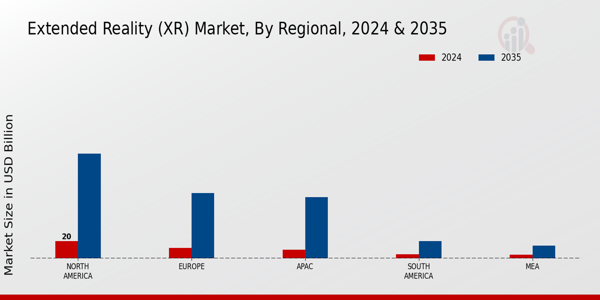
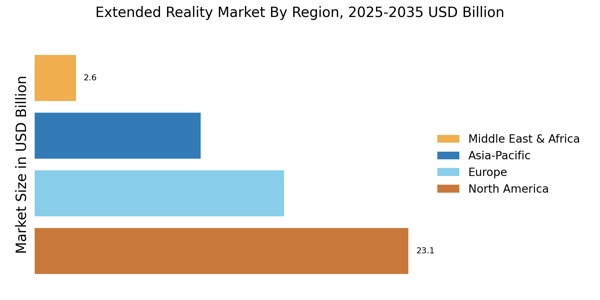
Der Markt für erweiterte Realität (XR) steht vor robustem Wachstum in verschiedenen Regionen, was ein starkes Interesse und Investitionen in Technologien im Zusammenhang mit virtueller Realität, erweiterter Realität und immersiven Erfahrungen widerspiegelt. Im Jahr 2024 hält Nordamerika einen signifikanten Marktanteil von 20,0 Milliarden USD, angetrieben durch eine hohe Akzeptanzrate von XR-Technologien sowohl bei Unternehmen als auch bei Verbrauchern, die bis 2035 voraussichtlich 120,0 Milliarden USD erreichen wird und damit die Landschaft dominiert. Europa folgt mit einer Marktbewertung von 12,0 Milliarden USD im Jahr 2024, die auf 75,0 Milliarden USD wächst und von starken Forschungs- und Entwicklungsinitiativen sowie einer florierenden Gaming-Industrie profitiert.

Die APAC-Region, die im Jahr 2024 mit 10,0 Milliarden USD bewertet wird und bis 2035 voraussichtlich 70,0 Milliarden USD erreichen wird, exemplifiziert eine schnelle technologische Akzeptanz, wobei Länder wie China und Japan führend in XR-Innovationen sind. Südamerika, obwohl kleiner, zeigt Potenzial mit 5,0 Milliarden USD im Jahr 2024, das voraussichtlich auf 20,0 Milliarden USD ansteigt, da lokale Unternehmen beginnen, XR für verbesserte betriebliche Effizienzen zu nutzen. In der Zwischenzeit hat der Nahe Osten und Afrika (MEA) im Jahr 2024 einen Marktwert von 4,32 Milliarden USD, der auf 15,0 Milliarden USD wächst, was die allmähliche Akzeptanz von XR-Technologien zeigt, die durch Bildungs- und Gesundheitssektoren vorangetrieben wird.

Jede Region trägt auf einzigartige Weise zur Gesamtwachstumsdynamik des Marktes für erweiterte Realität (XR) bei, während sie mit unterschiedlichen Herausforderungen und Chancen innerhalb ihrer lokalen Volkswirtschaften konfrontiert ist.

Markt für erweiterte Realität (XR) Regionale Einblicke

Quelle: Primärforschung, Sekundärforschung, Marktforschungszukunft Datenbank und Analystenbewertung

Erweiterter Realität Markt Regional Image

Hauptakteure und Wettbewerbseinblicke

Der Markt für erweiterte Realität (XR) ist eine sich entwickelnde und wettbewerbsintensive Landschaft, die durch rasante Fortschritte und die wachsende Akzeptanz innovativer Technologien wie virtuelle Realität (VR), erweiterte Realität (AR) und gemischte Realität (MR) gekennzeichnet ist. Dieser Markt wird zunehmend von einer Vielzahl von Faktoren beeinflusst, darunter technologische Entwicklungen, Verbrauchernachfrage und die Integration von XR in verschiedene Sektoren wie Gaming, Gesundheitswesen, Bildung und Unternehmenslösungen. Unternehmen bemühen sich ständig, ihre Angebote zu differenzieren und immersive Erlebnisse zu schaffen, die das Benutzerengagement erhöhen und gleichzeitig die unterschiedlichen Bedürfnisse ihrer Zielgruppen ansprechen.

Während die Grenzen zwischen der physischen und der digitalen Welt verschwimmen, zeigen wettbewerbliche Einblicke ein Rennen nicht nur um technologische Fähigkeiten, sondern auch um die Schaffung skalierbarer und benutzerfreundlicher Plattformen, die Marktanteile gewinnen und Markentreue fördern können. HTC hat sich als bedeutender Akteur im Markt für erweiterte Realität (XR) etabliert, mit starker Markenbekanntheit und einer reichen Geschichte im VR-Bereich. Das Unternehmen verfügt über ein robustes Portfolio an XR-Produkten, einschließlich Headsets und Softwareplattformen, die sowohl Verbraucher als auch Unternehmen ansprechen.

Die Stärken von HTC liegen in seinem innovativen Ansatz zur Benutzererfahrung und seinem Engagement, die VR-Technologie mit hochwertiger Hardware und Content-Partnerschaften zu verbessern. Das Unternehmen hat auch bedeutende Fortschritte beim Aufbau eines globalen Vertriebsnetzes gemacht, das es ihm ermöglicht, ein breites Publikum zu erreichen, während es sich auf die Unterstützung von Entwicklern und die Einbindung der Community konzentriert, um die Akzeptanz zu fördern. Dieser strategische Fokus auf den Aufbau eines umfassenden Ökosystems rund um seine XR-Angebote hat HTC geholfen, einen Wettbewerbsvorteil zu wahren und starke Beziehungen innerhalb der XR-Community zu fördern.

Valve ist ein weiterer wichtiger Akteur im Markt für erweiterte Realität (XR), der für seine besonderen Beiträge zum Gaming-Segment durch innovative Technologien und Plattformen anerkannt ist. Das Unternehmen ist bekannt für die Entwicklung der SteamVR-Plattform und Hardwareangebote wie das Valve Index-Headset, die bei Gamern und Entwicklern gleichermaßen erheblichen Anklang gefunden haben. Die Stärken von Valve umfassen seine starke Präsenz in der Gaming-Industrie, kontinuierliche Verbesserungen der VR-Erlebnisse und die Unterstützung sowohl von Inhouse- als auch von Drittanbieter-Inhalten. Das Unternehmen hat aktiv Partnerschaften und Kooperationen angestrebt, um seine Reichweite zu erweitern und seine technologischen Fähigkeiten zu verbessern.

In den letzten Jahren war Valve auch an Fusionen und Übernahmen beteiligt, die darauf abzielen, sein XR-Ökosystem zu stärken und seine Wettbewerbsposition auf dem globalen Markt zu festigen. Dieser strategische Fokus auf Innovation und Zusammenarbeit positioniert Valve als einen ernstzunehmenden Wettbewerber im sich schnell entwickelnden XR-Bereich.

Zu den wichtigsten Unternehmen im Erweiterter Realität Markt-Markt gehören

Branchenentwicklungen

Der Markt für erweiterte Realität (XR) hat kürzlich bedeutende Entwicklungen erlebt, insbesondere mit Fortschritten in der Hardware und Software. Unternehmen wie Meta und Qualcomm investieren stark in XR-Technologien und verbessern weiterhin ihre Plattformfähigkeiten. Mit der Veröffentlichung des Vision Pro-Headsets von Apple im Oktober 2023 wurden die Erwartungen der Branche erhöht, was das Engagement des Unternehmens für hochwertige XR-Erlebnisse zeigt. Im Hinblick auf Fusionen und Übernahmen gab NVIDIA im September 2022 die Übernahme von Arm bekannt, um sein Technologieportfolio für XR-Anwendungen zu erweitern. Außerdem erwarb Microsoft im März 2023 Activision Blizzard, wodurch es seine Präsenz im Gaming- und XR-Bereich stärkt.

Das Wachstum der Marktbewertung von Unternehmen wie Epic Games und Sony wird durch die steigende Nachfrage nach immersiven Erlebnissen in den Bereichen Gaming und Unternehmenssektor vorangetrieben, unterstützt durch eine durchschnittliche jährliche Wachstumsrate (CAGR), die in den kommenden Jahren voraussichtlich 40 % übersteigen wird. In den letzten zwei bis drei Jahren hat die Branche einen zunehmenden Fokus auf die Integration von XR mit KI-Technologien erlebt, insbesondere für verbesserte Benutzerinteraktionen und Simulationen. Dieser Trend wird voraussichtlich weitere Innovationen in verschiedenen Anwendungen im Gesundheitswesen, in der Bildung und im globalen Unterhaltungsbereich vorantreiben.

Zukunftsaussichten

Erweiterter Realität Markt Zukunftsaussichten

Der Markt für erweiterte Realität wird von 2024 bis 2035 voraussichtlich mit einer durchschnittlichen jährlichen Wachstumsrate (CAGR) von 17,41 % wachsen, angetrieben durch technologische Fortschritte, eine erhöhte Akzeptanz in verschiedenen Sektoren und verbesserte Benutzererfahrungen.

Neue Möglichkeiten liegen in:

  • Entwicklung von immersiven Schulungsprogrammen für Unternehmenssektoren
  • Integration von XR-Lösungen in Telemedizin-Dienste
  • Schaffung von virtuellen Einzelhandelsumgebungen zur Verbesserung des Kundenengagements

Bis 2035 wird der Markt für erweiterte Realität voraussichtlich ein entscheidender Bestandteil der globalen digitalen Transformation sein.

Marktsegmentierung

Extended Reality Market End Use Outlook

  • Consumer
  • Commercial
  • Industrial

Extended Reality Market Technology Outlook

  • Virtual Reality
  • Augmented Reality
  • Mixed Reality

Extended Reality Market Application Outlook

  • Gaming
  • Education
  • Healthcare
  • Real Estate
  • Military

Extended Reality Market Device Type Outlook

  • Head-Mounted Displays
  • Smartphones
  • Tablets
  • Wearable Devices

Berichtsumfang

MARKTGRÖSSE 2024 51,32 (Milliarden USD)
MARKTGRÖSSE 2025 60,25 (Milliarden USD)
MARKTGRÖSSE 2035 299,95 (Milliarden USD)
DURCHSCHNITTLICHE JÄHRLICHE WACHSTUMSRATE (CAGR) 17,41 % (2024 - 2035)
BERICHTSABDECKUNG Umsatzprognose, Wettbewerbslandschaft, Wachstumsfaktoren und Trends
GRUNDJAHR 2024
Marktprognosezeitraum 2025 - 2035
Historische Daten 2019 - 2024
Marktprognoseeinheiten Milliarden USD
Wichtige Unternehmen Marktanalyse in Bearbeitung
Abgedeckte Segmente Marktsegmentierungsanalyse in Bearbeitung
Wichtige Marktchancen Die Integration von künstlicher Intelligenz im Bereich der erweiterten Realität verbessert das Benutzererlebnis und die Personalisierung.
Wichtige Marktdynamiken Technologische Fortschritte treiben die Wettbewerbsfaktoren voran, verändern das Verbraucherverhalten und fördern die Marktverfestigung im Bereich der erweiterten Realität.
Abgedeckte Länder Nordamerika, Europa, APAC, Südamerika, MEA

FAQs

What is the projected market valuation of the Extended Reality Market by 2035?

The Extended Reality Market is projected to reach a valuation of 299.95 USD Billion by 2035.

What was the market valuation of the Extended Reality Market in 2024?

In 2024, the Extended Reality Market was valued at 51.32 USD Billion.

What is the expected CAGR for the Extended Reality Market from 2025 to 2035?

The expected CAGR for the Extended Reality Market during the forecast period 2025 - 2035 is 17.41%.

Which companies are considered key players in the Extended Reality Market?

Key players in the Extended Reality Market include Meta Platforms, Microsoft, Apple, Google, Sony, NVIDIA, HTC, Samsung, and Unity Technologies.

What are the main application segments of the Extended Reality Market?

The main application segments include Gaming, Education, Healthcare, Real Estate, and Military.

How does the valuation of the Healthcare segment compare to others in 2025?

The Healthcare segment is projected to grow from 12.0 USD Billion to 70.0 USD Billion, indicating substantial growth potential.

What is the projected valuation for the Augmented Reality segment by 2035?

The Augmented Reality segment is expected to grow from 20.0 USD Billion to 120.0 USD Billion by 2035.

Which device types are expected to dominate the Extended Reality Market?

Head-Mounted Displays, Smartphones, Tablets, and Wearable Devices are the primary device types in the market.

What is the projected growth for the Consumer end-use segment by 2035?

The Consumer end-use segment is anticipated to grow from 15.0 USD Billion to 85.0 USD Billion by 2035.

How does the Mixed Reality technology segment compare to others in terms of growth?

The Mixed Reality segment is projected to grow from 16.32 USD Billion to 94.95 USD Billion, suggesting a robust growth trajectory.

Autor
Author
Author Profile
Ankit Gupta LinkedIn
Team Lead - Research
Ankit Gupta is a seasoned market intelligence and strategic research professional with over six plus years of experience in the ICT and Semiconductor industries. With academic roots in Telecom, Marketing, and Electronics, he blends technical insight with business strategy. Ankit has led 200+ projects, including work for Fortune 500 clients like Microsoft and Rio Tinto, covering market sizing, tech forecasting, and go-to-market strategies. Known for bridging engineering and enterprise decision-making, his insights support growth, innovation, and investment planning across diverse technology markets.

Research Approach

Secondary Research

The secondary research process involved comprehensive analysis of regulatory databases, technology publications, patent repositories, industry whitepapers, and authoritative technology organizations. Key sources included the US Federal Communications Commission (FCC), European Telecommunications Standards Institute (ETSI), Institute of Electrical and Electronics Engineers (IEEE), International Telecommunication Union (ITU), Consumer Technology Association (CTA), International Data Corporation (IDC), Gartner Research, National Science Foundation (NSF), National Institute of Standards and Technology (NIST), US Bureau of Labor Statistics, Organization for Economic Co-operation and Development (OECD) Digital Economy Outlook, Eurostat ICT Statistics, World Economic Forum (WEF) Future of Jobs Report, China Academy of Information and Communications Technology (CAICT), Japan Ministry of Internal Affairs and Communications (MIC), and South Korea Ministry of Science and ICT.

Adoption statistics, regulatory approval data for XR devices, patent filings, spectrum allocation policies, enterprise deployment trends, and market landscape analysis for VR, AR, and MR, as well as related hardware ecosystems like wearables, smartphones, tablets, and head-mounted displays, were gathered from these sources.

Primary Research

In order to gather both qualitative and quantitative insights, supply-side and demand-side stakeholders were interviewed during the primary research process. Chief technology officers, vice presidents of hardware engineering, heads of regulatory affairs, and commercial directors from XR headset producers, semiconductor suppliers, and software platform developers were examples of supply-side sources. Chief information officers, digital transformation leaders, training directors from Fortune 500 companies, procurement chiefs from healthcare systems, coordinators of educational technologies, and executives from gaming studios were among the demand-side sources. Primary research confirmed product pipeline timelines for next-generation headsets and haptic technologies, validated market segmentation across gaming, education, healthcare, real estate, and military applications, and acquired information on enterprise adoption patterns, pricing strategies, content ecosystem development, and integration challenges with current IT infrastructure.

Primary Respondent Breakdown:

By Designation: C-level Primaries (28%), Director Level (32%), Others (40%)

By Region: North America (32%), Europe (30%), Asia-Pacific (28%), Rest of World (10%)

Market Size Estimation

Revenue mapping, device shipment analysis, and enterprise deployment tracking were used to determine the global market valuation. The methodology comprised:

Finding more than fifty major producers and platform suppliers in North America, Europe, Asia-Pacific, and Latin America, such as Meta Platforms, Microsoft, Apple, Google, Sony, NVIDIA, HTC, Samsung, and Unity Technologies

Product mapping for wearables, smartphones, tablets, head-mounted displays, and augmented, mixed, and virtual reality technologies

Analysis of the XR hardware, software, and services portfolios reported and projected yearly revenues

Coverage of platform providers and manufacturers accounting for 75–80% of the worldwide market share in 2024

Extrapolation of segment-specific valuations across consumer, commercial, and industrial end-use categories using top-down (manufacturer revenue validation, platform ecosystem value assessment) and bottom-up (device shipments × ASP by country/region, enterprise license deployments, content marketplace revenues) methods

Kostenloses Muster herunterladen

Bitte füllen Sie das folgende Formular aus, um ein kostenloses Muster dieses Berichts zu erhalten

Download PDF ×

We do not share your information with anyone. However, we may send you emails based on your report interest from time to time. You may contact us at any time to opt-out.