Marché de la Réalité Étendue

Rapport d'étude de marché sur la réalité étendue (XR) par application (Jeux, Éducation, Santé, Immobilier, Militaire), par technologie (Réalité virtuelle, Réalité augmentée, Réalité mixte), par utilisation finale (Consommateur, Commercial, Industriel), par type de dispositif (Casques, Smartphones, Tablettes, Dispositifs portables) et par région (Amérique du Nord, Europe, Amérique du Sud, Asie-Pacifique, Moyen-Orient et Afrique) - Prévisions jusqu'en 2035.
ID: MRFR/ICT/7080-CR
111 Pages
Ankit Gupta
Last Updated: July 29, 2026
Extended Reality (XR) Market
Market Size
Forecast Period2025 - 2035
CAGR (2025 - 2035)17.41%
2024 Market Size$ 51.32 Billion
2025 Market Size$ 60.25 Billion
2035 Market Size$ 299.95 Billion
Key Players
Meta Platforms
Microsoft
Apple
Google
Sony
NVIDIA
Opportunities
  • Advancements in Hardware Technology
  • Integration of Artificial Intelligence
  • Rising Investment in Augmented Reality

Marché de la Réalité Étendue Résumé

Selon l'analyse de MRFR, la taille du marché de la réalité étendue était estimée à 51,32 milliards USD en 2024. L'industrie de la réalité étendue devrait croître de 60,25 milliards USD en 2025 à 299,95 milliards USD d'ici 2035, affichant un taux de croissance annuel composé (CAGR) de 17,41 pendant la période de prévision 2025 - 2035.

Principales tendances et faits saillants du marché

Le marché de la réalité étendue connaît une croissance robuste, soutenue par des applications diverses dans divers secteurs.

  • Le marché connaît une adoption accrue dans le secteur de la santé, améliorant les soins aux patients et les méthodologies de formation.\r\nLes outils de collaboration à distance se développent, facilitant la communication et le travail d'équipe sans frontières géographiques.\r\nLe jeu reste le plus grand segment, tandis que l'éducation émerge comme le secteur à la croissance la plus rapide dans le paysage du marché de la réalité étendue.\r\nLes principaux moteurs du marché incluent une augmentation de la demande pour la formation et la simulation, ainsi qu'un investissement croissant dans les technologies de réalité augmentée.

Taille du marché et prévisions

2024 Market Size 51.32 (USD Billion)
2035 Market Size 299.95 (USD Billion)
CAGR (2025 - 2035) 17.41%

Principaux acteurs

Meta Platforms (US), Microsoft (US), Apple (US), Google (US), Sony (JP), NVIDIA (US), HTC (TW), Samsung (KR), Unity Technologies (US)

Marché de la Réalité Étendue conducteurs

Advancements in Hardware Technology

Advancements in hardware technology are playing a crucial role in shaping the Extended Reality Market. The development of more powerful and affordable devices, such as headsets and smart glasses, is making extended reality experiences more accessible to a broader audience. Innovations in display technology, such as higher resolution screens and improved field of view, enhance the overall user experience, making applications more immersive and engaging. Furthermore, the introduction of standalone devices that do not require external hardware is likely to drive adoption rates among consumers and businesses alike. As hardware continues to evolve, the Extended Reality Market is expected to benefit from increased user engagement and a wider range of applications across different sectors.

Integration of Artificial Intelligence

The integration of artificial intelligence into the Extended Reality Market is poised to revolutionize user experiences and application capabilities. AI technologies enhance the interactivity and personalization of extended reality applications, allowing for more intuitive user interfaces and adaptive learning environments. For example, AI algorithms can analyze user behavior in real-time, adjusting the virtual environment to optimize engagement and learning outcomes. This synergy between AI and extended reality is expected to drive market growth, with projections indicating that the AI-enhanced segment of the Extended Reality Market could account for a substantial share by 2026. As companies invest in AI-driven solutions, the Extended Reality Market will likely witness a transformation in how users interact with digital content.

Rising Investment in Augmented Reality

Investment in augmented reality technologies is on the rise, significantly impacting the Extended Reality Market. Companies across various sectors, including retail, real estate, and education, are increasingly leveraging augmented reality to enhance customer engagement and improve operational efficiency. For instance, retailers are utilizing AR applications to provide virtual try-on experiences, allowing customers to visualize products before making a purchase. Recent statistics indicate that the augmented reality segment is expected to grow at a compound annual growth rate of over 40% in the next few years. This influx of investment is likely to drive innovation and expand the range of applications within the Extended Reality Market, fostering a competitive landscape that encourages the development of new solutions.

Surge in Demand for Training and Simulation

The Extended Reality Market is experiencing a notable surge in demand for training and simulation applications across various sectors. Industries such as aviation, military, and healthcare are increasingly adopting immersive technologies to enhance training effectiveness. For instance, the use of virtual reality simulations allows trainees to engage in realistic scenarios without the associated risks. According to recent data, the training segment within the Extended Reality Market is projected to grow at a compound annual growth rate of over 30% in the coming years. This growth is driven by the need for cost-effective and efficient training solutions that can be tailored to specific industry requirements. As organizations recognize the benefits of immersive training, the Extended Reality Market is likely to see further expansion in this domain.

Growing Interest in Virtual Events and Experiences

The growing interest in virtual events and experiences is significantly influencing the Extended Reality Market. As organizations seek innovative ways to connect with audiences, virtual reality and augmented reality are being utilized to create immersive event experiences that transcend geographical limitations. This trend is particularly evident in sectors such as entertainment, education, and corporate training, where virtual events are becoming more prevalent. Recent data suggests that the market for virtual events is expected to grow substantially, with many companies investing in extended reality solutions to enhance audience engagement. As the demand for virtual experiences continues to rise, the Extended Reality Market is likely to see an influx of new applications and services designed to meet this evolving need.
Aperçu des segments de marché

By Application: Gaming (Largest) vs. Education (Fastest-Growing)

In the Extended Reality Market, the 'Gaming' application leads in market share, capturing a substantial portion of user engagement and investment. This segment has consistently attracted users with immersive experiences, leveraging advanced technologies to create engaging environments. Meanwhile, 'Education' is gaining momentum, rapidly expanding its footprint as more educational institutions and learning platforms integrate extended reality to enhance instructional methods and student engagement.

Gaming (Dominant) vs. Education (Emerging)

The 'Gaming' segment is characterized by extensive investment in immersive technology, creating compelling experiences that captivate users. This dominance is driven by advancements in VR and AR, enabling developers to produce high-quality games that appeal to a wide audience. Conversely, the 'Education' segment, while currently emerging, is experiencing accelerated growth as it adopts extended reality to facilitate interactive learning environments. This segment focuses on utilizing these technologies to improve training, simulations, and student engagement, thus attracting significant attention and investment for its potential to reshape educational methodologies.

By Technology: Virtual Reality (Largest) vs. Augmented Reality (Fastest-Growing)

In the Extended Reality Market, Virtual Reality (VR) currently stands as the largest segment, commanding a significant portion of the market share. This technology is predominantly adopted in gaming, entertainment, and training applications, thus giving it a robust market presence. In contrast, Augmented Reality (AR) is emerging rapidly, gaining traction across various industries, including retail, healthcare, and education, due to its versatile applications and user engagement strategies. The growth trends indicate a dynamic shift toward AR, where user-friendly solutions and continuous technological advancements are driving adoption. Furthermore, advancements in mobile technology and software integration bolster AR's market potential, as it becomes a preferred option for businesses seeking innovative ways to enhance customer experiences. Both segments are expected to witness significant growth, fuelled by increasing investment in technology development and application diversification.

Virtual Reality: Dominant vs. Augmented Reality: Emerging

Virtual Reality (VR) serves as the dominant segment within the Extended Reality Market, characterized by immersive environments that replace the user's real-world surroundings. This technology has made significant strides in various applications, such as gaming, simulations, and training, thereby enhancing user engagement through its interactive nature. VR attracts major investments, indicating its strong market position and potential for further evolution. Conversely, Augmented Reality (AR) is positioned as an emerging segment, characterized by its ability to overlay digital information onto the real world. AR's versatility allows for innovative applications in fields like retail, where it enhances shopping experiences through virtual trials, and healthcare, where it's utilized for surgical simulations. With a focus on user experience and accessibility, AR is witnessing faster adoption rates, indicating its vital role in shaping the future of the Extended Reality Market.

By End Use: Consumer (Largest) vs. Commercial (Fastest-Growing)

In the Extended Reality Market, the distribution of end use segments reveals that the consumer sector holds the largest share, primarily driven by the increasing adoption of VR and AR technologies in gaming and entertainment. The consumer segment benefits from a growing number of devices and applications, enhancing accessibility and appeal to a broader audience. On the other hand, the commercial segment is rapidly expanding, fueled by businesses leveraging Extended Reality Market for training, marketing, and customer engagement, highlighting a shift towards immersive experiences in professional settings.

End Use: Consumer (Dominant) vs. Commercial (Emerging)

The consumer segment in the Extended Reality Market is characterized by a strong dominance, as it encompasses a wide range of VR and AR applications tailored for entertainment, gaming, and social interaction. This segment is heavily influenced by major technological advancements and content creation, leading to a steady influx of innovative products. Conversely, the commercial segment, while emerging, is experiencing exponential growth as organizations adopt Extended Reality Market for competitive advantages. This includes training simulations, virtual meetings, and product showcases, propelling businesses into a new era of customer interaction and operational efficiency. The increasing emphasis on experiential marketing and training in sectors such as retail and real estate is particularly driving this transition.

By Device Type: Head-Mounted Displays (Largest) vs. Wearable Devices (Fastest-Growing)

In the Extended Reality Market, Head-Mounted Displays hold the largest market share due to their extensive usage in gaming and training simulations. These devices have become a standard for immersive experiences, capturing the attention of both consumers and enterprises. On the other hand, smartphones and tablets also contribute significantly, thanks to their accessibility and growing AR capabilities. However, they lag behind Head-Mounted Displays in terms of specialized applications and user engagement. The growth trends in the Extended Reality Market indicate a surge in interest towards wearable devices, which are rapidly becoming the fastest-growing segment. Factors driving this growth include advancements in technology, increasing demand for health and fitness applications, and integration with IoT. This trend highlights a shift towards more personal and compact devices, fostering a more immersive experience wherever users go.

Head-Mounted Displays (Dominant) vs. Wearable Devices (Emerging)

Head-Mounted Displays are considered the dominant device in the Extended Reality Market due to their superior immersive capabilities, which are essential for applications in gaming, training, and simulation environments. These devices provide users with unparalleled engagement and interaction, leading to widespread adoption among both consumers and businesses. They have well-established ecosystems and are supported by continuous innovation from leading technology companies. Conversely, wearable devices are emerging as a significant player, driven by advancements in miniaturization and functionality. These devices often incorporate features that promote health tracking, fitness monitoring, and enhanced user experiences through augmented reality. As consumers increasingly seek convenient solutions that integrate seamlessly into their daily lives, the demand for wearable devices is expected to grow, positioning them as an essential component of the Extended Reality Market landscape.

Obtenez des informations plus détaillées sur Marché de la Réalité Étendue

Aperçu régional

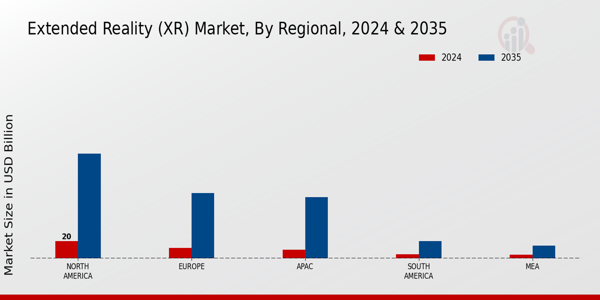
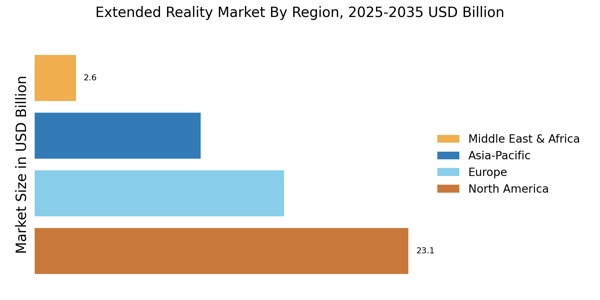
Le marché de la réalité étendue (XR) est en passe de connaître une forte croissance dans diverses régions, reflétant un intérêt et un investissement importants dans les technologies liées à la réalité virtuelle, la réalité augmentée et les expériences immersives. En 2024, l'Amérique du Nord détient une part significative du marché avec 20,0 milliards USD, soutenue par un taux d'adoption élevé des technologies XR parmi les entreprises et les consommateurs, qui devrait atteindre 120,0 milliards USD d'ici 2035, dominant ainsi le paysage. L'Europe suit avec une valorisation du marché de 12,0 milliards USD en 2024, atteignant 75,0 milliards USD, bénéficiant d'initiatives solides de recherche et développement et d'une industrie du jeu florissante.

La région APAC, évaluée à 10,0 milliards USD en 2024 et projetée pour atteindre 70,0 milliards USD en 2035, illustre une adoption technologique rapide, avec des pays comme la Chine et le Japon en tête des innovations XR. L'Amérique du Sud, bien que plus petite, montre un potentiel avec 5,0 milliards USD en 2024, anticipé pour augmenter à 20,0 milliards USD, alors que les entreprises locales commencent à tirer parti de la XR pour améliorer leur efficacité opérationnelle. Pendant ce temps, le Moyen-Orient et l'Afrique (MEA) détient une valeur de marché de 4,32 milliards USD en 2024, croissant à 15,0 milliards USD, indiquant l'acceptation progressive des technologies XR, soutenue par les secteurs de l'éducation et de la santé.

Chaque région contribue de manière unique à la trajectoire de croissance globale du marché de la réalité étendue (XR), tout en faisant face à des défis et des opportunités distincts au sein de leurs économies locales.

Aperçu régional du marché de la réalité étendue (XR)

Source : Recherche primaire, recherche secondaire, Base de données et revue d'analyste de Market Research Future

Marché de la Réalité Étendue Regional Image

Acteurs clés et aperçu concurrentiel

Le marché de la réalité étendue (XR) est un paysage en évolution et compétitif caractérisé par des avancées rapides et l'adoption croissante de technologies innovantes telles que la réalité virtuelle (VR), la réalité augmentée (AR) et la réalité mixte (MR). Ce marché est de plus en plus influencé par une gamme de facteurs, notamment les développements technologiques, la demande des consommateurs et l'intégration de la XR dans divers secteurs tels que le jeu, la santé, l'éducation et les solutions d'entreprise. Les entreprises s'efforcent continuellement de différencier leurs offres et de créer des expériences immersives qui améliorent l'engagement des utilisateurs tout en répondant aux divers besoins de leurs publics cibles.

Alors que les frontières entre les mondes physique et numérique s'estompent, les informations concurrentielles révèlent une course non seulement pour la prouesse technologique, mais aussi pour créer des plateformes évolutives et conviviales capables de capturer des parts de marché et de favoriser la fidélité à la marque. HTC s'est imposé comme un acteur majeur sur le marché de la réalité étendue (XR), avec une forte reconnaissance de marque et une riche histoire dans l'espace VR. L'entreprise dispose d'un portefeuille robuste de produits XR, y compris des casques et des plateformes logicielles qui s'adressent à la fois aux consommateurs et aux entreprises.

Les forces de HTC résident dans son approche innovante de l'expérience utilisateur et son engagement à améliorer la technologie VR avec du matériel de haute qualité et des partenariats de contenu. L'entreprise a également réalisé des progrès significatifs dans l'établissement d'un réseau de distribution mondial, lui permettant d'atteindre un large public tout en se concentrant sur le soutien aux développeurs et l'engagement communautaire pour favoriser l'adoption. Ce focus stratégique sur la construction d'un écosystème complet autour de ses offres XR a aidé HTC à maintenir un avantage concurrentiel et à favoriser de solides relations au sein de la communauté XR.

Valve est un autre acteur clé sur le marché de la réalité étendue (XR), reconnu pour ses contributions distinctes au segment du jeu grâce à ses technologies et plateformes innovantes. L'entreprise est bien connue pour le développement de la plateforme SteamVR et des offres matérielles comme le casque Valve Index, qui ont gagné une traction considérable parmi les joueurs et les développeurs. Les forces de Valve incluent sa forte présence dans l'industrie du jeu, des améliorations continues des expériences VR et un soutien à la création de contenu tant de première que de tierce partie. L'entreprise a activement poursuivi des partenariats et des collaborations pour étendre sa portée sur le marché et améliorer ses capacités technologiques.

Ces dernières années, Valve a également été impliqué dans des fusions et acquisitions visant à renforcer son écosystème XR, consolidant ainsi sa position concurrentielle sur le marché mondial. Ce focus stratégique sur l'innovation et la collaboration positionne Valve comme un concurrent redoutable dans l'espace XR en rapide évolution.

Les principales entreprises du marché Marché de la Réalité Étendue incluent

Développements de l'industrie

Le marché de la réalité étendue (XR) a récemment connu des développements significatifs, notamment avec les avancées en matière de matériel et de logiciels. Des entreprises comme Meta et Qualcomm investissent massivement dans les technologies XR, continuant à améliorer les capacités de leurs plateformes. En octobre 2023, le lancement par Apple du casque Vision Pro a suscité des attentes dans l'industrie, montrant l'engagement de l'entreprise envers des expériences XR de haute qualité. En ce qui concerne les fusions et acquisitions, NVIDIA a annoncé son acquisition d'Arm en septembre 2022, élargissant son portefeuille technologique pour les applications XR. De plus, en mars 2023, Microsoft a acquis Activision Blizzard, renforçant ainsi son empreinte dans le secteur du jeu et de la XR.

La croissance de la valorisation des entreprises telles qu'Epic Games et Sony est alimentée par une demande accrue d'expériences immersives dans les secteurs du jeu et de l'entreprise, soutenue par un taux de croissance annuel composé (CAGR) projeté à dépasser 40 % dans les années à venir. Au cours des deux à trois dernières années, l'industrie a connu un intérêt croissant pour l'intégration de la XR avec les technologies d'IA, notamment pour améliorer les interactions et les simulations des utilisateurs. Cette tendance devrait stimuler davantage d'innovations dans diverses applications dans les domaines de la santé, de l'éducation et du divertissement à l'échelle mondiale.

Perspectives d'avenir

Marché de la Réalité Étendue Perspectives d'avenir

Le marché de la réalité étendue devrait croître à un taux de croissance annuel composé (CAGR) de 17,41 % de 2024 à 2035, soutenu par les avancées technologiques, l'adoption accrue dans divers secteurs et l'amélioration des expériences utilisateur.

De nouvelles opportunités résident dans :

  • Développement de programmes de formation immersifs pour les secteurs d'entreprise
  • Intégration de solutions XR dans les services de télésanté
  • Création d'environnements de vente au détail virtuels pour un engagement consommateur amélioré

D'ici 2035, le marché de la réalité étendue devrait être un élément clé de la transformation numérique mondiale.

Segmentation du marché

Extended Reality Market End Use Outlook

  • Consumer
  • Commercial
  • Industrial

Extended Reality Market Technology Outlook

  • Virtual Reality
  • Augmented Reality
  • Mixed Reality

Extended Reality Market Application Outlook

  • Gaming
  • Education
  • Healthcare
  • Real Estate
  • Military

Extended Reality Market Device Type Outlook

  • Head-Mounted Displays
  • Smartphones
  • Tablets
  • Wearable Devices

Portée du rapport

TAILLE DU MARCHÉ 2024 51,32 (milliards USD)
TAILLE DU MARCHÉ 2025 60,25 (milliards USD)
TAILLE DU MARCHÉ 2035 299,95 (milliards USD)
TAUX DE CROISSANCE ANNUEL COMPOSÉ (CAGR) 17,41 % (2024 - 2035)
COUVERTURE DU RAPPORT Prévisions de revenus, paysage concurrentiel, facteurs de croissance et tendances
ANNÉE DE BASE 2024
Période de prévision du marché 2025 - 2035
Données historiques 2019 - 2024
Unités de prévision du marché milliards USD
Principales entreprises profilées Analyse de marché en cours
Segments couverts Analyse de segmentation du marché en cours
Principales opportunités de marché L'intégration de l'intelligence artificielle dans le marché de la réalité étendue améliore l'expérience utilisateur et la personnalisation.
Dynamiques clés du marché Les avancées technologiques stimulent les forces concurrentielles, remodelant le comportement des consommateurs et favorisant la consolidation du marché dans le secteur de la réalité étendue.
Pays couverts Amérique du Nord, Europe, APAC, Amérique du Sud, MEA

FAQs

What is the projected market valuation of the Extended Reality Market by 2035?

The Extended Reality Market is projected to reach a valuation of 299.95 USD Billion by 2035.

What was the market valuation of the Extended Reality Market in 2024?

In 2024, the Extended Reality Market was valued at 51.32 USD Billion.

What is the expected CAGR for the Extended Reality Market from 2025 to 2035?

The expected CAGR for the Extended Reality Market during the forecast period 2025 - 2035 is 17.41%.

Which companies are considered key players in the Extended Reality Market?

Key players in the Extended Reality Market include Meta Platforms, Microsoft, Apple, Google, Sony, NVIDIA, HTC, Samsung, and Unity Technologies.

What are the main application segments of the Extended Reality Market?

The main application segments include Gaming, Education, Healthcare, Real Estate, and Military.

How does the valuation of the Healthcare segment compare to others in 2025?

The Healthcare segment is projected to grow from 12.0 USD Billion to 70.0 USD Billion, indicating substantial growth potential.

What is the projected valuation for the Augmented Reality segment by 2035?

The Augmented Reality segment is expected to grow from 20.0 USD Billion to 120.0 USD Billion by 2035.

Which device types are expected to dominate the Extended Reality Market?

Head-Mounted Displays, Smartphones, Tablets, and Wearable Devices are the primary device types in the market.

What is the projected growth for the Consumer end-use segment by 2035?

The Consumer end-use segment is anticipated to grow from 15.0 USD Billion to 85.0 USD Billion by 2035.

How does the Mixed Reality technology segment compare to others in terms of growth?

The Mixed Reality segment is projected to grow from 16.32 USD Billion to 94.95 USD Billion, suggesting a robust growth trajectory.

Auteur
Author
Author Profile
Ankit Gupta LinkedIn
Team Lead - Research
Ankit Gupta is a seasoned market intelligence and strategic research professional with over six plus years of experience in the ICT and Semiconductor industries. With academic roots in Telecom, Marketing, and Electronics, he blends technical insight with business strategy. Ankit has led 200+ projects, including work for Fortune 500 clients like Microsoft and Rio Tinto, covering market sizing, tech forecasting, and go-to-market strategies. Known for bridging engineering and enterprise decision-making, his insights support growth, innovation, and investment planning across diverse technology markets.

Research Approach

Secondary Research

The secondary research process involved comprehensive analysis of regulatory databases, technology publications, patent repositories, industry whitepapers, and authoritative technology organizations. Key sources included the US Federal Communications Commission (FCC), European Telecommunications Standards Institute (ETSI), Institute of Electrical and Electronics Engineers (IEEE), International Telecommunication Union (ITU), Consumer Technology Association (CTA), International Data Corporation (IDC), Gartner Research, National Science Foundation (NSF), National Institute of Standards and Technology (NIST), US Bureau of Labor Statistics, Organization for Economic Co-operation and Development (OECD) Digital Economy Outlook, Eurostat ICT Statistics, World Economic Forum (WEF) Future of Jobs Report, China Academy of Information and Communications Technology (CAICT), Japan Ministry of Internal Affairs and Communications (MIC), and South Korea Ministry of Science and ICT.

Adoption statistics, regulatory approval data for XR devices, patent filings, spectrum allocation policies, enterprise deployment trends, and market landscape analysis for VR, AR, and MR, as well as related hardware ecosystems like wearables, smartphones, tablets, and head-mounted displays, were gathered from these sources.

Primary Research

In order to gather both qualitative and quantitative insights, supply-side and demand-side stakeholders were interviewed during the primary research process. Chief technology officers, vice presidents of hardware engineering, heads of regulatory affairs, and commercial directors from XR headset producers, semiconductor suppliers, and software platform developers were examples of supply-side sources. Chief information officers, digital transformation leaders, training directors from Fortune 500 companies, procurement chiefs from healthcare systems, coordinators of educational technologies, and executives from gaming studios were among the demand-side sources. Primary research confirmed product pipeline timelines for next-generation headsets and haptic technologies, validated market segmentation across gaming, education, healthcare, real estate, and military applications, and acquired information on enterprise adoption patterns, pricing strategies, content ecosystem development, and integration challenges with current IT infrastructure.

Primary Respondent Breakdown:

By Designation: C-level Primaries (28%), Director Level (32%), Others (40%)

By Region: North America (32%), Europe (30%), Asia-Pacific (28%), Rest of World (10%)

Market Size Estimation

Revenue mapping, device shipment analysis, and enterprise deployment tracking were used to determine the global market valuation. The methodology comprised:

Finding more than fifty major producers and platform suppliers in North America, Europe, Asia-Pacific, and Latin America, such as Meta Platforms, Microsoft, Apple, Google, Sony, NVIDIA, HTC, Samsung, and Unity Technologies

Product mapping for wearables, smartphones, tablets, head-mounted displays, and augmented, mixed, and virtual reality technologies

Analysis of the XR hardware, software, and services portfolios reported and projected yearly revenues

Coverage of platform providers and manufacturers accounting for 75–80% of the worldwide market share in 2024

Extrapolation of segment-specific valuations across consumer, commercial, and industrial end-use categories using top-down (manufacturer revenue validation, platform ecosystem value assessment) and bottom-up (device shipments × ASP by country/region, enterprise license deployments, content marketplace revenues) methods

Télécharger l'échantillon gratuit

Veuillez remplir le formulaire ci-dessous pour recevoir un échantillon gratuit de ce rapport

Download PDF ×

We do not share your information with anyone. However, we may send you emails based on your report interest from time to time. You may contact us at any time to opt-out.