Markt für das industrielle Internet der Dinge

Marktgröße, Marktanteil und Forschungsbericht zum industriellen IoT: Nach Komponenten (Hardware, Lösung & Dienstleistung), Nach Bereitstellung (In der Cloud, Vor Ort), Nach Konnektivität (Kabelgebunden und Drahtlos), Nach Endbenutzer (IT & Telekommunikation, Fertigung, Gesundheitswesen, Einzelhandel, Öl & Gas, Automobil und andere) - Prognose 2034
ID: MRFR/ICT/1593-CR
100 Pages
Apoorva Priyadarshi, Shubham Munde
Last Updated: July 29, 2026
Industrial Internet Of Things Market
Market Size
Forecast Period2025 - 2035
CAGR (2025 - 2035)8.16%
2024 Market Size$ 196.4 Billion
2025 Market Size$ 212.43 Billion
2035 Market Size$ 465.45 Billion
Key Players
Siemens
General Electric
Honeywell
Cisco
Rockwell Automation
Schneider Electric
Opportunities
  • Rising Demand for Automation
  • Advancements in Sensor Technology
  • Integration of Advanced Analytics

Markt für das industrielle Internet der Dinge Zusammenfassung

Laut der Analyse von Market Research Future wurde die Größe des Industrial IoT-Marktes im Jahr 2024 auf 196,4 Milliarden USD geschätzt. Die Industrie für Industrial IoT wird voraussichtlich von 212,43 Milliarden USD im Jahr 2025 auf 465,45 Milliarden USD bis 2035 wachsen, was einer jährlichen Wachstumsrate (CAGR) von 8,16 % im Prognosezeitraum 2025 - 2035 entspricht.

Wichtige Markttrends & Highlights

Der Markt für industrielles IoT steht vor einem erheblichen Wachstum, das durch technologische Fortschritte und die steigende Nachfrage nach Automatisierung vorangetrieben wird.

  • Nordamerika bleibt der größte Markt für industrielles IoT und zeigt starke Investitionen in Automatisierungstechnologien.
  • Asien-Pazifik entwickelt sich zur am schnellsten wachsenden Region, angetrieben durch rasche Industrialisierung und digitale Transformationsinitiativen.
  • Wi-Fi-Technologie dominiert weiterhin den Markt, während BLE als am schnellsten wachsendes Segment aufgrund seiner Energieeffizienz an Bedeutung gewinnt.
  • Die steigende Nachfrage nach Automatisierung und Fortschritte in der Sensortechnologie sind die Haupttreiber, die den Markt vorantreiben.

Marktgröße & Prognose

2024 Market Size 196.4 (USD Billion)
2035 Market Size 465.45 (USD Billion)
CAGR (2025 - 2035) 8.16%

Hauptakteure

Siemens (DE), General Electric (US), Honeywell (US), Cisco (US), Rockwell Automation (US), Schneider Electric (FR), ABB (CH), IBM (US), Microsoft (US)

Markt für das industrielle Internet der Dinge Treiber

Rising Demand for Automation

The Industrial IoT Market is experiencing a notable surge in demand for automation across various sectors. This trend is driven by the need for enhanced operational efficiency and reduced labor costs. Industries such as manufacturing and logistics are increasingly adopting IoT solutions to streamline processes and minimize human error. According to recent data, the automation segment within the Industrial IoT Market is projected to grow at a compound annual growth rate of approximately 25% over the next five years. This growth is indicative of a broader shift towards smart factories and automated supply chains, where real-time data analytics and machine-to-machine communication play pivotal roles in decision-making and operational optimization.

Advancements in Sensor Technology

Advancements in sensor technology are significantly influencing the Industrial IoT Market. The proliferation of low-cost, high-performance sensors enables industries to collect vast amounts of data in real-time, facilitating better monitoring and control of processes. These sensors are integral to applications such as predictive maintenance, where they help in identifying potential equipment failures before they occur. The market for sensors in the Industrial IoT Market is expected to reach USD 30 billion by 2026, reflecting the growing reliance on data-driven insights. As industries continue to invest in smart technologies, the integration of advanced sensors will likely enhance operational capabilities and drive further innovation.

Integration of Advanced Analytics

The integration of advanced analytics into the Industrial IoT Market is transforming how organizations interpret and utilize data. By leveraging big data analytics, companies can gain deeper insights into operational performance, customer behavior, and market trends. This capability allows for more informed decision-making and strategic planning. The analytics segment within the Industrial IoT Market is anticipated to witness substantial growth, with projections indicating a market size of USD 15 billion by 2025. As industries increasingly recognize the value of data-driven strategies, the demand for sophisticated analytics tools and platforms is likely to escalate, further propelling the evolution of the Industrial IoT landscape.

Growing Focus on Supply Chain Optimization

The Industrial IoT Market is witnessing a growing focus on supply chain optimization, driven by the need for greater visibility and efficiency. IoT technologies enable real-time tracking of goods and assets, allowing companies to respond swiftly to disruptions and enhance inventory management. This trend is particularly relevant in sectors such as retail and manufacturing, where supply chain agility is critical. Recent studies indicate that companies implementing IoT solutions for supply chain management can achieve cost reductions of up to 30%. As organizations strive to create more resilient supply chains, the adoption of IoT technologies is expected to accelerate, further shaping the future of the Industrial IoT Market.

Emphasis on Sustainability and Energy Efficiency

The Industrial IoT Market is increasingly aligning with sustainability goals, as organizations seek to reduce their carbon footprints and enhance energy efficiency. IoT solutions facilitate real-time monitoring of energy consumption, enabling companies to identify inefficiencies and implement corrective measures. This focus on sustainability is not only driven by regulatory pressures but also by consumer demand for environmentally responsible practices. The market for energy management solutions within the Industrial IoT Market is projected to grow significantly, with estimates suggesting a value of USD 20 billion by 2025. This trend indicates a shift towards greener operations, where IoT technologies play a crucial role in achieving sustainability objectives.

Einblicke in Marktsegmente

By Connectivity: Wi-Fi (Largest) vs. BLE (Fastest-Growing)

In the Industrial IoT market, the connectivity segment showcases a diverse array of technologies with Wi-Fi leading the pack as the largest segment. It holds a significant market share due to its widespread adoption in industrial applications, such as monitoring and control systems. Following Wi-Fi are technologies like ZWave and RF, which also contribute notably, but they have not yet reached the same scale of deployment and user acceptance as Wi-Fi. Other technologies, while present, account for a smaller portion of the overall market share, marking them as less dominant players in this space. As the industry evolves, growth trends indicate a rise in the adoption of BLE (Bluetooth Low Energy) technologies, particularly in asset tracking and smart manufacturing scenarios. The demand for low-power, efficient connectivity solutions is propelling BLE into the spotlight, exhibiting rapid growth rates. Additionally, the introduction of innovative applications in the Industrial IoT space, such as smart sensors and devices, is driving competition among connectivity technologies. Emergence of Li-Fi solutions further signifies a trend toward enhanced data transmission capabilities, aiming to meet the increasing data needs of modern industrial setups.

Connectivity: Wi-Fi (Dominant) vs. BLE (Emerging)

Wi-Fi remains the dominant choice for industrial connectivity, providing robust and high-speed data transfer essentials for various applications, from real-time monitoring to data analytics. Its ability to cover wide areas and integrate seamlessly with existing infrastructure makes it a preferred option for many organizations seeking scalability and flexibility. In contrast, BLE is emerging as a pivotal technology tailored for applications where power efficiency and low data rates are primary concerns. It is particularly suited for short-range communication, making it ideal for interconnected devices in smart factories. BLE's rapid growth stems from its capability to enhance automation by connecting numerous devices while maintaining power requirements, thereby carving out a significant niche within the Industrial IoT landscape.

By Deployment: Cloud (Largest) vs. On-Premises (Fastest-Growing)

In the Industrial IoT Market, the deployment segment is characterized by a clear division between cloud-based and on-premises solutions. Cloud deployment has emerged as the largest segment due to its scalability, cost-effectiveness, and ease of access. Many industries favor cloud solutions for their flexibility in handling large datasets and analysis in real-time, contributing to its dominant position. In contrast, on-premises deployment is gaining traction as organizations that prioritize data security and control opt for this more traditional solution. The trend towards on-premises solutions is fueled by increasing concerns over data privacy and security, prompting industries to invest in localized infrastructure. This has led to a significant growth momentum for on-premises solutions, appealing especially to sectors like manufacturing and critical infrastructure. Organizations are increasingly adopting hybrid models, combining advantages from both deployment types to leverage their respective benefits, while also enhancing system reliability and operational efficiency.

Deployment: Cloud (Dominant) vs. On-Premises (Emerging)

Cloud deployment in the Industrial IoT Market is considered a dominant force due to its ability to offer scalable solutions that cater to a myriad of industrial needs. With its inherent advantage of facilitating remote access and data storage capabilities, it enables organizations to optimize operations without heavy upfront investments in hardware. On the other hand, on-premises deployment is an emerging choice, particularly among firms that prioritize stringent control over their data and systems. This segment is characterized by tailored solutions that suit specific operational requirements, offering organizations the peace of mind that comes with managing data within their own infrastructure. As a result, on-premises systems are increasingly being viewed as integral in sectors requiring high security, making them a compelling alternative to cloud solutions.

By Components: Services (Largest) vs. Hardware (Fastest-Growing)

The Industrial IoT market is characterized by a diverse component distribution, with services leading in market share compared to hardware and software. Services encompass consulting and support, contributing significantly to overall revenue due to their critical role in deployment and maintenance. In contrast, hardware and software segments are vital, albeit to a lesser extent, reflecting the market's increasing reliance on integrated solutions and real-time data management for efficient industrial operations. Growth trends indicate that while services are proliferating due to ongoing digital transformation initiatives, hardware stands out as the fastest-growing segment. The expansion is fueled by advancements in sensor technology and edge computing. As industries seek enhanced connectivity and automation, demand for innovative hardware solutions is surging, highlighting the necessity for robust infrastructure to support IoT applications.

Services: Consulting (Dominant) vs. Hardware: Edge Devices (Emerging)

In the realm of Industrial IoT, consulting services represent a dominant value, providing essential support in strategy formulation, technology integration, and optimization. Consulting firms help manufacturers navigate the complexities of digital transformation, enabling a seamless transition to IoT-based operations. Conversely, edge devices as an emerging hardware segment are experiencing rapid growth due to their essential role in processing data closer to the source. This mitigates latency issues and enhances response times, thereby driving operational efficiencies. As companies increasingly prioritize real-time analytics, the market for edge devices is expected to witness significant innovation, making them imperative for the next phase of industrial automation.

By Organization Size: Large (Largest) vs. Small (Fastest-Growing)

The Industrial IoT market exhibits a diverse distribution across organization sizes, with large organizations commanding the highest market share due to their extensive resources and robust infrastructures. These enterprises leverage advanced IoT technology to optimize their operations and maintain a competitive edge, reflecting a significant share in the market. Conversely, small organizations, while currently representing a smaller portion of the market, are rapidly increasing their presence, driven by the ease of access to IoT solutions and the growing demand for efficiency in operations. The growth trends in the Industrial IoT sector indicate a notable rise in adoption among small-sized organizations. Historically underserved, this segment is now experiencing a surge in technological advancements allowing them to innovate and automate processes effectively. Key drivers include heightened awareness of IoT benefits, affordability of solutions, and increased customization options tailored to their unique operational needs, positioning them for significant growth in the coming years.

Large (Dominant) vs. Small (Emerging)

Large organizations in the Industrial IoT market position themselves as dominant players due to their ability to invest in large-scale IoT deployments and partnerships with leading technology providers. They typically operate with complex, integrated systems that enhance efficiency and drive innovation across their massive operations. Their established market presence allows them to leverage extensive data analytics to optimize performance further. In contrast, small organizations are emerging as crucial players within this segment, benefitting from simplified and cost-effective IoT solutions. These companies are able to implement IoT technologies that enhance operational processes without the heavy infrastructure burdens faced by larger firms, demonstrating agility and speed in adopting new technologies. As they continue to explore IoT applications, small organizations are likely to contribute significantly to the overall market growth.

By Vertical: Healthcare (Largest) vs. BFSI (Fastest-Growing)

In the Industrial IoT market, the vertical segment shows a diversified range of applications, with Healthcare capturing the largest share. It leverages IoT technology for patient monitoring, equipment tracking, and enhanced healthcare services, making it a preferred choice among industries seeking operational efficiency. Following closely, the BFSI sector is rapidly growing, utilizing IoT for security, risk management, and customer service enhancements, showcasing significant investment in smart banking solutions.

Healthcare (Dominant) vs. BFSI (Emerging)

The Healthcare sector stands as a dominant player in the Industrial IoT landscape, characterized by robust integration of IoT devices that improve patient care and streamline operations. This vertical focuses on advanced technologies such as wearables and telehealth services, fostering a patient-centric approach. In contrast, the BFSI segment, while emerging, is experiencing rapid expansion as banks and financial institutions adopt IoT solutions for real-time data analytics and cyber security measures. This growing emphasis on digital transformation positions BFSI as a crucial contender in the market.

Erhalten Sie detailliertere Einblicke zu Markt für das industrielle Internet der Dinge

Regionale Einblicke

Nordamerika: Innovations- und Führungszentrum

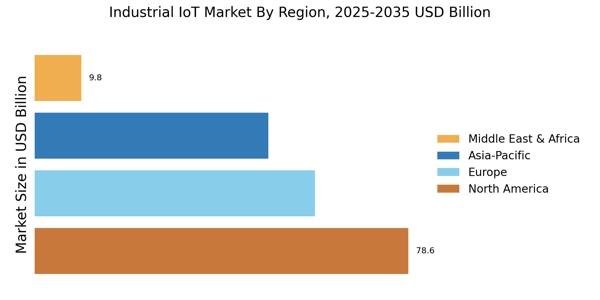
Nordamerika ist der größte Markt für Industrial IoT und hält etwa 40 % des globalen Anteils. Das Wachstum der Region wird durch schnelle technologische Fortschritte, eine zunehmende Akzeptanz von intelligenter Fertigung und unterstützende staatliche Initiativen vorangetrieben. Regulierungsrahmen, die die digitale Transformation und Cybersicherheit fördern, sind ebenfalls bedeutende Katalysatoren für die Markterweiterung. Die USA führen diesen Markt an, gefolgt von Kanada, das etwa 10 % zum Gesamtanteil beiträgt. Die Wettbewerbslandschaft in Nordamerika ist robust und umfasst Schlüsselakteure wie Siemens, General Electric und Honeywell. Diese Unternehmen stehen an der Spitze der Innovation und bieten hochmoderne Lösungen, die die Betriebseffizienz steigern. Die Präsenz großer Technologieunternehmen wie Cisco und IBM stärkt den Markt weiter und fördert ein kollaboratives Ökosystem, das Wachstum und Entwicklung im Bereich Industrial IoT vorantreibt.

Europa: Aufstrebende industrielle Macht

Europa verzeichnet ein signifikantes Wachstum im Industrial IoT-Markt und macht etwa 30 % des globalen Anteils aus. Das Wachstum der Region wird durch strenge Vorschriften gefördert, die darauf abzielen, die industrielle Effizienz und Nachhaltigkeit zu verbessern. Länder wie Deutschland und Frankreich führen diesen Trend an, wobei Deutschland allein etwa 15 % zum Markt beiträgt. Die Initiativen der Europäischen Union zur Förderung der Digitalisierung in der Fertigung sind entscheidend für die Steigerung der Nachfrage nach IoT-Lösungen. Deutschland, der größte Markt in Europa, beherbergt bedeutende Akteure wie Siemens und Schneider Electric, die entscheidend zur Förderung von IoT-Technologien beitragen. Frankreich und das Vereinigte Königreich spielen ebenfalls eine wichtige Rolle, mit einer wachsenden Anzahl von Startups und etablierten Unternehmen, die sich auf IoT-Innovationen konzentrieren. Die Wettbewerbslandschaft ist durch die Zusammenarbeit zwischen traditionellen Fertigungsunternehmen und Technologieunternehmen gekennzeichnet, was die Fähigkeiten der Region im Bereich Industrial IoT verbessert.

Asien-Pazifik: Schnell wachsender Markt

Asien-Pazifik entwickelt sich zu einem bedeutenden Akteur im Industrial IoT-Markt und hält etwa 25 % des globalen Anteils. Das Wachstum der Region wird durch zunehmende industrielle Automatisierung, staatliche Initiativen zur Förderung intelligenter Städte und eine steigende Nachfrage nach Echtzeitdatenanalysen vorangetrieben. China und Japan sind die größten Märkte, wobei China allein etwa 15 % des Gesamtmarktanteils ausmacht, was seine schnelle Industrialisierung und technologische Fortschritte widerspiegelt. Die Wettbewerbslandschaft in Asien-Pazifik ist vielfältig und umfasst sowohl etablierte Unternehmen als auch innovative Startups. Schlüsselakteure wie ABB und Rockwell Automation erweitern ihre Präsenz, während lokale Unternehmen ebenfalls Fortschritte bei IoT-Lösungen machen. Der Fokus der Region auf die Verbesserung der Fertigungseffizienz und Nachhaltigkeit treibt die Akzeptanz von Industrial IoT-Technologien voran und macht sie zu einem dynamischen Markt für zukünftiges Wachstum.

Naher Osten und Afrika: Aufstrebendes Marktpotenzial

Die Region Naher Osten und Afrika entwickelt sich allmählich im Industrial IoT-Markt und hält etwa 5 % des globalen Anteils. Das Wachstum wird hauptsächlich durch zunehmende Investitionen in Infrastruktur und einen Vorstoß zur digitalen Transformation in verschiedenen Branchen vorangetrieben. Länder wie die VAE und Südafrika führen diesen Trend an, wobei die VAE etwa 3 % zum Marktanteil beitragen, unterstützt durch staatliche Initiativen zur Förderung der technologischen Akzeptanz. Die Wettbewerbslandschaft in dieser Region entwickelt sich, mit einer Mischung aus lokalen und internationalen Akteuren, die in den Markt eintreten. Unternehmen konzentrieren sich darauf, IoT-Lösungen zu entwickeln, die auf die einzigartigen Bedürfnisse von Branchen wie Öl und Gas, Fertigung und Logistik zugeschnitten sind. Die Präsenz wichtiger Akteure sowie eine wachsende Anzahl von Startups fördert Innovationen und treibt die Akzeptanz von Industrial IoT-Technologien in der Region voran.

Markt für das industrielle Internet der Dinge Regional Image

Hauptakteure und Wettbewerbseinblicke

Der Industrial IoT-Markt ist derzeit durch eine dynamische Wettbewerbslandschaft gekennzeichnet, die durch schnelle technologische Fortschritte und die zunehmende Nachfrage nach Automatisierung in verschiedenen Sektoren vorangetrieben wird. Schlüsselakteure wie Siemens (DE), General Electric (US) und Honeywell (US) positionieren sich strategisch durch Innovation und Partnerschaften. Siemens (DE) konzentriert sich auf digitale Transformation und intelligente Infrastruktur, während General Electric (US) seine digitale Industrie-Strategie betont und IoT mit seinem umfangreichen industriellen Portfolio integriert. Honeywell (US) verbessert seine Fähigkeiten in der Betriebstechnologie, was auf einen kollektiven Wandel zu integrierten Lösungen hinweist, die die Effizienz steigern und die Betriebskosten senken.

Die Marktstruktur scheint moderat fragmentiert zu sein, mit einer Mischung aus etablierten Akteuren und aufstrebenden Startups. Unternehmen verfolgen verschiedene Geschäftstaktiken, wie die Lokalisierung der Produktion und die Optimierung von Lieferketten, um ihre Wettbewerbsfähigkeit zu steigern. Diese Fragmentierung ermöglicht vielfältige Angebote, doch der Einfluss der großen Akteure bleibt erheblich, da sie Branchenstandards setzen und Innovationen durch erhebliche F&E-Investitionen vorantreiben.

Im August 2025 kündigte Siemens (DE) eine strategische Partnerschaft mit einem führenden Cloud-Dienstanbieter an, um die Fähigkeiten seiner IoT-Plattform zu verbessern. Diese Zusammenarbeit zielt darauf ab, Cloud-Computing zu nutzen, um Datenanalysen und Anwendungen des maschinellen Lernens in industriellen Umgebungen zu verbessern. Die strategische Bedeutung dieses Schrittes liegt im Engagement von Siemens, skalierbare und flexible Lösungen anzubieten, die den sich entwickelnden Bedürfnissen seiner Kunden gerecht werden und somit seine Marktposition stärken.

Im September 2025 stellte General Electric (US) eine neue Suite von KI-gesteuerten Werkzeugen für vorausschauende Wartung vor, die für den Fertigungssektor konzipiert sind. Diese Initiative spiegelt GEs Fokus wider, künstliche Intelligenz zu nutzen, um die Leistung von Geräten zu optimieren und Ausfallzeiten zu reduzieren. Die Einführung dieser Werkzeuge wird voraussichtlich die Kundenzufriedenheit und -loyalität erhöhen, da Unternehmen zunehmend nach Lösungen suchen, die betriebliche Störungen minimieren.

Im Juli 2025 brachte Honeywell (US) ein neues Cybersicherheitsframework auf den Markt, das speziell für industrielle IoT-Anwendungen entwickelt wurde. Dieses Framework zielt darauf ab, kritische Infrastrukturen vor Cyberbedrohungen zu schützen, die im digitalen Zeitalter zu einem wachsenden Anliegen geworden sind. Durch die Priorisierung der Cybersicherheit adressiert Honeywell nicht nur ein dringendes Marktbedürfnis, sondern positioniert sich auch als führend im Schutz industrieller Abläufe, wodurch seine Wettbewerbsdifferenzierung gestärkt wird.

Stand Oktober 2025 umfassen die herausragendsten Trends, die die Wettbewerbslandschaft prägen, Digitalisierung, Nachhaltigkeit und die Integration von künstlicher Intelligenz. Strategische Allianzen werden zunehmend zu einem Grundpfeiler der Wettbewerbsstrategie, der es Unternehmen ermöglicht, Ressourcen und Fachwissen zu bündeln. Ausblickend scheint es, dass sich die wettbewerbliche Differenzierung von traditioneller preisbasierter Konkurrenz hin zu einem Fokus auf Innovation, technologische Fortschritte und Zuverlässigkeit der Lieferkette entwickeln wird. Dieser Wandel deutet darauf hin, dass Unternehmen, die diese Elemente priorisieren, wahrscheinlich als Führer im Industrial IoT-Markt hervorgehen werden.
Zu den wichtigsten Unternehmen im Markt für das industrielle Internet der Dinge-Markt gehören

Branchenentwicklungen

  • Q2 2024: Siemens startet Industrial Edge Management System für IIoT Siemens kündigte die Einführung seines neuen Industrial Edge Management Systems an, das es Herstellern ermöglicht, IIoT-Geräte und -Anwendungen in großem Maßstab zu verwalten und die Echtzeitdatenverarbeitung und Betriebseffizienz zu verbessern.
  • Q2 2024: Rockwell Automation erwirbt Clearpath Robotics zur Erweiterung der IIoT-Fähigkeiten Rockwell Automation hat die Übernahme von Clearpath Robotics abgeschlossen, um fortschrittliche autonome mobile Roboter in sein Portfolio für industrielles IoT zu integrieren und intelligentere Fertigungsumgebungen zu schaffen.
  • Q2 2024: ABB und Microsoft kündigen strategische Partnerschaft für KI-gestützte IIoT-Lösungen an ABB und Microsoft haben eine strategische Partnerschaft geschlossen, um KI-gesteuerte industrielle IoT-Lösungen zu entwickeln, die sich auf vorausschauende Wartung und Energieoptimierung für Fertigungskunden konzentrieren.
  • Q2 2024: Honeywell eröffnet neues IIoT-fähiges Werk in Texas Honeywell eröffnete ein neues Fertigungswerk in Texas, das mit fortschrittlichen IIoT-Sensoren und Analyseplattformen ausgestattet ist, um den Betrieb von Smart Factories der nächsten Generation zu demonstrieren.
  • Q2 2024: Industrial IoT-Startup Tulip erhält 50 Millionen USD in Serie-C-Finanzierung zur Skalierung der Plattform Tulip, ein Anbieter von IIoT-Software für die Fertigung, sicherte sich 50 Millionen USD in Serie-C-Finanzierung, um die Produktentwicklung zu beschleunigen und seine globale Kundenbasis zu erweitern.
  • Q3 2024: Schneider Electric startet EcoStruxure Automation Expert 2024 für IIoT Schneider Electric veröffentlichte die neueste Version seiner EcoStruxure Automation Expert-Plattform, die verbesserte IIoT-Integration und Edge-Computing-Fähigkeiten für industrielle Automatisierung bietet.
  • Q3 2024: Bosch geht Partnerschaft mit AWS ein, um cloudbasierte IIoT-Analysen bereitzustellen Bosch gab eine Partnerschaft mit Amazon Web Services bekannt, um cloudbasierte Analysen und maschinelles Lernen für industrielle IoT-Implementierungen anzubieten, die sich auf die Fertigungs- und Logistiksektoren konzentrieren.
  • Q3 2024: Emerson ernennt neuen Chief Digital Officer zur Leitung der IIoT-Strategie Emerson ernannte einen neuen Chief Digital Officer, um seine Strategie für industrielles IoT zu leiten, mit dem Fokus auf die Erweiterung von digitalen Transformationsinitiativen in seinen globalen Operationen.
  • Q4 2024: GE Vernova gewinnt 100 Millionen USD Vertrag für IIoT-fähige Netzmodernisierung GE Vernova sicherte sich einen Vertrag über 100 Millionen USD zur Bereitstellung von IIoT-fähigen Lösungen für die Netzmodernisierung, einschließlich intelligenter Sensoren und vorausschauender Analysen für Versorgungsunternehmen.
  • Q4 2024: Siemens und SAP kündigen gemeinsame IIoT-Plattform für die Fertigung an Siemens und SAP haben eine gemeinsame IIoT-Plattform gestartet, die darauf abzielt, Daten von der Fertigungsebene mit Enterprise-Resource-Planning-Systemen zu integrieren und nahtlose digitale Arbeitsabläufe für Hersteller zu ermöglichen.
  • Q1 2025: Hitachi eröffnet neues IIoT-F&E-Zentrum in Japan Hitachi eröffnete ein neues Forschungs- und Entwicklungszentrum, das sich auf Technologien des industriellen IoT konzentriert, um Innovationen in der intelligenten Fertigung und vernetzten Infrastruktur zu beschleunigen.
  • Q1 2025: Industrial IoT-Startup Element Analytics erhält 30 Millionen USD in Serie-B-Finanzierung Element Analytics, das sich auf die Integration und Analyse von IIoT-Daten spezialisiert hat, erhielt 30 Millionen USD in Serie-B-Finanzierung, um sein Produktangebot zu erweitern und sein Ingenieurteam zu vergrößern.

Zukunftsaussichten

Markt für das industrielle Internet der Dinge Zukunftsaussichten

Der Markt für industrielles IoT wird voraussichtlich von 2024 bis 2035 mit einer CAGR von 8,16 % wachsen, angetrieben durch Fortschritte in der Konnektivität, Automatisierung und Datenanalyse.

Neue Möglichkeiten liegen in:

  • Integration von AI-gesteuerten Predictive-Maintenance-Lösungen
  • Entwicklung maßgeschneiderter IoT-Plattformen für bestimmte Branchen
  • Erweiterung der Edge-Computing-Fähigkeiten zur Echtzeit-Datenverarbeitung

Bis 2035 wird erwartet, dass der Markt für industrielles IoT robust ist, angetrieben durch Innovation und strategische Investitionen.

Marktsegmentierung

Industrial Internet Of Things Market Vertical Outlook

  • Public Sector
  • Healthcare
  • BFSI
  • Government

Industrial Internet Of Things Market Components Outlook

  • Services
  • Software
  • Hardware

Industrial Internet Of Things Market Deployment Outlook

  • Cloud
  • On-Premises

Industrial Internet Of Things Market Connectivity Outlook

  • Wi-Fi
  • ZWave
  • RF
  • Li-Fi
  • LAN
  • BLE
  • Others

Industrial Internet Of Things Market Organization Size Outlook

  • Small
  • Medium
  • Large

Berichtsumfang

MARKTGRÖSSE 2024 196.4 (USD Billion)
MARKTGRÖSSE 2025 212.43 (USD Billion)
MARKTGRÖSSE 2035 465.45 (USD Billion)
ZUSAMMENGESETZTE JÄHRLICHE WACHSTUMSRATE (CAGR) 8.16% (2024 - 2035)
BERICHTSBEREICH Umsatzprognose, Wettbewerbslandschaft, Wachstumsfaktoren und Trends
BASISJAHR 2024
Marktprognosezeitraum 2025 - 2035
Historische Daten 2019 - 2024
Marktprognoseeinheiten USD Milliarden
Wichtige Unternehmen im Profil Marktanalyse in Fortschritt
Abgedeckte Segmente Marktsegmentierungsanalyse in Fortschritt
Wichtige Marktchancen Die Integration fortschrittlicher Analysen und maschinellem Lernen steigert die betriebliche Effizienz im industriellen IoT-Markt.
Wichtige Marktdynamiken Die steigende Nachfrage nach Echtzeit-Datenanalysen treibt Innovation und Wettbewerb im Bereich des industriellen Internets der Dinge voran.
Abgedeckte Länder Nordamerika, Europa, APAC, Südamerika, MEA

FAQs

What is the projected market valuation of the Industrial IoT Market by 2035?

The Industrial IoT Market is projected to reach a valuation of 465.45 USD Billion by 2035.

What was the market valuation of the Industrial IoT Market in 2024?

In 2024, the Industrial IoT Market was valued at 196.4 USD Billion.

What is the expected CAGR for the Industrial IoT Market during the forecast period 2025 - 2035?

The expected CAGR for the Industrial IoT Market during the forecast period 2025 - 2035 is 8.16%.

Which companies are considered key players in the Industrial IoT Market?

Key players in the Industrial IoT Market include Siemens, General Electric, Honeywell, Cisco, Rockwell Automation, Schneider Electric, ABB, IBM, and Microsoft.

What are the projected valuations for the connectivity segment in the Industrial IoT Market?

The connectivity segment is projected to range from 76.4 to 170.45 USD Billion.

How does the deployment segment of the Industrial IoT Market compare between cloud and on-premises solutions?

The deployment segment indicates cloud solutions may reach 186.12 USD Billion, while on-premises solutions could reach 279.33 USD Billion.

What is the expected performance of the components segment in the Industrial IoT Market?

The components segment is projected to have valuations ranging from 78.56 to 186.24 USD Billion for both software and hardware.

What are the projected valuations for the organization size segment in the Industrial IoT Market?

The organization size segment is expected to range from 39.28 to 233.7 USD Billion, depending on the size classification.

Which verticals are expected to drive growth in the Industrial IoT Market?

The verticals expected to drive growth include healthcare, BFSI, government, and the public sector, with valuations ranging from 30.0 to 175.45 USD Billion.

What does the future hold for the Industrial IoT Market in terms of growth and innovation?

The Industrial IoT Market appears poised for substantial growth, driven by technological advancements and increasing adoption across various sectors.

Autor
Author
Author Profile
Apoorva Priyadarshi LinkedIn
Research Analyst
With 4+ years of experience in Market Intelligence and Strategic Research, Apoorv specializes in ICT, Semiconductor, and BFSI markets. Combining strong analytical capabilities with a deep understanding of technology-driven industries, he focuses on delivering data-driven insights that support strategic decision-making. With a background in technology and business research, Apoorv has contributed to numerous global market studies, competitive landscape analyses, and opportunity assessments across sectors such as semiconductors, digital banking, cybersecurity, and telecommunications.
Co-Author
Co-Author Profile
Shubham Munde LinkedIn
Team Lead - Research
Shubham brings over 7 years of expertise in Market Intelligence and Strategic Consulting, with a strong focus on the Automotive, Aerospace, and Defense sectors. Backed by a solid foundation in semiconductors, electronics, and software, he has successfully delivered high-impact syndicated and custom research on a global scale. His core strengths include market sizing, forecasting, competitive intelligence, consumer insights, and supply chain mapping. Widely recognized for developing scalable growth strategies, Shubham empowers clients to navigate complex markets and achieve a lasting competitive edge. Trusted by start-ups and Fortune 500 companies alike, he consistently converts challenges into strategic opportunities that drive sustainable growth.

Research Approach

Secondary Research

The secondary research process involved comprehensive analysis of industrial standards databases, government technology initiatives, peer-reviewed engineering journals, IoT industry publications, and authoritative manufacturing organizations. Key sources included the National Institute of Standards and Technology (NIST) Smart Manufacturing Systems, International Electrotechnical Commission (IEC) Industrial IoT Standards, Institute of Electrical and Electronics Engineers (IEEE) IoT Technical Community, International Society of Automation (ISA) Automation Standards, US Department of Energy Industrial Efficiency Programs, European Commission Digital Industry initiatives, Germany's Federal Ministry for Economic Affairs and Climate Action (Industry 4.0 programs), China Ministry of Industry and Information Technology (MIIT) Smart Manufacturing policies, US Bureau of Economic Analysis Manufacturing Data, International Data Corporation (IDC) Industrial IoT Trackers, GSMA Intelligence Industrial Connectivity Reports, Industrial Internet Consortium (IIC) White Papers, Platform Industrie 4.0 Germany, Manufacturing USA Institutes, US Census Bureau Annual Survey of Manufactures, Eurostat Digital Economy and Society Statistics, Japan Ministry of Economy Trade and Industry (METI) Connected Industries Initiative, and national digital transformation reports from key industrial markets. These sources were used to collect industrial automation adoption statistics, regulatory compliance frameworks, cybersecurity standards, manufacturing output trends, connectivity infrastructure deployments, and competitive landscape analysis for IoT platforms, industrial sensors, edge computing devices, and predictive analytics solutions.

Primary Research

Qualitative and quantitative insights were obtained by interviewing supply-side and demand-side stakeholders during the primary research process. The supply-side sources comprised CEOs, CTOs, VPs of IoT Product Development, heads of Industrial Automation, and commercial directors from IIoT platform providers, industrial communication vendors, sensor manufacturers, edge computing hardware companies, and cloud service providers that served industrial sectors. Demand-side sources consist of Chief Digital Officers, VP of Manufacturing Operations, Plant Directors, OT/IT Managers, and procurement representatives from discrete and process manufacturing enterprises, oil and gas operators, automotive OEMs, healthcare device manufacturers, and utility companies. The primary research validated market segmentation across hardware, software, and services layers, confirmed Industry 4.0 implementation timelines, and gathered insights on IoT adoption barriers, cybersecurity investment priorities, cloud vs. edge deployment preferences, and ROI metrics for predictive maintenance implementations.

Primary Respondent Breakdown:

By Designation: C-level Primaries (28%), Director Level (35%), Others (37%)

By Region: North America (40%), Europe (30%), Asia-Pacific (22%), Rest of World (8%)

Market Size Estimation

Global market valuation was derived through revenue mapping and industrial connectivity deployment analysis. The methodology included:

Identification of 55+ key IIoT ecosystem participants across platform providers, industrial automation vendors, cloud hyperscalers, and connectivity specialists spanning North America, Europe, Asia-Pacific, and Latin America

Product mapping across IoT platforms, industrial gateways, sensors & actuators, edge computing hardware, predictive maintenance software, and managed connectivity services

Analysis of reported and modeled annual revenues specific to industrial IoT portfolios, including automation software licenses, hardware shipments, and recurring cloud subscriptions

Coverage of manufacturers and service providers representing 75-80% of global market share in 2024

Extrapolation using bottom-up (device shipments × ASP by component category and vertical) and top-down (vendor revenue validation across platform, hardware, and services segments) approaches to derive segment-specific valuations, including separate estimations for cloud vs. on-premise deployments and wireless vs. wired connectivity technologies

Kostenloses Muster herunterladen

Bitte füllen Sie das folgende Formular aus, um ein kostenloses Muster dieses Berichts zu erhalten

Download PDF ×

We do not share your information with anyone. However, we may send you emails based on your report interest from time to time. You may contact us at any time to opt-out.