Marché de l’Internet industriel des objets

Taille du marché de l'IoT industriel, part et rapport de recherche : par composant (matériel, solution et service), par déploiement (sur le cloud, sur site), par connectivité (filaire et sans fil), par utilisateur final (IT et télécommunications, fabrication, santé, vente au détail, pétrole et gaz, automobile et autres) - Prévisions 2034
ID: MRFR/ICT/1593-CR
100 Pages
Apoorva Priyadarshi, Shubham Munde
Last Updated: July 29, 2026
Industrial Internet Of Things Market
Market Size
Forecast Period2025 - 2035
CAGR (2025 - 2035)8.16%
2024 Market Size$ 196.4 Billion
2025 Market Size$ 212.43 Billion
2035 Market Size$ 465.45 Billion
Key Players
Siemens
General Electric
Honeywell
Cisco
Rockwell Automation
Schneider Electric
Opportunities
  • Rising Demand for Automation
  • Advancements in Sensor Technology
  • Integration of Advanced Analytics

Marché de l’Internet industriel des objets Résumé

Selon l'analyse de Market Research Future, la taille du marché de l'IoT industriel était estimée à 196,4 milliards USD en 2024. L'industrie de l'IoT industriel devrait croître de 212,43 milliards USD en 2025 à 465,45 milliards USD d'ici 2035, affichant un taux de croissance annuel composé (CAGR) de 8,16 % pendant la période de prévision 2025 - 2035

Principales tendances et faits saillants du marché

Le marché de l'IoT industriel est prêt pour une croissance substantielle, soutenue par les avancées technologiques et la demande croissante d'automatisation.

  • L'Amérique du Nord reste le plus grand marché pour l'IoT industriel, montrant un investissement robuste dans les technologies d'automatisation.
  • L'Asie-Pacifique émerge comme la région à la croissance la plus rapide, alimentée par une industrialisation rapide et des initiatives de transformation numérique.
  • La technologie Wi-Fi continue de dominer le marché, tandis que le BLE gagne du terrain en tant que segment à la croissance la plus rapide en raison de son efficacité énergétique.
  • La demande croissante d'automatisation et les avancées dans la technologie des capteurs sont des moteurs clés propulsant le marché vers l'avant.

Taille du marché et prévisions

2024 Market Size 196.4 (USD Billion)
2035 Market Size 465.45 (USD Billion)
CAGR (2025 - 2035) 8.16%

Principaux acteurs

Siemens (DE), General Electric (US), Honeywell (US), Cisco (US), Rockwell Automation (US), Schneider Electric (FR), ABB (CH), IBM (US), Microsoft (US)

Marché de l’Internet industriel des objets conducteurs

Rising Demand for Automation

The Industrial IoT Market is experiencing a notable surge in demand for automation across various sectors. This trend is driven by the need for enhanced operational efficiency and reduced labor costs. Industries such as manufacturing and logistics are increasingly adopting IoT solutions to streamline processes and minimize human error. According to recent data, the automation segment within the Industrial IoT Market is projected to grow at a compound annual growth rate of approximately 25% over the next five years. This growth is indicative of a broader shift towards smart factories and automated supply chains, where real-time data analytics and machine-to-machine communication play pivotal roles in decision-making and operational optimization.

Advancements in Sensor Technology

Advancements in sensor technology are significantly influencing the Industrial IoT Market. The proliferation of low-cost, high-performance sensors enables industries to collect vast amounts of data in real-time, facilitating better monitoring and control of processes. These sensors are integral to applications such as predictive maintenance, where they help in identifying potential equipment failures before they occur. The market for sensors in the Industrial IoT Market is expected to reach USD 30 billion by 2026, reflecting the growing reliance on data-driven insights. As industries continue to invest in smart technologies, the integration of advanced sensors will likely enhance operational capabilities and drive further innovation.

Integration of Advanced Analytics

The integration of advanced analytics into the Industrial IoT Market is transforming how organizations interpret and utilize data. By leveraging big data analytics, companies can gain deeper insights into operational performance, customer behavior, and market trends. This capability allows for more informed decision-making and strategic planning. The analytics segment within the Industrial IoT Market is anticipated to witness substantial growth, with projections indicating a market size of USD 15 billion by 2025. As industries increasingly recognize the value of data-driven strategies, the demand for sophisticated analytics tools and platforms is likely to escalate, further propelling the evolution of the Industrial IoT landscape.

Growing Focus on Supply Chain Optimization

The Industrial IoT Market is witnessing a growing focus on supply chain optimization, driven by the need for greater visibility and efficiency. IoT technologies enable real-time tracking of goods and assets, allowing companies to respond swiftly to disruptions and enhance inventory management. This trend is particularly relevant in sectors such as retail and manufacturing, where supply chain agility is critical. Recent studies indicate that companies implementing IoT solutions for supply chain management can achieve cost reductions of up to 30%. As organizations strive to create more resilient supply chains, the adoption of IoT technologies is expected to accelerate, further shaping the future of the Industrial IoT Market.

Emphasis on Sustainability and Energy Efficiency

The Industrial IoT Market is increasingly aligning with sustainability goals, as organizations seek to reduce their carbon footprints and enhance energy efficiency. IoT solutions facilitate real-time monitoring of energy consumption, enabling companies to identify inefficiencies and implement corrective measures. This focus on sustainability is not only driven by regulatory pressures but also by consumer demand for environmentally responsible practices. The market for energy management solutions within the Industrial IoT Market is projected to grow significantly, with estimates suggesting a value of USD 20 billion by 2025. This trend indicates a shift towards greener operations, where IoT technologies play a crucial role in achieving sustainability objectives.
Aperçu des segments de marché

By Connectivity: Wi-Fi (Largest) vs. BLE (Fastest-Growing)

In the Industrial IoT market, the connectivity segment showcases a diverse array of technologies with Wi-Fi leading the pack as the largest segment. It holds a significant market share due to its widespread adoption in industrial applications, such as monitoring and control systems. Following Wi-Fi are technologies like ZWave and RF, which also contribute notably, but they have not yet reached the same scale of deployment and user acceptance as Wi-Fi. Other technologies, while present, account for a smaller portion of the overall market share, marking them as less dominant players in this space. As the industry evolves, growth trends indicate a rise in the adoption of BLE (Bluetooth Low Energy) technologies, particularly in asset tracking and smart manufacturing scenarios. The demand for low-power, efficient connectivity solutions is propelling BLE into the spotlight, exhibiting rapid growth rates. Additionally, the introduction of innovative applications in the Industrial IoT space, such as smart sensors and devices, is driving competition among connectivity technologies. Emergence of Li-Fi solutions further signifies a trend toward enhanced data transmission capabilities, aiming to meet the increasing data needs of modern industrial setups.

Connectivity: Wi-Fi (Dominant) vs. BLE (Emerging)

Wi-Fi remains the dominant choice for industrial connectivity, providing robust and high-speed data transfer essentials for various applications, from real-time monitoring to data analytics. Its ability to cover wide areas and integrate seamlessly with existing infrastructure makes it a preferred option for many organizations seeking scalability and flexibility. In contrast, BLE is emerging as a pivotal technology tailored for applications where power efficiency and low data rates are primary concerns. It is particularly suited for short-range communication, making it ideal for interconnected devices in smart factories. BLE's rapid growth stems from its capability to enhance automation by connecting numerous devices while maintaining power requirements, thereby carving out a significant niche within the Industrial IoT landscape.

By Deployment: Cloud (Largest) vs. On-Premises (Fastest-Growing)

In the Industrial IoT Market, the deployment segment is characterized by a clear division between cloud-based and on-premises solutions. Cloud deployment has emerged as the largest segment due to its scalability, cost-effectiveness, and ease of access. Many industries favor cloud solutions for their flexibility in handling large datasets and analysis in real-time, contributing to its dominant position. In contrast, on-premises deployment is gaining traction as organizations that prioritize data security and control opt for this more traditional solution. The trend towards on-premises solutions is fueled by increasing concerns over data privacy and security, prompting industries to invest in localized infrastructure. This has led to a significant growth momentum for on-premises solutions, appealing especially to sectors like manufacturing and critical infrastructure. Organizations are increasingly adopting hybrid models, combining advantages from both deployment types to leverage their respective benefits, while also enhancing system reliability and operational efficiency.

Deployment: Cloud (Dominant) vs. On-Premises (Emerging)

Cloud deployment in the Industrial IoT Market is considered a dominant force due to its ability to offer scalable solutions that cater to a myriad of industrial needs. With its inherent advantage of facilitating remote access and data storage capabilities, it enables organizations to optimize operations without heavy upfront investments in hardware. On the other hand, on-premises deployment is an emerging choice, particularly among firms that prioritize stringent control over their data and systems. This segment is characterized by tailored solutions that suit specific operational requirements, offering organizations the peace of mind that comes with managing data within their own infrastructure. As a result, on-premises systems are increasingly being viewed as integral in sectors requiring high security, making them a compelling alternative to cloud solutions.

By Components: Services (Largest) vs. Hardware (Fastest-Growing)

The Industrial IoT market is characterized by a diverse component distribution, with services leading in market share compared to hardware and software. Services encompass consulting and support, contributing significantly to overall revenue due to their critical role in deployment and maintenance. In contrast, hardware and software segments are vital, albeit to a lesser extent, reflecting the market's increasing reliance on integrated solutions and real-time data management for efficient industrial operations. Growth trends indicate that while services are proliferating due to ongoing digital transformation initiatives, hardware stands out as the fastest-growing segment. The expansion is fueled by advancements in sensor technology and edge computing. As industries seek enhanced connectivity and automation, demand for innovative hardware solutions is surging, highlighting the necessity for robust infrastructure to support IoT applications.

Services: Consulting (Dominant) vs. Hardware: Edge Devices (Emerging)

In the realm of Industrial IoT, consulting services represent a dominant value, providing essential support in strategy formulation, technology integration, and optimization. Consulting firms help manufacturers navigate the complexities of digital transformation, enabling a seamless transition to IoT-based operations. Conversely, edge devices as an emerging hardware segment are experiencing rapid growth due to their essential role in processing data closer to the source. This mitigates latency issues and enhances response times, thereby driving operational efficiencies. As companies increasingly prioritize real-time analytics, the market for edge devices is expected to witness significant innovation, making them imperative for the next phase of industrial automation.

By Organization Size: Large (Largest) vs. Small (Fastest-Growing)

The Industrial IoT market exhibits a diverse distribution across organization sizes, with large organizations commanding the highest market share due to their extensive resources and robust infrastructures. These enterprises leverage advanced IoT technology to optimize their operations and maintain a competitive edge, reflecting a significant share in the market. Conversely, small organizations, while currently representing a smaller portion of the market, are rapidly increasing their presence, driven by the ease of access to IoT solutions and the growing demand for efficiency in operations. The growth trends in the Industrial IoT sector indicate a notable rise in adoption among small-sized organizations. Historically underserved, this segment is now experiencing a surge in technological advancements allowing them to innovate and automate processes effectively. Key drivers include heightened awareness of IoT benefits, affordability of solutions, and increased customization options tailored to their unique operational needs, positioning them for significant growth in the coming years.

Large (Dominant) vs. Small (Emerging)

Large organizations in the Industrial IoT market position themselves as dominant players due to their ability to invest in large-scale IoT deployments and partnerships with leading technology providers. They typically operate with complex, integrated systems that enhance efficiency and drive innovation across their massive operations. Their established market presence allows them to leverage extensive data analytics to optimize performance further. In contrast, small organizations are emerging as crucial players within this segment, benefitting from simplified and cost-effective IoT solutions. These companies are able to implement IoT technologies that enhance operational processes without the heavy infrastructure burdens faced by larger firms, demonstrating agility and speed in adopting new technologies. As they continue to explore IoT applications, small organizations are likely to contribute significantly to the overall market growth.

By Vertical: Healthcare (Largest) vs. BFSI (Fastest-Growing)

In the Industrial IoT market, the vertical segment shows a diversified range of applications, with Healthcare capturing the largest share. It leverages IoT technology for patient monitoring, equipment tracking, and enhanced healthcare services, making it a preferred choice among industries seeking operational efficiency. Following closely, the BFSI sector is rapidly growing, utilizing IoT for security, risk management, and customer service enhancements, showcasing significant investment in smart banking solutions.

Healthcare (Dominant) vs. BFSI (Emerging)

The Healthcare sector stands as a dominant player in the Industrial IoT landscape, characterized by robust integration of IoT devices that improve patient care and streamline operations. This vertical focuses on advanced technologies such as wearables and telehealth services, fostering a patient-centric approach. In contrast, the BFSI segment, while emerging, is experiencing rapid expansion as banks and financial institutions adopt IoT solutions for real-time data analytics and cyber security measures. This growing emphasis on digital transformation positions BFSI as a crucial contender in the market.

Obtenez des informations plus détaillées sur Marché de l’Internet industriel des objets

Aperçu régional

Amérique du Nord : Pôle d'innovation et de leadership

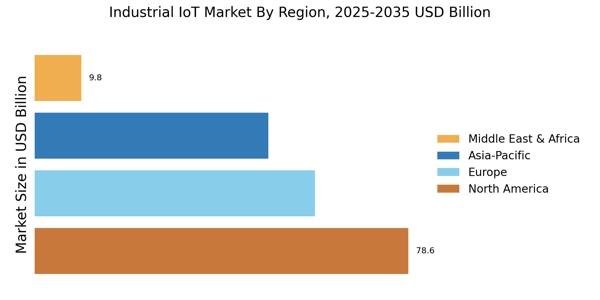
L'Amérique du Nord est le plus grand marché pour l'IoT industriel, détenant environ 40 % de la part mondiale. La croissance de la région est propulsée par des avancées technologiques rapides, une adoption accrue de la fabrication intelligente et des initiatives gouvernementales favorables. Les cadres réglementaires promouvant la transformation numérique et la cybersécurité sont également des catalyseurs significatifs pour l'expansion du marché. Les États-Unis dominent ce marché, suivis de près par le Canada, qui contribue environ 10 % à la part globale. Le paysage concurrentiel en Amérique du Nord est robuste, avec des acteurs clés tels que Siemens, General Electric et Honeywell. Ces entreprises sont à la pointe de l'innovation, fournissant des solutions de pointe qui améliorent l'efficacité opérationnelle. La présence de grandes entreprises technologiques telles que Cisco et IBM renforce encore le marché, favorisant un écosystème collaboratif qui stimule la croissance et le développement dans le secteur de l'IoT industriel.

Europe : Émergence d'une puissance industrielle

L'Europe connaît une croissance significative sur le marché de l'IoT industriel, représentant environ 30 % de la part mondiale. L'expansion de la région est alimentée par des réglementations strictes visant à améliorer l'efficacité industrielle et la durabilité. Des pays comme l'Allemagne et la France mènent la charge, l'Allemagne contribuant à elle seule environ 15 % au marché. Les initiatives de l'Union européenne pour promouvoir la numérisation dans la fabrication sont essentielles pour stimuler la demande de solutions IoT. L'Allemagne, le plus grand marché d'Europe, abrite des acteurs majeurs tels que Siemens et Schneider Electric, qui jouent un rôle essentiel dans l'avancement des technologies IoT. La France et le Royaume-Uni jouent également des rôles cruciaux, avec un nombre croissant de startups et d'entreprises établies se concentrant sur les innovations IoT. Le paysage concurrentiel se caractérise par la collaboration entre les entreprises de fabrication traditionnelles et les entreprises technologiques, renforçant les capacités de la région dans le domaine de l'IoT industriel.

Asie-Pacifique : Marché en forte croissance

L'Asie-Pacifique émerge comme un acteur significatif sur le marché de l'IoT industriel, détenant environ 25 % de la part mondiale. La croissance de la région est propulsée par l'automatisation industrielle croissante, les initiatives gouvernementales promouvant les villes intelligentes et une demande croissante pour l'analyse de données en temps réel. La Chine et le Japon sont les plus grands marchés, la Chine représentant à elle seule environ 15 % de la part totale du marché, reflétant sa rapide industrialisation et ses avancées technologiques. Le paysage concurrentiel en Asie-Pacifique est diversifié, avec à la fois des entreprises établies et des startups innovantes. Des acteurs clés comme ABB et Rockwell Automation étendent leur présence, tandis que des entreprises locales font également des progrès dans les solutions IoT. L'accent mis par la région sur l'amélioration de l'efficacité de la fabrication et de la durabilité propulse l'adoption des technologies IoT industrielles, faisant de celle-ci un marché dynamique pour la croissance future.

Moyen-Orient et Afrique : Potentiel de marché émergent

La région du Moyen-Orient et de l'Afrique émerge progressivement sur le marché de l'IoT industriel, détenant environ 5 % de la part mondiale. La croissance est principalement alimentée par des investissements croissants dans les infrastructures et une poussée vers la transformation numérique dans divers secteurs. Des pays comme les Émirats Arabes Unis et l'Afrique du Sud mènent cette tendance, les Émirats contribuant environ 3 % à la part du marché, soutenus par des initiatives gouvernementales visant à améliorer l'adoption technologique. Le paysage concurrentiel dans cette région évolue, avec un mélange d'acteurs locaux et internationaux entrant sur le marché. Les entreprises se concentrent sur le développement de solutions IoT adaptées aux besoins uniques des industries telles que le pétrole et le gaz, la fabrication et la logistique. La présence d'acteurs clés, ainsi qu'un nombre croissant de startups, favorise l'innovation et stimule l'adoption des technologies IoT industrielles dans la région.

Marché de l’Internet industriel des objets Regional Image

Acteurs clés et aperçu concurrentiel

Le marché de l'IoT industriel est actuellement caractérisé par un paysage concurrentiel dynamique, propulsé par des avancées technologiques rapides et une demande croissante d'automatisation dans divers secteurs. Des acteurs clés tels que Siemens (DE), General Electric (US) et Honeywell (US) se positionnent stratégiquement par l'innovation et les partenariats. Siemens (DE) se concentre sur la transformation numérique et l'infrastructure intelligente, tandis que General Electric (US) met l'accent sur sa stratégie industrielle numérique, intégrant l'IoT à son vaste portefeuille industriel. Honeywell (US) améliore ses capacités en technologie opérationnelle, indiquant un changement collectif vers des solutions intégrées qui améliorent l'efficacité et réduisent les coûts opérationnels.

La structure du marché semble modérément fragmentée, avec un mélange d'acteurs établis et de startups émergentes. Les entreprises adoptent diverses tactiques commerciales, telles que la localisation de la fabrication et l'optimisation des chaînes d'approvisionnement, pour améliorer leur avantage concurrentiel. Cette fragmentation permet des offres diversifiées, mais l'influence des grands acteurs reste substantielle, car ils établissent des normes industrielles et stimulent l'innovation grâce à des investissements substantiels en R&D.

En août 2025, Siemens (DE) a annoncé un partenariat stratégique avec un fournisseur de services cloud de premier plan pour améliorer les capacités de sa plateforme IoT. Cette collaboration vise à tirer parti de l'informatique cloud pour améliorer l'analyse des données et les applications d'apprentissage automatique dans les environnements industriels. L'importance stratégique de ce mouvement réside dans l'engagement de Siemens à fournir des solutions évolutives et flexibles qui répondent aux besoins évolutifs de ses clients, renforçant ainsi sa position sur le marché.

En septembre 2025, General Electric (US) a dévoilé une nouvelle suite d'outils de maintenance prédictive alimentés par l'IA conçus pour le secteur manufacturier. Cette initiative reflète l'accent mis par GE sur l'exploitation de l'intelligence artificielle pour optimiser les performances des équipements et réduire les temps d'arrêt. L'introduction de ces outils devrait améliorer la satisfaction et la fidélité des clients, alors que les entreprises recherchent de plus en plus des solutions qui minimisent les interruptions opérationnelles.

En juillet 2025, Honeywell (US) a lancé un nouveau cadre de cybersécurité adapté aux applications IoT industrielles. Ce cadre vise à protéger les infrastructures critiques contre les menaces cybernétiques, qui sont devenues une préoccupation croissante à l'ère numérique. En donnant la priorité à la cybersécurité, Honeywell répond non seulement à un besoin pressant du marché, mais se positionne également comme un leader dans la protection des opérations industrielles, renforçant ainsi sa différenciation concurrentielle.

À partir d'octobre 2025, les tendances les plus marquantes qui façonnent le paysage concurrentiel incluent la numérisation, la durabilité et l'intégration de l'intelligence artificielle. Les alliances stratégiques deviennent de plus en plus un pilier de la stratégie concurrentielle, permettant aux entreprises de mutualiser leurs ressources et leur expertise. En regardant vers l'avenir, il semble que la différenciation concurrentielle évoluera d'une compétition basée sur le prix à un accent sur l'innovation, l'avancement technologique et la fiabilité de la chaîne d'approvisionnement. Ce changement suggère que les entreprises qui priorisent ces éléments émergeront probablement comme des leaders sur le marché de l'IoT industriel.

Les principales entreprises du marché Marché de l’Internet industriel des objets incluent

Développements de l'industrie

  • T2 2024 : Siemens lance le système de gestion de l'edge industriel pour l'IIoT Siemens a annoncé le lancement de son nouveau système de gestion de l'edge industriel, permettant aux fabricants de gérer les dispositifs et applications IIoT à grande échelle, améliorant le traitement des données en temps réel et l'efficacité opérationnelle.
  • T2 2024 : Rockwell Automation acquiert Clearpath Robotics pour étendre ses capacités IIoT Rockwell Automation a finalisé l'acquisition de Clearpath Robotics, visant à intégrer des robots mobiles autonomes avancés dans son portefeuille IoT industriel pour des environnements de fabrication plus intelligents.
  • T2 2024 : ABB et Microsoft annoncent un partenariat stratégique pour des solutions IIoT alimentées par l'IA ABB et Microsoft ont conclu un partenariat stratégique pour co-développer des solutions IoT industriel alimentées par l'IA, se concentrant sur la maintenance prédictive et l'optimisation énergétique pour les clients manufacturiers.
  • T2 2024 : Honeywell dévoile une nouvelle usine IIoT à Texas Honeywell a ouvert une nouvelle installation de fabrication au Texas équipée de capteurs IIoT avancés et de plateformes d'analyse, conçue pour mettre en valeur les opérations de smart factory de nouvelle génération.
  • T2 2024 : La startup IoT industriel Tulip lève 50 millions de dollars en série C pour développer sa plateforme Tulip, un fournisseur de logiciels de fabrication IIoT, a sécurisé 50 millions de dollars en financement de série C pour accélérer le développement de produits et élargir sa clientèle mondiale.
  • T3 2024 : Schneider Electric lance EcoStruxure Automation Expert 2024 pour l'IIoT Schneider Electric a publié la dernière version de sa plateforme EcoStruxure Automation Expert, présentant une intégration IIoT améliorée et des capacités d'informatique en périphérie pour l'automatisation industrielle.
  • T3 2024 : Bosch s'associe à AWS pour fournir des analyses IIoT basées sur le cloud Bosch a annoncé un partenariat avec Amazon Web Services pour offrir des services d'analyse basés sur le cloud et d'apprentissage automatique pour les déploiements IoT industriels, ciblant les secteurs de la fabrication et de la logistique.
  • T3 2024 : Emerson nomme un nouveau directeur numérique pour diriger la stratégie IIoT Emerson a nommé un nouveau directeur numérique pour diriger sa stratégie IoT industriel, se concentrant sur l'expansion des initiatives de transformation numérique à travers ses opérations mondiales.
  • T4 2024 : GE Vernova remporte un contrat de 100 millions de dollars pour la modernisation du réseau IIoT GE Vernova a sécurisé un contrat de 100 millions de dollars pour déployer des solutions IIoT pour la modernisation du réseau, y compris des capteurs intelligents et des analyses prédictives pour les clients de services publics.
  • T4 2024 : Siemens et SAP annoncent une plateforme IIoT conjointe Siemens et SAP ont lancé une plateforme IIoT conjointe conçue pour intégrer les données de l'atelier avec les systèmes de planification des ressources d'entreprise, permettant des flux de travail numériques transparents pour les fabricants.
  • T1 2025 : Hitachi ouvre un nouveau centre de R&D IIoT au Japon Hitachi a inauguré un nouveau centre de recherche et développement axé sur les technologies IoT industrielles, visant à accélérer l'innovation dans la fabrication intelligente et l'infrastructure connectée.
  • T1 2025 : La startup IoT industriel Element Analytics lève 30 millions de dollars en série B Element Analytics, spécialisée dans l'intégration et l'analyse de données IIoT, a levé 30 millions de dollars en financement de série B pour élargir son offre de produits et développer son équipe d'ingénierie.

Perspectives d'avenir

Marché de l’Internet industriel des objets Perspectives d'avenir

Le marché de l'IoT industriel devrait croître à un TCAC de 8,16 % de 2024 à 2035, soutenu par les avancées en connectivité, automatisation et analyse de données.

De nouvelles opportunités résident dans :

  • Intégration de solutions de maintenance prédictive pilotées par AI
  • Développement de plateformes IoT personnalisées pour des industries spécifiques
  • Expansion des capacités de calcul de pointe pour le traitement des données en temps réel

D'ici 2035, le marché de l'IoT industriel devrait être robuste, soutenu par l'innovation et des investissements stratégiques.

Segmentation du marché

Industrial Internet Of Things Market Vertical Outlook

  • Public Sector
  • Healthcare
  • BFSI
  • Government

Industrial Internet Of Things Market Components Outlook

  • Services
  • Software
  • Hardware

Industrial Internet Of Things Market Deployment Outlook

  • Cloud
  • On-Premises

Industrial Internet Of Things Market Connectivity Outlook

  • Wi-Fi
  • ZWave
  • RF
  • Li-Fi
  • LAN
  • BLE
  • Others

Industrial Internet Of Things Market Organization Size Outlook

  • Small
  • Medium
  • Large

Portée du rapport

TAILLE DU MARCHÉ 2024 196.4 (USD Billion)
TAILLE DU MARCHÉ 2025 212.43 (USD Billion)
TAILLE DU MARCHÉ 2035 465.45 (USD Billion)
TAUX DE CROISSANCE ANNUEL COMPOSÉ (TCAC) 8.16% (2024 - 2035)
COUVERTURE DU RAPPORT Prévisions de revenus, paysage concurrentiel, facteurs de croissance et tendances
ANNÉE DE BASE 2024
Période de prévision du marché 2025 - 2035
Données historiques 2019 - 2024
Unités de prévision du marché USD Milliard
Entreprises clés profilées Analyse de marché en cours
Segments couverts Analyse de segmentation du marché Progrès in
Principales opportunités de marché L'intégration d'analyses avancées et d'apprentissage automatique améliore l'efficacité opérationnelle in sur le marché industriel IoT.
Dynamique clé du marché La demande croissante d’analyses de données en temps réel stimule l’innovation et la concurrence in dans le secteur de l’Internet industriel des objets.
Pays couverts Amérique du Nord, Europe, APAC, Amérique du Sud, MEA

FAQs

What is the projected market valuation of the Industrial IoT Market by 2035?

The Industrial IoT Market is projected to reach a valuation of 465.45 USD Billion by 2035.

What was the market valuation of the Industrial IoT Market in 2024?

In 2024, the Industrial IoT Market was valued at 196.4 USD Billion.

What is the expected CAGR for the Industrial IoT Market during the forecast period 2025 - 2035?

The expected CAGR for the Industrial IoT Market during the forecast period 2025 - 2035 is 8.16%.

Which companies are considered key players in the Industrial IoT Market?

Key players in the Industrial IoT Market include Siemens, General Electric, Honeywell, Cisco, Rockwell Automation, Schneider Electric, ABB, IBM, and Microsoft.

What are the projected valuations for the connectivity segment in the Industrial IoT Market?

The connectivity segment is projected to range from 76.4 to 170.45 USD Billion.

How does the deployment segment of the Industrial IoT Market compare between cloud and on-premises solutions?

The deployment segment indicates cloud solutions may reach 186.12 USD Billion, while on-premises solutions could reach 279.33 USD Billion.

What is the expected performance of the components segment in the Industrial IoT Market?

The components segment is projected to have valuations ranging from 78.56 to 186.24 USD Billion for both software and hardware.

What are the projected valuations for the organization size segment in the Industrial IoT Market?

The organization size segment is expected to range from 39.28 to 233.7 USD Billion, depending on the size classification.

Which verticals are expected to drive growth in the Industrial IoT Market?

The verticals expected to drive growth include healthcare, BFSI, government, and the public sector, with valuations ranging from 30.0 to 175.45 USD Billion.

What does the future hold for the Industrial IoT Market in terms of growth and innovation?

The Industrial IoT Market appears poised for substantial growth, driven by technological advancements and increasing adoption across various sectors.

Auteur
Author
Author Profile
Apoorva Priyadarshi LinkedIn
Research Analyst
With 4+ years of experience in Market Intelligence and Strategic Research, Apoorv specializes in ICT, Semiconductor, and BFSI markets. Combining strong analytical capabilities with a deep understanding of technology-driven industries, he focuses on delivering data-driven insights that support strategic decision-making. With a background in technology and business research, Apoorv has contributed to numerous global market studies, competitive landscape analyses, and opportunity assessments across sectors such as semiconductors, digital banking, cybersecurity, and telecommunications.
Co-Author
Co-Author Profile
Shubham Munde LinkedIn
Team Lead - Research
Shubham brings over 7 years of expertise in Market Intelligence and Strategic Consulting, with a strong focus on the Automotive, Aerospace, and Defense sectors. Backed by a solid foundation in semiconductors, electronics, and software, he has successfully delivered high-impact syndicated and custom research on a global scale. His core strengths include market sizing, forecasting, competitive intelligence, consumer insights, and supply chain mapping. Widely recognized for developing scalable growth strategies, Shubham empowers clients to navigate complex markets and achieve a lasting competitive edge. Trusted by start-ups and Fortune 500 companies alike, he consistently converts challenges into strategic opportunities that drive sustainable growth.

Research Approach

Secondary Research

The secondary research process involved comprehensive analysis of industrial standards databases, government technology initiatives, peer-reviewed engineering journals, IoT industry publications, and authoritative manufacturing organizations. Key sources included the National Institute of Standards and Technology (NIST) Smart Manufacturing Systems, International Electrotechnical Commission (IEC) Industrial IoT Standards, Institute of Electrical and Electronics Engineers (IEEE) IoT Technical Community, International Society of Automation (ISA) Automation Standards, US Department of Energy Industrial Efficiency Programs, European Commission Digital Industry initiatives, Germany's Federal Ministry for Economic Affairs and Climate Action (Industry 4.0 programs), China Ministry of Industry and Information Technology (MIIT) Smart Manufacturing policies, US Bureau of Economic Analysis Manufacturing Data, International Data Corporation (IDC) Industrial IoT Trackers, GSMA Intelligence Industrial Connectivity Reports, Industrial Internet Consortium (IIC) White Papers, Platform Industrie 4.0 Germany, Manufacturing USA Institutes, US Census Bureau Annual Survey of Manufactures, Eurostat Digital Economy and Society Statistics, Japan Ministry of Economy Trade and Industry (METI) Connected Industries Initiative, and national digital transformation reports from key industrial markets. These sources were used to collect industrial automation adoption statistics, regulatory compliance frameworks, cybersecurity standards, manufacturing output trends, connectivity infrastructure deployments, and competitive landscape analysis for IoT platforms, industrial sensors, edge computing devices, and predictive analytics solutions.

Primary Research

Qualitative and quantitative insights were obtained by interviewing supply-side and demand-side stakeholders during the primary research process. The supply-side sources comprised CEOs, CTOs, VPs of IoT Product Development, heads of Industrial Automation, and commercial directors from IIoT platform providers, industrial communication vendors, sensor manufacturers, edge computing hardware companies, and cloud service providers that served industrial sectors. Demand-side sources consist of Chief Digital Officers, VP of Manufacturing Operations, Plant Directors, OT/IT Managers, and procurement representatives from discrete and process manufacturing enterprises, oil and gas operators, automotive OEMs, healthcare device manufacturers, and utility companies. The primary research validated market segmentation across hardware, software, and services layers, confirmed Industry 4.0 implementation timelines, and gathered insights on IoT adoption barriers, cybersecurity investment priorities, cloud vs. edge deployment preferences, and ROI metrics for predictive maintenance implementations.

Primary Respondent Breakdown:

By Designation: C-level Primaries (28%), Director Level (35%), Others (37%)

By Region: North America (40%), Europe (30%), Asia-Pacific (22%), Rest of World (8%)

Market Size Estimation

Global market valuation was derived through revenue mapping and industrial connectivity deployment analysis. The methodology included:

Identification of 55+ key IIoT ecosystem participants across platform providers, industrial automation vendors, cloud hyperscalers, and connectivity specialists spanning North America, Europe, Asia-Pacific, and Latin America

Product mapping across IoT platforms, industrial gateways, sensors & actuators, edge computing hardware, predictive maintenance software, and managed connectivity services

Analysis of reported and modeled annual revenues specific to industrial IoT portfolios, including automation software licenses, hardware shipments, and recurring cloud subscriptions

Coverage of manufacturers and service providers representing 75-80% of global market share in 2024

Extrapolation using bottom-up (device shipments × ASP by component category and vertical) and top-down (vendor revenue validation across platform, hardware, and services segments) approaches to derive segment-specific valuations, including separate estimations for cloud vs. on-premise deployments and wireless vs. wired connectivity technologies

Télécharger l'échantillon gratuit

Veuillez remplir le formulaire ci-dessous pour recevoir un échantillon gratuit de ce rapport

Download PDF ×

We do not share your information with anyone. However, we may send you emails based on your report interest from time to time. You may contact us at any time to opt-out.