産業用モノのインターネット市場

産業IoT市場の規模、シェアおよび調査報告書:コンポーネント別(ハードウェア、ソリューション&サービス)、展開別(クラウド上、オンプレミス)、接続性別(有線および無線)、エンドユーザー別(IT&テレコム、製造、ヘルスケア、小売、石油&ガス、自動車およびその他) - 2034年予測
ID: MRFR/ICT/1593-CR
100 Pages
Apoorva Priyadarshi, Shubham Munde
Last Updated: July 29, 2026
Industrial Internet Of Things Market
Market Size
Forecast Period2025 - 2035
CAGR (2025 - 2035)8.16%
2024 Market Size$ 196.4 Billion
2025 Market Size$ 212.43 Billion
2035 Market Size$ 465.45 Billion
Key Players
Siemens
General Electric
Honeywell
Cisco
Rockwell Automation
Schneider Electric
Opportunities
  • Rising Demand for Automation
  • Advancements in Sensor Technology
  • Integration of Advanced Analytics

産業用モノのインターネット市場 概要

市場調査未来の分析によると、産業IoT市場の規模は2024年に196.4億米ドルと推定されています。産業IoT業界は、2025年に212.43億米ドルから2035年までに465.45億米ドルに成長すると予測されており、2025年から2035年の予測期間中に8.16%の年平均成長率(CAGR)を示しています。

主要な市場動向とハイライト

産業IoT市場は、技術の進歩と自動化の需要の高まりにより、 substantialな成長が見込まれています。

  • 北米は産業IoTの最大市場であり、自動化技術への強力な投資を示しています。
  • アジア太平洋地域は急速な産業化とデジタルトランスフォーメーションの取り組みにより、最も成長が早い地域として浮上しています。
  • Wi-Fi技術は市場を支配し続けており、BLEはエネルギー効率の良さから最も成長が早いセグメントとして注目を集めています。
  • 自動化の需要の高まりとセンサー技術の進歩が市場を前進させる主要な要因です。

市場規模と予測

2024 Market Size 196.4 (USD Billion)
2035 Market Size 465.45 (USD Billion)
CAGR (2025 - 2035) 8.16%

主要なプレーヤー

シーメンス(DE)、ゼネラル・エレクトリック(US)、ハネウェル(US)、シスコ(US)、ロックウェル・オートメーション(US)、シュナイダーエレクトリック(FR)、ABB(CH)、IBM(US)、マイクロソフト(US)

産業用モノのインターネット市場 運転手

Rising Demand for Automation

The Industrial IoT Market is experiencing a notable surge in demand for automation across various sectors. This trend is driven by the need for enhanced operational efficiency and reduced labor costs. Industries such as manufacturing and logistics are increasingly adopting IoT solutions to streamline processes and minimize human error. According to recent data, the automation segment within the Industrial IoT Market is projected to grow at a compound annual growth rate of approximately 25% over the next five years. This growth is indicative of a broader shift towards smart factories and automated supply chains, where real-time data analytics and machine-to-machine communication play pivotal roles in decision-making and operational optimization.

Advancements in Sensor Technology

Advancements in sensor technology are significantly influencing the Industrial IoT Market. The proliferation of low-cost, high-performance sensors enables industries to collect vast amounts of data in real-time, facilitating better monitoring and control of processes. These sensors are integral to applications such as predictive maintenance, where they help in identifying potential equipment failures before they occur. The market for sensors in the Industrial IoT Market is expected to reach USD 30 billion by 2026, reflecting the growing reliance on data-driven insights. As industries continue to invest in smart technologies, the integration of advanced sensors will likely enhance operational capabilities and drive further innovation.

Integration of Advanced Analytics

The integration of advanced analytics into the Industrial IoT Market is transforming how organizations interpret and utilize data. By leveraging big data analytics, companies can gain deeper insights into operational performance, customer behavior, and market trends. This capability allows for more informed decision-making and strategic planning. The analytics segment within the Industrial IoT Market is anticipated to witness substantial growth, with projections indicating a market size of USD 15 billion by 2025. As industries increasingly recognize the value of data-driven strategies, the demand for sophisticated analytics tools and platforms is likely to escalate, further propelling the evolution of the Industrial IoT landscape.

Growing Focus on Supply Chain Optimization

The Industrial IoT Market is witnessing a growing focus on supply chain optimization, driven by the need for greater visibility and efficiency. IoT technologies enable real-time tracking of goods and assets, allowing companies to respond swiftly to disruptions and enhance inventory management. This trend is particularly relevant in sectors such as retail and manufacturing, where supply chain agility is critical. Recent studies indicate that companies implementing IoT solutions for supply chain management can achieve cost reductions of up to 30%. As organizations strive to create more resilient supply chains, the adoption of IoT technologies is expected to accelerate, further shaping the future of the Industrial IoT Market.

Emphasis on Sustainability and Energy Efficiency

The Industrial IoT Market is increasingly aligning with sustainability goals, as organizations seek to reduce their carbon footprints and enhance energy efficiency. IoT solutions facilitate real-time monitoring of energy consumption, enabling companies to identify inefficiencies and implement corrective measures. This focus on sustainability is not only driven by regulatory pressures but also by consumer demand for environmentally responsible practices. The market for energy management solutions within the Industrial IoT Market is projected to grow significantly, with estimates suggesting a value of USD 20 billion by 2025. This trend indicates a shift towards greener operations, where IoT technologies play a crucial role in achieving sustainability objectives.

市場セグメントの洞察

By Connectivity: Wi-Fi (Largest) vs. BLE (Fastest-Growing)

In the Industrial IoT market, the connectivity segment showcases a diverse array of technologies with Wi-Fi leading the pack as the largest segment. It holds a significant market share due to its widespread adoption in industrial applications, such as monitoring and control systems. Following Wi-Fi are technologies like ZWave and RF, which also contribute notably, but they have not yet reached the same scale of deployment and user acceptance as Wi-Fi. Other technologies, while present, account for a smaller portion of the overall market share, marking them as less dominant players in this space. As the industry evolves, growth trends indicate a rise in the adoption of BLE (Bluetooth Low Energy) technologies, particularly in asset tracking and smart manufacturing scenarios. The demand for low-power, efficient connectivity solutions is propelling BLE into the spotlight, exhibiting rapid growth rates. Additionally, the introduction of innovative applications in the Industrial IoT space, such as smart sensors and devices, is driving competition among connectivity technologies. Emergence of Li-Fi solutions further signifies a trend toward enhanced data transmission capabilities, aiming to meet the increasing data needs of modern industrial setups.

Connectivity: Wi-Fi (Dominant) vs. BLE (Emerging)

Wi-Fi remains the dominant choice for industrial connectivity, providing robust and high-speed data transfer essentials for various applications, from real-time monitoring to data analytics. Its ability to cover wide areas and integrate seamlessly with existing infrastructure makes it a preferred option for many organizations seeking scalability and flexibility. In contrast, BLE is emerging as a pivotal technology tailored for applications where power efficiency and low data rates are primary concerns. It is particularly suited for short-range communication, making it ideal for interconnected devices in smart factories. BLE's rapid growth stems from its capability to enhance automation by connecting numerous devices while maintaining power requirements, thereby carving out a significant niche within the Industrial IoT landscape.

By Deployment: Cloud (Largest) vs. On-Premises (Fastest-Growing)

In the Industrial IoT Market, the deployment segment is characterized by a clear division between cloud-based and on-premises solutions. Cloud deployment has emerged as the largest segment due to its scalability, cost-effectiveness, and ease of access. Many industries favor cloud solutions for their flexibility in handling large datasets and analysis in real-time, contributing to its dominant position. In contrast, on-premises deployment is gaining traction as organizations that prioritize data security and control opt for this more traditional solution. The trend towards on-premises solutions is fueled by increasing concerns over data privacy and security, prompting industries to invest in localized infrastructure. This has led to a significant growth momentum for on-premises solutions, appealing especially to sectors like manufacturing and critical infrastructure. Organizations are increasingly adopting hybrid models, combining advantages from both deployment types to leverage their respective benefits, while also enhancing system reliability and operational efficiency.

Deployment: Cloud (Dominant) vs. On-Premises (Emerging)

Cloud deployment in the Industrial IoT Market is considered a dominant force due to its ability to offer scalable solutions that cater to a myriad of industrial needs. With its inherent advantage of facilitating remote access and data storage capabilities, it enables organizations to optimize operations without heavy upfront investments in hardware. On the other hand, on-premises deployment is an emerging choice, particularly among firms that prioritize stringent control over their data and systems. This segment is characterized by tailored solutions that suit specific operational requirements, offering organizations the peace of mind that comes with managing data within their own infrastructure. As a result, on-premises systems are increasingly being viewed as integral in sectors requiring high security, making them a compelling alternative to cloud solutions.

By Components: Services (Largest) vs. Hardware (Fastest-Growing)

The Industrial IoT market is characterized by a diverse component distribution, with services leading in market share compared to hardware and software. Services encompass consulting and support, contributing significantly to overall revenue due to their critical role in deployment and maintenance. In contrast, hardware and software segments are vital, albeit to a lesser extent, reflecting the market's increasing reliance on integrated solutions and real-time data management for efficient industrial operations. Growth trends indicate that while services are proliferating due to ongoing digital transformation initiatives, hardware stands out as the fastest-growing segment. The expansion is fueled by advancements in sensor technology and edge computing. As industries seek enhanced connectivity and automation, demand for innovative hardware solutions is surging, highlighting the necessity for robust infrastructure to support IoT applications.

Services: Consulting (Dominant) vs. Hardware: Edge Devices (Emerging)

In the realm of Industrial IoT, consulting services represent a dominant value, providing essential support in strategy formulation, technology integration, and optimization. Consulting firms help manufacturers navigate the complexities of digital transformation, enabling a seamless transition to IoT-based operations. Conversely, edge devices as an emerging hardware segment are experiencing rapid growth due to their essential role in processing data closer to the source. This mitigates latency issues and enhances response times, thereby driving operational efficiencies. As companies increasingly prioritize real-time analytics, the market for edge devices is expected to witness significant innovation, making them imperative for the next phase of industrial automation.

By Organization Size: Large (Largest) vs. Small (Fastest-Growing)

The Industrial IoT market exhibits a diverse distribution across organization sizes, with large organizations commanding the highest market share due to their extensive resources and robust infrastructures. These enterprises leverage advanced IoT technology to optimize their operations and maintain a competitive edge, reflecting a significant share in the market. Conversely, small organizations, while currently representing a smaller portion of the market, are rapidly increasing their presence, driven by the ease of access to IoT solutions and the growing demand for efficiency in operations. The growth trends in the Industrial IoT sector indicate a notable rise in adoption among small-sized organizations. Historically underserved, this segment is now experiencing a surge in technological advancements allowing them to innovate and automate processes effectively. Key drivers include heightened awareness of IoT benefits, affordability of solutions, and increased customization options tailored to their unique operational needs, positioning them for significant growth in the coming years.

Large (Dominant) vs. Small (Emerging)

Large organizations in the Industrial IoT market position themselves as dominant players due to their ability to invest in large-scale IoT deployments and partnerships with leading technology providers. They typically operate with complex, integrated systems that enhance efficiency and drive innovation across their massive operations. Their established market presence allows them to leverage extensive data analytics to optimize performance further. In contrast, small organizations are emerging as crucial players within this segment, benefitting from simplified and cost-effective IoT solutions. These companies are able to implement IoT technologies that enhance operational processes without the heavy infrastructure burdens faced by larger firms, demonstrating agility and speed in adopting new technologies. As they continue to explore IoT applications, small organizations are likely to contribute significantly to the overall market growth.

By Vertical: Healthcare (Largest) vs. BFSI (Fastest-Growing)

In the Industrial IoT market, the vertical segment shows a diversified range of applications, with Healthcare capturing the largest share. It leverages IoT technology for patient monitoring, equipment tracking, and enhanced healthcare services, making it a preferred choice among industries seeking operational efficiency. Following closely, the BFSI sector is rapidly growing, utilizing IoT for security, risk management, and customer service enhancements, showcasing significant investment in smart banking solutions.

Healthcare (Dominant) vs. BFSI (Emerging)

The Healthcare sector stands as a dominant player in the Industrial IoT landscape, characterized by robust integration of IoT devices that improve patient care and streamline operations. This vertical focuses on advanced technologies such as wearables and telehealth services, fostering a patient-centric approach. In contrast, the BFSI segment, while emerging, is experiencing rapid expansion as banks and financial institutions adopt IoT solutions for real-time data analytics and cyber security measures. This growing emphasis on digital transformation positions BFSI as a crucial contender in the market.

産業用モノのインターネット市場に関する詳細な洞察を得る

地域の洞察

北米:革新とリーダーシップのハブ

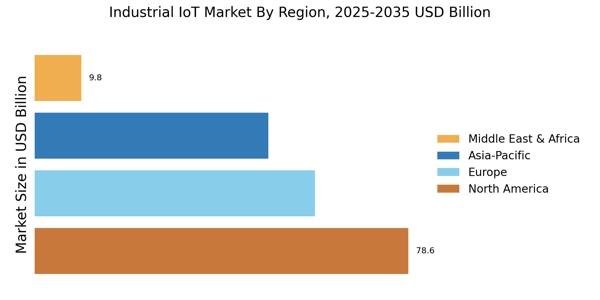
北米は産業IoTの最大市場であり、世界のシェアの約40%を占めています。この地域の成長は、急速な技術革新、スマート製造の採用の増加、政府の支援策によって推進されています。デジタルトランスフォーメーションとサイバーセキュリティを促進する規制フレームワークも市場拡大の重要な触媒です。米国がこの市場をリードしており、カナダが約10%を貢献しています。 北米の競争環境は堅牢で、シーメンス、ゼネラル・エレクトリック、ハネウェルなどの主要プレーヤーがいます。これらの企業は革新の最前線にあり、運用効率を向上させる最先端のソリューションを提供しています。シスコやIBMなどの主要なテクノロジー企業の存在は、市場をさらに強化し、産業IoTセクターの成長と発展を促進する協力的なエコシステムを育んでいます。

ヨーロッパ:新興の産業大国

ヨーロッパは産業IoT市場での重要な成長を目の当たりにしており、世界のシェアの約30%を占めています。この地域の拡大は、産業効率と持続可能性を向上させることを目的とした厳格な規制によって促進されています。ドイツやフランスなどの国々が先頭に立っており、ドイツだけで市場に約15%を貢献しています。製造業におけるデジタル化を促進する欧州連合のイニシアチブは、IoTソリューションの需要を推進する上で重要です。 ヨーロッパで最大の市場であるドイツは、シーメンスやシュナイダーエレクトリックなどの主要プレーヤーがIoT技術の進展に重要な役割を果たしています。フランスや英国も重要な役割を果たしており、IoT革新に焦点を当てた新興スタートアップや確立された企業が増えています。競争環境は、伝統的な製造企業とテクノロジー企業の間の協力によって特徴付けられ、産業IoT分野での地域の能力を向上させています。

アジア太平洋:急成長する市場

アジア太平洋は産業IoT市場で重要なプレーヤーとして浮上しており、世界のシェアの約25%を占めています。この地域の成長は、産業自動化の増加、スマートシティを促進する政府のイニシアチブ、リアルタイムデータ分析の需要の高まりによって推進されています。中国と日本が最大の市場であり、中国だけで市場全体の約15%を占めており、その急速な産業化と技術革新を反映しています。 アジア太平洋の競争環境は多様で、確立された企業と革新的なスタートアップが共存しています。ABBやロックウェル・オートメーションなどの主要プレーヤーが存在感を拡大している一方で、地元企業もIoTソリューションで進展を遂げています。製造効率と持続可能性を向上させることに焦点を当てたこの地域は、産業IoT技術の採用を促進しており、将来の成長に向けた活気ある市場となっています。

中東およびアフリカ:新興市場の可能性

中東およびアフリカ地域は、産業IoT市場で徐々に浮上しており、世界のシェアの約5%を占めています。この成長は、インフラへの投資の増加と、さまざまな産業でのデジタルトランスフォーメーションの推進によって主に推進されています。UAEや南アフリカなどの国々がこのトレンドをリードしており、UAEは市場シェアの約3%を貢献しており、技術採用を促進する政府のイニシアチブによって支えられています。 この地域の競争環境は進化しており、地元企業と国際企業が市場に参入しています。企業は、石油・ガス、製造、物流などの産業の独自のニーズに合わせたIoTソリューションの開発に焦点を当てています。主要プレーヤーの存在とともに、増加するスタートアップが革新を促進し、この地域での産業IoT技術の採用を推進しています。

産業用モノのインターネット市場 Regional Image

主要企業と競争の洞察

産業IoT市場は、急速な技術革新とさまざまなセクターでの自動化の需要の高まりによって推進される動的な競争環境が特徴です。シーメンス(DE)、ゼネラル・エレクトリック(US)、ハネウェル(US)などの主要プレーヤーは、革新とパートナーシップを通じて戦略的に自らを位置づけています。シーメンス(DE)はデジタルトランスフォーメーションとスマートインフラに焦点を当てており、ゼネラル・エレクトリック(US)はIoTをその広範な産業ポートフォリオに統合するデジタル産業戦略を強調しています。ハネウェル(US)は、運用技術能力を強化しており、効率を向上させ、運用コストを削減する統合ソリューションへの集団的なシフトを示しています。

市場構造は中程度に分散しているようで、確立されたプレーヤーと新興スタートアップのブレンドがあります。企業は、競争力を高めるために製造のローカライズやサプライチェーンの最適化など、さまざまなビジネス戦略を採用しています。この分散は多様な提供を可能にしますが、主要プレーヤーの影響は依然として重要であり、彼らは業界標準を設定し、 substantial R&D 投資を通じて革新を推進しています。

2025年8月、シーメンス(DE)は、IoTプラットフォーム機能を強化するために主要なクラウドサービスプロバイダーとの戦略的パートナーシップを発表しました。このコラボレーションは、クラウドコンピューティングを活用して、産業環境内でのデータ分析と機械学習アプリケーションを改善することを目的としています。この動きの戦略的重要性は、シーメンスが顧客の進化するニーズに応えるスケーラブルで柔軟なソリューションを提供することにコミットしていることにあり、これにより市場での地位を強化しています。

2025年9月、ゼネラル・エレクトリック(US)は、製造セクター向けに設計されたAI駆動の予測保守ツールの新しいスイートを発表しました。このイニシアチブは、設備のパフォーマンスを最適化し、ダウンタイムを削減するために人工知能を活用することに焦点を当てています。これらのツールの導入は、企業が運用の中断を最小限に抑えるソリューションをますます求める中で、顧客満足度とロイヤルティを向上させる可能性があります。

2025年7月、ハネウェル(US)は、産業IoTアプリケーション向けに特化した新しいサイバーセキュリティフレームワークを発表しました。このフレームワークは、デジタル時代において増大する懸念となっているサイバー脅威から重要なインフラを保護することを目的としています。サイバーセキュリティを優先することで、ハネウェルは市場の緊急のニーズに対応するだけでなく、産業運用を保護するリーダーとしての地位を確立し、競争の差別化を強化しています。

2025年10月現在、競争環境を形成する最も顕著なトレンドには、デジタル化、持続可能性、人工知能の統合が含まれます。戦略的提携は、競争戦略の基盤となりつつあり、企業がリソースと専門知識をプールできるようにしています。今後を見据えると、競争の差別化は従来の価格競争から革新、技術の進歩、サプライチェーンの信頼性に焦点を当てたものに進化するようです。このシフトは、これらの要素を優先する企業が産業IoT市場でリーダーとして浮上する可能性が高いことを示唆しています。

産業用モノのインターネット市場市場の主要企業には以下が含まれます

業界の動向

  • 2024年第2四半期:シーメンスがIIoT向け産業エッジ管理システムを発表 シーメンスは、新しい産業エッジ管理システムの発表を行い、製造業者がIIoTデバイスとアプリケーションを大規模に管理し、リアルタイムデータ処理と運用効率を向上させることを可能にします。
  • 2024年第2四半期:ロックウェル・オートメーションがクリアパス・ロボティクスを買収しIIoT機能を拡大 ロックウェル・オートメーションは、クリアパス・ロボティクスの買収を完了し、スマートな製造環境のために高度な自律型モバイルロボットを産業IoTポートフォリオに統合することを目指しています。
  • 2024年第2四半期:ABBとマイクロソフトがAI駆動のIIoTソリューションのための戦略的パートナーシップを発表 ABBとマイクロソフトは、製造クライアント向けに予測保守およびエネルギー最適化に焦点を当てたAI駆動の産業IoTソリューションを共同開発するための戦略的パートナーシップを結びました。
  • 2024年第2四半期:ハネウェルがテキサスに新しいIIoT対応工場を開設 ハネウェルは、次世代のスマートファクトリー運営を展示するために、先進的なIIoTセンサーと分析プラットフォームを備えた新しい製造施設をテキサスに開設しました。
  • 2024年第2四半期:産業IoTスタートアップのTulipが5000万ドルのシリーズC資金を調達 IIoT製造ソフトウェアの提供者であるTulipは、製品開発を加速し、グローバルな顧客基盤を拡大するために5000万ドルのシリーズC資金を調達しました。
  • 2024年第3四半期:シュナイダーエレクトリックがIIoT向けEcoStruxure Automation Expert 2024を発表 シュナイダーエレクトリックは、産業自動化のためのIIoT統合とエッジコンピューティング機能を強化したEcoStruxure Automation Expertプラットフォームの最新バージョンをリリースしました。
  • 2024年第3四半期:ボッシュがAWSと提携しクラウドベースのIIoT分析を提供 ボッシュは、製造業と物流セクターをターゲットにした産業IoT展開のためのクラウドベースの分析と機械学習サービスを提供するために、アマゾンウェブサービスと提携しました。
  • 2024年第3四半期:エマーソンがIIoT戦略をリードする新しい最高デジタル責任者を任命 エマーソンは、産業IoT戦略を推進するために新しい最高デジタル責任者を任命し、グローバルな運営全体でのdigital transformationイニシアチブの拡大に焦点を当てています。
  • 2024年第4四半期:GE VernovaがIIoT対応のグリッド近代化のために1億ドルの契約を獲得 GE Vernovaは、ユーティリティクライアント向けのスマートセンサーと予測分析を含むIIoT対応のソリューションを展開するために1億ドルの契約を獲得しました。
  • 2024年第4四半期:シーメンスとSAPが製造向けの共同IIoTプラットフォームを発表 シーメンスとSAPは、製造業者のためにショップフロアデータを企業資源計画システムと統合するように設計された共同IIoTプラットフォームを立ち上げました。
  • 2025年第1四半期:日立が日本に新しいIIoT R&Dセンターを開設 日立は、スマート製造と接続されたインフラにおける革新を加速することを目指して、産業IoT技術に特化した新しい研究開発センターを開設しました。
  • 2025年第1四半期:産業IoTスタートアップのElement Analyticsが3000万ドルのシリーズB資金を調達 IIoTデータ統合と分析を専門とするElement Analyticsは、製品提供を拡大し、エンジニアリングチームを成長させるために3000万ドルのシリーズB資金を調達しました。

今後の見通し

産業用モノのインターネット市場 今後の見通し

産業IoT市場は2024年から2035年にかけて8.16%のCAGRで成長すると予測されており、接続性、自動化、データ分析の進歩が推進力となります。

新しい機会は以下にあります:

  • AI 主導の予知保全ソリューションの統合
  • 特定の業界向けにカスタマイズされた IoT プラットフォームの開発
  • リアルタイムデータ処理のためのエッジコンピューティング機能の拡張

2035年までに、産業IoT市場は革新と戦略的投資により堅調なものになると期待されています。

市場セグメンテーション

Industrial Internet Of Things Market Vertical Outlook

  • Public Sector
  • Healthcare
  • BFSI
  • Government

Industrial Internet Of Things Market Components Outlook

  • Services
  • Software
  • Hardware

Industrial Internet Of Things Market Deployment Outlook

  • Cloud
  • On-Premises

Industrial Internet Of Things Market Connectivity Outlook

  • Wi-Fi
  • ZWave
  • RF
  • Li-Fi
  • LAN
  • BLE
  • Others

Industrial Internet Of Things Market Organization Size Outlook

  • Small
  • Medium
  • Large

レポートの範囲

市場規模 2024 196.4 (USD Billion)
市場規模 2025 212.43 (USD Billion)
市場規模 2035 465.45 (USD Billion)
年間複利成長率 (CAGR) 8.16% (2024 - 2035)
レポートの範囲 収益予測、競争環境、成長要因、トレンド
基準年 2024
市場予測期間 2025 - 2035
過去のデータ 2019 - 2024
市場予測単位 USD 億
主要企業の概要 市場分析での進捗状況
対象となるセグメント 市場セグメンテーション分析での進捗状況
主要な市場機会 高度な分析と機械学習の統合により、業務効率が向上します。
主要な市場動向 リアルタイム データ分析に対する需要の高まりにより、産業用モノのインターネット分野のイノベーションと競争が促進されます。
対象国 北アメリカ、ヨーロッパ、APAC、南アメリカ、MEA

FAQs

What is the projected market valuation of the Industrial IoT Market by 2035?

The Industrial IoT Market is projected to reach a valuation of 465.45 USD Billion by 2035.

What was the market valuation of the Industrial IoT Market in 2024?

In 2024, the Industrial IoT Market was valued at 196.4 USD Billion.

What is the expected CAGR for the Industrial IoT Market during the forecast period 2025 - 2035?

The expected CAGR for the Industrial IoT Market during the forecast period 2025 - 2035 is 8.16%.

Which companies are considered key players in the Industrial IoT Market?

Key players in the Industrial IoT Market include Siemens, General Electric, Honeywell, Cisco, Rockwell Automation, Schneider Electric, ABB, IBM, and Microsoft.

What are the projected valuations for the connectivity segment in the Industrial IoT Market?

The connectivity segment is projected to range from 76.4 to 170.45 USD Billion.

How does the deployment segment of the Industrial IoT Market compare between cloud and on-premises solutions?

The deployment segment indicates cloud solutions may reach 186.12 USD Billion, while on-premises solutions could reach 279.33 USD Billion.

What is the expected performance of the components segment in the Industrial IoT Market?

The components segment is projected to have valuations ranging from 78.56 to 186.24 USD Billion for both software and hardware.

What are the projected valuations for the organization size segment in the Industrial IoT Market?

The organization size segment is expected to range from 39.28 to 233.7 USD Billion, depending on the size classification.

Which verticals are expected to drive growth in the Industrial IoT Market?

The verticals expected to drive growth include healthcare, BFSI, government, and the public sector, with valuations ranging from 30.0 to 175.45 USD Billion.

What does the future hold for the Industrial IoT Market in terms of growth and innovation?

The Industrial IoT Market appears poised for substantial growth, driven by technological advancements and increasing adoption across various sectors.

著者
Author
Author Profile
Apoorva Priyadarshi LinkedIn
Research Analyst
With 4+ years of experience in Market Intelligence and Strategic Research, Apoorv specializes in ICT, Semiconductor, and BFSI markets. Combining strong analytical capabilities with a deep understanding of technology-driven industries, he focuses on delivering data-driven insights that support strategic decision-making. With a background in technology and business research, Apoorv has contributed to numerous global market studies, competitive landscape analyses, and opportunity assessments across sectors such as semiconductors, digital banking, cybersecurity, and telecommunications.
Co-Author
Co-Author Profile
Shubham Munde LinkedIn
Team Lead - Research
Shubham brings over 7 years of expertise in Market Intelligence and Strategic Consulting, with a strong focus on the Automotive, Aerospace, and Defense sectors. Backed by a solid foundation in semiconductors, electronics, and software, he has successfully delivered high-impact syndicated and custom research on a global scale. His core strengths include market sizing, forecasting, competitive intelligence, consumer insights, and supply chain mapping. Widely recognized for developing scalable growth strategies, Shubham empowers clients to navigate complex markets and achieve a lasting competitive edge. Trusted by start-ups and Fortune 500 companies alike, he consistently converts challenges into strategic opportunities that drive sustainable growth.

Research Approach

Secondary Research

The secondary research process involved comprehensive analysis of industrial standards databases, government technology initiatives, peer-reviewed engineering journals, IoT industry publications, and authoritative manufacturing organizations. Key sources included the National Institute of Standards and Technology (NIST) Smart Manufacturing Systems, International Electrotechnical Commission (IEC) Industrial IoT Standards, Institute of Electrical and Electronics Engineers (IEEE) IoT Technical Community, International Society of Automation (ISA) Automation Standards, US Department of Energy Industrial Efficiency Programs, European Commission Digital Industry initiatives, Germany's Federal Ministry for Economic Affairs and Climate Action (Industry 4.0 programs), China Ministry of Industry and Information Technology (MIIT) Smart Manufacturing policies, US Bureau of Economic Analysis Manufacturing Data, International Data Corporation (IDC) Industrial IoT Trackers, GSMA Intelligence Industrial Connectivity Reports, Industrial Internet Consortium (IIC) White Papers, Platform Industrie 4.0 Germany, Manufacturing USA Institutes, US Census Bureau Annual Survey of Manufactures, Eurostat Digital Economy and Society Statistics, Japan Ministry of Economy Trade and Industry (METI) Connected Industries Initiative, and national digital transformation reports from key industrial markets. These sources were used to collect industrial automation adoption statistics, regulatory compliance frameworks, cybersecurity standards, manufacturing output trends, connectivity infrastructure deployments, and competitive landscape analysis for IoT platforms, industrial sensors, edge computing devices, and predictive analytics solutions.

Primary Research

Qualitative and quantitative insights were obtained by interviewing supply-side and demand-side stakeholders during the primary research process. The supply-side sources comprised CEOs, CTOs, VPs of IoT Product Development, heads of Industrial Automation, and commercial directors from IIoT platform providers, industrial communication vendors, sensor manufacturers, edge computing hardware companies, and cloud service providers that served industrial sectors. Demand-side sources consist of Chief Digital Officers, VP of Manufacturing Operations, Plant Directors, OT/IT Managers, and procurement representatives from discrete and process manufacturing enterprises, oil and gas operators, automotive OEMs, healthcare device manufacturers, and utility companies. The primary research validated market segmentation across hardware, software, and services layers, confirmed Industry 4.0 implementation timelines, and gathered insights on IoT adoption barriers, cybersecurity investment priorities, cloud vs. edge deployment preferences, and ROI metrics for predictive maintenance implementations.

Primary Respondent Breakdown:

By Designation: C-level Primaries (28%), Director Level (35%), Others (37%)

By Region: North America (40%), Europe (30%), Asia-Pacific (22%), Rest of World (8%)

Market Size Estimation

Global market valuation was derived through revenue mapping and industrial connectivity deployment analysis. The methodology included:

Identification of 55+ key IIoT ecosystem participants across platform providers, industrial automation vendors, cloud hyperscalers, and connectivity specialists spanning North America, Europe, Asia-Pacific, and Latin America

Product mapping across IoT platforms, industrial gateways, sensors & actuators, edge computing hardware, predictive maintenance software, and managed connectivity services

Analysis of reported and modeled annual revenues specific to industrial IoT portfolios, including automation software licenses, hardware shipments, and recurring cloud subscriptions

Coverage of manufacturers and service providers representing 75-80% of global market share in 2024

Extrapolation using bottom-up (device shipments × ASP by component category and vertical) and top-down (vendor revenue validation across platform, hardware, and services segments) approaches to derive segment-specific valuations, including separate estimations for cloud vs. on-premise deployments and wireless vs. wired connectivity technologies

無料サンプルをダウンロード

このレポートの無料サンプルを受け取るには、以下のフォームにご記入ください

Download PDF ×

We do not share your information with anyone. However, we may send you emails based on your report interest from time to time. You may contact us at any time to opt-out.