Kostenloses Muster herunterladen
Bitte füllen Sie das folgende Formular aus, um ein kostenloses Muster dieses Berichts zu erhalten
Marktforschungsbericht über neuartige Medikamente und intelligente Geräte für Atemwegserkrankungen nach Produkttyp (neuartiges Medikament, intelligentes Gerät, Kombinationstherapie), nach Anwendung (Asthma, chronisch obstruktive Lungenerkrankung, zystische Fibrose, pulmonale arterielle Hypertonie), nach Endbenutzer (Krankenhäuser, häusliche Pflegeeinrichtungen, Apotheken, Forschungseinrichtungen), nach Verabreichungsweg (Inhalation, oral, injizierbar) und nach Region (Nordamerika, Europa, Südamerika, Asien-Pazifik, Naher Osten und Afrika) - Prognose bis 2035
Laut der Analyse von MRFR wurde der Markt für neuartige Medikamente und intelligente Geräte zur Behandlung von Atemwegserkrankungen im Jahr 2024 auf 56,48 Milliarden USD geschätzt. Der Markt wird voraussichtlich von 59,95 Milliarden USD im Jahr 2025 auf 108,8 Milliarden USD bis 2035 wachsen, was einer durchschnittlichen jährlichen Wachstumsrate (CAGR) von 6,14 während des Prognosezeitraums 2025 - 2035 entspricht.
Der Markt für neuartige Medikamente und intelligente Geräte zur Behandlung von Atemwegserkrankungen steht vor einem erheblichen Wachstum, das durch technologische Fortschritte und zunehmendes Gesundheitsbewusstsein vorangetrieben wird.
| 2024 Market Size | 56,48 (USD Milliarden) |
| 2035 Market Size | 108,8 (Milliarden USD) |
| CAGR (2025 - 2035) | 6,14 % |
GlaxoSmithKline (GB), AstraZeneca (GB), Boehringer Ingelheim (DE), Novartis (CH), Roche (CH), Teva Pharmaceutical Industries (IL), Merck & Co. (US), Pfizer (US), Sanofi (FR), AbbVie (US)
Der Markt für neuartige Medikamente und intelligente Geräte zur Behandlung von Atemwegserkrankungen befindet sich derzeit in einer transformierenden Phase, die durch technologische Fortschritte und ein wachsendes Verständnis von Atemwegserkrankungen vorangetrieben wird. Innovationen in der Arzneimittelzusammensetzung und die Integration intelligenter Geräte verändern die Behandlungsparadigmen und bieten den Patienten effektivere Managementoptionen. Die Konvergenz von Pharmazeutika und digitalen Gesundheitslösungen scheint die Patientenadhärenz und -überwachung zu verbessern, was potenziell zu besseren Gesundheitsergebnissen führen kann. Darüber hinaus erfordert die zunehmende Verbreitung von Atemwegserkrankungen weltweit die Entwicklung maßgeschneiderter Therapien und Geräte, die auf die unterschiedlichen Bedürfnisse der Patienten eingehen. Zudem passen sich die Regulierungsbehörden an diese Veränderungen an und fördern ein innovationsfreundliches Umfeld. Der Fokus auf personalisierte Medizin und die Nutzung von künstlicher Intelligenz in der Arzneimittelentwicklung und der Funktionalität von Geräten deuten auf eine vielversprechende Zukunft für diesen Markt hin. Während die Akteure, einschließlich Pharmaunternehmen und Technologieunternehmen, enger zusammenarbeiten, scheint das Potenzial für bahnbrechende Lösungen in der Atemwegspflege zu wachsen. Diese Synergie könnte nicht nur die Lebensqualität der Patienten verbessern, sondern auch die Gesundheitsversorgungssysteme optimieren, sodass sie effizienter und reaktionsschneller auf individuelle Anforderungen reagieren.
Die Integration digitaler Gesundheitstechnologien in die Atemwegspflege wird zunehmend verbreitet. Intelligente Geräte, wie Inhalatoren mit Sensoren, ermöglichen die Echtzeitüberwachung der Medikamenteneinnahme und der Patientenadhärenz. Dieser Trend deutet auf einen Wandel hin zu interaktiveren und personalisierten Behandlungsansätzen hin, die potenziell die Patientenergebnisse verbessern könnten.
Es gibt einen wachsenden Fokus auf personalisierte Medizin im Markt für neuartige Medikamente und intelligente Geräte zur Behandlung von Atemwegserkrankungen. Maßgeschneiderte Therapien, die individuelle Patientenprofile und genetische Faktoren berücksichtigen, werden voraussichtlich die Behandlungseffizienz erhöhen. Dieser Trend zeigt eine Abkehr von Lösungen, die für alle gleich sind, hin zu einer individuelleren Gesundheitsversorgung.
Innovationen in den Arzneimittelabgabesystemen verändern, wie Atemwegserkrankungen behandelt werden. Neue Formulierungen und Abgabemechanismen, wie Nebelgeräte und Inhalatoren mit erweiterten Funktionen, könnten die Arzneimittelaufnahme und die Patientenadhärenz verbessern. Dieser Trend hebt die fortlaufende Entwicklung therapeutischer Strategien in der Atemwegspflege hervor.
Die zunehmende Häufigkeit von Atemwegserkrankungen wie Asthma und chronisch obstruktiver Lungenerkrankung (COPD) ist ein Haupttreiber für den Markt für neuartige Medikamente und intelligente Geräte zur Behandlung von Atemwegserkrankungen. Laut aktuellen Schätzungen sind Atemwegserkrankungen weltweit von Millionen von Menschen betroffen, was zu einer erhöhten Nachfrage nach innovativen Behandlungsoptionen führt. Dieser Anstieg der Prävalenz erfordert die Entwicklung neuartiger Medikamente und intelligenter Geräte, die Symptome effektiv managen und die Patientenergebnisse verbessern können. Der Markt wird voraussichtlich ein erhebliches Wachstum erleben, da Gesundheitsdienstleister nach fortschrittlichen Lösungen suchen, um die wachsende Belastung durch Atemwegserkrankungen zu bewältigen. Darüber hinaus wird die Integration intelligenter Geräte in Behandlungsregime voraussichtlich die Patientenadhärenz und -überwachung verbessern, was zur allgemeinen Expansion des Marktes beiträgt.
Regulierungsbehörden unterstützen zunehmend die Entwicklung innovativer Therapien für Atemwegserkrankungen, was als wesentlicher Treiber für den Markt für neuartige Medikamente und intelligente Geräte für Atemwegserkrankungen dient. Initiativen, die darauf abzielen, den Genehmigungsprozess für neuartige Medikamente und Geräte zu beschleunigen, ermutigen Pharmaunternehmen, in Forschung und Entwicklung zu investieren. Programme wie Durchbruchtherapie-Bezeichnungen und beschleunigte Genehmigungen sind darauf ausgelegt, wirksame Behandlungen schneller auf den Markt zu bringen. Dieses regulatorische Umfeld fördert Innovationen und ermutigt die Einführung modernster Lösungen, die ungedeckte medizinische Bedürfnisse in der Atemwegspflege ansprechen. Infolgedessen ist der Markt bereit für Wachstum, da neue Therapien und intelligente Geräte die regulatorische Genehmigung erhalten und den Patienten zur Verfügung stehen.
Der Trend zu Lösungen im Bereich der häuslichen Gesundheitsversorgung ist ein wesentlicher Treiber für den Markt für neuartige Medikamente und intelligente Geräte bei Atemwegserkrankungen. Mit einer zunehmenden Zahl von Patienten, die es vorziehen, ihre Gesundheitszustände zu Hause zu verwalten, steigt die Nachfrage nach intelligenten Geräten, die eine Fernüberwachung und Behandlung ermöglichen. Geräte wie tragbare Vernebler und intelligente Inhalatoren werden zu unverzichtbaren Hilfsmitteln für Patienten mit Atemwegserkrankungen, da sie eine bequeme und effektive Verwaltung ihrer Erkrankungen ermöglichen. Dieser Trend wird durch die alternde Bevölkerung weiter unterstützt, die häufig eine kontinuierliche Atemwegspflege benötigt. Der Markt wird voraussichtlich weiterhin wachsen, da sich die Gesundheitssysteme an diese Nachfrage anpassen und sich darauf konzentrieren, zugängliche und benutzerfreundliche Lösungen anzubieten, die es den Patienten ermöglichen, die Kontrolle über ihre Gesundheit zu übernehmen.
Technologische Innovationen in der Arzneimittelentwicklung beeinflussen den Markt für neuartige Medikamente und intelligente Geräte bei Atemwegserkrankungen erheblich. Das Aufkommen fortschrittlicher biopharmazeutischer Produkte und neuartiger Arzneimittelformulierungen hat die Behandlungslandschaft für Atemwegserkrankungen revolutioniert. Techniken wie Hochdurchsatz-Screening und künstliche Intelligenz optimieren den Arzneimittelentdeckungsprozess und ermöglichen eine schnellere und effizientere Entwicklung wirksamer Therapien. Darüber hinaus verbessert das Aufkommen intelligenter Inhalatoren und vernetzter Geräte die Arzneimittelabgabe und das Patientenengagement. Diese Fortschritte verbessern nicht nur die therapeutischen Ergebnisse, sondern fördern auch einen personalisierteren Ansatz für die Behandlung. Infolgedessen wird erwartet, dass der Markt wächst, da Pharmaunternehmen in Forschung und Entwicklung investieren, um innovative Lösungen für Patienten mit Atemwegserkrankungen bereitzustellen.
Es gibt ein wachsendes Bewusstsein und eine zunehmende Aufklärung über die Atemwegsgesundheit, was den Markt für neuartige Medikamente und intelligente Geräte bei Atemwegserkrankungen antreibt. Öffentlichkeitskampagnen und Bildungsinitiativen informieren die Patienten über die Bedeutung einer frühen Diagnose und einer effektiven Behandlung von Atemwegserkrankungen. Dieses gesteigerte Bewusstsein führt zu einer erhöhten Patientenbeteiligung und einer größeren Bereitschaft, Behandlung zu suchen. Da die Patienten besser über ihre Erkrankungen informiert sind, nutzen sie eher neuartige Medikamente und intelligente Geräte, die ihre Lebensqualität verbessern können. Der Markt wird von diesem Trend profitieren, da Gesundheitsdienstleister und Organisationen weiterhin die Aufklärung über Atemwegsgesundheit fördern, was letztendlich zu verbesserten Patientenergebnissen und einer erhöhten Nachfrage nach innovativen Lösungen führt.
Im Markt für neuartige Medikamente und intelligente Geräte zur Behandlung von Atemwegserkrankungen halten neuartige Medikamente den größten Marktanteil, was einen erheblichen Teil aufgrund ihrer nachgewiesenen Wirksamkeit und umfangreicher Forschungsunterstützung darstellt. Während sie weiterhin dominieren, gewinnen intelligente Geräte als wesentlicher Bestandteil an Bedeutung und erobern allmählich einen größeren Anteil, indem sie fortschrittliche Technologie integrieren, um die Patientencompliance und -ergebnisse zu verbessern. Die Kombinationstherapie, obwohl wichtig, nimmt einen kleineren Anteil ein, da sie sowohl Medikamente als auch Geräte verbindet und sich an spezialisierte Märkte richtet. Die Wachstumstrends zeigen eine Verschiebung hin zu personalisierteren und technologisch getriebenen Lösungen für Atemwegserkrankungen. Mit dem zunehmenden Bewusstsein für Atemwegserkrankungen und der Erweiterung innovativer Behandlungsoptionen wird erwartet, dass die Nachfrage nach intelligenten Geräten ansteigt, angetrieben durch Fortschritte in der Telemedizin und der Fernüberwachung. In der Zwischenzeit entwickeln sich neuartige Medikamente weiter mit verbesserten Formulierungen, die spezifische Wege bei Atemwegserkrankungen ansprechen, und bewahren ihre Relevanz neben diesen aufkommenden Technologien.
Neues Medikament (Dominant) vs. Smart Device (Aufkommend)
Im Markt für neuartige Medikamente und intelligente Geräte zur Behandlung von Atemwegserkrankungen ist das Segment der neuartigen Medikamente dominant, da es eine langjährige Präsenz und eine etablierte therapeutische Wirksamkeit aufweist, die auf chronische Erkrankungen wie Asthma und COPD abzielt. Diese Medikamente stehen an der Spitze der Behandlung, unterstützt durch strenge klinische Studien und behördliche Genehmigungen. In der Zwischenzeit stellen intelligente Geräte das aufstrebende Segment dar, das innovative Funktionen wie Echtzeitüberwachung und Datenanalytik integriert, um der wachsenden Präferenz der Patienten für Selbstmanagement gerecht zu werden. Diese Geräte verbessern die Therapietreue und bieten wertvolle Gesundheitsinformationen, die technikaffine Verbraucher ansprechen. Die Kombinationstherapie ergänzt diese Segmente, indem sie die Stärken von Medikamenten und Geräten nutzt, um die Behandlungsergebnisse für unterschiedliche Patientenbedürfnisse zu optimieren.
Asthma bleibt ein dominierendes Segment im Markt für neuartige Medikamente und intelligente Geräte zur Behandlung von Atemwegserkrankungen und trägt erheblich zur gesamten Anwendungslandschaft bei. Diese Erkrankung betrifft eine große Bevölkerung und führt zu einer Vielzahl innovativer Therapien und intelligenter Geräte, die darauf ausgelegt sind, Symptome zu managen und die Patientenergebnisse zu verbessern. Eng gefolgt wird dies von der chronisch obstruktiven Lungenerkrankung (COPD), die schnell aufkommt, angetrieben durch eine steigende Inzidenzrate, die mit Faktoren wie Rauchen und Umweltverschmutzung verbunden ist. Der Fokus auf das Management von COPD treibt Fortschritte in der Arzneimittel- und Gerätetechnologie voran, die darauf abzielen, die Lebensqualität der Patienten zu verbessern.
Asthma (Dominant) vs. Mukoviszidose (Emerging)
Asthma ist die dominierende Anwendung im Markt für neuartige Medikamente und intelligente Geräte bei Atemwegserkrankungen, aufgrund seiner weit verbreiteten Häufigkeit und der erheblichen Aufmerksamkeit von Pharmaunternehmen und Geräteherstellern. Die umfangreiche Palette an Behandlungen, einschließlich Inhalatoren, Verneblern und Biologika, positioniert es fest an der Spitze dieses Sektors. Im Gegensatz dazu hat sich Mukoviszidose als ein wichtiges Fokusgebiet herauskristallisiert, angesichts der einzigartigen Herausforderungen, die sie mit sich bringt. Der Bedarf an spezialisierten Therapien und Geräten zur Behandlung dieser genetischen Erkrankung wächst, angetrieben durch Fortschritte in der genetischen Forschung und das Engagement zur Verbesserung der Behandlungsergebnisse. Beide Segmente unterstreichen die Vielfalt und dynamische Natur des Marktes für Atemwegserkrankungen.
Im Markt für neuartige Medikamente und intelligente Geräte zur Behandlung von Atemwegserkrankungen sind Krankenhäuser das größte Endnutzungssegment, das einen erheblichen Anteil aufgrund ihrer fortschrittlichen Gesundheitsinfrastruktur und der Fähigkeit zur Bereitstellung spezialisierter Atemwegstherapien einnimmt. Die Präsenz von geschultem medizinischen Personal und umfassenden Patientenversorgungseinrichtungen in Krankenhäusern ermöglicht es ihnen, neuartige Medikamente und intelligente Geräte effektiver zu übernehmen als in anderen Sektoren. Im Gegensatz dazu verzeichnen häusliche Pflegeeinrichtungen ein rapides Wachstum, da Patienten zunehmend häusliche Pflege zur Bewältigung von Atemwegserkrankungen bevorzugen. Dieser Wandel wird durch technologische Fortschritte unterstützt, die eine Fernüberwachung und -behandlung ermöglichen, wodurch die häusliche Pflege zu einer praktikableren Option wird. Die Wachstumstrends in diesem Segment werden durch die zunehmende Prävalenz von Atemwegserkrankungen und die alternde Bevölkerung vorangetrieben, was zu einer höheren Nachfrage nach sowohl Krankenhauspflege als auch häuslichen Gesundheitslösungen führt. Innovative Arzneimittelabgabesysteme und intelligente Geräte verbessern die Patientenergebnisse, was Krankenhäuser dazu anregt, stark in diese Technologien zu investieren. Darüber hinaus befähigt der rasante Anstieg der Telemedizin-Dienste die häuslichen Pflegeeinrichtungen, ihre Dienstleistungen auszubauen und ein Umfeld zu schaffen, das die Übernahme neuartiger Medikamente und intelligenter Geräte begünstigt. Somit wird die Wachstumskurve des Marktes sowohl von institutionellen als auch von individuellen Gesundheitsbedürfnissen beeinflusst.
Krankenhäuser (Dominant) vs. häusliche Pflegeeinrichtungen (Emerging)
Krankenhäuser werden als das dominierende Endverbrauchersegment im Markt für neuartige Medikamente und intelligente Geräte zur Behandlung von Atemwegserkrankungen angesehen, da sie über umfangreiche Ressourcen verfügen, die es ihnen ermöglichen, fortschrittliche Behandlungsoptionen für Patienten bereitzustellen. Sie haben in der Regel Zugang zu den neuesten Technologien und medizinischem Fachwissen, was die Implementierung neuartiger Medikamente und intelligenter Geräte ermöglicht, die die Patientenversorgung verbessern. Im Gegensatz dazu gewinnen häusliche Pflegeeinrichtungen als kritisches Segment an Bedeutung, da die wachsende Präferenz für Behandlungsoptionen zu Hause bei Patienten mit Atemwegserkrankungen zunimmt. Die Integration intelligenter Geräte in der häuslichen Pflege hat zu einer verbesserten Überwachung und Verwaltung von Erkrankungen geführt, wodurch Patienten mehr Autonomie erhalten. Während Krankenhäuser akute Pflege bieten, verbessern häusliche Pflegeeinrichtungen die Kontinuität der Versorgung und machen sie zu einem wesentlichen Bestandteil des Gesundheitsökosystems in diesem Markt.
Das Segment 'Verabreichungsweg' im Markt für neuartige Medikamente und intelligente Geräte bei Atemwegserkrankungen zeigt eine vielfältige Verteilung des Marktanteils zwischen Inhalation, oral und injizierbar. Die Inhalation bleibt das größte Segment aufgrund ihrer Effektivität bei der direkten Abgabe von Medikamenten an die Lungen, was die therapeutischen Ergebnisse maximiert. Im Gegensatz dazu gewinnt das Segment der oralen Verabreichung, obwohl kleiner, an Bedeutung aufgrund seiner Bequemlichkeit und der Patientencompliance, was die Marktdynamik erheblich beeinflusst. Wachstumstrends zeigen einen robusten Anstieg im Sektor der oralen Verabreichung, angestoßen durch Fortschritte in der Arzneimittel-Formulierung und -Abgabe Technologien. Da immer mehr Patienten nicht-invasive und benutzerfreundliche Optionen bevorzugen, verzeichnet der Markt eine zunehmende Anzahl innovativer oraler Medikamente für Atemwegserkrankungen. Darüber hinaus floriert die Inhalationstherapie weiterhin, angetrieben durch steigende Inzidenzen von Atemwegserkrankungen und einen wachsenden Fokus auf das Management der Atemwegsgesundheit, was darauf hindeutet, dass beide Segmente einzigartige Wachstumsfaktoren haben, die auf die Bedürfnisse der Patienten abgestimmt sind.
Inhalation (dominant) vs. Oral (emerging)
Die Inhalation bleibt der dominierende Verabreichungsweg im Markt für neuartige Medikamente und intelligente Geräte bei Atemwegserkrankungen, hauptsächlich aufgrund ihrer Fähigkeit, einen schnellen Wirkungseintritt und eine gezielte Behandlung von Erkrankungen wie Asthma und COPD zu bieten. Geräte wie Vernebler und Inhalatoren haben sich erheblich weiterentwickelt und bieten verbesserte Abgabesysteme und Formulierungen. Andererseits entwickelt sich die orale Verabreichung zu einer praktikablen Alternative, die sich durch ihre Benutzerfreundlichkeit und eine hohe Patientenakzeptanz auszeichnet. Das Aufkommen neuartiger oraler Arzneimittelformulierungen, die für Atemwegserkrankungen entwickelt wurden, weckt das Interesse an diesem Verabreichungsweg und markiert einen Wandel in der Patientenpräferenz hin zu zugänglicheren Behandlungsoptionen. Sowohl Inhalation als auch orale Wege sind entscheidend, um den unterschiedlichen Bedürfnissen der Patienten gerecht zu werden, was die sich entwickelnde Landschaft der Therapeutika für Atemwegserkrankungen unterstreicht.
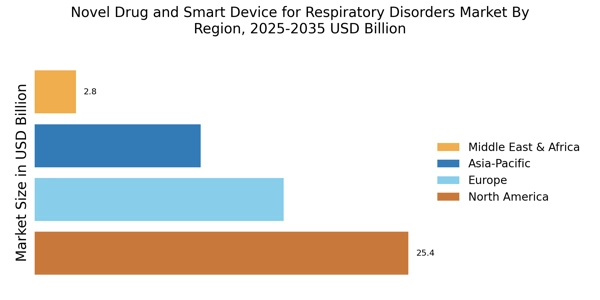
Der Markt für neuartige Medikamente und intelligente Geräte bei Atemwegserkrankungen zeigt eine erhebliche regionale Diversität, wobei Nordamerika mit einer Bewertung von 20,0 Milliarden USD im Jahr 2023 an der Spitze steht, die voraussichtlich bis 2032 auf 34,8 Milliarden USD steigen wird, was seine Mehrheitsbeteiligung in der Branche verdeutlicht. Europa folgt mit einer Bewertung von 12,5 Milliarden USD im Jahr 2023 und einem prognostizierten Wachstum auf 20,0 Milliarden USD, was die signifikante Nachfrage nach innovativen Atemwegslösungen widerspiegelt. Die Region Asien-Pazifik gewinnt an Bedeutung, mit einem Wert von 10,0 Milliarden USD im Jahr 2023, der voraussichtlich 18,0 Milliarden USD erreichen wird, bedingt durch die zunehmende Prävalenz von Atemwegserkrankungen.
Unterdessen stellen Südamerika und der Nahe Osten Afrika kleinere, aber bemerkenswerte Segmente dar, die im Jahr 2023 mit 4,0 Milliarden USD bzw. 3,63 Milliarden USD bewertet werden. Das Wachstum in Südamerika wird durch die Verbesserung der Gesundheitsinfrastruktur gefördert, während die Expansion der MEA-Region auf eine wachsende Bevölkerung mit Atemwegserkrankungen zurückzuführen ist. Diese Segmentierung hebt die Daten des Marktes für neuartige Medikamente und intelligente Geräte bei Atemwegserkrankungen hervor und zeigt wichtige Wachstumsbereiche, Herausforderungen und Chancen, die die Marktlandschaft prägen.

Quelle: Primärforschung, Sekundärforschung, MRFR-Datenbank und Analystenbewertung
Der Markt für neuartige Medikamente und intelligente Geräte zur Behandlung von Atemwegserkrankungen ist durch eine Vielzahl von Akteuren gekennzeichnet, darunter Pharmaunternehmen und Technologieunternehmen, die alle bestrebt sind, Innovationen voranzutreiben und den sich wandelnden Bedürfnissen von Patienten und Gesundheitsdienstleistern gerecht zu werden. Dieser Markt basiert auf der zunehmenden Häufigkeit von Atemwegserkrankungen, die die Beteiligten dazu gezwungen hat, stark in Forschung und Entwicklung zu investieren, um neuartige Therapien und fortschrittliche medizinische Geräte bereitzustellen.
Die Wettbewerbsdynamik wird von mehreren Faktoren bestimmt, darunter Fortschritte in der Arzneimittellieferung, ein Fokus auf personalisierte Medizin und die Integration intelligenter Technologien, die das Patientenmanagement und die Therapietreue verbessern. Während Unternehmen versuchen, ihre Angebote durch einzigartige Wertversprechen zu differenzieren, navigieren sie auch durch regulatorische Herausforderungen und ein sich schnell veränderndes Gesundheitsumfeld, das Ergebnisse und Kosteneffektivität betont.
Sanofi ist ein bedeutender Akteur im Markt für neuartige Medikamente und intelligente Geräte zur Behandlung von Atemwegserkrankungen und nutzt sein robustes Portfolio an Medikamenten, die darauf ausgelegt sind, verschiedene Atemwegserkrankungen zu behandeln. Die Stärken des Unternehmens umfassen ein starkes Engagement für Innovationen, unterstützt durch erhebliche Investitionen in Forschung und Entwicklung, die es ihm ermöglichen, bahnbrechende Behandlungen einzuführen.
Sanofi hat sich einen soliden Ruf für seine globale Reichweite und die Zusammenarbeit mit Gesundheitsfachleuten erarbeitet, um maßgeschneiderte therapeutische Lösungen zu entwickeln. Dies hat ihnen geholfen, einen Wettbewerbsvorteil im Markt zu erlangen, da sie sich darauf konzentrieren, die Patientenergebnisse durch maßgeschneiderte Behandlungsstrategien und effektive Arzneimittellieferungssysteme, die intelligente Technologie integrieren, zu verbessern. Das Erbe des Unternehmens und seine etablierte Marktpräsenz zeigen weiter seine Fähigkeit, auf aufkommende Herausforderungen in der Atemwegspflege zu reagieren.
Johnson und Johnson hat ebenfalls einen bedeutenden Einfluss auf den Markt für neuartige Medikamente und intelligente Geräte zur Behandlung von Atemwegserkrankungen und zeigt seine umfangreiche Erfahrung sowohl in der Pharmaindustrie als auch bei fortschrittlichen medizinischen Geräten. Die Stärke des Unternehmens liegt in seinem umfassenden Produktportfolio, das eine Vielzahl von Atemwegserkrankungen abdeckt und sicherstellt, dass es den unterschiedlichen Bedürfnissen der Patienten in verschiedenen demografischen Gruppen gerecht wird.
Der innovative Ansatz von Johnson und Johnson spiegelt sich in seinen Investitionen in intelligente Gesundheitstechnologien wider, die die Funktionalität und Benutzererfahrung von Atemweggeräten verbessern und so die Therapietreue und das Engagement der Patienten effektiv fördern. Darüber hinaus positioniert der starke Ruf, den Johnson und Johnson weltweit aufgebaut hat, das Unternehmen günstig bei Gesundheitsdienstleistern und Patienten, und sein Engagement, die Lebensqualität von Menschen mit Atemwegserkrankungen zu verbessern, treibt weiterhin seinen Markterfolg und seine Wettbewerbspositionierung voran.



Aktuelle Entwicklungen im Markt für neuartige Medikamente und intelligente Geräte zur Behandlung von Atemwegserkrankungen umfassen die fortlaufenden Fortschritte in Therapien und Technologien, die darauf abzielen, die Patientenergebnisse zu verbessern. Unternehmen wie Sanofi, Johnson Johnson und GlaxoSmithKline bringen aktiv innovative Lösungen auf den Markt, um Atemwegserkrankungen zu adressieren, und betonen die Notwendigkeit effektiver Management-Tools. Aktuelle Ereignisse heben die steigende Nachfrage nach intelligenten Geräten hervor, die eine Echtzeitüberwachung und -verwaltung von Atemwegserkrankungen ermöglichen, wobei große Akteure wie Merck Co und Teva Pharmaceuticals in digitale Gesundheitsplattformen investieren.
Bemerkenswert ist, dass AstraZeneca und Gilead Sciences für ihre gemeinsamen Anstrengungen bei der Entwicklung von Kombinationstherapien zur Verbesserung der Behandlungseffizienz anerkannt wurden. In Bezug auf Fusionen und Übernahmen konzentrierte sich die jüngste Akquisitionsstrategie von Amgen auf die Integration modernster Atemwegstherapien, was das Unternehmen wettbewerbsfähig im Markt positioniert.
In der Zwischenzeit waren Boehringer Ingelheim und Vertex Pharmaceuticals ebenfalls an strategischen Partnerschaften beteiligt, um die Entwicklung neuartiger Medikamente zu beschleunigen. Die Marktbewertung führender Unternehmen wird erheblich von diesen Innovationen und Kooperationen beeinflusst, was einen robusten Wachstumstrend widerspiegelt, während die Akteure bestrebt sind, den sich entwickelnden Patientenbedürfnissen in der Atemwegspflege gerecht zu werden.
Der Markt für neuartige Medikamente und intelligente Geräte zur Behandlung von Atemwegserkrankungen wird von 2024 bis 2035 voraussichtlich mit einer durchschnittlichen jährlichen Wachstumsrate (CAGR) von 6,14 % wachsen, angetrieben durch technologische Fortschritte und die zunehmende Verbreitung von Atemwegserkrankungen.
Neue Möglichkeiten liegen in:
Bis 2035 wird der Markt voraussichtlich robust sein, angetrieben von Innovation und steigender Nachfrage.
| MARKTGRÖSSE 2024 | 56,48 (Milliarden USD) |
| MARKTGRÖSSE 2025 | 59,95 (Milliarden USD) |
| MARKTGRÖSSE 2035 | 108,8 (Milliarden USD) |
| Durchschnittliche jährliche Wachstumsrate (CAGR) | 6,14 % (2024 - 2035) |
| BERICHTSABDECKUNG | Umsatzprognose, Wettbewerbslandschaft, Wachstumsfaktoren und Trends |
| GRUNDJAHR | 2024 |
| Marktprognosezeitraum | 2025 - 2035 |
| Historische Daten | 2019 - 2024 |
| Marktprognoseeinheiten | Milliarden USD |
| Wichtige Unternehmen | Marktanalyse in Bearbeitung |
| Abgedeckte Segmente | Marktsegmentierungsanalyse in Bearbeitung |
| Wichtige Marktchancen | Die Integration von künstlicher Intelligenz in intelligente Geräte verbessert die personalisierte Behandlung von Atemwegserkrankungen. |
| Wichtige Marktdynamiken | Die steigende Nachfrage nach innovativen Therapien und intelligenten Geräten treibt den Wettbewerb und die regulatorische Überprüfung im Management von Atemwegserkrankungen voran. |
| Abgedeckte Länder | Nordamerika, Europa, APAC, Südamerika, MEA |


Bitte füllen Sie das folgende Formular aus, um ein kostenloses Muster dieses Berichts zu erhalten

“This is really good guys. Excellent work on a tight deadline. I will continue to use you going forward and recommend you to others. Nice job”


“Thanks. It’s been a pleasure working with you, please use me as reference with any other Intel employees.”


“Thanks for sending the report it gives us a good global view of the Betaïne market.”


“Thank you, this will be very helpful for OQS.”


“We found the report very insightful! we found your research firm very helpful. I'm sending this email to secure our future business.”


“I am very pleased with how market segments have been defined in a relevant way for my purposes (such as "Portable Freezers & refrigerators" and "last-mile"). In general the report is well structured. Thanks very much for your efforts.”


“I have been reading the first document or the study, ,the Global HVAC and FP market report 2021 till 2026. Must say, good info! I have not gone in depth at all parts, but got a good indication of the data inside!”


“We got the report in time, we really thank you for your support in this process. I also thank to all of your team as they did a great job.”


“The Automotive 48V ECU Components Procurement Intelligence Study” was a complex project, but the Market Research Future (MRFR) team handled it with quality, agility, and customer-centricity. They delivered all requested data on time and within the agreed scope. The team, including Shubhendra Anand and Rahul Gotadki, was always readily available to clarify questions and swiftly implement necessary adjustments, driving the project to a successful conclusion within a very demanding timeframe.
I would also like to specifically commend Akshay Agarwal for his responsiveness and support at every stage—from our initial inquiry on May 6th through to final delivery on June 18th. His dedication made the entire process seamless.”



