Télécharger l'échantillon gratuit
Veuillez remplir le formulaire ci-dessous pour recevoir un échantillon gratuit de ce rapport
Rapport d'étude de marché sur les médicaments novateurs et les dispositifs intelligents pour les troubles respiratoires par type de produit (Médicament novateur, Dispositif intelligent, Thérapie combinée), par application (Asthme, Maladie pulmonaire obstructive chronique, Fibrose kystique, Hypertension artérielle pulmonaire), par utilisateur final (Hôpitaux, Soins à domicile, Pharmacies, Institutions de recherche), par voie d'administration (Inhalation, Oral, Injectable) et par région (Amérique du Nord, Europe, Amérique du Sud, Asie-Pacifique, Moyen-Orient et Afrique) - Prévisions jusqu'en 2035.
Selon l'analyse de MRFR, le marché des nouveaux médicaments et des dispositifs intelligents pour les troubles respiratoires était estimé à 56,48 milliards USD en 2024. Le marché devrait croître de 59,95 milliards USD en 2025 à 108,8 milliards USD d'ici 2035, affichant un taux de croissance annuel composé (CAGR) de 6,14 pendant la période de prévision 2025 - 2035.
Le marché des nouveaux médicaments et des dispositifs intelligents pour les troubles respiratoires est prêt à connaître une croissance substantielle, stimulée par les avancées technologiques et une prise de conscience croissante de la santé.
| 2024 Market Size | 56,48 (milliards USD) |
| 2035 Market Size | 108,8 (milliards USD) |
| CAGR (2025 - 2035) | 6,14 % |
GlaxoSmithKline (GB), AstraZeneca (GB), Boehringer Ingelheim (DE), Novartis (CH), Roche (CH), Teva Pharmaceutical Industries (IL), Merck & Co. (US), Pfizer (US), Sanofi (FR), AbbVie (US)
Le marché des nouveaux médicaments et des dispositifs intelligents pour les troubles respiratoires connaît actuellement une phase transformative, propulsée par les avancées technologiques et une compréhension croissante des conditions respiratoires. Les innovations dans les formulations de médicaments et l'intégration de dispositifs intelligents redéfinissent les paradigmes de traitement, offrant aux patients des options de gestion plus efficaces. La convergence des produits pharmaceutiques et des solutions de santé numérique semble améliorer l'adhésion des patients et le suivi, ce qui pourrait conduire à de meilleurs résultats de santé. De plus, la prévalence croissante des troubles respiratoires dans le monde nécessite le développement de thérapies et de dispositifs sur mesure qui répondent aux besoins divers des patients. En outre, les organismes de réglementation s'adaptent à ces changements, favorisant un environnement propice à l'innovation. L'accent mis sur la médecine personnalisée et l'utilisation de l'intelligence artificielle dans le développement de médicaments et la fonctionnalité des dispositifs suggère un avenir prometteur pour ce marché. À mesure que les parties prenantes, y compris les entreprises pharmaceutiques et les entreprises technologiques, collaborent plus étroitement, le potentiel de solutions révolutionnaires dans les soins respiratoires semble s'élargir. Cette synergie pourrait non seulement améliorer la qualité de vie des patients, mais aussi rationaliser les systèmes de livraison des soins de santé, les rendant plus efficaces et réactifs aux besoins individuels.
L'incorporation des technologies de santé numérique dans les soins respiratoires devient de plus en plus répandue. Les dispositifs intelligents, tels que les inhalateurs équipés de capteurs, permettent un suivi en temps réel de l'utilisation des médicaments et de l'adhésion des patients. Cette tendance suggère un passage vers des approches de traitement plus interactives et personnalisées, pouvant potentiellement améliorer les résultats pour les patients.
Il y a un accent croissant sur la médecine personnalisée dans le marché des nouveaux médicaments et des dispositifs intelligents pour les troubles respiratoires. Les thérapies sur mesure qui prennent en compte les profils individuels des patients et les facteurs génétiques sont susceptibles d'améliorer l'efficacité du traitement. Cette tendance indique un éloignement des solutions universelles vers des soins de santé plus personnalisés.
Les innovations dans les systèmes de livraison de médicaments transforment la manière dont les médicaments respiratoires sont administrés. De nouvelles formulations et mécanismes de livraison, tels que les nébuliseurs et les inhalateurs avec des capacités améliorées, peuvent améliorer l'absorption des médicaments et l'adhésion des patients. Cette tendance met en lumière l'évolution continue des stratégies thérapeutiques dans les soins respiratoires.
L'incidence croissante des troubles respiratoires, tels que l'asthme et la maladie pulmonaire obstructive chronique (MPOC), est un moteur principal du marché des nouveaux médicaments et des dispositifs intelligents pour les troubles respiratoires. Selon des estimations récentes, les maladies respiratoires touchent des millions d'individus dans le monde, entraînant une demande accrue pour des options de traitement innovantes. Cette augmentation de la prévalence nécessite le développement de nouveaux médicaments et de dispositifs intelligents capables de gérer efficacement les symptômes et d'améliorer les résultats pour les patients. Le marché devrait connaître une croissance substantielle alors que les prestataires de soins de santé recherchent des solutions avancées pour faire face à la charge croissante des affections respiratoires. De plus, l'intégration de dispositifs intelligents dans les régimes de traitement est susceptible d'améliorer l'adhésion et le suivi des patients, contribuant ainsi à l'expansion globale du marché.
Les organismes de réglementation soutiennent de plus en plus le développement de thérapies innovantes pour les troubles respiratoires, ce qui constitue un moteur clé pour le marché des nouveaux médicaments et des dispositifs intelligents pour les troubles respiratoires. Les initiatives visant à accélérer le processus d'approbation des nouveaux médicaments et dispositifs encouragent les entreprises pharmaceutiques à investir dans la recherche et le développement. Des programmes tels que les désignations de thérapie révolutionnaire et les approbations accélérées sont conçus pour amener des traitements efficaces sur le marché plus rapidement. Cet environnement réglementaire favorise l'innovation et encourage l'introduction de solutions de pointe qui répondent aux besoins médicaux non satisfaits en matière de soins respiratoires. En conséquence, le marché est prêt à croître alors que de nouvelles thérapies et dispositifs intelligents obtiennent l'approbation réglementaire et deviennent disponibles pour les patients.
L'évolution vers des solutions de soins de santé à domicile est un moteur significatif pour le marché des nouveaux médicaments et des dispositifs intelligents pour les troubles respiratoires. Avec un nombre croissant de patients préférant gérer leurs conditions de santé à domicile, la demande pour des dispositifs intelligents facilitant la surveillance et le traitement à distance est en hausse. Des dispositifs tels que les nébuliseurs portables et les inhalateurs intelligents deviennent des outils essentiels pour les patients souffrant de troubles respiratoires, permettant une gestion pratique et efficace de leurs conditions. Cette tendance est encore soutenue par le vieillissement de la population, qui nécessite souvent des soins respiratoires continus. Le marché devrait continuer à croître alors que les systèmes de santé s'adaptent à cette demande, en se concentrant sur la fourniture de solutions accessibles et conviviales qui permettent aux patients de prendre le contrôle de leur santé.
Les innovations technologiques dans le développement de médicaments influencent considérablement le marché des nouveaux médicaments et des dispositifs intelligents pour les troubles respiratoires. L'avènement des biopharmaceutiques avancés et des nouvelles formulations de médicaments a révolutionné le paysage du traitement des troubles respiratoires. Des techniques telles que le criblage à haut débit et l'intelligence artificielle rationalisent le processus de découverte de médicaments, permettant un développement plus rapide et plus efficace de thérapies efficaces. De plus, l'émergence des inhalateurs intelligents et des dispositifs connectés améliore la délivrance de médicaments et l'engagement des patients. Ces avancées non seulement améliorent les résultats thérapeutiques, mais favorisent également une approche plus personnalisée du traitement. En conséquence, le marché devrait s'étendre à mesure que les entreprises pharmaceutiques investissent dans la recherche et le développement pour apporter des solutions innovantes aux patients souffrant d'affections respiratoires.
Il y a une prise de conscience croissante et une éducation concernant la santé respiratoire, ce qui stimule le marché des nouveaux médicaments et des dispositifs intelligents pour les troubles respiratoires. Les campagnes de santé publique et les initiatives éducatives informent les patients sur l'importance d'un diagnostic précoce et d'une gestion efficace des troubles respiratoires. Cette sensibilisation accrue conduit à un engagement accru des patients et à une plus grande volonté de rechercher un traitement. À mesure que les patients deviennent plus informés sur leurs conditions, ils sont plus susceptibles d'utiliser des médicaments novateurs et des dispositifs intelligents qui peuvent améliorer leur qualité de vie. Le marché devrait bénéficier de cette tendance alors que les prestataires de soins de santé et les organisations continuent de promouvoir l'éducation à la santé respiratoire, conduisant finalement à de meilleurs résultats pour les patients et à une demande accrue de solutions innovantes.
Dans le marché des nouveaux médicaments et des dispositifs intelligents pour les troubles respiratoires, les nouveaux médicaments détiennent la plus grande part de marché, représentant une portion significative en raison de leur efficacité établie et de la recherche approfondie qui les soutient. Bien qu'ils continuent de dominer, les dispositifs intelligents émergent comme un composant vital, capturant progressivement une part plus importante en intégrant des technologies avancées pour améliorer la conformité et les résultats des patients. La thérapie combinée, bien qu'importante, occupe une portion plus petite car elle fait le lien entre les médicaments et les dispositifs, attirant des marchés spécialisés. Les tendances de croissance indiquent un changement vers des solutions plus personnalisées et technologiquement avancées pour les troubles respiratoires. À mesure que la sensibilisation aux maladies respiratoires augmente et que les options de traitement innovantes s'élargissent, la demande pour les dispositifs intelligents devrait augmenter, stimulée par les avancées en télésanté et en surveillance à distance. Pendant ce temps, les nouveaux médicaments continuent d'évoluer avec des formulations améliorées qui ciblent des voies spécifiques dans les conditions respiratoires, préservant leur pertinence aux côtés de ces technologies émergentes.
Nouvelle Médicament (Dominant) vs. Dispositif Intelligent (Émergent)
Dans le marché des nouveaux médicaments et des dispositifs intelligents pour les troubles respiratoires, le segment des nouveaux médicaments est dominant en raison de sa présence de longue date et de son efficacité thérapeutique établie ciblant des conditions chroniques comme l'asthme et la BPCO. Ces médicaments sont à l'avant-garde du traitement, soutenus par des essais cliniques rigoureux et des approbations réglementaires. Pendant ce temps, les dispositifs intelligents représentent le segment émergent, intégrant des fonctionnalités innovantes telles que la surveillance en temps réel et l'analyse des données, qui répondent à la préférence croissante pour l'autogestion parmi les patients. Ces dispositifs améliorent l'adhésion au traitement et fournissent des informations précieuses sur la santé, attirant les consommateurs férus de technologie. La thérapie combinée complète ces segments en exploitant les forces des médicaments et des dispositifs, visant à optimiser les résultats du traitement pour divers besoins des patients.
L'asthme reste un segment dominant sur le marché des nouveaux médicaments et des dispositifs intelligents pour les troubles respiratoires, contribuant de manière significative au paysage global des applications. Cette condition affecte une vaste population, entraînant une prolifération de thérapies innovantes et de dispositifs intelligents conçus pour gérer les symptômes et améliorer les résultats pour les patients. Suivant de près, la maladie pulmonaire obstructive chronique (MPOC) émerge rapidement, alimentée par un taux d'incidence croissant lié à des facteurs tels que le tabagisme et la pollution. L'accent mis sur la gestion de la MPOC stimule les avancées dans la technologie des médicaments et des dispositifs adaptés pour améliorer la qualité de vie des patients.
Asthme (Dominant) vs. Fibrose Kystique (Émergente)
L'asthme se distingue comme l'application dominante sur le marché des nouveaux médicaments et des dispositifs intelligents pour les troubles respiratoires en raison de sa prévalence généralisée et de l'attention considérable qu'il suscite de la part des entreprises pharmaceutiques et des fabricants de dispositifs. L'éventail étendu de traitements, y compris les inhalateurs, les nébuliseurs et les biologiques, le positionne fermement à l'avant-garde de ce secteur. En revanche, la fibrose kystique est devenue un domaine d'intérêt vital, compte tenu des défis uniques qu'elle présente. Le besoin de thérapies et de dispositifs spécialisés pour gérer ce trouble génétique est en croissance, alimenté par les avancées dans la recherche génétique et un engagement à améliorer les résultats des traitements. Les deux segments soulignent la diversité et la nature dynamique du marché des troubles respiratoires.
Dans le marché des nouveaux médicaments et des dispositifs intelligents pour les troubles respiratoires, les hôpitaux constituent le plus grand segment d'utilisateurs finaux, détenant une part significative en raison de leur infrastructure de santé avancée et de leur capacité à fournir des traitements respiratoires spécialisés. La présence de personnel médical formé et d'installations de soins aux patients complètes dans les hôpitaux leur permet d'adopter des médicaments novateurs et des dispositifs intelligents plus efficacement par rapport à d'autres secteurs. Les soins à domicile, en revanche, connaissent une croissance rapide alors que les patients préfèrent de plus en plus les soins à domicile pour gérer leurs conditions respiratoires. Ce changement est soutenu par des avancées technologiques qui permettent la surveillance et le traitement à distance, rendant les soins à domicile une option plus viable. Les tendances de croissance dans ce segment sont alimentées par une prévalence croissante des troubles respiratoires et le vieillissement de la population, ce qui entraîne une demande accrue tant pour les soins hospitaliers que pour les solutions de santé à domicile. Des systèmes de délivrance de médicaments innovants et des dispositifs intelligents améliorent les résultats pour les patients, incitant les hôpitaux à investir massivement dans ces technologies. De plus, la montée rapide des services de télésanté permet aux soins à domicile d'élargir leurs services, favorisant un environnement propice à l'adoption de nouveaux médicaments et dispositifs intelligents. Ainsi, la trajectoire de croissance du marché est influencée par les besoins de santé institutionnels et individuels.
Hôpitaux (Dominants) vs. Cadres de Soins à Domicile (Émergents)
Les hôpitaux sont considérés comme le segment d'utilisateur final dominant sur le marché des nouveaux médicaments et des dispositifs intelligents pour les troubles respiratoires en raison de leurs ressources étendues, leur permettant de faciliter des options de traitement avancées pour les patients. Ils ont généralement accès aux dernières technologies et à l'expertise médicale, permettant la mise en œuvre de nouveaux médicaments et de dispositifs intelligents qui améliorent les soins aux patients. En revanche, les soins à domicile émergent comme un segment critique, gagnant en traction en raison de la préférence croissante des patients atteints de troubles respiratoires pour les options de traitement à domicile. L'intégration de dispositifs intelligents dans les soins à domicile a conduit à une amélioration du suivi et de la gestion des conditions, offrant aux patients une plus grande autonomie. Alors que les hôpitaux fournissent des soins aigus, les soins à domicile améliorent la continuité des soins, les rendant une partie vitale de l'écosystème de santé sur ce marché.
Le segment 'Voie d'administration' du marché des nouveaux médicaments et dispositifs intelligents pour les troubles respiratoires présente une distribution diversifiée de la part de marché entre les voies inhalation, orale et injectable. L'inhalation reste le plus grand segment en raison de son efficacité à délivrer des médicaments directement dans les poumons, maximisant ainsi les résultats thérapeutiques. En revanche, le segment de l'administration orale, bien que plus petit, gagne en popularité grâce à sa commodité et à la conformité des patients, influençant ainsi de manière significative la dynamique du marché. Les tendances de croissance indiquent une forte augmentation dans le secteur de l'administration orale, stimulée par les avancées dans la formulation et la délivrance des technologies. Alors que de plus en plus de patients privilégient des options non invasives et conviviales, le marché observe un nombre croissant de médicaments oraux innovants pour les troubles respiratoires. De plus, la thérapie par inhalation continue de prospérer, propulsée par l'augmentation des cas de maladies respiratoires et un accent croissant sur la gestion de la santé respiratoire, indiquant que les deux segments ont des moteurs de croissance uniques alignés sur les besoins des patients.
Inhalation (Dominant) vs. Oral (Émergent)
L'inhalation reste la principale voie d'administration sur le marché des nouveaux médicaments et des dispositifs intelligents pour les troubles respiratoires, principalement en raison de sa capacité à fournir un début d'action rapide et un traitement ciblé pour des conditions telles que l'asthme et la BPCO. Des dispositifs tels que les nébuliseurs et les inhalateurs ont évolué de manière significative, offrant des systèmes de délivrance et des formulations améliorés. D'autre part, l'administration orale émerge comme une alternative viable, caractérisée par sa facilité d'utilisation et une conformité favorable des patients. L'émergence de nouvelles formulations de médicaments oraux conçues pour des applications respiratoires suscite un intérêt croissant pour cette voie, marquant un changement dans la préférence des patients vers des options de traitement plus accessibles. Les voies d'inhalation et orale sont toutes deux essentielles pour répondre aux divers besoins des patients, soulignant l'évolution du paysage des thérapeutiques pour les troubles respiratoires.
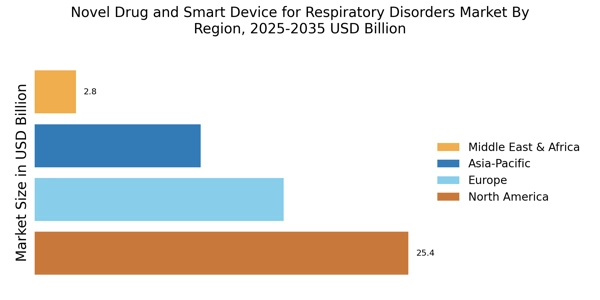
Le marché des nouveaux médicaments et des dispositifs intelligents pour les troubles respiratoires présente une diversité régionale substantielle, avec l'Amérique du Nord en tête du marché avec une valorisation de 20,0 milliards USD en 2023, qui devrait atteindre 34,8 milliards USD d'ici 2032, montrant sa part majoritaire dans l'industrie. L'Europe suit avec une valorisation de 12,5 milliards USD en 2023 et une croissance prévue de 20,0 milliards USD, reflétant sa demande significative pour des solutions respiratoires innovantes. La région Asie-Pacifique gagne en traction, évaluée à 10,0 milliards USD en 2023, projetant d'atteindre 18,0 milliards USD en raison de l'augmentation de la prévalence des maladies respiratoires.
Parallèlement, l'Amérique du Sud et le Moyen-Orient Afrique représentent des segments plus petits mais notables, évalués à 4,0 milliards USD et 3,63 milliards USD en 2023, respectivement. La croissance de l'Amérique du Sud est stimulée par l'amélioration des infrastructures de santé, tandis que l'expansion de la région MEA est attribuée à une population croissante souffrant de troubles respiratoires. Cette segmentation met en évidence les données du marché des nouveaux médicaments et des dispositifs intelligents pour les troubles respiratoires, indiquant les principales zones de croissance, les défis et les opportunités qui façonnent le paysage du marché.

Source : Recherche primaire, recherche secondaire, base de données MRFR et revue des analystes
Le marché des nouveaux médicaments et des dispositifs intelligents pour les troubles respiratoires se caractérise par une gamme diversifiée de participants, y compris des entreprises pharmaceutiques et des sociétés technologiques, chacune s'efforçant d'innover et de répondre aux besoins évolutifs des patients et des prestataires de soins de santé. Ce marché repose sur la prévalence croissante des troubles respiratoires, ce qui a contraint les parties prenantes à investir massivement dans la recherche et le développement pour offrir des thérapies novatrices et des dispositifs médicaux avancés.
Les dynamiques concurrentielles sont influencées par plusieurs facteurs, notamment les avancées dans les systèmes de délivrance de médicaments, un accent sur la médecine personnalisée et l'intégration de technologies intelligentes qui améliorent la gestion des patients et l'adhésion. Alors que les entreprises cherchent à différencier leurs offres par des propositions de valeur uniques, elles naviguent également dans des défis réglementaires et un environnement de soins de santé en rapide évolution qui met l'accent sur les résultats et l'efficacité des coûts.
Sanofi est un acteur majeur sur le marché des nouveaux médicaments et des dispositifs intelligents pour les troubles respiratoires, tirant parti de son solide portefeuille de médicaments conçus pour traiter diverses affections respiratoires. Les forces de l'entreprise incluent un fort engagement envers l'innovation, soutenu par des investissements substantiels dans la recherche et le développement qui lui permettent de déployer des traitements de pointe.
Sanofi a établi une solide réputation pour sa portée mondiale et ses efforts de collaboration avec des professionnels de la santé pour développer des solutions thérapeutiques personnalisées. Cela les a aidés à obtenir un avantage concurrentiel sur le marché, car ils se concentrent sur l'amélioration des résultats pour les patients grâce à des stratégies de traitement sur mesure et des systèmes de délivrance de médicaments efficaces qui intègrent la technologie intelligente. L'héritage de l'entreprise et sa présence établie sur le marché démontrent davantage sa capacité à répondre aux défis émergents dans les soins respiratoires.
Johnson et Johnson a également un impact significatif sur le marché des nouveaux médicaments et des dispositifs intelligents pour les troubles respiratoires, mettant en avant son expérience étendue tant dans les produits pharmaceutiques que dans les dispositifs médicaux avancés. La force de l'entreprise réside dans son portefeuille de produits complet, qui répond à une variété de troubles respiratoires, garantissant qu'elle satisfait les besoins divers des patients à travers différentes démographies.
L'approche innovante de Johnson et Johnson se reflète dans son investissement dans des technologies de santé intelligentes qui améliorent la fonctionnalité et l'expérience utilisateur des dispositifs respiratoires, promouvant efficacement l'adhésion et l'engagement des patients. De plus, la forte réputation que Johnson et Johnson a bâtie à l'échelle mondiale la position favorablement parmi les prestataires de soins de santé et les patients, et son engagement à améliorer la qualité de vie des individus souffrant de troubles respiratoires continue de stimuler son succès sur le marché et son positionnement concurrentiel.





Les développements récents sur le marché des nouveaux médicaments et des dispositifs intelligents pour les troubles respiratoires incluent les avancées continues dans les thérapies et la technologie visant à améliorer les résultats pour les patients. Des entreprises comme Sanofi, Johnson & Johnson et GlaxoSmithKline lancent activement des solutions innovantes pour traiter les affections respiratoires, soulignant le besoin d'outils de gestion efficaces. Les actualités mettent en évidence la demande croissante pour des dispositifs intelligents qui facilitent la surveillance et la gestion en temps réel des troubles respiratoires, avec des acteurs majeurs tels que Merck & Co et Teva Pharmaceuticals investissant dans des plateformes de santé numérique.
Notamment, AstraZeneca et Gilead Sciences ont été reconnus pour leurs efforts collaboratifs dans le développement de thérapies combinées pour améliorer l'efficacité des traitements. En termes de fusions et acquisitions, la récente stratégie d'acquisition d'Amgen axée sur l'intégration de traitements respiratoires de pointe la positionne de manière compétitive sur le marché.
Parallèlement, Boehringer Ingelheim et Vertex Pharmaceuticals ont également été impliqués dans des partenariats stratégiques pour accélérer le développement de nouveaux médicaments. La valorisation du marché pour les entreprises leaders est significativement impactée par ces innovations et collaborations, reflétant une trajectoire de croissance robuste alors que les parties prenantes s'efforcent de répondre aux besoins évolutifs des patients en matière de soins respiratoires.
Le marché des nouveaux médicaments et des dispositifs intelligents pour les troubles respiratoires devrait croître à un TCAC de 6,14 % de 2024 à 2035, soutenu par les avancées technologiques et l'augmentation de la prévalence des maladies respiratoires.
De nouvelles opportunités résident dans :
D'ici 2035, le marché devrait être robuste, soutenu par l'innovation et une demande accrue.
| TAILLE DU MARCHÉ 2024 | 56,48 (milliards USD) |
| TAILLE DU MARCHÉ 2025 | 59,95 (milliards USD) |
| TAILLE DU MARCHÉ 2035 | 108,8 (milliards USD) |
| TAUX DE CROISSANCE ANNUEL COMPOSÉ (CAGR) | 6,14 % (2024 - 2035) |
| COUVERTURE DU RAPPORT | Prévisions de revenus, paysage concurrentiel, facteurs de croissance et tendances |
| ANNÉE DE BASE | 2024 |
| Période de prévision du marché | 2025 - 2035 |
| Données historiques | 2019 - 2024 |
| Unités de prévision du marché | milliards USD |
| Principales entreprises profilées | Analyse de marché en cours |
| Segments couverts | Analyse de segmentation du marché en cours |
| Principales opportunités de marché | L'intégration de l'intelligence artificielle dans les dispositifs intelligents améliore le traitement personnalisé des troubles respiratoires. |
| Dynamiques clés du marché | La demande croissante pour des thérapies innovantes et des dispositifs intelligents stimule la concurrence et l'examen réglementaire dans la gestion des troubles respiratoires. |
| Pays couverts | Amérique du Nord, Europe, APAC, Amérique du Sud, MEA |


Veuillez remplir le formulaire ci-dessous pour recevoir un échantillon gratuit de ce rapport

“This is really good guys. Excellent work on a tight deadline. I will continue to use you going forward and recommend you to others. Nice job”


“Thanks. It’s been a pleasure working with you, please use me as reference with any other Intel employees.”


“Thanks for sending the report it gives us a good global view of the Betaïne market.”


“Thank you, this will be very helpful for OQS.”


“We found the report very insightful! we found your research firm very helpful. I'm sending this email to secure our future business.”


“I am very pleased with how market segments have been defined in a relevant way for my purposes (such as "Portable Freezers & refrigerators" and "last-mile"). In general the report is well structured. Thanks very much for your efforts.”


“I have been reading the first document or the study, ,the Global HVAC and FP market report 2021 till 2026. Must say, good info! I have not gone in depth at all parts, but got a good indication of the data inside!”


“We got the report in time, we really thank you for your support in this process. I also thank to all of your team as they did a great job.”


“The Automotive 48V ECU Components Procurement Intelligence Study” was a complex project, but the Market Research Future (MRFR) team handled it with quality, agility, and customer-centricity. They delivered all requested data on time and within the agreed scope. The team, including Shubhendra Anand and Rahul Gotadki, was always readily available to clarify questions and swiftly implement necessary adjustments, driving the project to a successful conclusion within a very demanding timeframe.
I would also like to specifically commend Akshay Agarwal for his responsiveness and support at every stage—from our initial inquiry on May 6th through to final delivery on June 18th. His dedication made the entire process seamless.”



