Smart Lock Market (2026 - 2035)

Informe de investigación de mercado de cerraduras inteligentes: pronóstico hasta 2032
ID: MRFR/SEM/3376-CR
176 Pages
Ankit Gupta, Shubham Munde
Last Updated: July 06, 2026
Smart Lock Market
Market Size
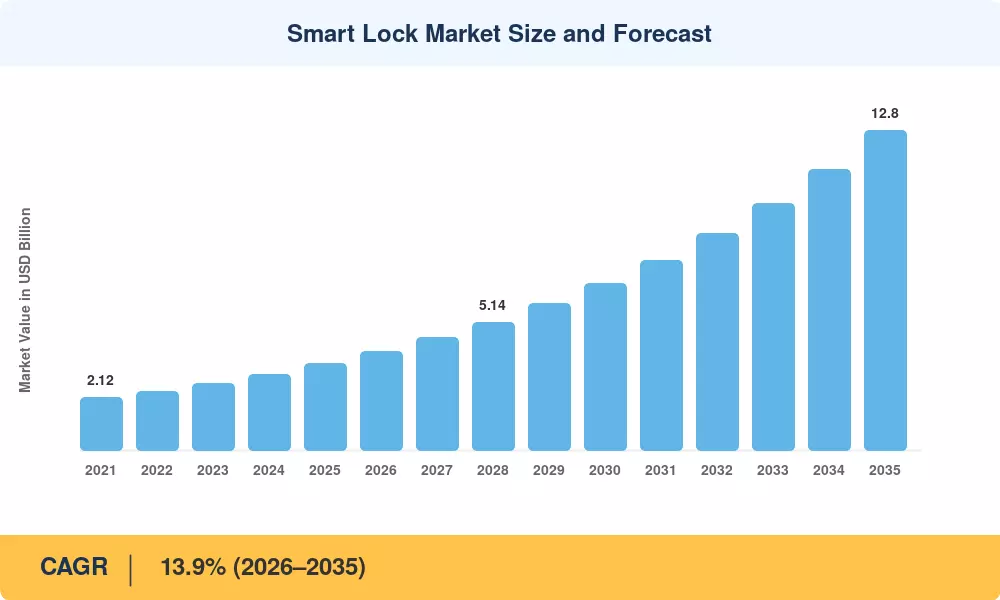
Forecast Period2026-2035
CAGR (2026-2035)13.9%
2025 Market SizeUSD 3.48 Billion
2035 Market SizeUSD 12.80 Billion
Key Players
ASSA ABLOY (Yale
August)
Allegion
Spectrum Brands
Samsung SDS
Dormakaba
Opportunities
  • AI-Powered Predictive Access Management
  • Emerging Market Urbanization
  • Access Analytics and Data Monetization

Smart Lock Market Resumen

Según el análisis de Market Research Future, el tamaño del mercado de Smart Lock se estimó en 1532,85 millones de dólares en 2024. Se proyecta que la industria de Smart Lock crecerá de 1772,01 millones de dólares en 2025 a 7553,0 millones de dólares en 2035, exhibiendo una tasa de crecimiento anual compuesta (CAGR) del 15,6% durante el período previsto 2025-2035.

Tendencias clave del mercado y aspectos destacados

El mercado de Smart Lock está experimentando un sólido crecimiento impulsado por los avances tecnológicos y la creciente demanda de soluciones de seguridad por parte de los consumidores.

  • La integración con sistemas domésticos inteligentes se está convirtiendo en una tendencia predominante, lo que mejora la comodidad y funcionalidad del usuario.
  • La experiencia del usuario es un punto focal, y los fabricantes dan prioridad a los diseños intuitivos y al funcionamiento perfecto.
  • En América del Norte, el segmento de cerrojos sigue siendo el más grande, mientras que en la región de Asia y el Pacífico se observa un rápido crecimiento en la adopción de manijas de palanca.
  • La creciente demanda de soluciones de seguridad para el hogar y los avances tecnológicos en los mecanismos de bloqueo son factores clave que impulsan la expansión del mercado.

Tamaño del mercado y previsión

Tamaño del mercado en 2024 1532.85 (USD Million)
Tamaño del mercado en 2035 7553.0 (USD Million)
CAGR (2025 - 2035) 15.6%
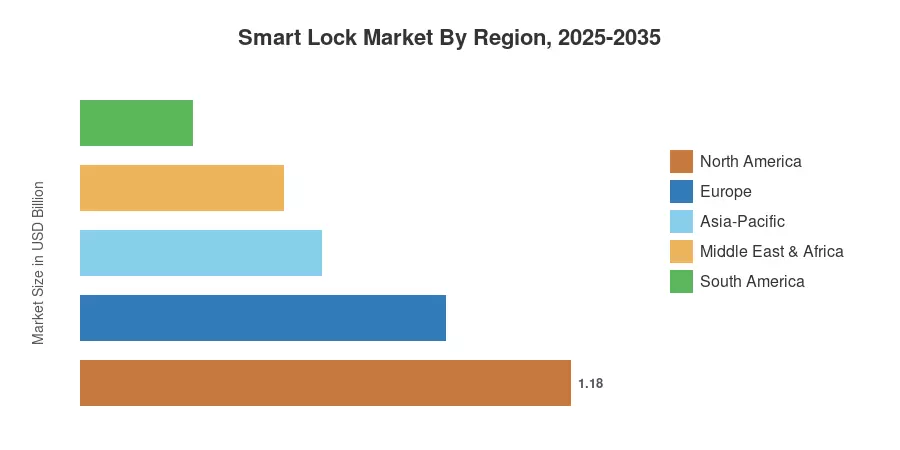
Mayor cuota de mercado regional en 2024 América del norte

Principales jugadores

Agosto Inicio(EE.UU.), Yale (EE.UU.), Kwikset (EE.UU.), Schlage (EE.UU.), Level Lock (EE.UU.), Danalock (DK), Nuki (AT),Samsung(KR), Assa Abloy (SE)
Estas empresas representan a los principales fabricantes de cerraduras inteligentes, empresas de cerraduras inteligentes y marcas de cerraduras inteligentes reconocidas a nivel mundial que dan forma al mercado de cerraduras inteligentes.

Our Impact
Enabled $4.3B Revenue Impact for Fortune 500 and Leading Multinationals
Partnering with 2000+ Global Organizations Each Year
30K+ Citations by Top-Tier Firms in the Industry

Las empresas clave en el mercado Smart Lock Market incluyen

Alcance del informe

FAQs

How do Matter and Thread standards affect smart lock purchase decisions?
Matter eliminates ecosystem lock-in, so buyers no longer need to match lock brands to specific voice assistants. This interoperability lowers switching risk and expands compatible product choices [3].
What total cost of ownership should a property manager expect per smart lock unit?
A mid-range commercial smart lock costs USD 250–400 upfront plus USD 3–8 monthly for cloud management software. Battery replacement and firmware updates add roughly USD 20–30 annually [12].
How do smart lock cybersecurity risks compare between Bluetooth and Wi-Fi models?
Bluetooth locks have a shorter attack radius but face relay vulnerabilities, while Wi-Fi locks expose a broader network surface. Both require encrypted firmware updates and multi-factor authentication for robust defense [16].
What role do smart locks play in multifamily housing insurance underwriting?
Insurers increasingly factor connected-lock presence into risk models for multifamily properties. Verified installations can reduce liability premiums by 5–12%, creating measurable NOI improvement for building owners [4].
Can existing mechanical deadbolt doors accommodate smart lock retrofits without structural modification?
Most smart deadbolts fit standard ANSI door preparations with no drilling. Retrofit-specific models from Yale and August use interior-only attachments that preserve the exterior keyed cylinder [8].
How are smart lock OEMs addressing battery life limitations in extreme-temperature climates?
Manufacturers are deploying wide-temperature lithium-iron-phosphate cells and energy-harvesting handle dynamos. These solutions extend operating range to –30°C/+60°C while pushing battery life beyond 18 months [9].
What procurement criteria differentiate enterprise-grade smart locks from residential models?
Enterprise locks require ANSI/BHMA Grade 1 durability, multi-credential reader support, centralized fleet management APIs, and UL 294 listing. Residential models prioritize ease of installation and consumer-app simplicity over audit-trail depth [8].    
Autor
Author
Author Profile
Ankit Gupta LinkedIn
Team Lead - Research
Ankit Gupta is a seasoned market intelligence and strategic research professional with over six plus years of experience in the ICT and Semiconductor industries. With academic roots in Telecom, Marketing, and Electronics, he blends technical insight with business strategy. Ankit has led 200+ projects, including work for Fortune 500 clients like Microsoft and Rio Tinto, covering market sizing, tech forecasting, and go-to-market strategies. Known for bridging engineering and enterprise decision-making, his insights support growth, innovation, and investment planning across diverse technology markets.
Co-Author
Co-Author Profile
Shubham Munde LinkedIn
Team Lead - Research
Shubham brings over 7 years of expertise in Market Intelligence and Strategic Consulting, with a strong focus on the Automotive, Aerospace, and Defense sectors. Backed by a solid foundation in semiconductors, electronics, and software, he has successfully delivered high-impact syndicated and custom research on a global scale. His core strengths include market sizing, forecasting, competitive intelligence, consumer insights, and supply chain mapping. Widely recognized for developing scalable growth strategies, Shubham empowers clients to navigate complex markets and achieve a lasting competitive edge. Trusted by start-ups and Fortune 500 companies alike, he consistently converts challenges into strategic opportunities that drive sustainable growth.
Deja un comentario

Research Approach


Secondary Research

The secondary research process involved comprehensive analysis of regulatory databases, peer-reviewed engineering journals, IoT security publications, and authoritative technology and construction organizations. Key sources included the National Institute of Standards and Technology (NIST) Cybersecurity Framework, Federal Communications Commission (FCC) equipment authorization database, European Telecommunications Standards Institute (ETSI), Consumer Product Safety Commission (CPSC), British Standards Institution (BSI), Underwriters Laboratories (UL) certification database, American National Standards Institute/Builders Hardware Manufacturers Association (ANSI/BHMA) A156.25 standards, International Electrotechnical Commission (IEC) 60839-11 protocols, IEEE Xplore Digital Library for IoT security research, ACM Digital Library for smart home algorithms, Consumer Technology Association (CTA) market data, National Association of Home Builders (NAHB) smart home integration surveys, International Facility Management Association (IFMA) security technology reports, ASSA ABLOY Security Doors Group technical whitepapers, Gartner IoT device forecasts, IDC Smart Home Tracking reports, and national cybersecurity center reports from key markets.

These sources were employed to gather shipment statistics, certification data, IoT vulnerability studies, smart home adoption trends, construction industry integration patterns, and competitive landscape analysis for Wi-Fi-enabled locks, Bluetooth Low Energy (BLE) deadbolts, NFC access control systems, biometric authentication modules, and emerging connectivity protocols.


Primary Research

Qualitative and quantitative insights were obtained by interviewing supply-side and demand-side stakeholders during the primary research process. The supply-side sources consist of CEOs, CTOs, VPs of IoT Product Development, Chief Information Security Officers (CISOs), heads of hardware engineering, and leaders of smart home partnerships from smart lock OEMs, semiconductor manufacturers (BLE/Wi-Fi chipsets), and battery technology suppliers. Security systems integrators, commercial facility managers, smart home installation professionals, real estate developers, hospitality procurement directors, multi-family property managers, and government facility security coordinators comprised demand-side sources. The primary research validated market segmentation in the deadbolt and lever handle categories, confirmed the timeline for the adoption of the Matter/Thread protocol, and collected insights on the integration of enterprise access control, consumer pricing sensitivity, and commercial subscription service models (Access-as-a-Service).

Primary Respondent Breakdown:

By Designation: C-level Primaries (32%), Director Level (30%), Others (38%)

By Region: North America (38%), Europe (25%), Asia-Pacific (28%), Rest of World (9%)


Market Size Estimation

The global market valuation was determined by analyzing the average selling price (ASP) and unit shipment mapping in both consumer and commercial channels. The methodology comprised the following:

Identification of over 45 significant manufacturers in North America, Europe, Asia-Pacific, and Latin America

Bluetooth Low Energy (BLE), Wi-Fi, and NFC connectivity modules; keypad, biometric touch, and card key authentication interfaces; and product mapping across deadbolt, lever handle, and padlock form factors. Examination of annual revenues that are specific to smart lock portfolios, including hardware sales and recurring software subscription revenues, as reported and modeled

In 2024, the coverage of manufacturers that hold 70-75% of the global market share will be as follows: August Home, Yale, Assa Abloy, Samsung, Kwikset, Schlage, Dormakaba, and emerging IoT-native entrants.

Segment-specific valuations are derived through extrapolation using bottom-up (unit shipments × blended ASP by country/channel, accounting for DIY retail vs. professional installation vs. commercial B2B contracts) and top-down (manufacturer revenue validation against construction industry security spend and smart home device category reports) approaches.

Descargar muestra gratis

Complete el formulario a continuación para recibir una muestra gratuita de este informe

Download PDF ×

We do not share your information with anyone. However, we may send you emails based on your report interest from time to time. You may contact us at any time to opt-out.