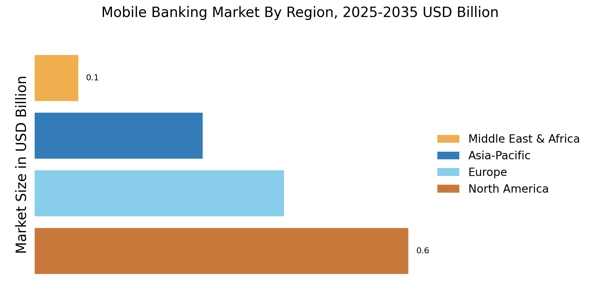
北米はモバイルバンキングの最大市場であり、世界のシェアの約45%を占めています。この地域の成長は、高いスマートフォン普及率、便利なバンキングソリューションに対する消費者の需要の増加、デジタルファイナンスを促進する堅牢な規制枠組みによって推進されています。アメリカがこの市場をリードし、カナダが続いており、全体の市場シェアの約15%を占めています。消費者金融保護局の取り組みなどの規制支援が、この分野の成長をさらに促進しています。競争環境は、JPMorgan Chase、Bank of America、Wells Fargoなどの主要プレーヤーによって支配されており、ユーザー体験を向上させるために継続的に革新を行っています。これらの主要プレーヤーの存在は、競争の激しい環境を育み、セキュリティやユーザーインターフェースの進歩を促しています。さらに、モバイルバンキングアプリケーションにおけるAIや機械学習の統合がますます普及しており、北米のモバイルバンキング市場におけるリーダーとしての地位をさらに強固にしています。
モバイルバンキング市場は、急速な技術革新と進化する消費者の嗜好によって推進される動的な競争環境が特徴です。JPMorgan Chase(米国)、Bank of America(米国)、HSBC(英国)などの主要プレーヤーが最前線に立ち、それぞれが市場ポジションを強化するための独自の戦略を採用しています。JPMorgan Chase(米国)は、フィンテックパートナーシップへの投資を通じて革新を強調し、最先端の技術をモバイルバンキングサービスに統合することを目指しています。一方、Bank of America(米国)は地域の拡大に焦点を当て、より広範な顧客基盤に対応するためにデジタルオファリングを強化しています。HSBC(英国)は、先進的なモバイルソリューションを通じて業務を効率化し、顧客エンゲージメントを向上させるデジタルトランスフォーメーションの取り組みを積極的に進めています。これらの戦略は、技術革新と顧客中心のサービスにますます焦点を当てた競争環境に寄与しています。
2025年9月、Bank of America(米国)は、パーソナライズされた財務アドバイスを提供するために機械学習を利用した新機能をモバイルバンキングアプリに導入しました。この取り組みは、技術を活用して顧客との関係を深めるという銀行のコミットメントを示しています。パーソナライズされたインサイトを提供することで、Bank of America(米国)は顧客エンゲージメントのリーダーとしての地位を確立し、パーソナライズされたサービスを重視する若い層を引き付ける可能性があります。
A consulting professional focused on helping businesses navigate complex markets through structured research and strategic insights.
I partner with clients to solve high-impact business problems across market entry strategy, competitive intelligence, and opportunity assessment. Over the course of my experience, I have led and contributed to 100+ market research and consulting engagements, delivering insights across multiple industries and geographies, and supporting strategic decisions linked to $500M+ market opportunities.
My core expertise lies in building robust market sizing, forecasting, and commercial models (top-down and bottom-up), alongside deep-dive competitive and industry analysis. I have played a key role in shaping go-to-market strategies, investment cases, and growth roadmaps, enabling clients to make confident, data-backed decisions in dynamic markets.
The secondary research process involved comprehensive analysis of regulatory databases, financial technology publications, banking industry reports, and authoritative economic organizations. Key sources included:
Table
Copy
Regulatory & Government Sources Financial & Industry Bodies Technology & Academic Sources
US Federal Reserve (Fed) – Payments System Research Consumer Bankers Association (CBA) IEEE Computer Society
European Central Bank (ECB) – Payment Statistics American Bankers Association (ABA) Association for Computing Machinery (ACM)
Bank for International Settlements (BIS) – Committee on Payments and Market Infrastructures (CPMI) European Banking Federation (EBF) MIT Technology Review
UK Financial Conduct Authority (FCA) Asia-Pacific Economic Cooperation (APEC) Financial Regulators Group Stanford Financial Technology Research
Monetary Authority of Singapore (MAS) – Digital Banking Framework International Monetary Fund (IMF) Financial Access Survey Harvard Business School – Digital Finance Case Studies
Reserve Bank of India (RBI) – Payment and Settlement Systems Division World Bank Group – Global Findex Database NCBI/PubMed – Financial Inclusion Health Studies
China Banking and Insurance Regulatory Commission (CBIRC) Bank for International Settlements (BIS) National Bureau of Economic Research (NBER)
Consumer Financial Protection Bureau (CFPB) – Consumer Complaint Database The Clearing House (TCH) – Real-Time Payments IDC Financial Insights
European Banking Authority (EBA) Guidelines SWIFT Institute Gartner Research – Banking & Investment Services
Financial Stability Board (FSB) – Global Monitoring Report International Finance Corporation (IFC) – Digital Financial Services McKinsey Global Institute – Digital Finance Reports
US Department of the Treasury – Office of Financial Research GSM Association (GSMA) – Mobile Money Programme Statista – Digital Banking Statistics
Bank of England – FinTech Hub Financial Data and Technology Association (FDATA) S&P Global Market Intelligence
Japan Financial Services Agency (JFSA) – FinTech Policies International Telecommunication Union (ITU) – Digital Financial Inclusion CB Insights – FinTech & Banking Research
These sources were used to collect mobile banking adoption statistics, regulatory frameworks (PSD2, Open Banking standards), transaction volume data, security compliance requirements (PCI DSS, GDPR), consumer behavior studies, competitive landscape analysis, and technological advancement tracking across retail banking, corporate banking, and payment solutions.
Primary Research
In the primary research process, supply-side and demand-side stakeholders were interviewed to obtain qualitative and quantitative insights.
Supply-side sources included:
Banking Institutions: CEOs, Chief Digital Officers (CDOs), Heads of Mobile Banking Strategy, Chief Information Officers (CIOs), and Heads of Digital Transformation
FinTech Companies: Founders/CEOs, CTOs, VP of Product Development, and Heads of User Experience Design
Technology Providers: EVPs of Financial Services Solutions, Cloud Infrastructure Leads, and AI/ML Implementation Directors
Payment Networks: Business Development Directors, Strategic Partnership Leads, and Innovation Heads
Demand-side sources comprised:
Enterprise Banking Clients: CFOs, Treasurers, and Heads of Corporate Banking at Fortune 500 companies
Small & Medium Enterprises (SMEs): Business Owners and Finance Managers utilizing mobile banking solutions
Individual Consumers: High-net-worth individuals, millennials/Gen Z users, and underbanked population representatives
Channel Partners: System integrators, value-added resellers (VARs), and mobile banking solution consultants
Primary research validated market segmentation across transaction types (consumer-to-business, peer-to-peer, account management), confirmed digital roadmap timelines, gathered insights on user experience expectations, security concerns, adoption barriers, and competitive feature benchmarking (biometric authentication, AI-powered personalization, real-time payments).
Primary Respondent Breakdown:
Table
Copy
Category Segment Percentage
By Company Tier Tier 1 (>USD 50B market cap) 38%
Tier 2 (USD 5B–50B market cap) 35%
By Designation C-level Primaries (CEO, CFO, CDO, CIO) 40%
Director Level (VP, Director, Head of Department) 32%
Others (Managers, Specialists, Consultants) 28%
By Region North America 32%
Europe 25%
Asia-Pacific 35%
Rest of World (Latin America, MEA) 8%
By Stakeholder Type Banking Institutions (Traditional & Neo-banks) 45%
[Note: Tier classifications based on 2024 market capitalization and annual revenue reported in financial statements]
Market Size Estimation
Global market valuation was derived through revenue mapping and transaction volume analysis. The methodology included:
Market Coverage: Identification of 60+ key mobile banking solution providers across North America, Europe, Asia-Pacific, Latin America, and Middle East & Africa
Solution Mapping: Product categorization across mobile banking platforms, mobile wallets, peer-to-peer payment apps, personal financial management (PFM) tools, and corporate mobile banking solutions
Revenue Analysis: Analysis of reported and modeled annual revenues specific to mobile banking software, services, and transaction-based fees
Market Penetration: Coverage of providers representing 75-80% of global mobile banking market share in 2024
Validation Approaches:
Bottom-up: Active mobile banking users × Average Revenue Per User (ARPU) by country/region, segmented by transaction volume and service tiers
Top-down: Validation through banking IT spending allocations, digital transformation budgets, and published financial services technology investments
Growth Modeling: Integration of smartphone penetration rates, internet connectivity expansion, regulatory enablement (Open Banking APIs), and generational banking behavior shifts
Segment-Specific Data Collection Focus
Table
Copy
Segment Key Data Points
By Platform iOS vs. Android deployment statistics, native app vs. web-based usage trends
By Transaction Type Funds transfer volumes, bill payment frequencies, mobile check deposit adoption, P2P transaction growth
By Deployment Model Cloud-based vs. on-premise infrastructure, SaaS banking platform subscriptions
By End-User Retail banking (personal finance, savings, lending) vs. corporate banking (treasury management, payroll, trade finance)
By Technology AI/ML adoption for fraud detection, blockchain integration, biometric authentication implementation rates
This methodology ensures comprehensive coverage of the mobile banking ecosystem while maintaining statistical rigor through diversified source validation and robust primary research sampling.
“This is really good guys. Excellent work on a tight deadline. I will continue to use you going forward and recommend you to others. Nice job”
Noah MalgeriCo-Founder
“Thanks. It’s been a pleasure working with you, please use me as reference with any other Intel employees.”
Joseph AguayoSales Operations & Pricing Manager
“Thanks for sending the report it gives us a good global view of the Betaïne market.”
Peter Groot koerkampAccount and Business Manager
“Thank you, this will be very helpful for OQS.”
La Terria DoddProgram Support Specialist
“We found the report very insightful! we found your research firm very helpful. I'm sending this email to secure our future business.”
Younghwan ChoiSenior Retail Manager
“I am very pleased with how market segments have been defined in a relevant way for my purposes (such as "Portable Freezers & refrigerators" and "last-mile").
In general the report is well structured. Thanks very much for your efforts.”
Mark IrwinManagement Consultant
“I have been reading the first document or the study, ,the Global HVAC and FP market report 2021 till 2026. Must say, good info! I have not gone in depth at all parts, but got a good indication of the data inside!”
Rob KooikerGroup Product Manager HVAC & Fire Protection GMA
“We got the report in time, we really thank you for your support in this process. I also thank to all of your team as they did a great job.”
Akif MorogluStrategy & Business Development Director
“The Automotive 48V ECU Components Procurement Intelligence Study” was a complex project, but the Market Research Future (MRFR) team handled it with quality, agility, and customer-centricity. They delivered all requested data on time and within the agreed scope. The team, including Shubhendra Anand and Rahul Gotadki, was always readily available to clarify questions and swiftly implement necessary adjustments, driving the project to a successful conclusion within a very demanding timeframe.
I would also like to specifically commend Akshay Agarwal for his responsiveness and support at every stage—from our initial inquiry on May 6th through to final delivery on June 18th. His dedication made the entire process seamless.”
Guilherme Gomes MartinsProduct Management Director