Smart Lock Market (2026 - 2035)

Smart Lock 시장 조사 보고서 - 2032년까지 예측
ID: MRFR/SEM/3376-CR
176 Pages
Ankit Gupta, Shubham Munde
Last Updated: July 06, 2026
Smart Lock Market
Market Size
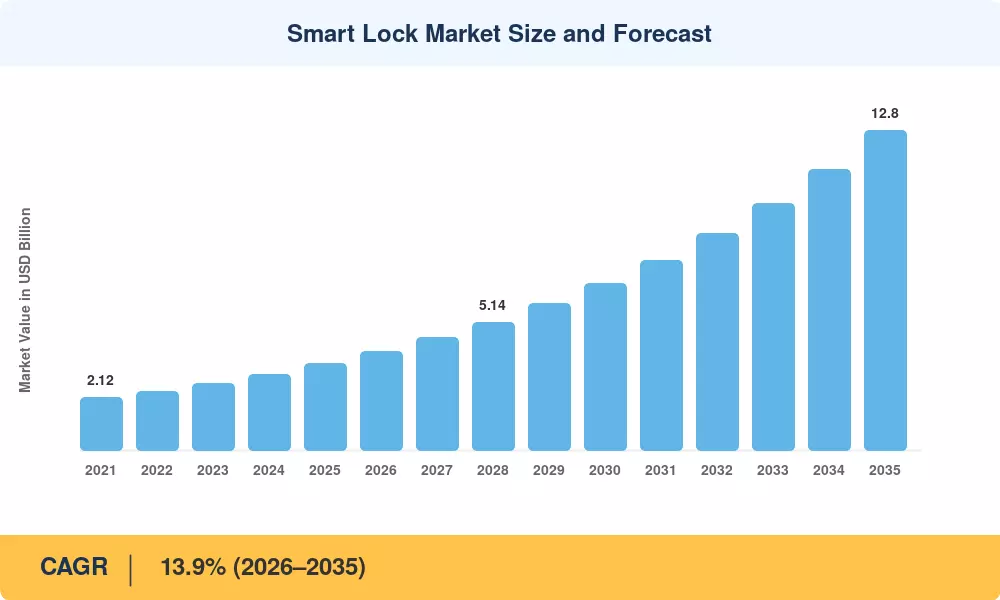
Forecast Period2026-2035
CAGR (2026-2035)13.9%
2025 Market SizeUSD 3.48 Billion
2035 Market SizeUSD 12.80 Billion
Key Players
ASSA ABLOY (Yale
August)
Allegion
Spectrum Brands
Samsung SDS
Dormakaba
Opportunities
  • AI-Powered Predictive Access Management
  • Emerging Market Urbanization
  • Access Analytics and Data Monetization

Smart Lock Market 요약

시장 조사 미래 분석에 따르면 스마트 잠금 장치 시장 규모는 2024년 1,532.85달러 백만 달러로 추산되었습니다. 스마트 잠금 장치 산업은 2025년 1,772.01달러 백만 달러에서 2035년까지 7,553.0달러 미화 백만 달러로 성장하여 예측 기간 2025~2035년 동안 15.6%의 연평균 성장률(CAGR)을 나타낼 것으로 예상됩니다.

주요 시장 동향 및 하이라이트

스마트 잠금 장치 시장은 기술 발전과 보안 솔루션에 대한 소비자 수요 증가로 인해 강력한 성장을 경험하고 있습니다.

  • 스마트홈 시스템과의 통합이 보편화되면서 사용자의 편의성과 기능성이 향상되고 있습니다.
  • 제조업체는 직관적인 디자인과 원활한 작동을 우선시하므로 사용자 경험이 핵심입니다.
  • 북미에서는 데드볼트 부문이 여전히 가장 큰 규모를 유지하고 있는 반면, 아시아 태평양 지역에서는 레버 핸들 채택이 빠르게 성장하고 있습니다.
  • 홈 보안 솔루션에 대한 수요 증가와 잠금 메커니즘의 기술 발전은 시장 확장을 촉진하는 주요 동인입니다.

시장 규모 및 예측

2024년 시장규모 1532.85 (USD Million)
2035년 시장규모 7553.0 (USD Million)
CAGR (2025 - 2035) 15.6%
2024년 지역 시장 점유율 최대 북아메리카

주요 기업

어거스트 홈(미국), Yale (미국), Kwikset (미국), Schlage (미국), Level Lock (미국), Danalock (DK), Nuki (AT),삼성(한국), 아사아블로이(SE)
이들 회사는 스마트 잠금 장치 시장을 형성하고 있는 선도적인 스마트 잠금 장치 제조업체, 스마트 잠금 장치 회사 및 전 세계적으로 인정받는 스마트 잠금 장치 브랜드를 대표합니다.

Our Impact
Enabled $4.3B Revenue Impact for Fortune 500 and Leading Multinationals
Partnering with 2000+ Global Organizations Each Year
30K+ Citations by Top-Tier Firms in the Industry

Smart Lock Market 시장의 주요 기업은 다음과 같습니다

보고서 범위

FAQs

How do Matter and Thread standards affect smart lock purchase decisions?
Matter eliminates ecosystem lock-in, so buyers no longer need to match lock brands to specific voice assistants. This interoperability lowers switching risk and expands compatible product choices [3].
What total cost of ownership should a property manager expect per smart lock unit?
A mid-range commercial smart lock costs USD 250–400 upfront plus USD 3–8 monthly for cloud management software. Battery replacement and firmware updates add roughly USD 20–30 annually [12].
How do smart lock cybersecurity risks compare between Bluetooth and Wi-Fi models?
Bluetooth locks have a shorter attack radius but face relay vulnerabilities, while Wi-Fi locks expose a broader network surface. Both require encrypted firmware updates and multi-factor authentication for robust defense [16].
What role do smart locks play in multifamily housing insurance underwriting?
Insurers increasingly factor connected-lock presence into risk models for multifamily properties. Verified installations can reduce liability premiums by 5–12%, creating measurable NOI improvement for building owners [4].
Can existing mechanical deadbolt doors accommodate smart lock retrofits without structural modification?
Most smart deadbolts fit standard ANSI door preparations with no drilling. Retrofit-specific models from Yale and August use interior-only attachments that preserve the exterior keyed cylinder [8].
How are smart lock OEMs addressing battery life limitations in extreme-temperature climates?
Manufacturers are deploying wide-temperature lithium-iron-phosphate cells and energy-harvesting handle dynamos. These solutions extend operating range to –30°C/+60°C while pushing battery life beyond 18 months [9].
What procurement criteria differentiate enterprise-grade smart locks from residential models?
Enterprise locks require ANSI/BHMA Grade 1 durability, multi-credential reader support, centralized fleet management APIs, and UL 294 listing. Residential models prioritize ease of installation and consumer-app simplicity over audit-trail depth [8].    
저자
Author
Author Profile
Ankit Gupta LinkedIn
Team Lead - Research
Ankit Gupta is a seasoned market intelligence and strategic research professional with over six plus years of experience in the ICT and Semiconductor industries. With academic roots in Telecom, Marketing, and Electronics, he blends technical insight with business strategy. Ankit has led 200+ projects, including work for Fortune 500 clients like Microsoft and Rio Tinto, covering market sizing, tech forecasting, and go-to-market strategies. Known for bridging engineering and enterprise decision-making, his insights support growth, innovation, and investment planning across diverse technology markets.
Co-Author
Co-Author Profile
Shubham Munde LinkedIn
Team Lead - Research
Shubham brings over 7 years of expertise in Market Intelligence and Strategic Consulting, with a strong focus on the Automotive, Aerospace, and Defense sectors. Backed by a solid foundation in semiconductors, electronics, and software, he has successfully delivered high-impact syndicated and custom research on a global scale. His core strengths include market sizing, forecasting, competitive intelligence, consumer insights, and supply chain mapping. Widely recognized for developing scalable growth strategies, Shubham empowers clients to navigate complex markets and achieve a lasting competitive edge. Trusted by start-ups and Fortune 500 companies alike, he consistently converts challenges into strategic opportunities that drive sustainable growth.
댓글 남기기

Research Approach


Secondary Research

The secondary research process involved comprehensive analysis of regulatory databases, peer-reviewed engineering journals, IoT security publications, and authoritative technology and construction organizations. Key sources included the National Institute of Standards and Technology (NIST) Cybersecurity Framework, Federal Communications Commission (FCC) equipment authorization database, European Telecommunications Standards Institute (ETSI), Consumer Product Safety Commission (CPSC), British Standards Institution (BSI), Underwriters Laboratories (UL) certification database, American National Standards Institute/Builders Hardware Manufacturers Association (ANSI/BHMA) A156.25 standards, International Electrotechnical Commission (IEC) 60839-11 protocols, IEEE Xplore Digital Library for IoT security research, ACM Digital Library for smart home algorithms, Consumer Technology Association (CTA) market data, National Association of Home Builders (NAHB) smart home integration surveys, International Facility Management Association (IFMA) security technology reports, ASSA ABLOY Security Doors Group technical whitepapers, Gartner IoT device forecasts, IDC Smart Home Tracking reports, and national cybersecurity center reports from key markets.

These sources were employed to gather shipment statistics, certification data, IoT vulnerability studies, smart home adoption trends, construction industry integration patterns, and competitive landscape analysis for Wi-Fi-enabled locks, Bluetooth Low Energy (BLE) deadbolts, NFC access control systems, biometric authentication modules, and emerging connectivity protocols.


Primary Research

Qualitative and quantitative insights were obtained by interviewing supply-side and demand-side stakeholders during the primary research process. The supply-side sources consist of CEOs, CTOs, VPs of IoT Product Development, Chief Information Security Officers (CISOs), heads of hardware engineering, and leaders of smart home partnerships from smart lock OEMs, semiconductor manufacturers (BLE/Wi-Fi chipsets), and battery technology suppliers. Security systems integrators, commercial facility managers, smart home installation professionals, real estate developers, hospitality procurement directors, multi-family property managers, and government facility security coordinators comprised demand-side sources. The primary research validated market segmentation in the deadbolt and lever handle categories, confirmed the timeline for the adoption of the Matter/Thread protocol, and collected insights on the integration of enterprise access control, consumer pricing sensitivity, and commercial subscription service models (Access-as-a-Service).

Primary Respondent Breakdown:

By Designation: C-level Primaries (32%), Director Level (30%), Others (38%)

By Region: North America (38%), Europe (25%), Asia-Pacific (28%), Rest of World (9%)


Market Size Estimation

The global market valuation was determined by analyzing the average selling price (ASP) and unit shipment mapping in both consumer and commercial channels. The methodology comprised the following:

Identification of over 45 significant manufacturers in North America, Europe, Asia-Pacific, and Latin America

Bluetooth Low Energy (BLE), Wi-Fi, and NFC connectivity modules; keypad, biometric touch, and card key authentication interfaces; and product mapping across deadbolt, lever handle, and padlock form factors. Examination of annual revenues that are specific to smart lock portfolios, including hardware sales and recurring software subscription revenues, as reported and modeled

In 2024, the coverage of manufacturers that hold 70-75% of the global market share will be as follows: August Home, Yale, Assa Abloy, Samsung, Kwikset, Schlage, Dormakaba, and emerging IoT-native entrants.

Segment-specific valuations are derived through extrapolation using bottom-up (unit shipments × blended ASP by country/channel, accounting for DIY retail vs. professional installation vs. commercial B2B contracts) and top-down (manufacturer revenue validation against construction industry security spend and smart home device category reports) approaches.

무료 샘플 다운로드

이 보고서의 무료 샘플을 받으려면 아래 양식을 작성하십시오

Download PDF ×

We do not share your information with anyone. However, we may send you emails based on your report interest from time to time. You may contact us at any time to opt-out.