×
Hero Background
English
Chinese
French
Japanese
Korean
German
Spanish

3D Printing Market Trends

ID: MRFR/SEM/0525-HCR
200 Pages
Aarti Dhapte
October 2025

3D Printing Market Size, Share and Research Report By Component (Hardware, Software & Services), Application (Prototyping, Tooling & Functional Parts), Printer Type (Desktop 3D Printer & Industrial 3D Printer), Technology (Stereolithography, Fused Deposition Modeling, Selective Laser Sintering, Direct Metal Laser Sintering & Others), Software (Design Software, Printer Software, Scanning Software), Vertical (Industrial 3D Printing, & Desktop 3D Printing), Material (Polymer, Metal & Ceramic) And Region– Industry Forecas... read more

Share:
Download PDF ×

We do not share your information with anyone. However, we may send you emails based on your report interest from time to time. You may contact us at any time to opt-out.

3D Printing Market Infographic
Purchase Options

Market Trends

Key Emerging Trends in the 3D Printing Market

The growing use of 3D printing for large-scale production is a new trend that is spreading quickly through the industry. Once only used for testing, 3D printing is now a useful tool for making large quantities of things thanks to progress in science and materials technology. A lot of people in the aircraft and car businesses now use 3D printers. It accelerates the production of intricate parts much more quickly and at a much lower cost than traditional methods. Due to changing customer tastes, the 3D printing market is quickly seeing a rise in the trend of customization. Customer preferences for customized goods are growing across all fields. One way that 3D printing helps medicine is by making it easier to make implants and other devices that fit each patient's body. In the consumer goods business, personalized phone cases and home decor items are another thing that has become very popular. This exciting trend in many places around the world has made 3D printing a major force in the age of custom manufacturing. This fits with the fact that customers want one-of-a-kind items more and more. One of the most important things that has always shaped the 3D printer market is new materials. Not too long ago, most people used and saw a lot of standard plastics. That being said, more and more new materials like metals, clay, and safe materials are taking their place. The ability to print with these new materials makes 3D printing more useful in areas that need certain materials. Stability is another important issue in the 3D printer business. This is because lots of companies are now trying to find eco-friendly products to use in their work. It goes without saying that 3D printing uses fewer resources than traditional ways of making things, which often result in a lot of waste. It is good for companies that want to be more eco-friendly because additive manufacturing doesn't make a lot of waste. 3D printing services have had a huge effect on the world market since they became so popular. Businesses and people can both use these easy-to-find, reliable options, so there's no need to make big expenses up front. Service companies offer on-demand 3D printing, which lets customers use the technology without having to buy and maintain a machine.

Author
Aarti Dhapte
Team Lead - Research

She holds an experience of about 6+ years in Market Research and Business Consulting, working under the spectrum of Information Communication Technology, Telecommunications and Semiconductor domains. Aarti conceptualizes and implements a scalable business strategy and provides strategic leadership to the clients. Her expertise lies in market estimation, competitive intelligence, pipeline analysis, customer assessment, etc.

Leave a Comment

FAQs

What is the current valuation of the 3D Printing Market in 2025?

The 3D Printing Market is valued at approximately 13.33 USD Billion in 2024.

What is the projected market size for the 3D Printing Market by 2035?

The market is expected to reach a valuation of 92.38 USD Billion by 2035.

What is the expected CAGR for the 3D Printing Market during the forecast period 2025 - 2035?

The anticipated CAGR for the 3D Printing Market during the forecast period is 19.24%.

Which companies are considered key players in the 3D Printing Market?

Key players include Stratasys, 3D Systems, Materialise, HP, EOS, GE Additive, Siemens, Formlabs, and Carbon.

What are the main segments of the 3D Printing Market?

The main segments include Type, Application, Printer Type, Technology, Software, Vertical, and Material.

How does the Hardware segment perform in the 3D Printing Market?

The Hardware segment is projected to grow from 5.0 USD Billion to 35.0 USD Billion by 2035.

What is the expected growth of the Industrial 3D Printing segment?

The Industrial 3D Printing segment is anticipated to expand from 8.0 USD Billion to 58.0 USD Billion by 2035.

Which application segment is expected to see the highest growth?

The Functional Parts application segment is likely to grow from 6.33 USD Billion to 43.38 USD Billion by 2035.

What materials are primarily used in the 3D Printing Market?

The primary materials include Polymer, Metal, and Ceramic, with projected valuations of 5.0, 6.0, and 2.33 USD Billion respectively by 2035.

What technology types are utilized in the 3D Printing Market?

Technology types include Stereolithography, Fused Deposition Modeling, and Selective Laser Sintering, among others, with varying projected valuations.

Which material led the 3D printing market?

The metal category dominated the market in 2022.

Market Summary

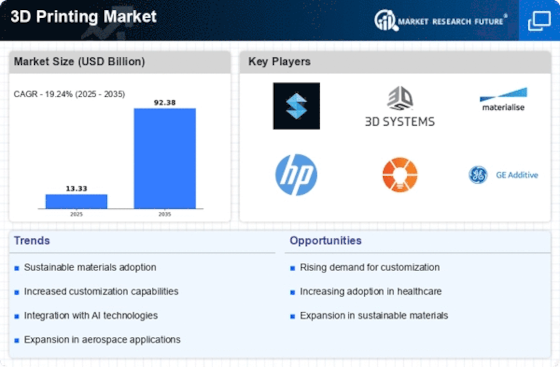
As per MRFR analysis, the 3D Printing Market Size was estimated at 13.33 USD Billion in 2024. The 3D Printing industry is projected to grow from 15.9 in 2025 to 92.38 by 2035, exhibiting a compound annual growth rate (CAGR) of 19.24 during the forecast period 2025 - 2035.

Key Market Trends & Highlights

The 3D Printing Market is experiencing robust growth driven by customization and technological advancements.

  • North America remains the largest market for 3D printing, showcasing a strong demand for innovative applications. Asia-Pacific is emerging as the fastest-growing region, fueled by increasing investments in advanced manufacturing technologies. The hardware segment continues to dominate the market, while services are rapidly gaining traction as a key growth area. Market drivers such as increased demand for prototyping and advancements in material science are propelling the industry's expansion.

Market Size & Forecast

2024 Market Size 13.33 (USD Billion)
2035 Market Size 92.38 (USD Billion)
CAGR (2025 - 2035) 19.24%
Largest Regional Market Share in 2024 Europe

Major Players

<p>Stratasys (US), 3D Systems (US), Materialise (BE), HP (US), EOS (DE), GE Additive (US), Siemens (DE), Formlabs (US), Carbon (US)</p>

Market Trends

The 3D Printing Market is currently experiencing a transformative phase characterized by rapid technological advancements and increasing adoption across various sectors. Industries such as aerospace, automotive, and healthcare are integrating additive manufacturing techniques to enhance production efficiency and reduce costs. This shift towards customization and on-demand production is reshaping traditional manufacturing paradigms, allowing for greater design flexibility and innovation. Furthermore, the growing emphasis on sustainability is driving the development of eco-friendly materials and processes, which could potentially redefine the market landscape. In addition, the rise of digital fabrication technologies is fostering collaboration between designers and engineers, leading to more innovative applications. As organizations recognize the potential of 3D printing to streamline supply chains and minimize waste, investment in research and development is likely to increase. The convergence of artificial intelligence and 3D printing may also enhance design capabilities, suggesting a future where automated systems play a crucial role in production. Overall, the 3D Printing Industry appears poised for substantial growth, driven by technological integration and evolving consumer demands.

Customization and Personalization

The trend towards customization in the 3D Printing Market is gaining momentum, as consumers increasingly seek tailored products. This shift allows manufacturers to create unique items that cater to individual preferences, enhancing customer satisfaction. Companies are leveraging additive manufacturing to produce bespoke solutions, which may lead to a more personalized consumer experience.

Sustainability Initiatives

Sustainability is becoming a focal point within the 3D Printing Industry, as businesses strive to reduce their environmental impact. The development of biodegradable materials and energy-efficient processes indicates a growing commitment to eco-friendly practices. This trend not only addresses consumer concerns but also aligns with regulatory pressures for greener manufacturing.

Integration of Advanced Technologies

The integration of advanced technologies, such as artificial intelligence and machine learning, is transforming the 3D Printing Market. These innovations enhance design processes and optimize production efficiency, potentially leading to faster turnaround times and reduced costs. As these technologies evolve, they may redefine the capabilities of additive manufacturing.

3D Printing Market Market Drivers

Cost Reduction in Manufacturing

Cost efficiency remains a pivotal driver in the 3D Printing Market, as organizations strive to minimize production expenses. The technology enables manufacturers to produce complex geometries and customized products without the need for extensive tooling or assembly processes. This capability not only reduces material waste but also lowers labor costs, making it an attractive option for businesses. Recent analyses suggest that companies utilizing 3D printing can achieve up to 70% savings in production costs compared to traditional methods. As industries continue to seek ways to enhance profitability, the adoption of 3D printing technologies is expected to grow, reinforcing its significance in the manufacturing landscape.

Advancements in Material Science

The evolution of material science plays a crucial role in the 3D Printing Market, as new materials expand the capabilities of 3D printing technologies. Innovations in polymers, metals, and composites enable the production of stronger, lighter, and more durable components. This diversification of materials allows for applications in sectors such as healthcare, where biocompatible materials are essential for creating medical devices and implants. Furthermore, the introduction of sustainable materials aligns with the growing emphasis on eco-friendly practices. As material options continue to expand, the potential applications of 3D printing are likely to broaden, driving further growth in the market.

Increased Demand for Prototyping

The 3D Printing Market experiences a notable surge in demand for rapid prototyping across various sectors. Industries such as automotive, aerospace, and consumer goods are increasingly adopting 3D printing technologies to accelerate product development cycles. This shift allows companies to create prototypes more efficiently, reducing time-to-market and costs associated with traditional manufacturing methods. According to recent data, the prototyping segment is projected to account for a substantial share of the 3D printing market, indicating a robust growth trajectory. As businesses seek to innovate and respond to consumer needs swiftly, the reliance on 3D printing for prototyping is likely to intensify, further solidifying its role in the market.

Integration of Advanced Technologies

The integration of advanced technologies, such as artificial intelligence and the Internet of Things, is transforming the 3D Printing Industry. These technologies enhance the efficiency and capabilities of 3D printing processes, enabling smarter manufacturing solutions. For instance, AI can optimize design processes and predict maintenance needs, while IoT facilitates real-time monitoring of production. This convergence of technologies is expected to streamline operations and improve product quality, making 3D printing more appealing to manufacturers. As industries increasingly adopt these advanced technologies, the 3D printing market is likely to experience accelerated growth, driven by enhanced operational efficiencies and innovative applications.

Customization and Personalization Trends

The demand for customization and personalization is a significant driver in the 3D Printing Industry. Consumers increasingly seek unique products tailored to their preferences, prompting manufacturers to adopt 3D printing technologies that facilitate bespoke designs. This trend is particularly evident in sectors such as fashion, jewelry, and consumer electronics, where personalized items command premium prices. Market data indicates that the customization segment is expected to witness substantial growth, as businesses leverage 3D printing to meet individual customer needs efficiently. The ability to produce one-of-a-kind products not only enhances customer satisfaction but also fosters brand loyalty, making it a vital aspect of the market.

Market Segment Insights

By Type: Hardware (Largest) vs. Services (Fastest-Growing)

<p>In the 3D Printing Market, the 'Type' segment reveals a diversified landscape where hardware holds the largest share. This includes various 3D printers and their components which play a crucial role in the production process. Contrastingly, services have emerged as the fastest-growing segment, indicating a shift in market dynamics as more businesses seek support in design and manufacturing processes. Furthermore, software supports both segments, providing essential tools for the design and management of 3D printed products. Growth trends indicate that the hardware segment, while still dominating the market, faces increasing competition from software and services. As more industries adopt 3D printing technology, the demand for associated services like maintenance, training, and design optimization is surging. This trend is accelerated by advancements in software that improve efficiency and ease of use, fostering wider adoption and transforming how businesses integrate 3d printing sector into their operations.</p>

<p>Services: Dominant vs. Software: Emerging</p>

<p>In the 3D Printing Industry, hardware remains a dominant force with established players driving innovation and delivering high-performance machines tailored for various applications, from prototyping to mass production. Services are emerging as a critical aspect, providing a range of solutions from technical support to consulting on best practices in 3D printing. Meanwhile, software is rapidly evolving, offering sophisticated tools that enhance design capabilities and streamline workflow processes. As companies increasingly recognize the potential of 3D printing, the combination of hardware, software, and services will play a pivotal role in shaping the market, ensuring that businesses can leverage the full benefits of this transformative technology.</p>

By Application: Prototyping (Largest) vs. Functional Parts (Fastest-Growing)

<p>The 3D printing market's application segment is primarily dominated by prototyping, capturing the largest share due to its wide acceptance across industries such as automotive, aerospace, and consumer goods. Prototyping enhances design flexibility and accelerates time-to-market, making it a preferred choice among manufacturers. Functional parts are emerging as a significant player in the market, gaining traction for their ability to produce end-use parts that meet specific requirements, a trend driven by advancements in material science and technology.</p>

<p>Prototyping (Dominant) vs. Functional Parts (Emerging)</p>

<p>Prototyping remains the dominant application in the 3D printing landscape, favored by numerous industries for product development and iterative design processes. The advantages of rapid prototyping, such as cost-effectiveness and time savings, have led to its widespread adoption. In contrast, functional parts are rapidly emerging, fueled by the demand for customized components that can withstand operational stresses. This sub-segment benefits from innovations that enable 3D printing of high-performance materials, positioning functional parts as a critical focus area for future growth. Manufacturers increasingly leverage these capabilities to optimize production efficiency and reduce waste.</p>

By Printer Type: Desktop 3D Printer (Largest) vs. Industrial 3D Printer (Fastest-Growing)

<p>In the 3D Printing Market, desktop 3D printers currently hold the largest share, driven by their accessibility and affordability for both hobbyists and small businesses. They cater to a diverse range of applications from prototyping to educational purposes, making them a popular choice among individual users and educational institutions. Meanwhile, industrial 3D printers are rapidly gaining traction due to their advanced capabilities and suitability for large-scale production, appealing to various sectors such as aerospace, automotive, and healthcare.</p>

<p>Printer Type: Desktop 3D Printer (Dominant) vs. Industrial 3D Printer (Emerging)</p>

<p>The dominant desktop 3D printer segment is characterized by its user-friendly design, compact size, and low cost, which have made it a staple for personal users and educational institutions alike. These printers are favored for their versatility, allowing users to experiment with different materials and designs with relative ease. In contrast, the industrial 3D printer segment is viewed as emerging but is experiencing significant growth due to the need for rapid prototyping and production efficiency in professional environments. Industrial printers are equipped with advanced technology and capabilities, enabling them to handle complex geometries and high-volume production, thus appealing to large manufacturers looking to innovate and improve their production workflows.</p>

By Technology: Stereolithography (Largest) vs. Fused Deposition Modeling (Fastest-Growing)

<p>In the 3D printing market, Stereolithography (SLA) holds the largest market share, primarily due to its superior precision and capability to deliver high-quality prototypes and end-use parts. Stereolithography is widely adopted in industries such as aerospace, healthcare, and automotive due to its ability to create intricate designs with smooth finishes. In contrast, Fused Deposition Modeling (FDM) is becoming the fastest-growing technology segment, driven by its affordability and ease of use. FDM is popular among hobbyists and small businesses, making it accessible for various applications.</p>

<p>3D Printing Market Technology: Stereolithography (Dominant) vs. Fused Deposition Modeling (Emerging)</p>

<p>Stereolithography, known for its precision and fine detail, dominates the 3D printing technology landscape, serving industries that require high-strength and intricate models. It utilizes a UV laser to cure liquid resin layer by layer, ensuring high accuracy, making it ideal for producing prototypes and intricate designs. Conversely, Fused Deposition Modeling has gained traction as an emerging player in the market, appealing particularly to education and home-based users due to its low cost and simple operation. FDM technology uses thermoplastic filaments to create objects layer by layer, resulting in quick production and less complexity compared to SLA, positioning it as a favorable choice for rapid prototyping and small-scale manufacturing.</p>

By Software: Design Software (Largest) vs. Printer Software (Fastest-Growing)

<p>The software segment in the 3D printing Industry has been characterized by a diverse range of products, notably dominated by design software, which holds the largest share. This segment includes applications that facilitate the creation and optimization of 3D models, catering to various industries such as automotive, healthcare, and consumer goods. On the other hand, printer software is witnessing rapid growth, processing commands and managing workflows essential for effective production, appealing to manufacturers looking to enhance efficiency and precision. As technological advancements continue to shape the landscape of 3D printing, design software remains at the forefront, empowering designers and engineers to innovate extensively. Simultaneously, the increasing adoption of automated solutions is propelling the demand for printer software, which enhances operational efficiencies. The push towards streamlined production processes, coupled with the rise in user-friendly software platforms, is expected to further accelerate growth across these segments in the coming years.</p>

<p>Design Software: Dominant vs. Printer Software: Emerging</p>

<p>Design software serves as the backbone of the 3D printing process, enabling intricate modeling and precise adjustments that are essential for successful print outcomes. As the dominant force, it is widely adopted across various industries, owing to its critical role in enhancing product quality and reducing time-to-market. Conversely, printer software is emerging as a vital component by focusing on improving the user experience and streamlining the printing operations. This segment is evolving quickly, driven by innovations that integrate real-time monitoring and data analytics, appealing to manufacturers seeking competitive advantages. While design software continues to lead, printer software presents a compelling case for growth as businesses prioritize automated and efficient production mechanisms.</p>

By Vertical: Industrial 3D Printing Market (Largest) vs. Desktop 3D Printing Market (Fastest-Growing)

<p>In the 3D Printing Market, the Industrial 3D Printing Market segment leads in terms of market share, embodying a significant portion of the overall market due to its extensive applications across various industries such as aerospace, automotive, and healthcare. This segment benefits from investments in advanced technologies and large-scale production capabilities that cater to the needs of enterprises, thus enabling it to maintain a dominant presence. On the other hand, Desktop 3D Printing Market, while smaller in market share, showcases rapid growth as it becomes increasingly accessible for educational institutions and hobbyists, catering to the rising demand for personalized products and prototypes.</p>

<p>3D Printing Market: Industrial (Dominant) vs. Desktop (Emerging)</p>

<p>Industrial 3D Printing Market is characterized by its focus on large-scale manufacturing, utilizing high-performance materials and advanced printing technologies like selective laser sintering and direct metal laser sintering. This segment appeals mostly to businesses looking to optimize production, reduce waste, and enhance product innovation. Conversely, Desktop 3D Printing Market is emerging rapidly, primarily due to affordability and user-friendliness. It leverages technologies such as fused deposition modeling, gaining traction among enthusiasts and smaller firms that seek to prototype or customize products without significant investment. Both segments cater to distinct market needs, underscoring the versatility of the 3D printing landscape.</p>

By Material: Polymer (Largest) vs. Metal (Fastest-Growing)

<p>In the 3D Printing Market, the material segment is primarily dominated by polymers, which hold the largest share due to their versatility and cost-effectiveness. Companies are increasingly adopting polymer materials for their capability to produce detailed and intricate designs with relative ease. Metals are emerging as a strong contender, thanks to their durability and suitability for industrial applications, driving a robust growth trajectory within the market.</p>

<p>Polymer (Dominant) vs. Metal (Emerging)</p>

<p>Polymers have established themselves as the dominant force in the 3D printing Industry, favored for applications in prototyping and end-use parts due to their lightweight nature and customization potentials. Common types include thermoplastics like ABS and PLA, which allow for rapid production cycles and wide accessibility. Conversely, the metal segment, while bearing a smaller market share, is rapidly emerging as a formidable player, driven by advancements in technology like selective laser melting. This growth is propelled by industries demanding high-performance components, particularly in aerospace and automotive sectors, leading to a greater focus on metal 3D printing solutions.</p>

Get more detailed insights about 3D Printing Market Research Report- Forecast 2035

Regional Insights

North America : Innovation and Leadership Hub

North America is the largest market for 3D printing, holding approximately 40% of the global share. The region's growth is driven by advancements in technology, increasing adoption across various industries, and supportive government initiatives. The demand for customized products and rapid prototyping is also on the rise, further fueling market expansion. Regulatory frameworks are evolving to support innovation, ensuring safety and quality standards are met. The United States leads the North American market, with significant contributions from Canada and Mexico. Key players such as Stratasys, 3D Systems, and HP are headquartered here, fostering a competitive landscape. The presence of research institutions and universities enhances innovation, while collaborations between industry and academia drive the development of new applications. The market is characterized by continuous investment in R&D, ensuring North America remains at the forefront of 3D printing technology.

Europe : Emerging Market with Growth Potential

Europe is the second-largest market for 3D printing, accounting for around 30% of the global share. The region's growth is propelled by increasing demand for additive manufacturing in sectors like aerospace, automotive, and healthcare. Regulatory support from the European Union encourages innovation and standardization, which is crucial for market expansion. Initiatives aimed at sustainability and reducing waste are also driving the adoption of 3D printing technologies. Leading countries in Europe include Germany, the UK, and France, with Germany being the largest market. The competitive landscape features key players like EOS and Siemens, alongside numerous startups focusing on niche applications. The presence of strong industrial bases and a skilled workforce enhances the region's capabilities in 3D printing. Collaborative efforts between businesses and research institutions are fostering innovation, ensuring Europe remains a significant player in the global market.

Asia-Pacific : Rapid Growth and Adoption

Asia-Pacific is witnessing rapid growth in the 3D printing market, holding approximately 25% of the global share. The region's expansion is driven by increasing investments in technology, a growing manufacturing sector, and rising demand for customized products. Countries like China and Japan are leading the charge, supported by government initiatives aimed at promoting advanced manufacturing technologies. The regulatory environment is gradually evolving to accommodate the unique challenges of 3D printing. China is the largest market in the region, with significant contributions from Japan and South Korea. The competitive landscape is marked by a mix of established players and emerging startups, focusing on various applications from industrial to consumer products. Key players such as Materialise and Formlabs are making strides in the region, while local companies are also gaining traction. The focus on innovation and collaboration is expected to drive further growth in the coming years.

Middle East and Africa : Untapped Potential and Growth

The Middle East and Africa represent an emerging market for 3D printing, accounting for about 5% of the global share. The region's growth is driven by increasing awareness of additive manufacturing benefits, coupled with investments in infrastructure and technology. Countries like the UAE and South Africa are leading the way, with government initiatives aimed at fostering innovation and attracting foreign investment. The regulatory landscape is still developing, but there is a growing recognition of the need for standards and guidelines. The competitive landscape is characterized by a mix of local and international players, with companies exploring various applications in sectors such as healthcare, construction, and aerospace. The presence of key players is gradually increasing, and collaborations between governments and private sectors are fostering a conducive environment for growth. As the region continues to invest in technology and education, the potential for 3D printing is expected to expand significantly.

Key Players and Competitive Insights

The 3D Printing Market is currently characterized by a dynamic competitive landscape, driven by rapid technological advancements and increasing demand across various sectors, including aerospace, healthcare, and automotive. Key players such as Stratasys (US), 3D Systems (US), and HP (US) are strategically positioning themselves through innovation and partnerships. Stratasys (US) focuses on enhancing its product offerings through continuous R&D, while 3D Systems (US) emphasizes expanding its service capabilities to cater to diverse customer needs. HP (US) is leveraging its expertise in digital manufacturing to penetrate new markets, thereby shaping a competitive environment that is increasingly reliant on technological differentiation and customer-centric solutions.

In terms of business tactics, companies are localizing manufacturing to reduce lead times and optimize supply chains, which appears to be a critical strategy in the current market. The competitive structure of the 3D Printing Market is moderately fragmented, with several players vying for market share. However, the collective influence of major companies like GE Additive (US) and EOS (DE) is significant, as they drive innovation and set industry standards, thereby impacting the overall market dynamics.

In August 2025, GE Additive (US) announced a partnership with a leading aerospace manufacturer to develop advanced metal 3D printing solutions. This collaboration is poised to enhance the production capabilities of both entities, allowing for the creation of lightweight components that could revolutionize aircraft design. The strategic importance of this partnership lies in its potential to accelerate the adoption of additive manufacturing in the aerospace sector, which is increasingly focused on sustainability and efficiency.

In September 2025, Materialise (BE) launched a new software platform aimed at streamlining the 3d printing sector workflow for medical applications. This initiative is particularly noteworthy as it addresses the growing demand for customized medical solutions, enabling healthcare providers to leverage 3D printing technology more effectively. The introduction of this platform signifies Materialise's commitment to innovation and its strategic focus on the healthcare sector, which is expected to expand significantly in the coming years.

In October 2025, Carbon (US) unveiled a new line of 3D printers designed for high-volume production, targeting the consumer goods market. This move is indicative of Carbon's strategy to diversify its product offerings and cater to a broader audience. By focusing on high-volume applications, Carbon aims to position itself as a leader in the consumer goods segment, which is increasingly adopting 3D printing technologies for rapid prototyping and production.

As of October 2025, current trends in the 3D Printing Industry are heavily influenced by digitalization, sustainability, and the integration of artificial intelligence. Strategic alliances among key players are shaping the competitive landscape, fostering innovation and enhancing operational efficiencies. Looking ahead, it is likely that competitive differentiation will evolve from traditional price-based competition to a focus on technological innovation, supply chain reliability, and sustainable practices, as companies strive to meet the demands of an increasingly discerning market.

Key Companies in the 3D Printing Market market include

Industry Developments

  • Q2 2024: Stratasys and Desktop Metal Announce Termination of Merger Agreement Stratasys Ltd. and Desktop Metal, Inc. announced the mutual termination of their previously announced merger agreement, ending plans to combine two major players in the 3D printing sector.
  • Q2 2024: 3D Systems Appoints Jeffrey Graves as President and CEO 3D Systems announced the appointment of Jeffrey Graves as its new President and Chief Executive Officer, effective immediately, marking a significant leadership change at the company.
  • Q2 2024: Markforged Announces $40 Million Series E Funding Round Markforged, a 3D printing company, raised $40 million in a Series E funding round to accelerate product development and expand its global reach.
  • Q3 2024: HP Unveils New Metal Jet S100 3D Printing Market Solution for Mass Production HP Inc. launched the Metal Jet S100 Solution, a new 3D printer designed for mass production of metal parts, expanding its additive manufacturing portfolio.
  • Q3 2024: Materialise Acquires Link3D to Strengthen Software Offering Materialise, a Belgian 3D printing company, acquired Link3D, a US-based additive manufacturing software provider, to enhance its end-to-end digital manufacturing solutions.
  • Q3 2024: GE Additive Opens New Additive Technology Center in Germany GE Additive inaugurated a new Additive Technology Center in Munich, Germany, to support research and development in advanced 3D printing technologies.
  • Q4 2024: Formlabs Raises $150 Million in Series F Funding Formlabs, a leading 3D printing company, secured $150 million in Series F funding to scale production and accelerate innovation in desktop and industrial 3D printing.
  • Q4 2024: Nano Dimension Announces Acquisition of Essemtec AG Nano Dimension, a provider of 3D printed electronics, acquired Essemtec AG, a Swiss company specializing in electronic manufacturing solutions, to expand its product offerings.
  • Q1 2025: Xometry Acquires Thomas for $300 Million Xometry, a digital manufacturing marketplace, acquired Thomas, a leader in product sourcing and supplier selection, for $300 million to expand its manufacturing network.
  • Q1 2025: EOS Launches New Industrial 3D Printer for Aerospace Applications EOS introduced a new industrial 3D printer specifically designed for aerospace applications, aiming to meet the sector's stringent quality and performance requirements.
  • Q2 2025: Carbon Announces Strategic Partnership with Adidas for 3D Printed Footwear Carbon, a 3D printing technology company, entered into a strategic partnership with Adidas to develop and manufacture 3D printed midsoles for athletic footwear.
  • Q2 2025: SLM Solutions Wins Major Contract with Airbus for Metal 3D Printing Market SLM Solutions secured a significant contract with Airbus to supply metal 3D printing systems for the production of aerospace components.

Future Outlook

3D Printing Market Future Outlook

<p>The 3D Printing Market Share is projected to grow at a 19.24% CAGR from 2024 to 2035, driven by advancements in materials, technology, and applications across various industries.</p>

New opportunities lie in:

  • <p>Development of customized 3D-printed medical implants</p><p>Expansion of on-demand manufacturing services</p><p>Integration of AI for optimized design processes</p>

<p>By 2035, the 3D Printing Market is expected to be a pivotal industry, driving innovation and efficiency.</p>

Market Segmentation

3D Printing Market Type Outlook

  • Hardware
  • Software
  • Services

3D Printing Market Material Outlook

  • Polymer
  • Metal
  • Ceramic

3D Printing Market Software Outlook

  • Design Software
  • Printer Software
  • Scanning Software
  • Others

3D Printing Market Vertical Outlook

  • Industrial 3D Printing
  • Desktop 3D Printing

3D Printing Market Technology Outlook

  • Stereolithography
  • Fused Deposition Modeling
  • Selective Laser Sintering
  • Direct Metal Laser Sintering
  • Polyjet Printing
  • Inkjet Printing
  • Electron Beam Melting
  • Laser Metal Deposition
  • Digital Light Processing
  • Laminated Object Manufacturing
  • Others

3D Printing Market Application Outlook

  • Prototyping
  • Tooling
  • Functional Parts

3D Printing Market Printer Type Outlook

  • Desktop 3D Printer
  • Industrial 3D Printer

Report Scope

MARKET SIZE 202413.33(USD Billion)
MARKET SIZE 202515.9(USD Billion)
MARKET SIZE 203592.38(USD Billion)
COMPOUND ANNUAL GROWTH RATE (CAGR)19.24% (2024 - 2035)
REPORT COVERAGERevenue Forecast, Competitive Landscape, Growth Factors, and Trends
BASE YEAR2024
Market Forecast Period2025 - 2035
Historical Data2019 - 2024
Market Forecast UnitsUSD Billion
Key Companies ProfiledMarket analysis in progress
Segments CoveredMarket segmentation analysis in progress
Key Market OpportunitiesIntegration of artificial intelligence in 3D Printing Market enhances design efficiency and customization capabilities.
Key Market DynamicsTechnological advancements and regulatory changes drive innovation and competition in the 3D printing market.
Countries CoveredNorth America, Europe, APAC, South America, MEA

FAQs

What is the current valuation of the 3D Printing Market in 2025?

The 3D Printing Market is valued at approximately 13.33 USD Billion in 2024.

What is the projected market size for the 3D Printing Market by 2035?

The market is expected to reach a valuation of 92.38 USD Billion by 2035.

What is the expected CAGR for the 3D Printing Market during the forecast period 2025 - 2035?

The anticipated CAGR for the 3D Printing Market during the forecast period is 19.24%.

Which companies are considered key players in the 3D Printing Market?

Key players include Stratasys, 3D Systems, Materialise, HP, EOS, GE Additive, Siemens, Formlabs, and Carbon.

What are the main segments of the 3D Printing Market?

The main segments include Type, Application, Printer Type, Technology, Software, Vertical, and Material.

How does the Hardware segment perform in the 3D Printing Market?

The Hardware segment is projected to grow from 5.0 USD Billion to 35.0 USD Billion by 2035.

What is the expected growth of the Industrial 3D Printing segment?

The Industrial 3D Printing segment is anticipated to expand from 8.0 USD Billion to 58.0 USD Billion by 2035.

Which application segment is expected to see the highest growth?

The Functional Parts application segment is likely to grow from 6.33 USD Billion to 43.38 USD Billion by 2035.

What materials are primarily used in the 3D Printing Market?

The primary materials include Polymer, Metal, and Ceramic, with projected valuations of 5.0, 6.0, and 2.33 USD Billion respectively by 2035.

What technology types are utilized in the 3D Printing Market?

Technology types include Stereolithography, Fused Deposition Modeling, and Selective Laser Sintering, among others, with varying projected valuations.

Which material led the 3D printing market?

The metal category dominated the market in 2022.

  1. SECTION I: EXECUTIVE SUMMARY AND KEY HIGHLIGHTS
    1. EXECUTIVE SUMMARY
      1. Market Overview
      2. Key Findings
      3. Market Segmentation
      4. Competitive Landscape
      5. Challenges and Opportunities
      6. Future Outlook 2 SECTION II: SCOPING, METHODOLOGY AND MARKET STRUCTURE
    2. MARKET INTRODUCTION
      1. Definition
      2. Scope of the study
    3. RESEARCH METHODOLOGY
      1. Overview
      2. Data Mining
      3. Secondary Research
      4. Primary Research
      5. Forecasting Model
      6. Market Size Estimation
      7. Data Triangulation
      8. Validation 3 SECTION III: QUALITATIVE ANALYSIS
    4. MARKET DYNAMICS
      1. Overview
      2. Drivers
      3. Restraints
      4. Opportunities
    5. MARKET FACTOR ANALYSIS
      1. Value chain Analysis
      2. Porter's Five Forces Analysis
      3. COVID-19 Impact Analysis
    6. Semiconductor & Electronics, BY Type (USD Billion)
      1. Hardware
      2. Software
      3. Services
    7. Semiconductor & Electronics, BY Application (USD Billion)
      1. Prototyping
      2. Tooling
      3. Functional Parts
    8. Semiconductor & Electronics, BY Printer Type (USD Billion)
      1. Desktop 3D Printer
      2. Industrial 3D Printer
    9. Semiconductor & Electronics, BY Technology (USD Billion)
      1. Stereolithography
      2. Fused Deposition Modeling
      3. Selective Laser Sintering
      4. Direct Metal Laser Sintering
      5. Polyjet Printing
      6. Inkjet Printing
      7. Electron Beam Melting
      8. Laser Metal Deposition
      9. Digital Light Processing
      10. Laminated Object Manufacturing
      11. Others
    10. Semiconductor & Electronics, BY Software (USD Billion)
      1. Design Software
      2. Printer Software
      3. Scanning Software
      4. Others
    11. Semiconductor & Electronics, BY Vertical (USD Billion)
      1. Industrial 3D Printing
      2. Desktop 3D Printing
    12. Semiconductor & Electronics, BY Material (USD Billion)
      1. Polymer
      2. Metal
      3. Ceramic
    13. Semiconductor & Electronics, BY Region (USD Billion)
      1. North America
      2. Europe
      3. APAC
      4. South America
      5. MEA
    14. Competitive Landscape
      1. Overview
      2. Competitive Analysis
      3. Market share Analysis
      4. Major Growth Strategy in the Semiconductor & Electronics
      5. Competitive Benchmarking
      6. Leading Players in Terms of Number of Developments in the Semiconductor & Electronics
      7. Key developments and growth strategies
      8. Major Players Financial Matrix
    15. Company Profiles
      1. Stratasys (US)
      2. 3D Systems (US)
      3. Materialise (BE)
      4. HP (US)
      5. EOS (DE)
      6. GE Additive (US)
      7. Siemens (DE)
      8. Formlabs (US)
      9. Carbon (US)
    16. Appendix
      1. References
      2. Related Reports 6 LIST OF FIGURES
    17. MARKET SYNOPSIS
    18. NORTH AMERICA MARKET ANALYSIS
    19. US MARKET ANALYSIS BY TYPE
    20. US MARKET ANALYSIS BY APPLICATION
    21. US MARKET ANALYSIS BY PRINTER TYPE
    22. US MARKET ANALYSIS BY TECHNOLOGY
    23. US MARKET ANALYSIS BY SOFTWARE
    24. US MARKET ANALYSIS BY VERTICAL
    25. US MARKET ANALYSIS BY MATERIAL
    26. CANADA MARKET ANALYSIS BY TYPE
    27. CANADA MARKET ANALYSIS BY APPLICATION
    28. CANADA MARKET ANALYSIS BY PRINTER TYPE
    29. CANADA MARKET ANALYSIS BY TECHNOLOGY
    30. CANADA MARKET ANALYSIS BY SOFTWARE
    31. CANADA MARKET ANALYSIS BY VERTICAL
    32. CANADA MARKET ANALYSIS BY MATERIAL
    33. EUROPE MARKET ANALYSIS
    34. GERMANY MARKET ANALYSIS BY TYPE
    35. GERMANY MARKET ANALYSIS BY APPLICATION
    36. GERMANY MARKET ANALYSIS BY PRINTER TYPE
    37. GERMANY MARKET ANALYSIS BY TECHNOLOGY
    38. GERMANY MARKET ANALYSIS BY SOFTWARE
    39. GERMANY MARKET ANALYSIS BY VERTICAL
    40. GERMANY MARKET ANALYSIS BY MATERIAL
    41. UK MARKET ANALYSIS BY TYPE
    42. UK MARKET ANALYSIS BY APPLICATION
    43. UK MARKET ANALYSIS BY PRINTER TYPE
    44. UK MARKET ANALYSIS BY TECHNOLOGY
    45. UK MARKET ANALYSIS BY SOFTWARE
    46. UK MARKET ANALYSIS BY VERTICAL
    47. UK MARKET ANALYSIS BY MATERIAL
    48. FRANCE MARKET ANALYSIS BY TYPE
    49. FRANCE MARKET ANALYSIS BY APPLICATION
    50. FRANCE MARKET ANALYSIS BY PRINTER TYPE
    51. FRANCE MARKET ANALYSIS BY TECHNOLOGY
    52. FRANCE MARKET ANALYSIS BY SOFTWARE
    53. FRANCE MARKET ANALYSIS BY VERTICAL
    54. FRANCE MARKET ANALYSIS BY MATERIAL
    55. RUSSIA MARKET ANALYSIS BY TYPE
    56. RUSSIA MARKET ANALYSIS BY APPLICATION
    57. RUSSIA MARKET ANALYSIS BY PRINTER TYPE
    58. RUSSIA MARKET ANALYSIS BY TECHNOLOGY
    59. RUSSIA MARKET ANALYSIS BY SOFTWARE
    60. RUSSIA MARKET ANALYSIS BY VERTICAL
    61. RUSSIA MARKET ANALYSIS BY MATERIAL
    62. ITALY MARKET ANALYSIS BY TYPE
    63. ITALY MARKET ANALYSIS BY APPLICATION
    64. ITALY MARKET ANALYSIS BY PRINTER TYPE
    65. ITALY MARKET ANALYSIS BY TECHNOLOGY
    66. ITALY MARKET ANALYSIS BY SOFTWARE
    67. ITALY MARKET ANALYSIS BY VERTICAL
    68. ITALY MARKET ANALYSIS BY MATERIAL
    69. SPAIN MARKET ANALYSIS BY TYPE
    70. SPAIN MARKET ANALYSIS BY APPLICATION
    71. SPAIN MARKET ANALYSIS BY PRINTER TYPE
    72. SPAIN MARKET ANALYSIS BY TECHNOLOGY
    73. SPAIN MARKET ANALYSIS BY SOFTWARE
    74. SPAIN MARKET ANALYSIS BY VERTICAL
    75. SPAIN MARKET ANALYSIS BY MATERIAL
    76. REST OF EUROPE MARKET ANALYSIS BY TYPE
    77. REST OF EUROPE MARKET ANALYSIS BY APPLICATION
    78. REST OF EUROPE MARKET ANALYSIS BY PRINTER TYPE
    79. REST OF EUROPE MARKET ANALYSIS BY TECHNOLOGY
    80. REST OF EUROPE MARKET ANALYSIS BY SOFTWARE
    81. REST OF EUROPE MARKET ANALYSIS BY VERTICAL
    82. REST OF EUROPE MARKET ANALYSIS BY MATERIAL
    83. APAC MARKET ANALYSIS
    84. CHINA MARKET ANALYSIS BY TYPE
    85. CHINA MARKET ANALYSIS BY APPLICATION
    86. CHINA MARKET ANALYSIS BY PRINTER TYPE
    87. CHINA MARKET ANALYSIS BY TECHNOLOGY
    88. CHINA MARKET ANALYSIS BY SOFTWARE
    89. CHINA MARKET ANALYSIS BY VERTICAL
    90. CHINA MARKET ANALYSIS BY MATERIAL
    91. INDIA MARKET ANALYSIS BY TYPE
    92. INDIA MARKET ANALYSIS BY APPLICATION
    93. INDIA MARKET ANALYSIS BY PRINTER TYPE
    94. INDIA MARKET ANALYSIS BY TECHNOLOGY
    95. INDIA MARKET ANALYSIS BY SOFTWARE
    96. INDIA MARKET ANALYSIS BY VERTICAL
    97. INDIA MARKET ANALYSIS BY MATERIAL
    98. JAPAN MARKET ANALYSIS BY TYPE
    99. JAPAN MARKET ANALYSIS BY APPLICATION
    100. JAPAN MARKET ANALYSIS BY PRINTER TYPE
    101. JAPAN MARKET ANALYSIS BY TECHNOLOGY
    102. JAPAN MARKET ANALYSIS BY SOFTWARE
    103. JAPAN MARKET ANALYSIS BY VERTICAL
    104. JAPAN MARKET ANALYSIS BY MATERIAL
    105. SOUTH KOREA MARKET ANALYSIS BY TYPE
    106. SOUTH KOREA MARKET ANALYSIS BY APPLICATION
    107. SOUTH KOREA MARKET ANALYSIS BY PRINTER TYPE
    108. SOUTH KOREA MARKET ANALYSIS BY TECHNOLOGY
    109. SOUTH KOREA MARKET ANALYSIS BY SOFTWARE
    110. SOUTH KOREA MARKET ANALYSIS BY VERTICAL
    111. SOUTH KOREA MARKET ANALYSIS BY MATERIAL
    112. MALAYSIA MARKET ANALYSIS BY TYPE
    113. MALAYSIA MARKET ANALYSIS BY APPLICATION
    114. MALAYSIA MARKET ANALYSIS BY PRINTER TYPE
    115. MALAYSIA MARKET ANALYSIS BY TECHNOLOGY
    116. MALAYSIA MARKET ANALYSIS BY SOFTWARE
    117. MALAYSIA MARKET ANALYSIS BY VERTICAL
    118. MALAYSIA MARKET ANALYSIS BY MATERIAL
    119. THAILAND MARKET ANALYSIS BY TYPE
    120. THAILAND MARKET ANALYSIS BY APPLICATION
    121. THAILAND MARKET ANALYSIS BY PRINTER TYPE
    122. THAILAND MARKET ANALYSIS BY TECHNOLOGY
    123. THAILAND MARKET ANALYSIS BY SOFTWARE
    124. THAILAND MARKET ANALYSIS BY VERTICAL
    125. THAILAND MARKET ANALYSIS BY MATERIAL
    126. INDONESIA MARKET ANALYSIS BY TYPE
    127. INDONESIA MARKET ANALYSIS BY APPLICATION
    128. INDONESIA MARKET ANALYSIS BY PRINTER TYPE
    129. INDONESIA MARKET ANALYSIS BY TECHNOLOGY
    130. INDONESIA MARKET ANALYSIS BY SOFTWARE
    131. INDONESIA MARKET ANALYSIS BY VERTICAL
    132. INDONESIA MARKET ANALYSIS BY MATERIAL
    133. REST OF APAC MARKET ANALYSIS BY TYPE
    134. REST OF APAC MARKET ANALYSIS BY APPLICATION
    135. REST OF APAC MARKET ANALYSIS BY PRINTER TYPE
    136. REST OF APAC MARKET ANALYSIS BY TECHNOLOGY
    137. REST OF APAC MARKET ANALYSIS BY SOFTWARE
    138. REST OF APAC MARKET ANALYSIS BY VERTICAL
    139. REST OF APAC MARKET ANALYSIS BY MATERIAL
    140. SOUTH AMERICA MARKET ANALYSIS
    141. BRAZIL MARKET ANALYSIS BY TYPE
    142. BRAZIL MARKET ANALYSIS BY APPLICATION
    143. BRAZIL MARKET ANALYSIS BY PRINTER TYPE
    144. BRAZIL MARKET ANALYSIS BY TECHNOLOGY
    145. BRAZIL MARKET ANALYSIS BY SOFTWARE
    146. BRAZIL MARKET ANALYSIS BY VERTICAL
    147. BRAZIL MARKET ANALYSIS BY MATERIAL
    148. MEXICO MARKET ANALYSIS BY TYPE
    149. MEXICO MARKET ANALYSIS BY APPLICATION
    150. MEXICO MARKET ANALYSIS BY PRINTER TYPE
    151. MEXICO MARKET ANALYSIS BY TECHNOLOGY
    152. MEXICO MARKET ANALYSIS BY SOFTWARE
    153. MEXICO MARKET ANALYSIS BY VERTICAL
    154. MEXICO MARKET ANALYSIS BY MATERIAL
    155. ARGENTINA MARKET ANALYSIS BY TYPE
    156. ARGENTINA MARKET ANALYSIS BY APPLICATION
    157. ARGENTINA MARKET ANALYSIS BY PRINTER TYPE
    158. ARGENTINA MARKET ANALYSIS BY TECHNOLOGY
    159. ARGENTINA MARKET ANALYSIS BY SOFTWARE
    160. ARGENTINA MARKET ANALYSIS BY VERTICAL
    161. ARGENTINA MARKET ANALYSIS BY MATERIAL
    162. REST OF SOUTH AMERICA MARKET ANALYSIS BY TYPE
    163. REST OF SOUTH AMERICA MARKET ANALYSIS BY APPLICATION
    164. REST OF SOUTH AMERICA MARKET ANALYSIS BY PRINTER TYPE
    165. REST OF SOUTH AMERICA MARKET ANALYSIS BY TECHNOLOGY
    166. REST OF SOUTH AMERICA MARKET ANALYSIS BY SOFTWARE
    167. REST OF SOUTH AMERICA MARKET ANALYSIS BY VERTICAL
    168. REST OF SOUTH AMERICA MARKET ANALYSIS BY MATERIAL
    169. MEA MARKET ANALYSIS
    170. GCC COUNTRIES MARKET ANALYSIS BY TYPE
    171. GCC COUNTRIES MARKET ANALYSIS BY APPLICATION
    172. GCC COUNTRIES MARKET ANALYSIS BY PRINTER TYPE
    173. GCC COUNTRIES MARKET ANALYSIS BY TECHNOLOGY
    174. GCC COUNTRIES MARKET ANALYSIS BY SOFTWARE
    175. GCC COUNTRIES MARKET ANALYSIS BY VERTICAL
    176. GCC COUNTRIES MARKET ANALYSIS BY MATERIAL
    177. SOUTH AFRICA MARKET ANALYSIS BY TYPE
    178. SOUTH AFRICA MARKET ANALYSIS BY APPLICATION
    179. SOUTH AFRICA MARKET ANALYSIS BY PRINTER TYPE
    180. SOUTH AFRICA MARKET ANALYSIS BY TECHNOLOGY
    181. SOUTH AFRICA MARKET ANALYSIS BY SOFTWARE
    182. SOUTH AFRICA MARKET ANALYSIS BY VERTICAL
    183. SOUTH AFRICA MARKET ANALYSIS BY MATERIAL
    184. REST OF MEA MARKET ANALYSIS BY TYPE
    185. REST OF MEA MARKET ANALYSIS BY APPLICATION
    186. REST OF MEA MARKET ANALYSIS BY PRINTER TYPE
    187. REST OF MEA MARKET ANALYSIS BY TECHNOLOGY
    188. REST OF MEA MARKET ANALYSIS BY SOFTWARE
    189. REST OF MEA MARKET ANALYSIS BY VERTICAL
    190. REST OF MEA MARKET ANALYSIS BY MATERIAL
    191. KEY BUYING CRITERIA OF SEMICONDUCTOR & ELECTRONICS
    192. RESEARCH PROCESS OF MRFR
    193. DRO ANALYSIS OF SEMICONDUCTOR & ELECTRONICS
    194. DRIVERS IMPACT ANALYSIS: SEMICONDUCTOR & ELECTRONICS
    195. RESTRAINTS IMPACT ANALYSIS: SEMICONDUCTOR & ELECTRONICS
    196. SUPPLY / VALUE CHAIN: SEMICONDUCTOR & ELECTRONICS
    197. SEMICONDUCTOR & ELECTRONICS, BY TYPE, 2024 (% SHARE)
    198. SEMICONDUCTOR & ELECTRONICS, BY TYPE, 2024 TO 2035 (USD Billion)
    199. SEMICONDUCTOR & ELECTRONICS, BY APPLICATION, 2024 (% SHARE)
    200. SEMICONDUCTOR & ELECTRONICS, BY APPLICATION, 2024 TO 2035 (USD Billion)
    201. SEMICONDUCTOR & ELECTRONICS, BY PRINTER TYPE, 2024 (% SHARE)
    202. SEMICONDUCTOR & ELECTRONICS, BY PRINTER TYPE, 2024 TO 2035 (USD Billion)
    203. SEMICONDUCTOR & ELECTRONICS, BY TECHNOLOGY, 2024 (% SHARE)
    204. SEMICONDUCTOR & ELECTRONICS, BY TECHNOLOGY, 2024 TO 2035 (USD Billion)
    205. SEMICONDUCTOR & ELECTRONICS, BY SOFTWARE, 2024 (% SHARE)
    206. SEMICONDUCTOR & ELECTRONICS, BY SOFTWARE, 2024 TO 2035 (USD Billion)
    207. SEMICONDUCTOR & ELECTRONICS, BY VERTICAL, 2024 (% SHARE)
    208. SEMICONDUCTOR & ELECTRONICS, BY VERTICAL, 2024 TO 2035 (USD Billion)
    209. SEMICONDUCTOR & ELECTRONICS, BY MATERIAL, 2024 (% SHARE)
    210. SEMICONDUCTOR & ELECTRONICS, BY MATERIAL, 2024 TO 2035 (USD Billion)
    211. BENCHMARKING OF MAJOR COMPETITORS 7 LIST OF TABLES
    212. LIST OF ASSUMPTIONS
    213. North America MARKET SIZE ESTIMATES; FORECAST
      1. BY TYPE, 2025-2035 (USD Billion)
      2. BY APPLICATION, 2025-2035 (USD Billion)
      3. BY PRINTER TYPE, 2025-2035 (USD Billion)
      4. BY TECHNOLOGY, 2025-2035 (USD Billion)
      5. BY SOFTWARE, 2025-2035 (USD Billion)
      6. BY VERTICAL, 2025-2035 (USD Billion)
      7. BY MATERIAL, 2025-2035 (USD Billion)
    214. US MARKET SIZE ESTIMATES; FORECAST
      1. BY TYPE, 2025-2035 (USD Billion)
      2. BY APPLICATION, 2025-2035 (USD Billion)
      3. BY PRINTER TYPE, 2025-2035 (USD Billion)
      4. BY TECHNOLOGY, 2025-2035 (USD Billion)
      5. BY SOFTWARE, 2025-2035 (USD Billion)
      6. BY VERTICAL, 2025-2035 (USD Billion)
      7. BY MATERIAL, 2025-2035 (USD Billion)
    215. Canada MARKET SIZE ESTIMATES; FORECAST
      1. BY TYPE, 2025-2035 (USD Billion)
      2. BY APPLICATION, 2025-2035 (USD Billion)
      3. BY PRINTER TYPE, 2025-2035 (USD Billion)
      4. BY TECHNOLOGY, 2025-2035 (USD Billion)
      5. BY SOFTWARE, 2025-2035 (USD Billion)
      6. BY VERTICAL, 2025-2035 (USD Billion)
      7. BY MATERIAL, 2025-2035 (USD Billion)
    216. Europe MARKET SIZE ESTIMATES; FORECAST
      1. BY TYPE, 2025-2035 (USD Billion)
      2. BY APPLICATION, 2025-2035 (USD Billion)
      3. BY PRINTER TYPE, 2025-2035 (USD Billion)
      4. BY TECHNOLOGY, 2025-2035 (USD Billion)
      5. BY SOFTWARE, 2025-2035 (USD Billion)
      6. BY VERTICAL, 2025-2035 (USD Billion)
      7. BY MATERIAL, 2025-2035 (USD Billion)
    217. Germany MARKET SIZE ESTIMATES; FORECAST
      1. BY TYPE, 2025-2035 (USD Billion)
      2. BY APPLICATION, 2025-2035 (USD Billion)
      3. BY PRINTER TYPE, 2025-2035 (USD Billion)
      4. BY TECHNOLOGY, 2025-2035 (USD Billion)
      5. BY SOFTWARE, 2025-2035 (USD Billion)
      6. BY VERTICAL, 2025-2035 (USD Billion)
      7. BY MATERIAL, 2025-2035 (USD Billion)
    218. UK MARKET SIZE ESTIMATES; FORECAST
      1. BY TYPE, 2025-2035 (USD Billion)
      2. BY APPLICATION, 2025-2035 (USD Billion)
      3. BY PRINTER TYPE, 2025-2035 (USD Billion)
      4. BY TECHNOLOGY, 2025-2035 (USD Billion)
      5. BY SOFTWARE, 2025-2035 (USD Billion)
      6. BY VERTICAL, 2025-2035 (USD Billion)
      7. BY MATERIAL, 2025-2035 (USD Billion)
    219. France MARKET SIZE ESTIMATES; FORECAST
      1. BY TYPE, 2025-2035 (USD Billion)
      2. BY APPLICATION, 2025-2035 (USD Billion)
      3. BY PRINTER TYPE, 2025-2035 (USD Billion)
      4. BY TECHNOLOGY, 2025-2035 (USD Billion)
      5. BY SOFTWARE, 2025-2035 (USD Billion)
      6. BY VERTICAL, 2025-2035 (USD Billion)
      7. BY MATERIAL, 2025-2035 (USD Billion)
    220. Russia MARKET SIZE ESTIMATES; FORECAST
      1. BY TYPE, 2025-2035 (USD Billion)
      2. BY APPLICATION, 2025-2035 (USD Billion)
      3. BY PRINTER TYPE, 2025-2035 (USD Billion)
      4. BY TECHNOLOGY, 2025-2035 (USD Billion)
      5. BY SOFTWARE, 2025-2035 (USD Billion)
      6. BY VERTICAL, 2025-2035 (USD Billion)
      7. BY MATERIAL, 2025-2035 (USD Billion)
    221. Italy MARKET SIZE ESTIMATES; FORECAST
      1. BY TYPE, 2025-2035 (USD Billion)
      2. BY APPLICATION, 2025-2035 (USD Billion)
      3. BY PRINTER TYPE, 2025-2035 (USD Billion)
      4. BY TECHNOLOGY, 2025-2035 (USD Billion)
      5. BY SOFTWARE, 2025-2035 (USD Billion)
      6. BY VERTICAL, 2025-2035 (USD Billion)
      7. BY MATERIAL, 2025-2035 (USD Billion)
    222. Spain MARKET SIZE ESTIMATES; FORECAST
      1. BY TYPE, 2025-2035 (USD Billion)
      2. BY APPLICATION, 2025-2035 (USD Billion)
      3. BY PRINTER TYPE, 2025-2035 (USD Billion)
      4. BY TECHNOLOGY, 2025-2035 (USD Billion)
      5. BY SOFTWARE, 2025-2035 (USD Billion)
      6. BY VERTICAL, 2025-2035 (USD Billion)
      7. BY MATERIAL, 2025-2035 (USD Billion)
    223. Rest of Europe MARKET SIZE ESTIMATES; FORECAST
      1. BY TYPE, 2025-2035 (USD Billion)
      2. BY APPLICATION, 2025-2035 (USD Billion)
      3. BY PRINTER TYPE, 2025-2035 (USD Billion)
      4. BY TECHNOLOGY, 2025-2035 (USD Billion)
      5. BY SOFTWARE, 2025-2035 (USD Billion)
      6. BY VERTICAL, 2025-2035 (USD Billion)
      7. BY MATERIAL, 2025-2035 (USD Billion)
    224. APAC MARKET SIZE ESTIMATES; FORECAST
      1. BY TYPE, 2025-2035 (USD Billion)
      2. BY APPLICATION, 2025-2035 (USD Billion)
      3. BY PRINTER TYPE, 2025-2035 (USD Billion)
      4. BY TECHNOLOGY, 2025-2035 (USD Billion)
      5. BY SOFTWARE, 2025-2035 (USD Billion)
      6. BY VERTICAL, 2025-2035 (USD Billion)
      7. BY MATERIAL, 2025-2035 (USD Billion)
    225. China MARKET SIZE ESTIMATES; FORECAST
      1. BY TYPE, 2025-2035 (USD Billion)
      2. BY APPLICATION, 2025-2035 (USD Billion)
      3. BY PRINTER TYPE, 2025-2035 (USD Billion)
      4. BY TECHNOLOGY, 2025-2035 (USD Billion)
      5. BY SOFTWARE, 2025-2035 (USD Billion)
      6. BY VERTICAL, 2025-2035 (USD Billion)
      7. BY MATERIAL, 2025-2035 (USD Billion)
    226. India MARKET SIZE ESTIMATES; FORECAST
      1. BY TYPE, 2025-2035 (USD Billion)
      2. BY APPLICATION, 2025-2035 (USD Billion)
      3. BY PRINTER TYPE, 2025-2035 (USD Billion)
      4. BY TECHNOLOGY, 2025-2035 (USD Billion)
      5. BY SOFTWARE, 2025-2035 (USD Billion)
      6. BY VERTICAL, 2025-2035 (USD Billion)
      7. BY MATERIAL, 2025-2035 (USD Billion)
    227. Japan MARKET SIZE ESTIMATES; FORECAST
      1. BY TYPE, 2025-2035 (USD Billion)
      2. BY APPLICATION, 2025-2035 (USD Billion)
      3. BY PRINTER TYPE, 2025-2035 (USD Billion)
      4. BY TECHNOLOGY, 2025-2035 (USD Billion)
      5. BY SOFTWARE, 2025-2035 (USD Billion)
      6. BY VERTICAL, 2025-2035 (USD Billion)
      7. BY MATERIAL, 2025-2035 (USD Billion)
    228. South Korea MARKET SIZE ESTIMATES; FORECAST
      1. BY TYPE, 2025-2035 (USD Billion)
      2. BY APPLICATION, 2025-2035 (USD Billion)
      3. BY PRINTER TYPE, 2025-2035 (USD Billion)
      4. BY TECHNOLOGY, 2025-2035 (USD Billion)
      5. BY SOFTWARE, 2025-2035 (USD Billion)
      6. BY VERTICAL, 2025-2035 (USD Billion)
      7. BY MATERIAL, 2025-2035 (USD Billion)
    229. Malaysia MARKET SIZE ESTIMATES; FORECAST
      1. BY TYPE, 2025-2035 (USD Billion)
      2. BY APPLICATION, 2025-2035 (USD Billion)
      3. BY PRINTER TYPE, 2025-2035 (USD Billion)
      4. BY TECHNOLOGY, 2025-2035 (USD Billion)
      5. BY SOFTWARE, 2025-2035 (USD Billion)
      6. BY VERTICAL, 2025-2035 (USD Billion)
      7. BY MATERIAL, 2025-2035 (USD Billion)
    230. Thailand MARKET SIZE ESTIMATES; FORECAST
      1. BY TYPE, 2025-2035 (USD Billion)
      2. BY APPLICATION, 2025-2035 (USD Billion)
      3. BY PRINTER TYPE, 2025-2035 (USD Billion)
      4. BY TECHNOLOGY, 2025-2035 (USD Billion)
      5. BY SOFTWARE, 2025-2035 (USD Billion)
      6. BY VERTICAL, 2025-2035 (USD Billion)
      7. BY MATERIAL, 2025-2035 (USD Billion)
    231. Indonesia MARKET SIZE ESTIMATES; FORECAST
      1. BY TYPE, 2025-2035 (USD Billion)
      2. BY APPLICATION, 2025-2035 (USD Billion)
      3. BY PRINTER TYPE, 2025-2035 (USD Billion)
      4. BY TECHNOLOGY, 2025-2035 (USD Billion)
      5. BY SOFTWARE, 2025-2035 (USD Billion)
      6. BY VERTICAL, 2025-2035 (USD Billion)
      7. BY MATERIAL, 2025-2035 (USD Billion)
    232. Rest of APAC MARKET SIZE ESTIMATES; FORECAST
      1. BY TYPE, 2025-2035 (USD Billion)
      2. BY APPLICATION, 2025-2035 (USD Billion)
      3. BY PRINTER TYPE, 2025-2035 (USD Billion)
      4. BY TECHNOLOGY, 2025-2035 (USD Billion)
      5. BY SOFTWARE, 2025-2035 (USD Billion)
      6. BY VERTICAL, 2025-2035 (USD Billion)
      7. BY MATERIAL, 2025-2035 (USD Billion)
    233. South America MARKET SIZE ESTIMATES; FORECAST
      1. BY TYPE, 2025-2035 (USD Billion)
      2. BY APPLICATION, 2025-2035 (USD Billion)
      3. BY PRINTER TYPE, 2025-2035 (USD Billion)
      4. BY TECHNOLOGY, 2025-2035 (USD Billion)
      5. BY SOFTWARE, 2025-2035 (USD Billion)
      6. BY VERTICAL, 2025-2035 (USD Billion)
      7. BY MATERIAL, 2025-2035 (USD Billion)
    234. Brazil MARKET SIZE ESTIMATES; FORECAST
      1. BY TYPE, 2025-2035 (USD Billion)
      2. BY APPLICATION, 2025-2035 (USD Billion)
      3. BY PRINTER TYPE, 2025-2035 (USD Billion)
      4. BY TECHNOLOGY, 2025-2035 (USD Billion)
      5. BY SOFTWARE, 2025-2035 (USD Billion)
      6. BY VERTICAL, 2025-2035 (USD Billion)
      7. BY MATERIAL, 2025-2035 (USD Billion)
    235. Mexico MARKET SIZE ESTIMATES; FORECAST
      1. BY TYPE, 2025-2035 (USD Billion)
      2. BY APPLICATION, 2025-2035 (USD Billion)
      3. BY PRINTER TYPE, 2025-2035 (USD Billion)
      4. BY TECHNOLOGY, 2025-2035 (USD Billion)
      5. BY SOFTWARE, 2025-2035 (USD Billion)
      6. BY VERTICAL, 2025-2035 (USD Billion)
      7. BY MATERIAL, 2025-2035 (USD Billion)
    236. Argentina MARKET SIZE ESTIMATES; FORECAST
      1. BY TYPE, 2025-2035 (USD Billion)
      2. BY APPLICATION, 2025-2035 (USD Billion)
      3. BY PRINTER TYPE, 2025-2035 (USD Billion)
      4. BY TECHNOLOGY, 2025-2035 (USD Billion)
      5. BY SOFTWARE, 2025-2035 (USD Billion)
      6. BY VERTICAL, 2025-2035 (USD Billion)
      7. BY MATERIAL, 2025-2035 (USD Billion)
    237. Rest of South America MARKET SIZE ESTIMATES; FORECAST
      1. BY TYPE, 2025-2035 (USD Billion)
      2. BY APPLICATION, 2025-2035 (USD Billion)
      3. BY PRINTER TYPE, 2025-2035 (USD Billion)
      4. BY TECHNOLOGY, 2025-2035 (USD Billion)
      5. BY SOFTWARE, 2025-2035 (USD Billion)
      6. BY VERTICAL, 2025-2035 (USD Billion)
      7. BY MATERIAL, 2025-2035 (USD Billion)
    238. MEA MARKET SIZE ESTIMATES; FORECAST
      1. BY TYPE, 2025-2035 (USD Billion)
      2. BY APPLICATION, 2025-2035 (USD Billion)
      3. BY PRINTER TYPE, 2025-2035 (USD Billion)
      4. BY TECHNOLOGY, 2025-2035 (USD Billion)
      5. BY SOFTWARE, 2025-2035 (USD Billion)
      6. BY VERTICAL, 2025-2035 (USD Billion)
      7. BY MATERIAL, 2025-2035 (USD Billion)
    239. GCC Countries MARKET SIZE ESTIMATES; FORECAST
      1. BY TYPE, 2025-2035 (USD Billion)
      2. BY APPLICATION, 2025-2035 (USD Billion)
      3. BY PRINTER TYPE, 2025-2035 (USD Billion)
      4. BY TECHNOLOGY, 2025-2035 (USD Billion)
      5. BY SOFTWARE, 2025-2035 (USD Billion)
      6. BY VERTICAL, 2025-2035 (USD Billion)
      7. BY MATERIAL, 2025-2035 (USD Billion)
    240. South Africa MARKET SIZE ESTIMATES; FORECAST
      1. BY TYPE, 2025-2035 (USD Billion)
      2. BY APPLICATION, 2025-2035 (USD Billion)
      3. BY PRINTER TYPE, 2025-2035 (USD Billion)
      4. BY TECHNOLOGY, 2025-2035 (USD Billion)
      5. BY SOFTWARE, 2025-2035 (USD Billion)
      6. BY VERTICAL, 2025-2035 (USD Billion)
      7. BY MATERIAL, 2025-2035 (USD Billion)
    241. Rest of MEA MARKET SIZE ESTIMATES; FORECAST
      1. BY TYPE, 2025-2035 (USD Billion)
      2. BY APPLICATION, 2025-2035 (USD Billion)
      3. BY PRINTER TYPE, 2025-2035 (USD Billion)
      4. BY TECHNOLOGY, 2025-2035 (USD Billion)
      5. BY SOFTWARE, 2025-2035 (USD Billion)
      6. BY VERTICAL, 2025-2035 (USD Billion)
      7. BY MATERIAL, 2025-2035 (USD Billion)
    242. PRODUCT LAUNCH/PRODUCT DEVELOPMENT/APPROVAL
    243. ACQUISITION/PARTNERSHIP

3D Printing Market Segmentation

3D Printing Component Outlook (USD Billion, 2018-2032)

Hardware

Software

Services

3D Printing Application Outlook (USD Billion, 2018-2032)

Prototyping

Tooling

Functional Parts

3D Printing Printer Type Outlook (USD Billion, 2018-2032)

Desktop 3D Printer

Industrial 3D Printer

3D Printing Technology Outlook (USD Billion, 2018-2032)

Stereolithography

Fused Deposition Modeling

Selective Laser Sintering

Direct Metal Laser Sintering

Polyjet Printing

Inkjet Printing

Electron Beam Melting

Laser Metal Deposition

Digital Light Processing

Laminated Object Manufacturing

Others

3D Printing Software Outlook (USD Billion, 2018-2032)

Design Software

Printer Software

Scanning Software

Others

3D Printing Vertical Outlook (USD Billion, 2018-2032)

Industrial 3D Printing

Automotive

Aerospace & Defense

Healthcare

Consumer Electronics

Industrial

Power & Energy

Others

Desktop 3D Printing

  •  

Educational Purpose

Fashion & Jewelry

Objects

Dental

Food

Others

3D Printing Material Outlook (USD Billion, 2018-2032)

Polymer

Metal

Ceramic

3D Printing Regional Outlook (USD Billion, 2018-2032)

North America Outlook (USD Billion, 2018-2032)

North America 3D Printing by Component

Hardware

Software

Services

North America 3D Printing by Application

Prototyping

Tooling

Functional Parts

North America 3D Printing by Printer Type

Desktop 3D Printer

Industrial 3D Printer

North America 3D Printing by Technology

Stereolithography

Fused Deposition Modeling

Selective Laser Sintering

Direct Metal Laser Sintering

Polyjet Printing

Inkjet Printing

Electron Beam Melting

Laser Metal Deposition

Digital Light Processing

Laminated Object Manufacturing

Others

North America 3D Printing by Software

Design Software

Printer Software

Scanning Software

Others

North America 3D Printing by Vertical

Industrial 3D Printing

Automotive

Aerospace & Defense

Healthcare

Consumer Electronics

Industrial

Power & Energy

Others

Desktop 3D Printing

Educational Purpose

Fashion & Jewelry

Objects

Dental

Food

Others

North America 3D Printing by Material

Polymer

Metal

Ceramic

US Outlook (USD Billion, 2018-2032)

US 3D Printing by Component

Hardware

Software

Services

US 3D Printing by Application

Prototyping

Tooling

Functional Parts

US 3D Printing by Printer Type

Desktop 3D Printer

Industrial 3D Printer

US 3D Printing by Technology

Stereolithography

Fused Deposition Modeling

Selective Laser Sintering

Direct Metal Laser Sintering

Polyjet Printing

Inkjet Printing

Electron Beam Melting

Laser Metal Deposition

Digital Light Processing

Laminated Object Manufacturing

Others

US 3D Printing by Software

Design Software

Printer Software

Scanning Software

Others

US 3D Printing by Vertical

Industrial 3D Printing

Automotive

Aerospace & Defense

Healthcare

Consumer Electronics

Industrial

Power & Energy

Others

Desktop 3D Printing

Educational Purpose

Fashion & Jewelry

Objects

Dental

Food

Others

US 3D Printing by Material

Polymer

Metal

Ceramic

CANADA Outlook (USD Billion, 2018-2032)

CANADA 3D Printing by Component

Hardware

Software

Services

CANADA 3D Printing by Application

Prototyping

Tooling

Functional Parts

CANADA 3D Printing by Printer Type

Desktop 3D Printer

Industrial 3D Printer

CANADA 3D Printing by Technology

Stereolithography

Fused Deposition Modeling

Selective Laser Sintering

Direct Metal Laser Sintering

Polyjet Printing

Inkjet Printing

Electron Beam Melting

Laser Metal Deposition

Digital Light Processing

Laminated Object Manufacturing

Others

CANADA 3D Printing by Software

Design Software

Printer Software

Scanning Software

Others

CANADA 3D Printing by Vertical

Industrial 3D Printing

Automotive

Aerospace & Defense

Healthcare

Consumer Electronics

Industrial

Power & Energy

Others

Desktop 3D Printing

Educational Purpose

Fashion & Jewelry

Objects

Dental

Food

Others

CANADA 3D Printing by Material

Polymer

Metal

Ceramic

Europe Outlook (USD Billion, 2018-2032)

Europe 3D Printing by Component

Hardware

Software

Services

Europe 3D Printing by Application

Prototyping

Tooling

Functional Parts

Europe 3D Printing by Printer Type

Desktop 3D Printer

Industrial 3D Printer

Europe 3D Printing by Technology

Stereolithography

Fused Deposition Modeling

Selective Laser Sintering

Direct Metal Laser Sintering

Polyjet Printing

Inkjet Printing

Electron Beam Melting

Laser Metal Deposition

Digital Light Processing

Laminated Object Manufacturing

Others

Europe 3D Printing by Software

Design Software

Printer Software

Scanning Software

Others

Europe 3D Printing by Vertical

Industrial 3D Printing

Automotive

Aerospace & Defense

Healthcare

Consumer Electronics

Industrial

Power & Energy

Others

Desktop 3D Printing

Educational Purpose

Fashion & Jewelry

Objects

Dental

Food

Others

Europe 3D Printing by Material

Polymer

Metal

Ceramic

Germany Outlook (USD Billion, 2018-2032)

Germany 3D Printing by Component

Hardware

Software

Services

Germany 3D Printing by Application

Prototyping

Tooling

Functional Parts

Germany 3D Printing by Printer Type

Desktop 3D Printer

Industrial 3D Printer

Germany 3D Printing by Technology

Stereolithography

Fused Deposition Modeling

Selective Laser Sintering

Direct Metal Laser Sintering

Polyjet Printing

Inkjet Printing

Electron Beam Melting

Laser Metal Deposition

Digital Light Processing

Laminated Object Manufacturing

Others

Germany 3D Printing by Software

Design Software

Printer Software

Scanning Software

Others

Germany 3D Printing by Vertical

Industrial 3D Printing

Automotive

Aerospace & Defense

Healthcare

Consumer Electronics

Industrial

Power & Energy

Others

Desktop 3D Printing

Educational Purpose

Fashion & Jewelry

Objects

Dental

Food

Others

Germany 3D Printing by Material

Polymer

Metal

Ceramic

France Outlook (USD Billion, 2018-2032)

France 3D Printing by Component

Hardware

Software

Services

France 3D Printing by Application

Prototyping

Tooling

Functional Parts

France 3D Printing by Printer Type

Desktop 3D Printer

Industrial 3D Printer

France 3D Printing by Technology

Stereolithography

Fused Deposition Modeling

Selective Laser Sintering

Direct Metal Laser Sintering

Polyjet Printing

Inkjet Printing

Electron Beam Melting

Laser Metal Deposition

Digital Light Processing

Laminated Object Manufacturing

Others

France 3D Printing by Software

Design Software

Printer Software

Scanning Software

Others

France 3D Printing by Vertical

Industrial 3D Printing

Automotive

Aerospace & Defense

Healthcare

Consumer Electronics

Industrial

Power & Energy

Others

Desktop 3D Printing

Educational Purpose

Fashion & Jewelry

Objects

Dental

Food

Others

France 3D Printing by Material

Polymer

Metal

Ceramic

UK Outlook (USD Billion, 2018-2032)

UK 3D Printing by Component

Hardware

Software

Services

UK 3D Printing by Application

Prototyping

Tooling

Functional Parts

UK 3D Printing by Printer Type

Desktop 3D Printer

Industrial 3D Printer

UK 3D Printing by Technology

Stereolithography

Fused Deposition Modeling

Selective Laser Sintering

Direct Metal Laser Sintering

Polyjet Printing

Inkjet Printing

Electron Beam Melting

Laser Metal Deposition

Digital Light Processing

Laminated Object Manufacturing

Others

UK 3D Printing by Software

Design Software

Printer Software

Scanning Software

Others

UK 3D Printing by Vertical

Industrial 3D Printing

Automotive

Aerospace & Defense

Healthcare

Consumer Electronics

Industrial

Power & Energy

Others

Desktop 3D Printing

Educational Purpose

Fashion & Jewelry

Objects

Dental

Food

Others

UK 3D Printing by Material

Polymer

Metal

Ceramic

ITALY Outlook (USD Billion, 2018-2032)

ITALY 3D Printing by Component

Hardware

Software

Services

ITALY 3D Printing by Application

Prototyping

Tooling

Functional Parts

ITALY 3D Printing by Printer Type

Desktop 3D Printer

Industrial 3D Printer

ITALY 3D Printing by Technology

Stereolithography

Fused Deposition Modeling

Selective Laser Sintering

Direct Metal Laser Sintering

Polyjet Printing

Inkjet Printing

Electron Beam Melting

Laser Metal Deposition

Digital Light Processing

Laminated Object Manufacturing

Others

ITALY 3D Printing by Software

Design Software

Printer Software

Scanning Software

Others

ITALY 3D Printing by Vertical

Industrial 3D Printing

Automotive

Aerospace & Defense

Healthcare

Consumer Electronics

Industrial

Power & Energy

Others

Desktop 3D Printing

Educational Purpose

Fashion & Jewelry

Objects

Dental

Food

Others

ITALY 3D Printing by Material

Polymer

Metal

Ceramic

SPAIN Outlook (USD Billion, 2018-2032)

Spain 3D Printing by Component

Hardware

Software

Services

Spain 3D Printing by Application

Prototyping

Tooling

Functional Parts

Spain 3D Printing by Printer Type

Desktop 3D Printer

Industrial 3D Printer

Spain 3D Printing by Technology

Stereolithography

Fused Deposition Modeling

Selective Laser Sintering

Direct Metal Laser Sintering

Polyjet Printing

Inkjet Printing

Electron Beam Melting

Laser Metal Deposition

Digital Light Processing

Laminated Object Manufacturing

Others

Spain 3D Printing by Software

Design Software

Printer Software

Scanning Software

Others

Spain 3D Printing by Vertical

Industrial 3D Printing

Automotive

Aerospace & Defense

Healthcare

Consumer Electronics

Industrial

Power & Energy

Others

Desktop 3D Printing

Educational Purpose

Fashion & Jewelry

Objects

Dental

Food

Others

Spain 3D Printing by Material

Polymer

Metal

Ceramic

Rest Of Europe Outlook (USD Billion, 2018-2032)

Rest Of Europe 3D Printing by Component

Hardware

Software

Services

Rest Of Europe 3D Printing by Application

Prototyping

Tooling

Functional Parts

REST OF EUROPE 3D Printing by Printer Type

Desktop 3D Printer

Industrial 3D Printer

Rest Of Europe 3D Printing by Technology

Stereolithography

Fused Deposition Modeling

Selective Laser Sintering

Direct Metal Laser Sintering

Polyjet Printing

Inkjet Printing

Electron Beam Melting

Laser Metal Deposition

Digital Light Processing

Laminated Object Manufacturing

Others

Rest Of Europe 3D Printing by Software

Design Software

Printer Software

Scanning Software

Others

Rest Of Europe 3D Printing by Vertical

Industrial 3D Printing

Automotive

Aerospace & Defense

Healthcare

Consumer Electronics

Industrial

Power & Energy

Others

Desktop 3D Printing

Educational Purpose

Fashion & Jewelry

Objects

Dental

Food

Others

REST OF EUROPE 3D Printing by Material

Polymer

Metal

Ceramic

Asia-Pacific Outlook (USD Billion, 2018-2032)

Asia-Pacific 3D Printing by Component

Hardware

Software

Services

Asia-Pacific 3D Printing by Application

Prototyping

Tooling

Functional Parts

Asia-Pacific 3D Printing by Printer Type

Desktop 3D Printer

Industrial 3D Printer

Asia-Pacific 3D Printing by Technology

Stereolithography

Fused Deposition Modeling

Selective Laser Sintering

Direct Metal Laser Sintering

Polyjet Printing

Inkjet Printing

Electron Beam Melting

Laser Metal Deposition

Digital Light Processing

Laminated Object Manufacturing

Others

Asia-Pacific 3D Printing by Software

Design Software

Printer Software

Scanning Software

Others

Asia-Pacific 3D Printing by Vertical

Industrial 3D Printing

Automotive

Aerospace & Defense

Healthcare

Consumer Electronics

Industrial

Power & Energy

Others

Desktop 3D Printing

Educational Purpose

Fashion & Jewelry

Objects

Dental

Food

Others

Asia-Pacific 3D Printing by Material

Polymer

Metal

Ceramic

China Outlook (USD Billion, 2018-2032)

China 3D Printing by Component

Hardware

Software

Services

China 3D Printing by Application

Prototyping

Tooling

Functional Parts

China 3D Printing by Printer Type

Desktop 3D Printer

Industrial 3D Printer

China 3D Printing by Technology

Stereolithography

Fused Deposition Modeling

Selective Laser Sintering

Direct Metal Laser Sintering

Polyjet Printing

Inkjet Printing

Electron Beam Melting

Laser Metal Deposition

Digital Light Processing

Laminated Object Manufacturing

Others

China 3D Printing by Software

Design Software

Printer Software

Scanning Software

Others

China 3D Printing by Vertical

Industrial 3D Printing

Automotive

Aerospace & Defense

Healthcare

Consumer Electronics

Industrial

Power & Energy

Others

Desktop 3D Printing

Educational Purpose

Fashion & Jewelry

Objects

Dental

Food

Others

China 3D Printing by Material

Polymer

Metal

Ceramic

Japan Outlook (USD Billion, 2018-2032)

Japan 3D Printing by Component

Hardware

Software

Services

Japan 3D Printing by Application

Prototyping

Tooling

Functional Parts

Japan 3D Printing by Printer Type

Desktop 3D Printer

Industrial 3D Printer

Japan 3D Printing by Technology

Stereolithography

Fused Deposition Modeling

Selective Laser Sintering

Direct Metal Laser Sintering

Polyjet Printing

Inkjet Printing

Electron Beam Melting

Laser Metal Deposition

Digital Light Processing

Laminated Object Manufacturing

Others

Japan 3D Printing by Software

Design Software

Printer Software

Scanning Software

Others

Japan 3D Printing by Vertical

Industrial 3D Printing

Automotive

Aerospace & Defense

Healthcare

Consumer Electronics

Industrial

Power & Energy

Others

Desktop 3D Printing

Educational Purpose

Fashion & Jewelry

Objects

Dental

Food

Others

Japan 3D Printing by Material

Polymer

Metal

Ceramic

India Outlook (USD Billion, 2018-2032)

India 3D Printing by Component

Hardware

Software

Services

India 3D Printing by Application

Prototyping

Tooling

Functional Parts

India 3D Printing by Printer Type

Desktop 3D Printer

Industrial 3D Printer

India 3D Printing by Technology

Stereolithography

Fused Deposition Modeling

Selective Laser Sintering

Direct Metal Laser Sintering

Polyjet Printing

Inkjet Printing

Electron Beam Melting

Laser Metal Deposition

Digital Light Processing

Laminated Object Manufacturing

Others

India 3D Printing by Software

Design Software

Printer Software

Scanning Software

Others

India 3D Printing by Vertical

Industrial 3D Printing

Automotive

Aerospace & Defense

Healthcare

Consumer Electronics

Industrial

Power & Energy

Others

Desktop 3D Printing

Educational Purpose

Fashion & Jewelry

Objects

Dental

Food

Others

India 3D Printing by Material

Polymer

Metal

Ceramic

Australia Outlook (USD Billion, 2018-2032)

Australia 3D Printing by Component

Hardware

Software

Services

Australia 3D Printing by Application

Prototyping

Tooling

Functional Parts

Australia 3D Printing by Printer Type

Desktop 3D Printer

Industrial 3D Printer

Australia 3D Printing by Technology

Stereolithography

Fused Deposition Modeling

Selective Laser Sintering

Direct Metal Laser Sintering

Polyjet Printing

Inkjet Printing

Electron Beam Melting

Laser Metal Deposition

Digital Light Processing

Laminated Object Manufacturing

Others

Australia 3D Printing by Software

Design Software

Printer Software

Scanning Software

Others

Australia 3D Printing by Vertical

Industrial 3D Printing

Automotive

Aerospace & Defense

Healthcare

Consumer Electronics

Industrial

Power & Energy

Others

Desktop 3D Printing

Educational Purpose

Fashion & Jewelry

Objects

Dental

Food

Others

Australia 3D Printing by Material

Polymer

Metal

Ceramic

Rest of Asia-Pacific Outlook (USD Billion, 2018-2032)

Rest of Asia-Pacific 3D Printing by Component

Hardware

Software

Services

Rest of Asia-Pacific 3D Printing by Application

Prototyping

Tooling

Functional Parts

Rest of Asia-Pacific 3D Printing by Printer Type

Desktop 3D Printer

Industrial 3D Printer

Rest of Asia-Pacific 3D Printing by Technology

Stereolithography

Fused Deposition Modeling

Selective Laser Sintering

Direct Metal Laser Sintering

Polyjet Printing

Inkjet Printing

Electron Beam Melting

Laser Metal Deposition

Digital Light Processing

Laminated Object Manufacturing

Others

Rest of Asia-Pacific 3D Printing by Software

Design Software

Printer Software

Scanning Software

Others

Rest of Asia-Pacific 3D Printing by Vertical

Industrial 3D Printing

Automotive

Aerospace & Defense

Healthcare

Consumer Electronics

Industrial

Power & Energy

Others

Desktop 3D Printing

Educational Purpose

Fashion & Jewelry

Objects

Dental

Food

Others

Rest of Asia-Pacific 3D Printing by Material

Polymer

Metal

Ceramic

Rest of the World Outlook (USD Billion, 2018-2032)

Rest of the World 3D Printing by Component

Hardware

Software

Services

Rest of the World 3D Printing by Application

Prototyping

Tooling

Functional Parts

Rest of the World 3D Printing by Printer Type

Desktop 3D Printer

Industrial 3D Printer

Rest of the World 3D Printing by Technology

Stereolithography

Fused Deposition Modeling

Selective Laser Sintering

Direct Metal Laser Sintering

Polyjet Printing

Inkjet Printing

Electron Beam Melting

Laser Metal Deposition

Digital Light Processing

Laminated Object Manufacturing

Others

Rest of the World 3D Printing by Software

Design Software

Printer Software

Scanning Software

Others

Rest of the World 3D Printing by Vertical

Industrial 3D Printing

Automotive

Aerospace & Defense

Healthcare

Consumer Electronics

Industrial

Power & Energy

Others

Desktop 3D Printing

Educational Purpose

Fashion & Jewelry

Objects

Dental

Food

Others

Rest of the World 3D Printing by Material

Polymer

Metal

Ceramic

Middle East Outlook (USD Billion, 2018-2032)

Middle East 3D Printing by Component

Hardware

Software

Services

Middle East 3D Printing by Application

Prototyping

Tooling

Functional Parts

Middle East 3D Printing by Printer Type

Desktop 3D Printer

Industrial 3D Printer

Middle East 3D Printing by Technology

Stereolithography

Fused Deposition Modeling

Selective Laser Sintering

Direct Metal Laser Sintering

Polyjet Printing

Inkjet Printing

Electron Beam Melting

Laser Metal Deposition

Digital Light Processing

Laminated Object Manufacturing

Others

Middle East 3D Printing by Software

Design Software

Printer Software

Scanning Software

Others

Middle East 3D Printing by Vertical

Industrial 3D Printing

Automotive

Aerospace & Defense

Healthcare

Consumer Electronics

Industrial

Power & Energy

Others

Desktop 3D Printing

Educational Purpose

Fashion & Jewelry

Objects

Dental

Food

Others

Middle East 3D Printing by Material

Polymer

Metal

Ceramic

Africa Outlook (USD Billion, 2018-2032)

Africa 3D Printing by Component

Hardware

Software

Services

Africa 3D Printing by Application

Prototyping

Tooling

Functional Parts

Africa 3D Printing by Printer Type

Desktop 3D Printer

Industrial 3D Printer

Africa 3D Printing by Technology

Stereolithography

Fused Deposition Modeling

Selective Laser Sintering

Direct Metal Laser Sintering

Polyjet Printing

Inkjet Printing

Electron Beam Melting

Laser Metal Deposition

Digital Light Processing

Laminated Object Manufacturing

Others

Africa 3D Printing by Software

Design Software

Printer Software

Scanning Software

Others

Africa 3D Printing by Vertical

Industrial 3D Printing

Automotive

Aerospace & Defense

Healthcare

Consumer Electronics

Industrial

Power & Energy

Others

Desktop 3D Printing

Educational Purpose

Fashion & Jewelry

Objects

Dental

Food

Others

Africa 3D Printing by Material

Polymer

Metal

Ceramic

Latin America Outlook (USD Billion, 2018-2032)

Latin America 3D Printing by Component

Hardware

Software

Services

Latin America 3D Printing by Application

Prototyping

Tooling

Functional Parts

Latin America 3D Printing by Printer Type

Desktop 3D Printer

Industrial 3D Printer

Latin America 3D Printing by Technology

Stereolithography

Fused Deposition Modeling

Selective Laser Sintering

Direct Metal Laser Sintering

Polyjet Printing

Inkjet Printing

Electron Beam Melting

Laser Metal Deposition

Digital Light Processing

Laminated Object Manufacturing

Others

Latin America 3D Printing by Software

Design Software

Printer Software

Scanning Software

Others

Latin America 3D Printing by Vertical

Industrial 3D Printing

Automotive

Aerospace & Defense

Healthcare

Consumer Electronics

Industrial

Power & Energy

Others

Desktop 3D Printing

Educational Purpose

Fashion & Jewelry

Objects

Dental

Food

Others

Latin America 3D Printing by Material

Polymer

Metal

Ceramic

Infographic

Free Sample Request

Kindly complete the form below to receive a free sample of this Report

Get Free Sample

Customer Strories

Compare Licence

×
Features License Type
Single User Multiuser License Enterprise User
Price $4,950 $5,950 $7,250
Maximum User Access Limit 1 User Upto 10 Users Unrestricted Access Throughout the Organization
Free Customization
Direct Access to Analyst
Deliverable Format
Platform Access
Discount on Next Purchase 10% 15% 15%
Printable Versions