×
Request Free Sample ×

Kindly complete the form below to receive a free sample of this Report

* Please use a valid business email

Leading companies partner with us for data-driven Insights

clients tt-cursor
Hero Background

3D Concrete Printing Market

ID: MRFR/PCM/1460-CR
135 Pages
Harshita Gorade
August 2017

3D Concrete Printing Market Research Report Information By Concrete Type (Ready Mix Concrete, Precast Concrete, Shotcrete, and High-Density Concrete), By Application (Residential, Industrial, Agricultural, and Others), By End-Use (Walls, Roofs, Floor, Staircase, and Others) And By Region (North America, Europe, Asia-Pacific, And Rest Of The World) –Market Forecast Till 2035

Share:
Download PDF ×

We do not share your information with anyone. However, we may send you emails based on your report interest from time to time. You may contact us at any time to opt-out.

3D Concrete Printing Market Infographic
Purchase Options

3D Concrete Printing Market Summary

As per MRFR analysis, the 3D Concrete Printing Market Size was estimated at 188.37 USD Million in 2024. The 3D Concrete Printing industry is projected to grow from 293.11 in 2025 to 24388.4 by 2035, exhibiting a compound annual growth rate (CAGR) of 55.6 during the forecast period 2025 - 2035.

Key Market Trends & Highlights

The 3D Concrete Printing Market is poised for substantial growth driven by sustainability and technological advancements.

  • North America remains the largest market for 3D concrete printing, reflecting a strong demand in residential construction.
  • Asia-Pacific is emerging as the fastest-growing region, propelled by rapid urbanization and infrastructure development.
  • The residential construction segment dominates the market, while infrastructure development is witnessing the highest growth rates.
  • Key market drivers include sustainability initiatives and customization, which are enhancing the appeal of 3D concrete printing solutions.

Market Size & Forecast

2024 Market Size 188.37 (USD Million)
2035 Market Size 24388.4 (USD Million)
CAGR (2025 - 2035) 55.6%

Major Players

ICON (US), Vertico (NL), Apis Cor (RU), XtreeE (FR), Sika AG (CH), LafargeHolcim (CH), BetAbram (IT), 3D Concrete Printing (DE), COBOD International (DK)

3D Concrete Printing Market Trends

The 3D Concrete Printing Market is currently experiencing a transformative phase, characterized by advancements in technology and increasing adoption across various sectors. This innovative construction method offers numerous advantages, including reduced waste, enhanced design flexibility, and accelerated project timelines. As stakeholders recognize the potential of 3D printing to revolutionize traditional building practices, investments in research and development are likely to rise. Furthermore, the integration of sustainable materials and eco-friendly practices within this market appears to be gaining traction, aligning with global efforts towards sustainability and environmental responsibility. In addition, the 3D Concrete Printing Market is witnessing a growing interest from both public and private sectors, as governments and organizations seek to address housing shortages and infrastructure challenges. The ability to produce complex structures with minimal labor input may lead to significant cost savings and efficiency improvements. As the technology matures, it seems plausible that the market will expand further, potentially leading to new applications and innovative solutions that could reshape the construction landscape in the coming years.

Sustainability Initiatives

The emphasis on sustainable construction practices is becoming increasingly prominent within the 3D Concrete Printing Market. Companies are exploring the use of recycled materials and eco-friendly mixtures, which not only reduce environmental impact but also appeal to a growing demographic of environmentally conscious consumers.

Customization and Design Flexibility

One of the most compelling aspects of 3D concrete printing is its ability to facilitate intricate designs and customized structures. This trend is likely to attract architects and designers who seek to push the boundaries of conventional construction, allowing for unique and personalized building solutions.

Automation and Robotics Integration

The integration of automation and robotics into the 3D Concrete Printing Market is poised to enhance efficiency and precision. As technology evolves, automated systems may streamline the printing process, reducing labor costs and minimizing human error, thereby improving overall project outcomes.

3D Concrete Printing Market Drivers

Sustainability Initiatives

Sustainability is becoming a pivotal driver in the Global 3D Concrete Printing Market Industry as environmental concerns gain prominence. The ability to utilize recycled materials and reduce waste during construction aligns with global sustainability goals. Moreover, 3D concrete printing minimizes the carbon footprint associated with traditional construction methods. This shift towards eco-friendly practices is likely to attract investments and foster growth in the sector. As the market evolves, the emphasis on sustainable construction practices could lead to a compound annual growth rate of 55.48% from 2025 to 2035, reflecting a growing preference for environmentally responsible building solutions.

Technological Advancements

The Global 3D Concrete Printing Market Industry is experiencing rapid technological advancements that enhance the efficiency and capabilities of construction processes. Innovations in materials, such as high-performance concrete and additives, allow for more complex designs and improved structural integrity. For instance, the integration of robotics and automation in 3D printing processes reduces labor costs and construction time. As a result, the market is projected to grow from 0.19 USD Billion in 2024 to an astounding 24.4 USD Billion by 2035, indicating a robust demand for advanced construction technologies.

Cost Efficiency and Labor Reduction

Cost efficiency and labor reduction are vital factors influencing the Global 3D Concrete Printing Market Industry. The technology significantly lowers construction costs by minimizing material waste and reducing the need for extensive labor. Automated processes streamline production, allowing for faster project completion. This economic advantage is particularly appealing in regions facing labor shortages or high labor costs. As the industry continues to evolve, the potential for further cost savings may enhance the attractiveness of 3D concrete printing, thereby encouraging broader adoption across various construction sectors.

Customization and Design Flexibility

Customization and design flexibility are increasingly recognized as key advantages of the Global 3D Concrete Printing Market Industry. Unlike traditional construction methods, 3D printing allows for the creation of intricate designs and tailored structures that meet specific client needs. This capability not only enhances aesthetic appeal but also optimizes functionality. As architects and builders embrace this technology, the demand for customized solutions is likely to rise, further driving market growth. The ability to produce unique structures efficiently positions 3D concrete printing as a preferred choice in modern construction.

Urbanization and Infrastructure Development

The ongoing trend of urbanization and the need for infrastructure development are significant drivers of the Global 3D Concrete Printing Market Industry. Rapid population growth in urban areas necessitates innovative construction solutions to meet housing and infrastructure demands. Governments worldwide are investing in smart city initiatives, which often incorporate advanced construction technologies like 3D concrete printing. This trend is expected to propel the market forward, as urban planners and developers seek efficient and cost-effective methods to construct residential and commercial buildings, thereby contributing to the projected market growth.
Market Segment Insights

By Application: Residential Construction (Largest) vs. Infrastructure Development (Fastest-Growing)

In the 3D Concrete Printing Market, the application segment is notably diverse, with Residential Construction leading in market share. This segment encompasses the innovative use of 3D printing technology to produce affordable housing, characterized by reduced construction time and cost. Following closely, Infrastructure Development is experiencing remarkable traction as municipalities and governments invest in sustainable, cost-effective building solutions. This shift indicates a growing preference for technologies that enhance construction efficacy while minimizing environmental impact. The growth trends in this segment are driven by urbanization and a surge in demand for innovative construction methods. Residential Construction continues to witness strong demand due to increasing urban populations and a need for affordable homes. Conversely, Infrastructure Development is identified as the fastest-growing segment, fueled by a substantial influx of government projects focusing on smart cities and sustainable infrastructure. As cities evolve, the need for advanced construction techniques is becoming evidently crucial to meet urban demands.

Residential Construction (Dominant) vs. Art and Design (Emerging)

Residential Construction stands as the dominant force within the 3D Concrete Printing Market, leveraging the technology to create intricate structures with efficiency and sustainability. This segment enjoys significant attention for streamlining the building process, allowing for customization and unique architectural designs while reducing construction timelines. On the other hand, Art and Design represents an emerging segment, attracting creative professionals looking to exploit the technology to push boundaries in artistic expression. This segment is characterized by bespoke projects where custom designs take precedence. As a niche market, Art and Design has the potential for expansion driven by collaborations between artists and architects seeking innovative solutions that defy traditional construction methods.

By Technology: Extrusion-Based Printing (Largest) vs. Binder Jetting (Fastest-Growing)

In the 3D Concrete Printing Market, Extrusion-Based Printing holds the largest share, characterized by its widespread adoption due to its ability to efficiently produce large concrete structures. This technology utilizes a continuous flow of concrete to build layers, making it ideal for various applications including residential and commercial buildings. On the other hand, Binder Jetting technology, while smaller in share, is the fastest-growing segment, attributed to its capabilities in producing intricate designs and reducing waste, appealing to modern architectural demands.

Technology: Extrusion-Based Printing (Dominant) vs. Binder Jetting (Emerging)

Extrusion-Based Printing remains the dominant technology in the 3D Concrete Printing Market, known for its reliability and efficiency in creating large scale constructions without compromising on strength. This method's straightforward process allows for rapid construction timelines and flexibility in design specifications. Conversely, Binder Jetting is emerging rapidly due to its innovative approach to material usage, allowing for diverse shapes and intricate patterns while minimizing excess material. This technology's eco-friendly nature and potential for customization position it as a promising alternative for future projects, catering to the growing architectural trend towards sustainability and design complexity.

By End Use: Building Components (Largest) vs. Art Installations (Fastest-Growing)

The 3D Concrete Printing Market showcases a diverse array of end-use segments, prominently featuring Building Components, Precast Elements, Custom Structures, and Art Installations. Among these, Building Components represent the largest share, driven by their widespread application in construction projects. In contrast, while Precast Elements and Custom Structures hold significant importance, Art Installations are emerging as the fastest-growing segment due to increasing interest in innovative design and unique artistic expressions in urban spaces.

Building Components (Dominant) vs. Art Installations (Emerging)

Building Components are at the forefront of the 3D Concrete Printing Market, favored for their practicality and efficiency in construction settings. They encompass essential structural elements like walls, slabs, and other foundational aspects, ensuring durability and reduced material waste. On the other hand, Art Installations represent an emerging trend where creativity and technology converge. This segment is gaining traction as artists and designers leverage 3D printing techniques to create unique pieces that challenge conventional artistic mediums. The appeal of personalized art within public spaces is attracting new audiences, thus driving growth in this area of the market.

By Material Type: Concrete (Largest) vs. Composite Materials (Fastest-Growing)

In the 3D Concrete Printing Market, Concrete remains the largest segment, commanding a significant share of the overall market due to its widespread application and established manufacturing processes. Its robustness and versatility make Concrete a preferred choice for various construction projects, leading to a stable demand in both residential and commercial sectors. Meanwhile, Composite Materials are emerging as a fast-growing segment, attracting attention for their potential to enhance material performance and reduce waste, thereby appealing to environmentally conscious builders and architects alike. The growth trajectory for Composite Materials in this market is driven by technological advancements and an increasing emphasis on sustainability. The development of innovative composite mixes that offer improved strength, flexibility, and lighter weight is reshaping traditional construction methodologies. This shift is not only fostering growth in the use of composite materials but also encouraging the broader adoption of 3D printing technologies in construction, creating significant opportunities for manufacturers and investors alike.

Concrete (Dominant) vs. Geopolymer Concrete (Emerging)

Concrete is undeniably the dominant material in the 3D Concrete Printing Market, primarily due to its long history of reliable use and performance in construction. Its extensive adaptability to various project needs, from residential homes to large-scale infrastructure, solidifies its market leadership. In contrast, Geopolymer Concrete is an emerging segment gaining traction thanks to its eco-friendly nature and potential to significantly reduce carbon emissions. It utilizes industrial by-products, such as fly ash and slag, making it a sustainable alternative. As awareness of environmental impact grows, Geopolymer Concrete is beginning to capture interest for its strength, durability, and lower environmental footprint, challenging traditional concrete and carving out a niche in the sustainable construction sector.

By Process Type: Digital Fabrication (Largest) vs. Additive Manufacturing (Fastest-Growing)

In the 3D Concrete Printing Market, the process types exhibit a distinct distribution of market share. Digital Fabrication currently represents the largest segment, leveraging advanced technologies to create intricate designs and structures. Additive Manufacturing follows closely, gaining traction due to technological advancements and a growing demand for customization in concrete structures. Layered Construction, while important, occupies a smaller share in this dynamic market landscape. Growth trends signify that Additive Manufacturing is the fastest-growing segment within the 3D Concrete Printing market. This surge is driven by increased adoption of innovative materials and techniques that enhance efficiency in construction processes. The demand for sustainable practices and eco-friendly solutions further propels the growth of this segment, as more construction firms seek to integrate 3D printing to reduce waste and improve overall project timelines.

Process Type: Digital Fabrication (Dominant) vs. Layered Construction (Emerging)

Digital Fabrication dominates the 3D Concrete Printing market due to its ability to produce high-precision and complex structures. It employs advanced technologies that allow for greater design flexibility and the efficient use of materials, making it favored by architects and builders aiming for innovative construction solutions. In contrast, Layered Construction is emerging as a viable alternative, focusing on simplified methods of stacking materials to create concrete forms. Although it currently has a smaller market presence, its appeal lies in straightforward applications, cost-effectiveness, and edge in rapid construction, positioning it as a segment to watch in upcoming years.

Get more detailed insights about 3D Concrete Printing Market

Regional Insights

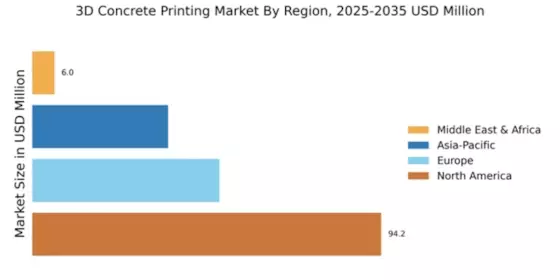
By region, the study provides market insights into North America, Europe, Asia-Pacific, and the Rest of the World. The North American 3D Concrete Printing Market area will dominate this market, owing to the well-established construction industry and a strong inclination toward technological advancements. The United States, in particular, dominates the market, fueled by investments in research and development and the presence of key market players. Government initiatives promoting sustainable construction practices and the adoption of 3D printing technologies further contribute to the growth of the market in the region.

Further, the major countries studied in the market report are TheUS, Canada, German, France, the UK, Italy, Spain, China, Japan, India, Australia, South Korea, and Brazil.

European Concrete Printing Market accounts for the second-largest market share due to factors such as stringent environmental regulations, a focus on sustainable construction, and increasing urbanization. Further, the German3D Concrete Printing Market held the largest market share, and the UK 3D Concrete Printing Market was the fastest-growing market in the European region

The Asia-Pacific 3D Concrete Printing Market is expected to grow at the fastest CAGR from 2023 to 2032. This is due to experiencing rapid urbanization, population growth, and increased infrastructure development, making it a promising market for 3D concrete. Expanding awareness of a healthy lifestyle and nutrition and rising per capita disposable income. Collaborations between academic institutions, research organizations, and construction companies foster innovation and drive market growth. Moreover, China’s3D Concrete Printing Market held the largest market share, and the Indian 3D Concrete Printing Market was the fastest growing market in the Asia-Pacific region.

Key Players and Competitive Insights

The 3D Concrete Printing Market is currently characterized by a dynamic competitive landscape, driven by technological advancements and increasing demand for sustainable construction solutions. Key players such as ICON (US), Sika AG (CH), and Apis Cor (RU) are strategically positioning themselves through innovation and partnerships. ICON (US) has focused on developing advanced printing technologies that enhance construction efficiency, while Sika AG (CH) emphasizes the integration of smart materials in its concrete solutions. Apis Cor (RU) is leveraging its expertise in mobile 3D printing to cater to diverse construction needs, thereby shaping a competitive environment that prioritizes adaptability and technological prowess.

In terms of business tactics, companies are increasingly localizing manufacturing to reduce lead times and optimize supply chains. The market appears moderately fragmented, with several players vying for market share. This fragmentation allows for a variety of innovative approaches, as companies seek to differentiate themselves through unique offerings and localized solutions. The collective influence of these key players fosters a competitive structure that encourages continuous improvement and innovation.

In November 2025, ICON (US) announced a partnership with a leading architectural firm to develop a series of sustainable housing projects utilizing their latest 3D printing technology. This collaboration is expected to enhance ICON's market presence and demonstrate the viability of 3D printed homes in addressing housing shortages. The strategic importance of this partnership lies in its potential to showcase the practical applications of 3D printing in residential construction, thereby attracting further investment and interest in the technology.

In October 2025, Sika AG (CH) launched a new line of eco-friendly concrete mixtures designed specifically for 3D printing applications. This initiative aligns with the growing emphasis on sustainability within the construction sector. By introducing these innovative materials, Sika AG not only strengthens its product portfolio but also positions itself as a leader in sustainable construction practices, which could resonate well with environmentally conscious consumers and regulatory bodies.

In September 2025, Apis Cor (RU) expanded its operations into the Asian market by establishing a manufacturing facility in Vietnam. This strategic move is indicative of Apis Cor's commitment to tapping into emerging markets where demand for affordable housing is surging. The establishment of local production capabilities is likely to enhance operational efficiency and reduce costs, thereby positioning Apis Cor favorably against competitors in the region.

As of December 2025, current trends in the 3D Concrete Printing Market are heavily influenced by digitalization, sustainability, and the integration of AI technologies. Strategic alliances are increasingly shaping the competitive landscape, as companies recognize the value of collaboration in driving innovation. Looking ahead, competitive differentiation is expected to evolve from traditional price-based competition to a focus on technological innovation, supply chain reliability, and sustainable practices. This shift underscores the importance of adaptability and forward-thinking strategies in maintaining a competitive edge in the market.

Key Companies in the 3D Concrete Printing Market market include

Industry Developments

January 2022:  MiCoB Pvt. Ltd stated that it had achieved a record delivery speed of 30 days for a 3D concrete printed runway controller hut to the Military Engineer Services for the Airbase in Pune. The finished building is India's first hybrid "G+1" structure to combine 3D concrete printing with a prefabricated steel frame.

April 2021: Project Milestone is a projected residential complex in Eindhoven, the Netherlands, consisting of five 3D-printed structures designed by Houben/Van Mierlo Architects. The first structure, a single-story single-family dwelling, has been built.

October 2023: A startup in California unveils a new 3D concrete printing system that uses recycled materials, promoting eco-friendly construction practices in the industry.

Future Outlook

3D Concrete Printing Market Future Outlook

The 3D Concrete Printing Market is projected to grow at a 55.6% CAGR from 2024 to 2035, driven by technological advancements, sustainability initiatives, and increasing demand for customized construction solutions.

New opportunities lie in:

  • Development of automated 3D printing construction robots
  • Integration of AI for optimized material usage
  • Expansion into residential housing projects with modular designs

By 2035, the market is expected to be a cornerstone of innovative construction solutions.

Market Segmentation

3D Concrete Printing Market End Use Outlook

  • Building Components
  • Precast Elements
  • Custom Structures
  • Art Installations

3D Concrete Printing Market Technology Outlook

  • Extrusion-Based Printing
  • Binder Jetting
  • Powder-Based Printing
  • Material Jetting

3D Concrete Printing Market Application Outlook

  • Residential Construction
  • Commercial Construction
  • Infrastructure Development
  • Art and Design
  • Repair and Maintenance

3D Concrete Printing Market Process Type Outlook

  • Digital Fabrication
  • Additive Manufacturing
  • Layered Construction

3D Concrete Printing Market Material Type Outlook

  • Concrete
  • Composite Materials
  • Reinforced Concrete
  • Geopolymer Concrete

Report Scope

MARKET SIZE 2024188.37(USD Million)
MARKET SIZE 2025293.11(USD Million)
MARKET SIZE 203524388.4(USD Million)
COMPOUND ANNUAL GROWTH RATE (CAGR)55.6% (2024 - 2035)
REPORT COVERAGERevenue Forecast, Competitive Landscape, Growth Factors, and Trends
BASE YEAR2024
Market Forecast Period2025 - 2035
Historical Data2019 - 2024
Market Forecast UnitsUSD Million
Key Companies ProfiledICON (US), Vertico (NL), Apis Cor (RU), XtreeE (FR), Sika AG (CH), LafargeHolcim (CH), BetAbram (IT), 3D Concrete Printing (DE), COBOD International (DK)
Segments CoveredApplication, Technology, End Use, Material Type, Process Type
Key Market OpportunitiesIntegration of sustainable materials in the 3D Concrete Printing Market enhances eco-friendly construction practices.
Key Market DynamicsTechnological advancements drive competitive forces, enhancing efficiency and sustainability in the 3D concrete printing market.
Countries CoveredNorth America, Europe, APAC, South America, MEA

Market Highlights

Author
Harshita Gorade
Research Analyst

Harshita Post graduate MBA in Business Administration from Welingkar Institute, Mumbai and 5 years of experience in the field of product market research. As a Research Analyst, I have cross-domain experience in packaging, and industrial Automation & Equipment. I am currently looking after the research process of packaging, logistics & transportation, and industrial automation & equipment at Market Research Future Reports. My responsibilities at the organization involve handling syndicate and custom reports as well as responding to client inquiries, and organize, co-ordinate with a group of 5 to 6 persons to manage all workflows.

Leave a Comment

FAQs

How much is the 3D Concrete Printing Market?

The 3D Concrete Printing Market size was valued at USD 0.19 Billion in 2024.

What is the growth rate of the 3D Concrete Printing Market?

3D Concrete Printing Market is expected to grow with a CAGR of 55.6% in the period 2025-2035

Which region held the largest market share in the 3D Concrete Printing Market?

North America had the largest share of the 3D Concrete Printing Market

Who are the key players in the 3D Concrete Printing Market?

The key players in the market are Winsun (China, Sika (Switzerland), XtreeE (France), CSP s.r.l.(Italy), CyBe Construction (Netherlands), Monolite UK (UK), Apis Cor (Russia).

Which Concrete Type led the 3D Concrete Printing Market?

The Ready Mix Concrete category dominated the 3D Concrete Printing Market in 2024.

Which Application had the largest market share in the 3D Concrete Printing Market?

The Residential had the largest share in the 3D Concrete Printing Market

Which End-Use had the largest market share in the 3D Concrete Printing Market?

The Walls had the largest share in the 3D Concrete Printing Market

Download Free Sample

Kindly complete the form below to receive a free sample of this Report

Compare Licence

×
Features License Type
Single User Multiuser License Enterprise User
Price $4,950 $5,950 $7,250
Maximum User Access Limit 1 User Upto 10 Users Unrestricted Access Throughout the Organization
Free Customization
Direct Access to Analyst
Deliverable Format
Platform Access
Discount on Next Purchase 10% 15% 15%
Printable Versions