Segmentation Quick Reference
| Dimension | Sub-Segments | Dominant Segment | Fastest Growing Segment |
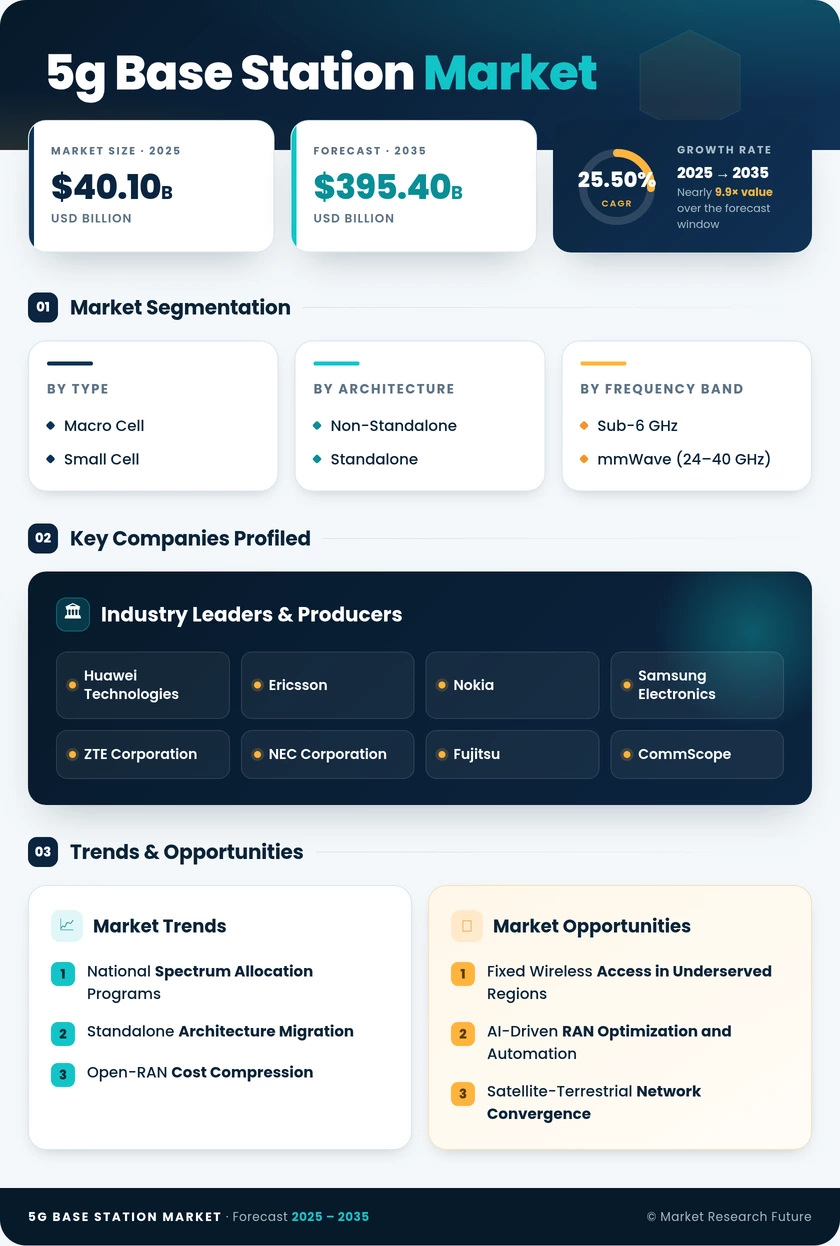
| Type | Macro Cell, Small Cell | Macro Cell | Small Cell |
| Architecture | Standalone, Non-Standalone | Non-Standalone | Standalone |
| Frequency Band | Sub-6 GHz, mmWave (24–40 GHz) | Sub-6 GHz | mmWave (24–40 GHz) |
| Power Rating | Below 10 W, 10–40 W, Above 40 W | 10–40 W | Above 40 W |
| MIMO Technology | Conventional MIMO, Massive MIMO | Massive MIMO | Massive MIMO |
| End User | Commercial Mobile Operators, Industrial Private Networks, Smart Cities and Public Safety | Commercial Mobile Operators | Industrial Private Networks |
| Geography | North America, Europe, Asia-Pacific, South America, Middle East & Africa | Asia-Pacific | Middle East & Africa |
Market Segmentation Overview
By Type
| Sub-Segment | Key Trend |
| Macro Cell | Continued wide-area coverage investments in suburban and rural corridors |
| Small Cell | Accelerating urban densification and enterprise indoor deployment |
Macro cell base stations anchor nationwide coverage, while small cell units address the capacity gap in dense urban environments where mid-band and mmWave propagation limits per-site reach.
By Architecture
| Sub-Segment | Key Trend |
| Standalone | Migration to independent 5G core for slicing and URLLC |
| Non-Standalone | Legacy installed base leveraging 4G core overlay |
Early deployments relied on non-standalone configurations to accelerate time-to-market; standalone architectures are now gaining share as operators pursue differentiated enterprise services.
By Frequency Band
| Sub-Segment | Key Trend |
| Sub-6 GHz | Balanced coverage-capacity deployments across geographies |
| mmWave (24–40 GHz) | Ultra-high-capacity hotspots, venue coverage, and fixed wireless access |
Sub-6 GHz remains the workhorse band for broad 5G coverage, while mmWave is deployed selectively for capacity-hungry applications.
By Power Rating
| Sub-Segment | Key Trend |
| Below 10 W | Indoor small cells and femtocell deployments |
| 10–40 W | Mid-power outdoor small cells and micro base stations |
| Above 40 W | High-power macro radio units for wide-area coverage |
The 10–40 W category holds the largest shipment share, reflecting the predominance of mid-power platforms across diverse deployment scenarios.
By MIMO Technology
| Sub-Segment | Key Trend |
| Conventional MIMO | Legacy 2T2R and 4T4R configurations in cost-sensitive markets |
| Massive MIMO | 32T32R and 64T64R antenna arrays for spectral efficiency gains |
Massive MIMO is both the dominant and fastest-growing category, delivering the spectral efficiency gains that operators require to support escalating data traffic.
By End User
| Sub-Segment | Key Trend |
| Commercial Mobile Operators | Consumer broadband and mobile broadband capex cycles |
| Industrial Private Networks | Dedicated campus networks for manufacturing, mining, and logistics |
| Smart Cities and Public Safety | Municipal IoT, surveillance, and public safety communications |
Commercial operators drive the bulk of equipment procurement, while industrial private networks represent the highest-growth end-user category as enterprises prioritize dedicated wireless connectivity.