5G Base Station Market (2026 - 2035)

5G Base Station Market Size, Share and Research Report By Type (Macro Cell and Small Cell), By Architecture (Standalone and Non-Standalone), By Frequency Band (Sub-6 GHz and mmWave 24–40 GHz), By Power Rating (Below 10 W, 10–40 W, and Above 40 W), By MIMO Technology (Conventional MIMO and Massive MIMO), By End User (Commercial Mobile Operators, Industrial Private Networks, Smart Cities and Public Safety, Residential/Consumer FWA, Government and Defense, and Other End Users), And By Region (North America, Europe, Asia-Pacific, And Rest Of The World) – Industry Forecast Till 2035
ID: MRFR/ICT/9042-HCR
99 Pages
Ankit Gupta
Last Updated: August 24, 2026
5G Base Station Market
Market Size
Forecast Period2026-2035
CAGR (2026-2035)25.50%
2025 Market SizeUSD 40.10 Billion
2035 Market SizeUSD 395.40 Billion
Key Players
Huawei Technologies
Ericsson
Nokia
Samsung Electronics
ZTE Corporation
NEC Corporation
Opportunities
  • Fixed Wireless Access in Underserved Regions
  • AI-Driven RAN Optimization and Automation
  • Satellite-Terrestrial Network Convergence

5G Base Station Market Summary

The 5G Base Station Market was valued at USD 40.10 Billion in 2025 and is projected to grow from USD 51.20 Billion in 2026 to USD 395.40 Billion by 2035, registering a CAGR of 25.50% during the forecast period. National spectrum allocation programs and carrier capital expenditure cycles have served as the twin catalysts accelerating deployment timelines across both developed and emerging economies. Governments in over 40 countries earmarked dedicated mid-band spectrum between 2023 and 2025, providing the regulatory runway operators needed to commit multi-year rollout budgets [1].

A fundamental technology transition underpins the 5G Base Station Market trajectory. Legacy 4G macro sites are being upgraded or replaced with multi-band, software-defined radio units capable of supporting both non-standalone and standalone 5G New Radio architectures. Operator spending on radio access network modernization exceeded USD 42 Billion globally in 2024, with gallium-nitride power amplifiers and Open-RAN disaggregated platforms compressing per-site costs by an estimated 18–22% compared to proprietary 4G basebands [2][3].

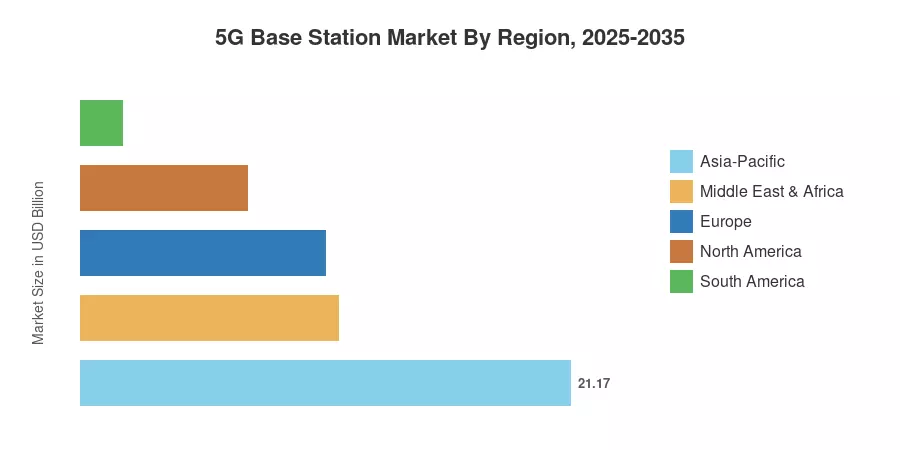
Asia-Pacific commands approximately 52.8% of 5G Base Station Market installations, driven by China's nationwide macro-cell buildout and India's accelerating greenfield deployment under the BharatNet Phase III program. The Middle East & Africa region is advancing at the fastest clip, posting a projected 27.80% CAGR as sovereign wealth funds in the Gulf states bankroll ambitious nationwide coverage targets. North America holds the second-largest revenue share, anchored by C-band densification across the United States. The next decade will see operator focus shift from coverage breadth to capacity depth, with private industrial networks and fixed wireless access emerging as incremental demand vectors.


Key Report Takeaways

• By Type

  • Macro cell infrastructure accounted for roughly 59.8% of 2025 5G Base Station Market revenue, reflecting continued demand for wide-area coverage across suburban and rural corridors.
  • Small cell deployments are forecast to expand at a 26.10% CAGR through 2035, driven by urban densification requirements and enterprise indoor coverage.

• By Architecture

  • Non-standalone nodes represented the majority of 2025 5G Base Station Market installations, though standalone configurations are growing faster as operators pursue network slicing and ultra-low-latency use cases.


• By Power Rating

  • The above-40 W power segment posted the highest CAGR among power rating categories, reflecting rising demand for high-capacity macro radio units.

• By Region

  • Asia-Pacific dominated with a 52.8% share of 2025 deployments, while the Middle East & Africa region posted the highest growth trajectory in the 5G Base Station Market.
  • North America contributed approximately USD 7.20 Billion in 2025 revenue, led by mid-band spectrum auctions and carrier densification in the United States.


Market Size and Forecast (2021–2035)

Market sizing relies on a bottom-up approach aggregating vendor shipment data, operator capital expenditure disclosures, and spectrum licensing records across 55 countries. Historical values (2021–2024) are triangulated against publicly filed annual reports and regulatory filings, while forecast figures (2026–2035) are modeled using carrier rollout guidance, spectrum pipeline analysis, and macroeconomic indicators.
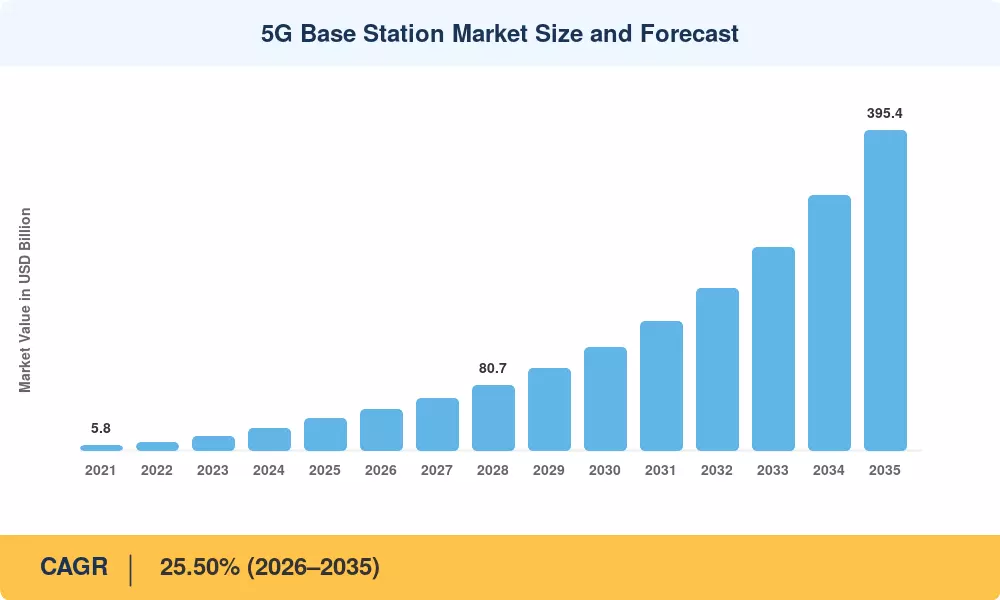
5G Base Station Market Size and Forecast
Our Impact
Enabled $4.3B Revenue Impact for Fortune 500 and Leading Multinationals
Partnering with 2000+ Global Organizations Each Year
30K+ Citations by Top-Tier Firms in the Industry

Driver Impact Analysis

Driver ~% Impact on CAGR Geographic Relevance Impact Timeline
National spectrum allocation programs 22–25% Global Short-term (≤2 yr)
Standalone architecture migration 18–21% North America, Europe Medium-term (2–4 yr)
Open-RAN cost compression 12–15% Global Medium-term (2–4 yr)
Private 5G industrial networks 10–13% Asia-Pacific, Europe Medium-term (2–4 yr)
Urban small-cell densification 9–11% North America, Asia-Pacific Short-term (≤2 yr)
Fixed wireless access expansion 8–10% Middle East, South America Long-term (≥4 yr)
GaN power amplifier adoption 5–7% Global Long-term (≥4 yr)


National Spectrum Allocation Programs

Over 40 nations' regulators auctioned or administratively allotted mid-band spectrum in the 3.3–4.2 GHz and 4.8–4.9 GHz areas between 2023 and 2025, bringing in a total of more than USD 78 billion in license income [1]. The Department of Telecommunications in India, for example, raised almost USD 19 billion from its 2022–2024 spectrum auctions, and licensees are contractually required to reach coverage targets within five years [5]. These allocations directly unlock carrier capital commitments. From equipment purchase to site activation, Spectrum Certainty shortens the 5G Base Station Market sales cycle.


Standalone Architecture Migration

In order to enable network slicing, edge computing, and ultra-reliable low-latency communication, operators are switching from non-standalone overlays, which anchor 5G radio to a 4G core, to fully standalone 5G cores. Between 2023 and 2025, the three mobile carriers in South Korea invested KRW 8.2 trillion (about USD 6.1 billion) in independent core deployments [6]. Because current non-standalone radio equipment needs firmware and hardware upgrades, this change generates replacement-cycle demand in the 5G base station market.


Open-RAN Cost Compression

The O-RAN Alliance's Release 3 specifications, finalized in late 2024, enabled multi-vendor interoperability across distributed-unit and centralized-unit interfaces [7]. Rakuten Mobile's fully virtualized Open-RAN network in Japan demonstrated a 30% reduction in total cost of ownership compared to traditional integrated RAN platforms. Vodafone committed GBP 2.5 Billion to Open-RAN deployments across six European markets by 2028 [7]. These economics widen the addressable customer base for the 5G Base Station Market, particularly among tier-2 and tier-3 operators.

Private 5G Industrial Networks

Dedicated 5G networks for manufacturing, mining, ports, and logistics facilities represented a USD 3.8 Billion segment in 2025 [8]. Germany's Bundesnetzagentur allocated dedicated 3.7–3.8 GHz campus-network spectrum, resulting in over 340 private 5G licenses by year-end 2024. Private networks typically require purpose-built small cells and edge-compute-enabled base stations, adding an incremental demand layer to the broader 5G Base Station Market.


Restraints Impact Analysis

Restraint ~% Impact on CAGR Geographic Relevance Impact Timeline
High site acquisition and energy costs –3 to –5% Europe, North America Short-term (≤2 yr)
Spectrum fragmentation and interference –2 to –4% Emerging markets Medium-term (2–4 yr)
Geopolitical vendor restrictions –2 to –3% Europe, North America Long-term (≥4 yr)
Skilled workforce shortages for RF engineering –1 to –2% Global Medium-term (2–4 yr)
Municipal permitting and zoning delays –1 to –2% North America, Europe Short-term (≤2 yr)


High Site Acquisition and Energy Costs

Roughly 70% of a mobile operator's overall network power expense comes from base station energy use. Return-on-investment timelines for new macro sites have been compressed by rising energy bills beyond 2022, with European operators spending an estimated EUR 7.8 billion on network electricity in 2024 alone [15]. In high-tariff nations, these cost pressures limit the rate of 5G base station market expansion and reduce site rollout velocities.


Geopolitical Vendor Restrictions

The 5G Base Station Market's procurement dynamics have changed as a result of security-related prohibitions on particular vendors. At an estimated total cost of EUR 3.2 billion, operators were forced to strip and replace equipment from designated high-risk vendors as a result of the European Union's 5G Toolbox and subsequent national-level restrictions in the UK, Sweden, and several other member states [16]. These rip-and-replace initiatives cause project delays of 12 to 18 months and redirect capital expenditures from greenfield expansion.


Skilled Workforce Shortages

The global shortfall is approximately 250,000 RF and telecom-infrastructure engineers through 2028 [17]. Deployment contractors report project backlogs of six to nine months in several North American and European markets, which directly constrains the 5G Base Station Market's ability to translate capex budgets into activated sites.


5G Base Station Market Opportunities

Fixed Wireless Access in Underserved Regions

Fixed wireless access using 5G base stations offers a compelling last-mile broadband alternative in regions where fiber economics are prohibitive. The ITU estimates 2.6 billion people remain unconnected, presenting a multi-billion-dollar addressable opportunity for operators deploying mid-band and mmWave fixed wireless platforms [10].

AI-Driven RAN Optimization and Automation

Machine learning models embedded directly in base station software can dynamically manage power consumption, beam steering, and carrier aggregation. Ericsson's AI-native RAN platform reduced site energy use by up to 15% in live network trials, pointing to a data-monetization and software-licensing revenue stream adjacent to the 5G Base Station Market hardware value chain [12].

Satellite-Terrestrial Network Convergence

3GPP Release 17 standardized non-terrestrial network integration, enabling direct-to-device connectivity via low-earth-orbit satellites linked to terrestrial gNodeB infrastructure. This convergence opens coverage possibilities in maritime, aviation, and remote rural settings that were previously uneconomical for ground-based base stations [14].

Edge Computing Co-Location

Operators and hyperscalers are co-locating multi-access edge computing hardware at base station sites to support low-latency applications such as autonomous vehicles and augmented reality. AWS Wavelength and Microsoft Azure Edge Zones are already operational at select tower sites in the US and Japan, creating ancillary revenue streams for tower companies and a pull-through effect on 5G Base Station Market equipment orders [8].

Emerging Market Greenfield Deployments

Markets across Sub-Saharan Africa, Southeast Asia, and Latin America are bypassing 4G densification in favor of direct 5G greenfield buildouts. Nigeria's National Communications Commission auctioned 3.5 GHz spectrum in 2024, and operators in Brazil have committed BRL 40 Billion to 5G rollout through 2029 [11].


5G Base Station Market Future Outlook

AI-Native Radio Access Networks

By 2030, most tier-1 operators are expected to embed AI inference engines directly into base station baseband units, enabling real-time traffic steering, predictive fault detection, and autonomous energy management. The GSMA forecasts that AI-native RAN could reduce operational expenditure by 20–25% across global mobile networks [12]. This shift transforms base stations from static radio transmitters into intelligent network nodes, reshaping vendor R&D priorities across the 5G Base Station Market.

Energy Efficiency and Sustainability Mandates

The ITU's Green Digital Action initiative targets a 45% reduction in telecom network energy intensity by 2030 relative to 2020 baselines [15]. Vendors are responding with sleep-mode-capable radio units, liquid-cooled active antenna systems, and solar-powered small cells. These sustainability imperatives will reshape procurement specifications in the 5G Base Station Market, favoring vendors that deliver verified carbon-reduction performance.

6G Research and Forward-Compatible Architecture

Early 6G research programs — including the EU's Hexa-X-II, Japan's Beyond 5G Promotion Consortium, and the US NextG Alliance — are defining sub-terahertz spectrum bands and reconfigurable intelligent surface technologies that will require new base station hardware architectures post-2030 [13]. Operators investing in modular, software-upgradable platforms today will minimize the transition cost to 6G-capable infrastructure.

Network-as-a-Service Business Models

Cloud-native 5G cores and Open-RAN architectures are enabling operators to offer network-as-a-service packages to enterprise customers, generating recurring software revenue alongside hardware sales. This platform-economics shift could add an estimated USD 18–25 Billion in annual service revenue by 2035, expanding the total addressable opportunity adjacent to the 5G Base Station Market [8].


5G Base Station Market Segmentation

By Type

Segment Key Metric Primary Demand Driver
Macro Cell 59.8% of 2025 revenue Wide-area coverage in suburban and rural zones
Small Cell 26.10% CAGR (2026–2035) Urban densification and indoor enterprise coverage


Macro cell base stations remain the backbone of the 5G Base Station Market, supporting wide-area coverage where propagation economics favor high-tower, high-power deployments. Small cells are the faster-growing category, driven by the physics of mid-band and mmWave propagation — shorter-range signals require denser site grids to maintain throughput in populated urban corridors. Enterprise indoor small cells are also gaining traction as corporate campuses and logistics hubs deploy private 5G networks.

By Architecture

Segment Key Metric Primary Demand Driver
Non-Standalone 63.90% of 2025 installations Leverages existing 4G core infrastructure
Standalone 26.30% CAGR (2026–2035) Enables network slicing and URLLC applications


Non-standalone configurations dominated the early phase of the 5G Base Station Market because they allowed operators to launch 5G radio layers without replacing legacy 4G cores. Standalone architecture, however, is now the growth driver as operators pursue revenue-generating capabilities like network slicing for enterprise customers and edge computing integration.

By Frequency Band

Segment Key Metric Primary Demand Driver
Sub-6 GHz 68.20% of 2025 deployments Balanced coverage-capacity economics
mmWave (24–40 GHz) 26.40% CAGR (2026–2035) Ultra-high-capacity hotspots and FWA


Sub-6 GHz frequencies anchor the 5G Base Station Market due to their favorable propagation characteristics, supporting both urban and suburban coverage. The mmWave segment is accelerating as operators deploy fixed wireless access services and dense-venue capacity solutions in stadiums, airports, and transit hubs.

By End User

Segment Key Metric Primary Demand Driver
Commercial Mobile Operators USD 29.00 Billion (2025) Consumer broadband and MBB services
Industrial Private Networks 27.10% CAGR (2026–2035) Manufacturing, mining, and port automation
Smart Cities and Public Safety USD 3.40 Billion (2025) Municipal IoT and public safety LTE/5G migration


Commercial mobile operators remain the primary buyer in the 5G Base Station Market, allocating the largest share of annual capex toward radio access network upgrades. Industrial private networks represent the fastest-growing end-user segment as enterprises seek dedicated, interference-free wireless connectivity for mission-critical operations.


Regional Market Share Analysis

Region Key Metric Primary Investment Themes
Asia-Pacific 52.8% of 2025 deployments China macro completion; India greenfield ramp
North America USD 7.20 Billion (2025) C-band densification; Open-RAN trials
Europe 26.40% CAGR (2026–2035) Vendor diversification; energy-efficient RAN
South America USD 1.80 Billion (2025) Greenfield 3.5 GHz rollout; FWA demand
Middle East & Africa 27.80% CAGR (2026–2035) Sovereign wealth fund financing; smart-city programs
Total USD 40.10 Billion (2025)

The 5G Base Station Market exhibits pronounced regional disparity, with Asia-Pacific anchoring the majority of global shipments while the Middle East & Africa region accelerates fastest on the back of sovereign-funded coverage mandates.


North America

Country Key Metric Key Driver
United States 78.2% of regional revenue C-band mid-band densification; carrier capex cycles
Canada 14.5% of regional revenue 3,500 MHz auction obligations
Mexico USD 0.53 Billion (2025) América Móvil and Telcel 5G commitments


The United States dominates the North American 5G Base Station Market, with the top three carriers collectively investing over USD 35 Billion in network capital expenditure during 2024–2025. T-Mobile's extended-range 5G program targeted 98% population coverage by mid-2025, while AT&T and Verizon focused C-band deployments on top-50 metro areas [3]. Canada's Innovation, Science and Economic Development ministry released 3,800 MHz spectrum in 2024, catalyzing new build commitments from Rogers and Telus.

Europe

Country Key Metric Key Driver
Germany 26.30% CAGR Industrial campus-network demand
United Kingdom USD 1.35 Billion (2025) Shared Rural Network program
France 18.6% of regional revenue 3.4–3.8 GHz rollout obligations
Italy 14.2% of regional revenue TIM-Vodafone network-sharing JV
Spain USD 0.62 Billion (2025) Telefónica 5G SA migration
Nordic Countries 27.10% CAGR Early standalone adoption
Russia USD 0.40 Billion (2025) Domestic equipment substitution
Rest of Europe 11.8% of regional revenue EU Recovery Fund allocations


European deployment in the 5G Base Station Market is shaped by vendor-diversification mandates and energy-cost pressures. The European Commission's Gigabit Infrastructure Act, adopted in 2024, streamlines permitting for small-cell installations on public infrastructure, reducing average site-approval timelines from 18 months to six [15]. Germany's private campus-network spectrum scheme has generated over 340 licenses, making it the continent's largest industrial 5G testbed.

Asia-Pacific

Country Key Metric Key Driver
China 61.4% of regional deployments State-directed macro buildout completion
India 28.50% CAGR BharatNet Phase III and Jio/Airtel competition
Japan USD 2.90 Billion (2025) NTT Docomo Open-RAN leadership
South Korea 12.3% of regional revenue Standalone core migration
ASEAN 29.20% CAGR Thailand and Indonesia spectrum auctions
Rest of Asia-Pacific USD 1.10 Billion (2025) Australia and New Zealand 5G expansion


Asia-Pacific's dominance in the 5G Base Station Market is anchored by China's state-orchestrated rollout, which surpassed 3.7 million 5G base stations by year-end 2024 according to the Ministry of Industry and Information Technology [5]. India represents the region's fastest-growing market, with Reliance Jio and Bharti Airtel deploying over 400,000 sites combined since late 2022 under aggressive spectrum-utilization timelines.

South America

Country Key Metric Key Driver
Brazil 68.5% of regional revenue Anatel 3.5 GHz rollout mandates
Argentina 17.8% of regional revenue Telecom Argentina 5G pilot expansion
Rest of South America USD 0.25 Billion (2025) Chile and Colombia spectrum programs


Brazil shapes the South American 5G Base Station Market trajectory. Anatel's 2021 spectrum auction imposed coverage obligations requiring licensees to reach all municipalities above 30,000 inhabitants by 2028, creating a sustained multi-year equipment procurement cycle [11].

Middle East & Africa

Country Key Metric Key Driver
Saudi Arabia 34.8% of regional revenue Vision 2030 smart-city infrastructure
UAE 27.70% CAGR Etisalat and du nationwide SA deployment
South Africa USD 0.38 Billion (2025) MTN and Vodacom spectrum awards
Egypt 25.90% CAGR National Telecom Regulatory Authority reforms
Rest of MEA 19.3% of regional revenue Sub-Saharan greenfield buildouts


The Middle East & Africa region represents the fastest-growing corridor in the 5G Base Station Market, propelled by Gulf-state sovereign wealth fund investments. Saudi Arabia's NEOM and The Line projects alone have allocated over USD 2.5 Billion for advanced telecom infrastructure through 2030 [11]. South Africa's spectrum auction in 2022 unlocked 5G deployment for MTN, Vodacom, and Rain, kickstarting Sub-Saharan Africa's commercial 5G era.


5G Base Station Market By Region, 2025-2035

Competitive Benchmarking

The 5G Base Station Market exhibits moderate-to-high concentration, with an estimated top-five vendor share of approximately 72–76%. The Herfindahl-Hirschman Index sits in the 1,500–1,800 range, indicating a moderately concentrated structure. Geopolitical dynamics — particularly vendor restrictions in Western markets — have shifted share from some incumbents toward European and Korean suppliers, while Open-RAN interoperability standards are beginning to lower barriers for specialist challengers [16].

Company Est. Revenue Share Range Key Offerings for 5G Base Station Market Strategic Positioning
Huawei Technologies ~22–26% AAU5613, RRU5304, CloudRAN Global volume leader; dominant in APAC and MEA
Ericsson ~16–20% Radio 4422/6626, Ericsson Cloud RAN Strong in Europe and North America; Open-RAN contributor
Nokia ~12–16% AirScale massive MIMO, ReefShark SoC Multi-vendor interoperability focus; enterprise 5G strength
Samsung Electronics ~8–12% Compact Macro, Massive MIMO 64T64R Gained US share via Verizon and AT&T partnerships
ZTE Corporation ~7–10% UniSite, CloudBase Price-competitive; strong in China and Southeast Asia
NEC Corporation ~3–5% Open-RAN DU/CU platform Open-RAN pioneer; anchored in Japan
Fujitsu ~2–4% Virtual RAN, O-RAN compliant RUs O-RAN Alliance contributor; NTT Docomo partner
CommScope ~2–3% Small cells, DAS solutions Indoor and venue coverage specialist
Mavenir ~1–3% Cloud-native OpenRAN software Pure-play Open-RAN software provider
Comba Telecom ~1–2% Antenna systems, small cells Cost-effective small-cell solutions in APAC


Recent News & Developments

  • Ericsson (October 2024): Signed a USD 14 Billion, multi-year 5G network modernization contract with AT&T covering Open-RAN-ready radio units across the US. The deal reinforces Ericsson's position as a primary supplier in the North American 5G Base Station Market [7].
  • Nokia (August 2024): Launched its AirScale Habrok massive MIMO radio, delivering 32T32R capability in a form factor 40% lighter than its predecessor. The product targets European operators facing strict urban zoning constraints [9].
  • Samsung Electronics (June 2024): Expanded its partnership with Vodafone to deploy 5G Open-RAN infrastructure across the United Kingdom, marking Samsung's first major European Open-RAN deal [7].
  • Reliance Jio (March 2024): Announced completion of 150,000 5G base station installations across India in Q1 2024, making it one of the fastest large-scale 5G rollouts globally [5].
  • Rakuten Mobile (January 2024): Achieved full nationwide 5G population coverage in Japan using a fully virtualized Open-RAN architecture, validating the disaggregated network model for the 5G Base Station Market [7].


5G Base Station Market Report Scope

Parameter Detail
Market Scope Global 5G Base Station Market covering equipment hardware, radio units, and associated RAN infrastructure
Study Period 2021–2035
CAGR 25.50% (2026–2035)
Base Year Market Size USD 40.10 Billion (2025)
Forecast Endpoint USD 395.40 Billion (2035)
Fastest Growing Segment Industrial Private Networks (by end user); Standalone (by architecture)
Companies Profiled 10 (see Section 10)
Valuation Currency USD Billion

FAQs

What total cost of ownership factors should operators evaluate when selecting 5G base station vendors?
Operators should weigh energy consumption, site-lease costs, integration complexity, and software licensing fees alongside hardware price. Total cost of ownership over a seven-year lifecycle can vary by 25–35% between vendors [15].
How do Open-RAN-compliant base stations differ from traditional integrated platforms in field reliability?
Open-RAN platforms disaggregate hardware from software, enabling multi-vendor deployments but requiring rigorous integration testing. Early field data indicates comparable uptime once certified interoperability profiles are validated [7].
What role do tower companies play in shaping base station procurement decisions?
Tower companies influence vendor selection through co-location constraints such as weight limits, wind-load ratings, and power availability. Their structural specifications often narrow the equipment shortlist before the operator issues a purchase order [15].
How will 5G-Advanced (Release 18) capabilities affect base station hardware refresh cycles?
Release 18 introduces enhanced sidelink and ambient IoT features that may require new RF front-end modules. Operators on modular platforms can adopt these via software upgrades, while legacy hardware may face accelerated replacement [6].
What spectrum-sharing approaches are emerging for the 5G Base Station Market in unlicensed or shared bands?
Citizens Broadband Radio Service in the US and Licensed Shared Access in Europe allow dynamic spectrum sharing between incumbents and mobile operators. These models reduce spectrum acquisition costs but add coordination complexity [1].
How are sustainability-linked financing mechanisms affecting 5G Base Station Market procurement?
Green bonds and sustainability-linked loans now fund a growing share of telecom infrastructure projects. Lenders increasingly require vendors to certify energy-efficiency benchmarks, tying financing terms to verified carbon-reduction targets [21].
What cybersecurity certification standards apply to 5G base station equipment in regulated markets?
The EU Cybersecurity Act and the US FCC's equipment authorization program impose security testing requirements on all radio network equipment. Vendors must pass independent lab certification before equipment can be deployed on licensed spectrum [16].    
Author
Author
Author Profile
Ankit Gupta LinkedIn
Team Lead - Research
Ankit Gupta is a seasoned market intelligence and strategic research professional with over six plus years of experience in the ICT and Semiconductor industries. With academic roots in Telecom, Marketing, and Electronics, he blends technical insight with business strategy. Ankit has led 200+ projects, including work for Fortune 500 clients like Microsoft and Rio Tinto, covering market sizing, tech forecasting, and go-to-market strategies. Known for bridging engineering and enterprise decision-making, his insights support growth, innovation, and investment planning across diverse technology markets.

Research Approach


Secondary Research

The secondary research process involved comprehensive analysis of telecommunications regulatory databases, 3GPP technical specifications, peer-reviewed engineering journals, and authoritative ICT organizations. Key sources included the International Telecommunication Union (ITU-R and ITU-T), 3rd Generation Partnership Project (3GPP) specifications, Global System for Mobile Communications Association (GSMA) Intelligence, Federal Communications Commission (FCC) Spectrum Auction Database, European Conference of Postal and Telecommunications Administrations (CEPT) Electronic Communications Committee, Ofcom Spectrum Information System, National Institute of Standards and Technology (NMTS 5G Portfolio), IEEE Xplore Digital Library (5G NR and Massive MIMO publications), Ericsson Mobility Report, Nokia Bell Labs Technical Journal, Ookla Speedtest Intelligence, OpenSignal Analytics, TeleGeography GlobalComms Database, and national regulatory authority reports from key markets including China's Ministry of Industry and Information Technology (MIIT), Japan's Ministry of Internal Affairs and Communications (MIC), South Korea's Ministry of Science and ICT (MSIT), and India's Department of Telecommunications (DoT).

These sources were employed to gather base station deployment statistics, spectrum allocation data, 5G subscription forecasts, standardization timelines, and competitive landscape analysis for macro cells, small cells, radio access network (RAN) equipment, and virtualized baseband unit (vBBU) technologies.


Primary Research

Qualitative and quantitative insights were obtained by interviewing supply-side and demand-side stakeholders during the primary research process. The supply-side sources comprised CEOs, CTOs, VPs of RAN Engineering, leaders of 5G Product Lines, regulatory affairs directors, and chief strategy officers from semiconductor component providers, radio unit suppliers, and telecom infrastructure manufacturers (OEMs). The demand-side sources included chief technology officers of mobile network operators (MNOs), heads of network planning and deployment, procurement directors from telecommunications tower companies, chief information officers from enterprise verticals (automotive, manufacturing, healthcare), and smart city infrastructure directors from municipal governments. The primary research validated market segmentation across NSA and SA architectures, confirmed the timelines for 5G-Advanced and Open RAN pipelines, and collected insights on expenditure allocation patterns, energy efficiency requirements, and spectrum acquisition strategies.

Primary Respondent Breakdown:

By Designation: C-level Primaries (28%), Director Level (32%), Senior Managers & Technical Leads (40%)

By Region: North America (32%), Europe (25%), Asia-Pacific (35%), Rest of World (8%)

By Stakeholder Type: Telecom Equipment Vendors (45%), Mobile Network Operators (30%), Enterprise/Industry Verticals (15%), Tower Infrastructure Providers (10%)


Market Size Estimation

Revenue mapping and base station shipment analysis were employed to determine the global market valuation. The methodology comprised the following:

The identification of over 50 essential infrastructure manufacturers in North America, Europe, Asia-Pacific, and Latin America, including RAN vendors, small cell specialists, and Open RAN software providers.

Product mapping across macro cells (64T64R, 32T32R, 8T8R), small cells (femtocells, picocells, microcells), distributed antenna systems (DAS), and virtualized RAN (vRAN) categories

An examination of the annual revenues that have been reported and modeled for 5G base station portfolios, which include radio units, baseband units, and antenna systems

Manufacturers that account for 75-80% of the global market share in 2024 are included in the coverage.

Extrapolation is employed to derive segment-specific valuations across hardware and network services by utilizing bottom-up (base station unit shipments × ASP by country/region, segmented by Sub-6 GHz vs. mmWave) and top-down (infrastructure vendor revenue validation against operator capex reporting) approaches.

Regulatory/Spectrum: FCC Auction 110 (3.45 GHz), Auction 107 (C-band), Ofcom 5G Spectrum Awards, EU 5G Observables (CEF Digital)

Standardization: 3GPP Release 15/16/17 specifications (TS 38.104, TS 38.141), ITU-R M.2083 (IMT-2020)

Industry Associations: GSMA, 5G Americas, 5G-ACIA (Alliance for Connected Industries and Automation), Small Cell Forum

Operator Data: CTIA Annual Survey, European 5G Observatory, China Academy of Information and Communications Technology (CAICT)

Download Free Sample

Kindly complete the form below to receive a free sample of this Report

* Please use a valid business email

Download PDF ×

We do not share your information with anyone. However, we may send you emails based on your report interest from time to time. You may contact us at any time to opt-out.
















