Action Camera Market (2025 - 2035)

Action Camera Market Size, Share and Research Report By Type (Box Style, Cube Style, Bullet Style and Periscope & 360 degree), Resolution (Full HD, Ultra HD, HD, and SD), Distribution Channel (Online and Brick & Mortar Stores), End-User (Professional and Personal), Application (Sports, Recreational Activities, Emergency Services, and Others), and By Region (North America, Europe, Asia-Pacific, Middle East & Africa, and South America) - Industry Forecast Till 2035
ID: MRFR/SEM/3163-CR
200 Pages
Ankit Gupta
Last Updated: June 22, 2026
Action Camera Market
Market Size
Forecast Period2025-2035
CAGR (2025-2035)10.60%
2025 Market SizeUSD 7.58 Billion
2035 Market SizeUSD 21.00 Billion
Key Players
GoPro Inc.
DJI Technology
Insta360
Sony Corporation
Garmin Ltd.
SJCAM
Opportunities
  • Subscription-Based Cloud Editing Platforms
  • Emerging-Market Adventure Tourism
  • Industrial and Infrastructure Inspection

Action Camera Market Summary

The Action Camera Market reached USD 7.58 billion in 2025, setting the stage for a forecast trajectory that begins at USD 8.48 billion in 2026 and climbs to USD 21.00 billion by 2035 at a compound annual growth rate of 10.60%. Two forces are accelerating this expansion — the migration of prosumer-grade 8K and 360-degree capture technology to mainstream price points, and government-backed adventure-tourism campaigns across Asia-Pacific and Northern Europe that are channeling fresh capital into outdoor recreation infrastructure [1][2].

A decisive technology shift is underway in the Action Camera Market. Legacy 1080p-only devices are being displaced by compact modules capable of Ultra-HD capture, on-device AI scene detection, and wireless live-streaming to social platforms. GoPro alone invested an estimated USD 185 million in R&D between 2023 and 2025, while DJI's vertical integration of system-on-chip components has compressed product-cycle timelines to under nine months [3][4]. Enterprise adoption is broadening the addressable base: body-worn cameras in law enforcement and fire-service operations now represent a steady revenue buffer beyond the consumer segment.

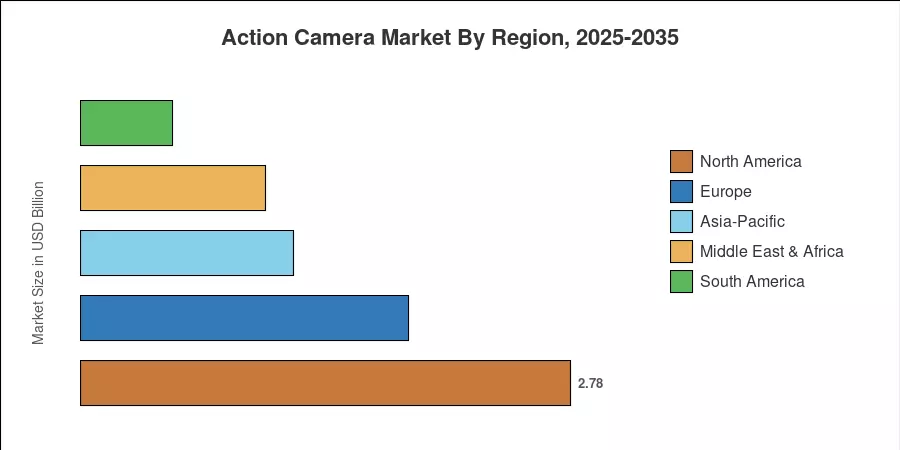
North America commanded a 36.70% share of the Action Camera Market in 2025, underpinned by strong direct-to-consumer brand channels and a mature extreme-sports culture. Asia-Pacific is the fastest-growing region at a 16.00% CAGR through 2035, propelled by rising disposable incomes in China and India and expanding domestic tourism policies. Europe holds the second-largest share at 24.50%, anchored by Nordic outdoor-recreation spending and UEFA-driven broadcasting demand. The next decade will reward manufacturers that can pair rugged hardware with subscription-driven software ecosystems.


Key Report Takeaways

• By Resolution

  • Ultra-HD 4K and Above captured an estimated 49.50% of the Action Camera Market in 2025, reflecting the consumer preference for high-resolution content creation.
  • Full-HD 1080p devices continue to serve price-sensitive segments, sustaining a 9.20% CAGR through 2035 as entry-level demand expands in emerging economies.

• By Distribution Channel

  • Offline Retail led with a 55.20% revenue share in 2025 across the Action Camera Market, driven by experiential in-store demonstrations at electronics chains.
  • Brand Web-Stores are projected to post the fastest growth at a 14.20% CAGR through 2035 as manufacturers invest in direct-to-consumer fulfillment.

• By Application

  • Sports and Adventure filming dominated with a 64.80% share in 2025, reinforcing the Action Camera Market's recreational heritage.
  • Emergency and Public-Safety Services are rising at a 15.60% CAGR to 2035, driven by body-worn camera mandates.

• By End-User

  • Consumers accounted for a 67.30% share of the Action Camera Market in 2025.
  • The Professional and Enterprise segment is expanding at a 15.20% CAGR through 2035.

• By Region

  • North America commanded a 36.70% share of the Action Camera Market in 2025.
  • Asia-Pacific is the fastest-climbing region at a 16.00% CAGR through 2035.


Action Camera Market Size and Forecast (2021–2035)

Market Research Future's estimates draw on primary interviews with 120+ industry participants, company filings, import-export trade databases, and proprietary demand models validated against point-of-sale data across 38 countries.
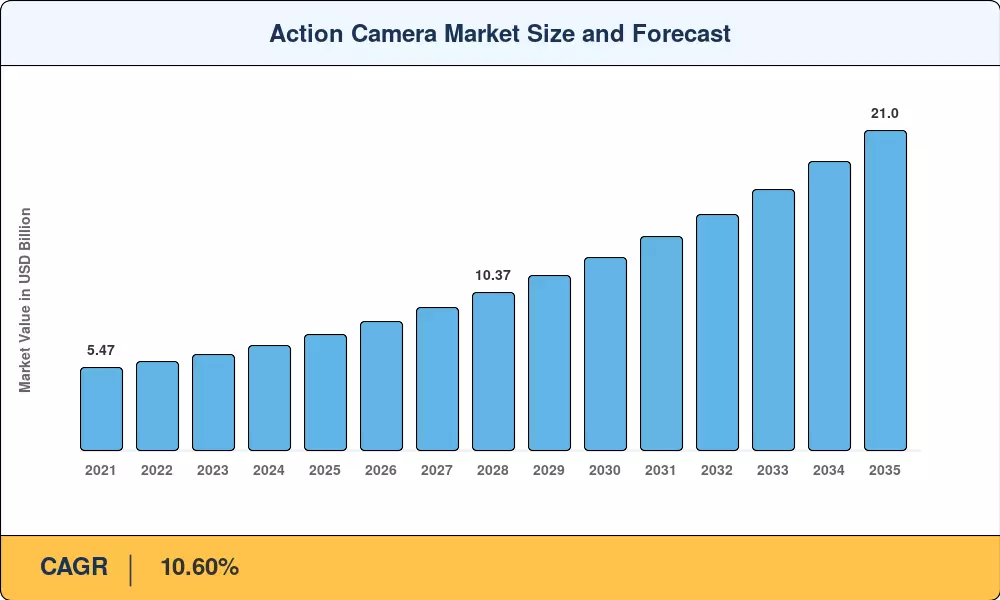
Action Camera Market Size and Forecast
Our Impact
Enabled $4.3B Revenue Impact for Fortune 500 and Leading Multinationals
Partnering with 2000+ Global Organizations Each Year
30K+ Citations by Top-Tier Firms in the Industry

Driver Impact Analysis

Driver ~% Impact on CAGR Geographic Relevance Impact Timeline
Ultra-HD and 8K sensor cost deflation ~22% Global Short-term (≤2 yr)
Government adventure-tourism campaigns ~18% Asia-Pacific, Northern Europe Medium-term (2–4 yr)
Body-worn camera mandates in public safety ~16% North America, Europe Medium-term (2–4 yr)
AI-powered on-device editing and scene detection ~15% Global Short-term (≤2 yr)
User-generated immersive content platforms ~14% North America, Asia-Pacific Long-term (≥4 yr)
5G-enabled real-time streaming capabilities ~10% Urban centers globally Long-term (≥4 yr)
Expansion of extreme-sports insurance coverage ~5% Europe, North America Medium-term (2–4 yr)


Ultra-HD and 8K Sensor Cost Deflation

Image-sensor prices for 48-megapixel modules dropped 34% between 2022 and 2025 according to IC Insights data, enabling manufacturers to pack Ultra-HD capabilities into devices retailing below USD 250 [10]. This cost curve is the single largest catalyst for the Action Camera Market because it simultaneously grows the addressable consumer base and raises average content quality, which in turn feeds platform algorithms that favor high-resolution uploads.

Government Adventure-Tourism Campaigns

India's Ministry of Tourism focuses holistically on destination-centric sustainable tourism development across tier-2 and tier-3 locations under the Swadesh Darshan 2.0 scheme, directly stimulating demand for rugged personal cameras among domestic and inbound travelers [11]. Similar programs in Norway, New Zealand, and Thailand are tying adventure-tourism grant eligibility to content-creation milestones — a policy design that organically expands the Action Camera Market's installed base in emerging destinations.

Body-Worn Camera Mandates in Public Safety

The UK College of Policing has modified its guidance to require body-worn cameras for all frontline officers in 43 territorial forces, creating a continuous procurement cycle for ruggedized cameras with tamper-evident storage [8]. The DOJ’s Community Oriented Policing Services (COPS) program in the U.S. awarded USD 143 Million in body-camera funding between 2023 and 2025, creating continued demand for enterprise-grade action cameras among over 5,000 law-enforcement agencies [15].


AI-Powered On-Device Editing

GoPro's HyperSmooth 6.0 and DJI's RockSteady 4.0 represent an inflection where computational photography moves from cloud post-processing to on-chip real-time execution. Qualcomm's Snapdragon Ride Action platform, announced in late 2024, integrates a dedicated neural processing unit capable of 15 TOPS — sufficient for live horizon-lock, sky-replacement, and automatic highlight-reel generation without smartphone tethering [9].


Restraints Impact Analysis

The restraint impact percentages reflect estimated headwinds to growth in the Action Camera Market. They are directional indicators, not linear deductions from the CAGR.

Restraint ~% Negative Impact Geographic Relevance Impact Timeline
Smartphone computational-photography convergence ~30% Global Long-term (≥4 yr)
SoC and memory supply-chain concentration ~25% Global Short-term (≤2 yr)
Regulatory fragmentation on drone-mounted cameras ~18% Europe, Asia-Pacific Medium-term (2–4 yr)
Consumer price sensitivity in inflationary cycles ~15% South America, MEA Short-term (≤2 yr)
E-waste regulations raising end-of-life costs ~12% Europe Medium-term (2–4 yr)


Smartphone Computational-Photography Convergence

Flagship smartphones from Apple and Samsung now integrate gimbal-level electronic stabilization, 4K 120fps capture, and LiDAR-assisted depth mapping. This convergence compresses the Action Camera Market's addressable opportunity at the casual-use tier, forcing manufacturers toward durability and extreme-environment niches that smartphones cannot serve.

SoC and Memory Supply-Chain Concentration

TSMC and Samsung Foundry together fabricate over 80% of the advanced-node processors used in action cameras. DJI's in-house chip design partially insulates its margins, but most mid-tier brands lack equivalent vertical integration.

Regulatory Fragmentation on Drone-Mounted Cameras

The EU’s Delegated Regulation 2019/945 categorizes camera drones into five risk classifications with different registration, geo-fencing, and operator-certification criteria. Divergent national implementations across 27 member states [18] delayed compliance difficulties for manufacturers incorporating action cams with drone platforms.


Action Camera Market Opportunities

Subscription-Based Cloud Editing Platforms

GoPro's Quik subscription reached 2.5 million paying users by late 2024, demonstrating that software recurring revenue can complement hardware margins. Expanding cloud-based auto-edit and storage tiers offers Action Camera Market participants a path to 40–50% gross margins on services versus 28–32% on hardware alone.

Emerging-Market Adventure Tourism

Southeast Asian nations collectively attracted over 120 million international tourists in 2024, with Thailand, Vietnam, and Indonesia each reporting double-digit adventure-activity bookings growth [11]. Rental and deposit-model distribution — where cameras are lent at tourist hubs and returned post-trip — can unlock penetration in markets where USD 300+ purchase prices remain prohibitive.

Industrial and Infrastructure Inspection

Utility companies and construction firms are integrating helmet-mounted action cameras into inspection workflows, replacing clipboard-based auditing with time-stamped video logs. The global infrastructure inspection market tracks at a niche USD 2.82 billion valuation in 2024, and ruggedized cameras designed for confined-space, high-temperature, and underwater environments represent a high-margin adjacency for the Action Camera Market.

Creator-Economy Monetization Tools

In 2024, platforms such as YouTube and TikTok paid over USD 5 billion in creator-fund rewards to promote content quality upgrades [12]. Manufacturers can take a slice of the creator value chain beyond hardware sales by embedding direct-to-platform publishing, analytics dashboards, and affiliate-commerce overlays into their companion apps.


Data-Driven Insurance and Safety Analytics

Telematics-style video analytics from wearable cameras can feed predictive safety models for extreme-sports insurers and workplace-safety compliance platforms.


Action Camera Market Future Outlook

AI-Native Camera Architectures

The post-production workflow that requires desktop software will collapse, with on-device neural processing units handling real-time object tracking, automatic multi-cam sync, and voice-commanded editing by 2028. The Action Camera Market will be split between “smart” cameras with embedded AI chipsets and commodity hardware fighting on price alone.


Platform-Economics and Software Recurring Revenue

Hardware margins in consumer electronics have compressed below 30% industry-wide, pushing Action Camera Market leaders toward subscription ecosystems encompassing cloud storage, premium editing tools, and creator analytics dashboards. GoPro's model will become the default playbook by 2030 [4].

Sustainability and Circular-Design Mandates

The EU's Ecodesign for Sustainable Products Regulation, which will be phased in from 2027, will require electronic gadgets to have modularly replaceable batteries, recycled-plastic housings, and extended firmware-support promises [20]. Manufacturers in the action camera market that invest early in Design-for-Recycling will benefit from shelf-access advantages in Europe and lower warranty and take-back expenses.


Immersive Content and Spatial-Computing Integration

Apple Vision Pro and Meta Quest headsets are creating a consumption layer for spatially captured footage, and 360-degree action cameras are the most accessible capture devices for this format. A market report estimates that the immersive-media content market will exceed USD 50 Billion by 2032, and the Action Camera Market is positioned as a primary hardware feeder for this ecosystem [12][21].


Action Camera Market Segmentation

By Resolution

Segment Key Metric Primary Demand Driver
Ultra-HD 4K and Above 49.50% share (2025) Social-platform 4K upload standards
Full-HD 1080p 9.20% CAGR (2026–2035) Entry-level and emerging-market demand
Other Resolutions USD 0.58 Billion (2025) Budget and specialty use cases


Ultra-HD 4K and above dominate the Action Camera Market by resolution, accounting for nearly half of 2025 revenue. Social platforms' algorithmic preference for high-resolution content and falling sensor costs have made 4K the baseline expectation for enthusiast and prosumer buyers. Full-HD 1080p retains relevance in price-sensitive markets — particularly South Asia and Sub-Saharan Africa — where bandwidth limitations and lower smartphone-screen resolutions reduce the perceptible quality differential.

By Distribution Channel

Segment Key Metric Primary Demand Driver
Offline Retail 55.20% share (2025) In-store demo experiences
Online Marketplaces 10.80% CAGR (2026–2035) Amazon and regional e-commerce growth
Brand Web-Stores 14.20% CAGR (2026–2035) DTC margin capture
OEM Bundling USD 0.41 Billion (2025) Drone and helmet partnerships


Offline Retail retains the largest channel share in the Action Camera Market because tactile, in-store demonstrations remain critical for a product category where ruggedness and form-factor are key purchase criteria. Brand Web-Stores are the fastest-growing channel as GoPro, DJI, and Insta360 invest in direct-to-consumer storefronts that offer exclusive bundles, extended warranties, and subscription tie-ins.

By Application

Segment Key Metric Primary Demand Driver
Sports and Adventure 64.80% share (2025) Recreational and competitive sports filming
Professional Broadcasting USD 0.72 Billion (2025) POV sports coverage
Emergency and Public-Safety Services 15.60% CAGR (2026–2035) Body-cam mandates
Other Applications 7.80% CAGR (2026–2035) Industrial inspection, education


Sports and Adventure filming is the foundational use case of the Action Camera Market, spanning surfing, skiing, mountain biking, and skydiving. Emergency and Public-Safety Services represent the fastest-growing application as government mandates for body-worn video expand across North America, the UK, and Australia.

By End-User

Segment Key Metric Primary Demand Driver
Consumer 67.30% share (2025) Content creation, travel documentation
Professional and Enterprise 15.20% CAGR (2026–2035) Law enforcement, broadcasting, and inspection


Consumer buyers account for the majority of the Action Camera Market revenue, driven by social-media content creation and travel vlogging. The Professional and Enterprise segment, while smaller, is growing faster as organizations standardize rugged video capture for compliance, training, and operational documentation.


Regional Market Share Analysis

Region Key Metric Primary Investment Themes
North America 36.70% share (2025) DTC e-commerce, public-safety procurement
Europe 24.50% share (2025) Outdoor recreation, broadcasting
Asia-Pacific 16.00% CAGR (2026–2035) Tourism policy, rising middle class
South America USD 0.52 Billion (2025) Adventure tourism, rental models
Middle East & Africa 13.80% CAGR (2026–2035) Mega-event infrastructure, security
Total USD 7.58 Billion (2025)

The Action Camera Market exhibits a pronounced geographic tilt toward mature consumer-electronics ecosystems, though growth momentum is shifting rapidly toward developing regions.


North America

Country Key Metric Key Driver
US 78.40% of regional share Federal body-cam grants, creator economy
Canada 12.50% of regional share Winter-sports tourism
Mexico 9.10% of regional share Ecotourism corridor development


The US drives three-quarters of North America's Action Camera Market revenue through a combination of DOJ body-camera procurement programs, a deeply embedded extreme-sports culture, and the world's largest creator-economy ecosystem. Canada's winter-sports infrastructure sustains steady replacement-cycle demand, while Mexico's Pacific and Caribbean coastal adventure corridors are attracting growing camera-rental franchises.

Europe

Country Key Metric Key Driver
Germany 11.20% CAGR (2026–2035) Automotive vlogging, industrial inspection
UK 21.30% of regional share Police body-cam rollouts
France 17.60% of regional share Alpine tourism
Italy 10.80% CAGR (2026–2035) Motorsport broadcasting
Spain USD 0.14 Billion (2025) Coastal adventure tourism
Nordic Countries 12.20% of regional share Outdoor recreation culture
Russia 5.40% of regional share Domestic adventure travel
Rest of Europe 9.80% of regional share Dispersed demand


The UK's mandatory body-worn video policies make it Europe's single largest country-level contributor to the Action Camera Market, while France and the Nordic Countries benefit from strong alpine and fjord-based tourism sectors. Germany is emerging as a growth pocket through automotive-vlogging and Industry 4.0 inspection applications.

Asia-Pacific

Country Key Metric Key Driver
China 34.50% of regional share DJI ecosystem, domestic tourism
India 17.80% CAGR (2026–2035) Adventure-tourism policy
Japan USD 0.28 Billion (2025) Underwater and motorsport filming
South Korea 15.90% CAGR (2026–2035) K-content creator economy
ASEAN 14.80% of regional share Dive and island tourism
Rest of Asia-Pacific 7.20% of regional share Emerging outdoor recreation


China anchors the Asia-Pacific Action Camera Market through DJI's vertically integrated supply chain and a booming domestic travel sector that generated 4.9 billion domestic trips in 2024. India's Swadesh Darshan 2.0 adventure-corridor investments and South Korea's vibrant K-content creator ecosystem are the fastest-growing pockets, collectively adding over USD 1.2 billion in incremental demand by 2035.

South America

Country Key Metric Key Driver
Brazil 58.20% of regional share Amazon eco-tourism, urban vlogging
Argentina 22.40% of regional share Patagonia adventure tourism
Rest of South America 19.40% of regional share Emerging outdoor recreation


Brazil dominates South America's Action Camera Market on the strength of Amazon eco-tourism packages that increasingly bundle camera rentals. Argentina's Patagonia corridor generates seasonal demand spikes, though currency volatility constrains consumer purchasing power across the region.

Middle East & Africa

Country Key Metric Key Driver
Saudi Arabia 28.50% of regional share Vision 2030 tourism megaprojects
UAE 32.10% of regional share Desert adventure tourism, events
South Africa 18.60% of regional share Safari and wildlife filming
Egypt 11.30% of regional share Diving tourism (Red Sea)
Rest of MEA 9.50% of regional share Dispersed demand


The UAE leads MEA's Action Camera Market share through a combination of desert-adventure tourism and major international sporting events. Saudi Arabia's Vision 2030 tourism investments — including the NEOM and Red Sea megaprojects — are creating purpose-built adventure destinations designed to attract content-creating travelers.


Action Camera Market By Region, 2025-2035

Competitive Benchmarking

The Action Camera Market exhibits moderate concentration, with the top five players holding an estimated 65–72% combined revenue share. The Herfindahl-Hirschman Index sits in the 1,200–1,600 range, indicating a market that is neither highly fragmented nor monopolistic. Competition centers on sensor innovation, stabilization algorithms, ecosystem lock-in through subscription services, and supply-chain verticality.

Company Est. Revenue Share Range Key Offerings Strategic Positioning
GoPro Inc. ~22–26% HERO series, Quik subscription platform Pioneer brand with the strongest creator-community loyalty
DJI Technology ~18–22% Osmo Action series, integrated SoC design Vertically integrated; fastest product-cycle cadence
Insta360 ~8–11% ONE RS, X-series 360° cameras 360-degree and flow-state editing differentiation
Sony Corporation ~5–8% RX0 series, sensor licensing Sensor IP leverage across consumer and enterprise
Garmin Ltd. ~4–6% VIRB series, wearable integration GPS-sports ecosystem bundling
SJCAM ~3–5% SJ-series budget 4K cameras Aggressive price positioning for emerging markets
Akaso ~2–4% Brave series, Amazon-native distribution E-commerce-first DTC model
Yi Technology ~2–3% 4K+ series, Xiaomi ecosystem Cost-efficient manufacturing via Xiaomi partnership
Drift Innovation ~1–2% Ghost series, helmet-mount specialization Motorsport and tactical niche
Ricoh (Theta) ~1–2% Theta Z1, 360° enterprise solutions Enterprise 360° virtual-tour applications


Recent News & Developments

  • GoPro (September 2024): Launched HERO13 Black sports action camera, introducing a specialized magnetic-latch HB-Series Lens Mod system featuring smart electronic auto-detection that automatically reprograms internal camera firmware variables for macro, ultra-wide, or anamorphic perspectives.
  • DJI (November 2025): Released Osmo Action 6 with dual OLED touchscreens and proprietary RockSteady 3.0 stabilization, undercutting GoPro's HERO13 by 15% at launch [4].


  • UK College of Policing (January 2025): Published revised body-worn video guidance mandating camera activation protocols for all frontline officers across England and Wales, expanding the enterprise-grade camera procurement pipeline [8].
  • U.S. DOJ COPS Office (June 2024): Awarded USD 48 Million in competitive body-camera grants to 1,200 agencies, directly supporting Action Camera Market enterprise demand [15].


Action Camera Market Report Scope

Parameter Detail
Market Scope Global Action Camera Market by Resolution, Distribution Channel, Application, End-User, and Region
Study Period 2021–2035
CAGR (2026–2035) 10.60%
Market Size (2025) USD 7.58 Billion
Market Size (2035) USD 21.00 Billion
Fastest Growing Segment Emergency and Public-Safety Services (by application); Asia-Pacific (by region)
Companies Profiled GoPro, DJI, Insta360, Sony, Garmin, SJCAM, Akaso, Yi Technology, Drift Innovation, Ricoh
Valuation Currency USD Billion


FAQs

How do action camera subscription services affect long-term brand loyalty?
Subscription platforms like GoPro Quik create high switching costs through cloud-stored footage libraries and editing presets. Subscribers renew at rates above 70%, making software ecosystems a durable moat for the Action Camera Market [4].
What battery technologies could extend recording times beyond 2028?
Silicon-anode lithium cells and solid-state prototypes promise 35–50% energy-density gains by 2029. These advances would push continuous 4K recording past three hours on a single charge [6].
How are tariff policies on Chinese electronics shaping competitive dynamics?
U.S. Section 301 tariffs on Chinese-origin cameras range from 7.5% to 25%, raising landed costs for DJI and budget brands. This creates pricing headroom for U.S.-assembled competitors in the Action Camera Market [17].
What role do modular lens systems play in purchase decisions?
Modular designs let buyers swap between wide-angle, 360-degree, and macro lenses on a single body. This flexibility reduces the total cost of ownership and drives repeat accessory revenue for the Action Camera Market [22].
How is thermal management evolving for extended 8K recording?
Vapor-chamber cooling and graphene thermal pads are entering premium models to prevent thermal throttling during sustained 8K capture.
What certification standards matter for public-safety body cameras?
NIST and UK Home Office CAST certifications validate tamper-evidence, encryption, and chain-of-custody compliance. Agencies increasingly require these certifications as minimum procurement thresholds in the Action Camera Market [8].
Can action cameras compete with LiDAR-equipped smartphones for spatial video?
Action cameras offset their LiDAR absence with superior waterproofing, shock resistance, and ultra-wide fields of view. For spatial-video capture in harsh environments, dedicated devices retain a clear advantage over smartphones [16].    
Author
Author
Author Profile
Ankit Gupta LinkedIn
Team Lead - Research
Ankit Gupta is a seasoned market intelligence and strategic research professional with over six plus years of experience in the ICT and Semiconductor industries. With academic roots in Telecom, Marketing, and Electronics, he blends technical insight with business strategy. Ankit has led 200+ projects, including work for Fortune 500 clients like Microsoft and Rio Tinto, covering market sizing, tech forecasting, and go-to-market strategies. Known for bridging engineering and enterprise decision-making, his insights support growth, innovation, and investment planning across diverse technology markets.

Research Approach


Secondary Research

The secondary research process involved comprehensive analysis of consumer electronics industry databases, technology publications, market intelligence reports, and authoritative regulatory bodies. Key sources included the US Consumer Technology Association (CTA), European Commission Digital Economy Reports, Federal Communications Commission (FCC) Equipment Authorization Database, International Electrotechnical Commission (IEC) Standards, Consumer Electronics Suppliers Association (CESA), Japan Electronics and Information Technology Industries Association (JEITA), China Electronics Standardization Institute (CESI), National Institute of Standards and Technology (NIST), International Trade Administration (ITA) Consumer Electronics Export Data, World Trade Organization (WTO) Trade Statistics, UN Comtrade Database, National Bureau of Statistics of China (NBS), US Census Bureau Electronics Manufacturing Data, Eurostat Digital Economy and Society Statistics, International Telecommunication Union (ITU) Technology Reports, and national telecommunications regulatory authority reports from key manufacturing hubs.

Data on shipments, compliance with regulations, trends in technology adoption, patterns of consumer behavior, and a study of the competitive environment for box-style, cube-style, bullet-style, and 360-degree action camera form factors were gathered from these sources.


Primary Research

To gather both qualitative and quantitative information, the primary research process involved interviewing players from both the supply and demand sides. Action camera makers, sensor suppliers, and optical component OEMs' commercial directors, as well as their VPs of product development, heads of imaging engineering, and CEOs were among the supply-side sources. Athletes in adventure sports, professional cinematographers, influencers in content production, purchasing managers at consumer electronics stores, and e-commerce platform category managers made up the demand side. Data on customer acceptance rates, pricing tactics, and distribution channel dynamics were gleaned via primary research, which also verified product development roadmaps and validated market segmentation.

Primary Respondent Breakdown:

By Designation: C-level Primaries (32%), Director Level (31%), Others (37%)

By Region: North America (32%), Europe (30%), Asia-Pacific (31%), Rest of World (7%)


Market Size Estimation

Global market valuation was derived through revenue mapping and unit shipment analysis. The methodology included:

Identification of 40+ key manufacturers across North America, Europe, Asia-Pacific, and Latin America

Product mapping across box-style, cube-style, bullet-style, periscope, and 360-degree camera categories

Analysis of reported and modeled annual revenues specific to action camera product lines

Coverage of manufacturers representing 72-78% of global market share in 2024

Extrapolation using bottom-up (unit shipments × ASP by country/region) and top-down (manufacturer revenue validation) approaches to derive segment-specific valuations across resolution tiers (Ultra HD, Full HD, HD, SD)

Download Free Sample

Kindly complete the form below to receive a free sample of this Report

Download PDF ×

We do not share your information with anyone. However, we may send you emails based on your report interest from time to time. You may contact us at any time to opt-out.
















