Adaptive Learning Market (2026 - 2035)

ID: MRFR/ICT/8998-HCR
141 Pages
Aarti Dhapte
Last Updated: August 04, 2026
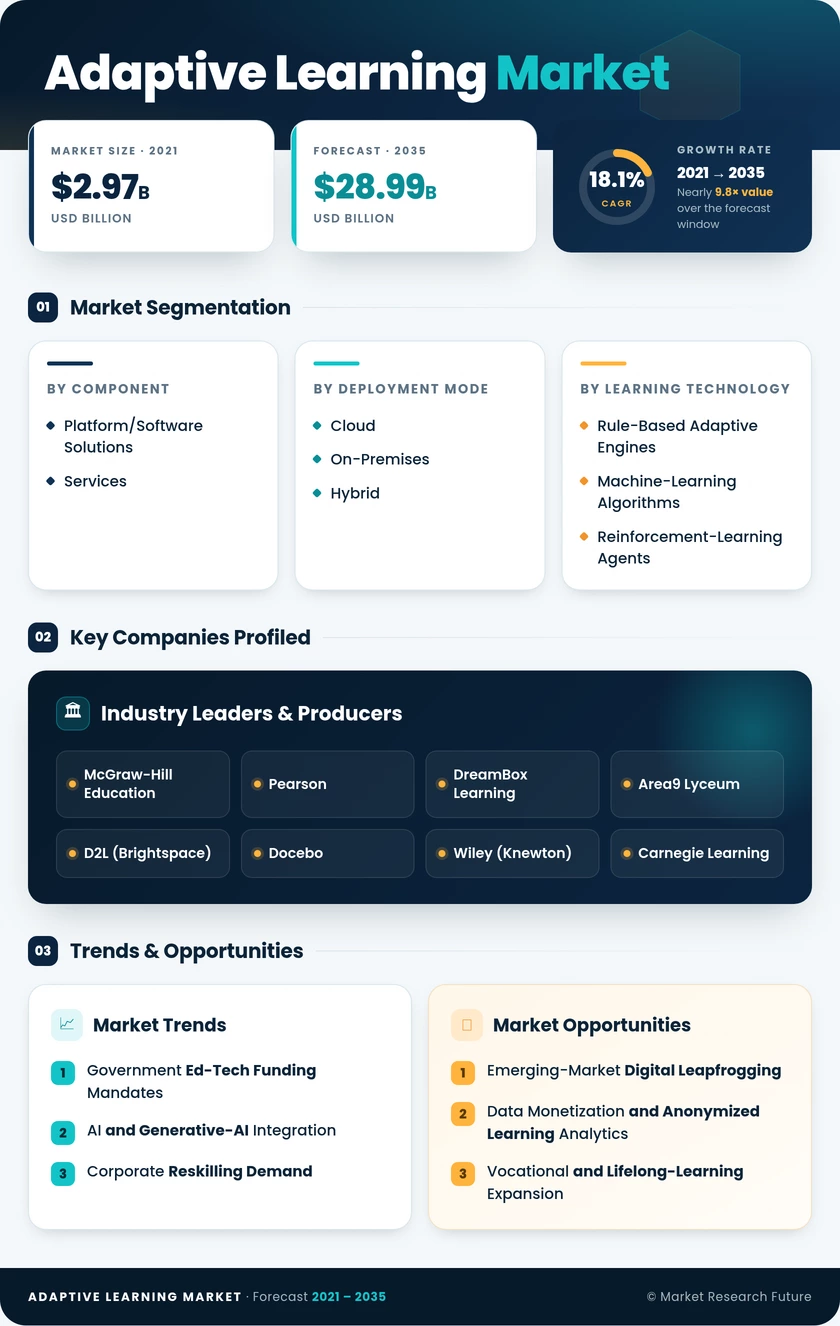
Adaptive Learning Platform Market Size, Share and Research Report By Component (Platform/Software Solutions, Services), By Deployment Mode (Cloud, On-Premises, Hybrid), By Learning Technology (Rule-Based Adaptive Engines, Machine-Learning Algorithms, Reinforcement-Learning Agents), By End User (K-12 Schools, Higher Education Institutions, Corporate/Enterprise, Government, Others) and By Regional (North America, Europe, South America, Asia Pacific, Middle East and Africa) - Industry Forecast to 2035.
Adaptive Learning Market
Market Size
Forecast Period2026-2035
CAGR (2026-2035)18.1%
2025 Market SizeUSD 5.49 Billion
2035 Market SizeUSD 29.0 Billion
Key Players
McGraw-Hill Education
Pearson
DreamBox Learning
Area9 Lyceum
D2L
Docebo
Opportunities
  • Emerging-Market Digital Leapfrogging
  • Data Monetization and Anonymized Learning Analytics
  • Vocational and Lifelong-Learning Expansion
  1. 1 Market Overview |
    1. 1.1 Study Assumptions & Market Definition |
    2. 1.2 Scope of the Study |
    3. 1.3 Research Methodology
  2. 2 Market Summary & Key Takeaways
  3. 3 Market Dynamics |
    1. 3.1 Market Drivers Analysis | |
      1. 3.1.1 Government Ed-Tech Funding Mandates | |
      2. 3.1.2 AI and Generative-AI Integration | |
      3. 3.1.3 Corporate Reskilling Demand | |
      4. 3.1.4 Cloud Infrastructure Expansion | |
      5. 3.1.5 Learning-Outcome Accountability Regulation | |
      6. 3.1.6 Mobile and Offline-Capable Learning | |
      7. 3.1.7 Data-Driven Content Personalization |
    2. 3.2 Market Restraints Analysis | |
      1. 3.2.1 Data-Privacy and Student-Data Regulations | |
      2. 3.2.2 Legacy LMS Integration Complexity | |
      3. 3.2.3 Digital-Infrastructure Gaps in Rural Areas | |
      4. 3.2.4 Teacher/Trainer Adoption Resistance | |
      5. 3.2.5 High Total Cost of Ownership for SMEs |
    3. 3.3 Market Opportunity Analysis | |
      1. 3.3.1 Emerging-Market Digital Leapfrogging | |
      2. 3.3.2 Data Monetization and Anonymized Learning Analytics | |
      3. 3.3.3 Vocational and Lifelong-Learning Expansion | |
      4. 3.3.4 Generative-AI Tutoring at Scale | |
      5. 3.3.5 Government Compliance and Accessibility Mandates |
    4. 3.4 Industry Value Chain Analysis |
    5. 3.5 Porter's Five Forces Analysis
  4. 4 Global Adaptive Learning Market Size & Forecast (2021โ€“2035) |
    1. 4.1 Historical Market Size (2021โ€“2025) |
    2. 4.2 Current & Forecast Market Size (2026โ€“2035) |
    3. 4.3 Market Size by Revenue (USD Billion) |
    4. 4.4 Year-over-Year Growth Analysis
  5. 5 Segmentation Analysis |
    1. 5.1 By Component | |
      1. 5.1.1 Platform/Software Solutions | |
      2. 5.1.2 Services |
    2. 5.2 By Deployment Mode | |
      1. 5.2.1 Cloud | |
      2. 5.2.2 On-Premises | |
      3. 5.2.3 Hybrid |
    3. 5.3 By Learning Technology | |
      1. 5.3.1 Rule-Based Adaptive Engines | |
      2. 5.3.2 Machine-Learning Algorithms | |
      3. 5.3.3 Reinforcement-Learning Agents |
    4. 5.4 By End User | |
      1. 5.4.1 K-12 Schools | |
      2. 5.4.2 Higher Education Institutions | |
      3. 5.4.3 Corporate/Enterprise | |
      4. 5.4.4 Government | |
      5. 5.4.5 Others
  6. 6 Regional Analysis |
    1. 6.1 North America | |
      1. 6.1.1 United States | |
      2. 6.1.2 Canada | |
      3. 6.1.3 Mexico |
    2. 6.2 Europe | |
      1. 6.2.1 Germany | |
      2. 6.2.2 United Kingdom | |
      3. 6.2.3 France | |
      4. 6.2.4 Italy | |
      5. 6.2.5 Spain | |
      6. 6.2.6 Nordic Countries | |
      7. 6.2.7 Russia | |
      8. 6.2.8 Rest of Europe |
    3. 6.3 Asia-Pacific | |
      1. 6.3.1 China | |
      2. 6.3.2 India | |
      3. 6.3.3 Japan | |
      4. 6.3.4 South Korea | |
      5. 6.3.5 ASEAN | |
      6. 6.3.6 Rest of Asia-Pacific |
    4. 6.4 South America | |
      1. 6.4.1 Brazil | |
      2. 6.4.2 Argentina | |
      3. 6.4.3 Rest of South America |
    5. 6.5 Middle East & Africa | |
      1. 6.5.1 Saudi Arabia | |
      2. 6.5.2 UAE | |
      3. 6.5.3 South Africa | |
      4. 6.5.4 Egypt | |
      5. 6.5.5 Rest of MEA
  7. 7 Competitive Landscape |
    1. 7.1 Market Share Analysis (2025) |
    2. 7.2 Competitive Benchmarking Matrix |
    3. 7.3 Company Profiles | |
      1. 7.3.1 McGraw-Hill Education | |
      2. 7.3.2 Pearson | |
      3. 7.3.3 DreamBox Learning | |
      4. 7.3.4 Area9 Lyceum | |
      5. 7.3.5 D2L (Brightspace) | |
      6. 7.3.6 Docebo | |
      7. 7.3.7 Wiley (Knewton) | |
      8. 7.3.8 Carnegie Learning | |
      9. 7.3.9 Realizeit | |
      10. 7.3.10 CogBooks
  8. 8 Future Outlook & Strategic Recommendations (2026โ€“2035) |
    1. 8.1 Generative-AI Native Platforms |
    2. 8.2 Platform Economics and Consolidation |
    3. 8.3 Competency-Based Credentialing |
    4. 8.4 Equity-Driven Policy Mandates
  9. 9 Recent Developments & News
  10. 10 Frequently Asked Questions (FAQs)
  11. 11 Report Scope & Methodology |
    1. 11.1 Study Period & Base Year |
    2. 11.2 Data Sources & Citations |
    3. 11.3 Abbreviations
  12. 1 LIST OF TABLES |
  13. TABLE 1 Global Adaptive Learning Market Size & Forecast, by Revenue (USD Billion), 2021โ€“2035 |
  14. TABLE 2 Global Adaptive Learning Market โ€“ Year-over-Year Growth Analysis, 2021โ€“2035 |
  15. TABLE 3 Driver Impact Analysis โ€“ Adaptive Learning Market, 2026โ€“2035 |
  16. TABLE 4 Restraint Impact Analysis โ€“ Adaptive Learning Market, 2026โ€“2035 |
  17. TABLE 5 Regional Market Summary โ€“ Adaptive Learning Market (2025) |
  18. TABLE 6 North America Adaptive Learning Market Size, by Country, 2021โ€“2035 |
  19. TABLE 7 Europe Adaptive Learning Market Size, by Country, 2021โ€“2035 |
  20. TABLE 8 Asia-Pacific Adaptive Learning Market Size, by Country, 2021โ€“2035 |
  21. TABLE 9 South America Adaptive Learning Market Size, by Country, 2021โ€“2035 |
  22. TABLE 10 Middle East & Africa Adaptive Learning Market Size, by Country, 2021โ€“2035 |
  23. TABLE 11 Global Adaptive Learning Market Size, by Component, 2021โ€“2035 |
  24. TABLE 12 Global Adaptive Learning Market Size, by Deployment Mode, 2021โ€“2035 |
  25. TABLE 13 Global Adaptive Learning Market Size, by Learning Technology, 2021โ€“2035 |
  26. TABLE 14 Global Adaptive Learning Market Size, by End User, 2021โ€“2035 |
  27. TABLE 15 Competitive Benchmarking Matrix โ€“ Adaptive Learning Market, 2025 |
  28. TABLE 16 Company Profiles โ€“ Key Players, Adaptive Learning Market |
  29. TABLE 17 Recent Developments & Strategic Announcements, 2023โ€“2025 |
  30. TABLE 18 Report Scope & Methodology Summary |
  31. TABLE 19 Detailed Sources and Citations |
  32. TABLE 20 North America Adaptive Learning Market Size, by Component, 2021โ€“2035 (USD Billion) |
  33. TABLE 21 North America Adaptive Learning Market Size, by Deployment Mode, 2021โ€“2035 (USD Billion) |
  34. TABLE 22 North America Adaptive Learning Market Size, by Learning Technology, 2021โ€“2035 (USD Billion) |
  35. TABLE 23 North America Adaptive Learning Market Size, by End User, 2021โ€“2035 (USD Billion) |
  36. TABLE 24 Europe Adaptive Learning Market Size, by Component, 2021โ€“2035 (USD Billion) |
  37. TABLE 25 Europe Adaptive Learning Market Size, by Deployment Mode, 2021โ€“2035 (USD Billion) |
  38. TABLE 26 Europe Adaptive Learning Market Size, by Learning Technology, 2021โ€“2035 (USD Billion) |
  39. TABLE 27 Europe Adaptive Learning Market Size, by End User, 2021โ€“2035 (USD Billion) |
  40. TABLE 28 Asia-Pacific Adaptive Learning Market Size, by Component, 2021โ€“2035 (USD Billion) |
  41. TABLE 29 Asia-Pacific Adaptive Learning Market Size, by Deployment Mode, 2021โ€“2035 (USD Billion) |
  42. TABLE 30 Asia-Pacific Adaptive Learning Market Size, by Learning Technology, 2021โ€“2035 (USD Billion) |
  43. TABLE 31 Asia-Pacific Adaptive Learning Market Size, by End User, 2021โ€“2035 (USD Billion) |
  44. TABLE 32 South America Adaptive Learning Market Size, by Component, 2021โ€“2035 (USD Billion) |
  45. TABLE 33 South America Adaptive Learning Market Size, by Deployment Mode, 2021โ€“2035 (USD Billion) |
  46. TABLE 34 South America Adaptive Learning Market Size, by Learning Technology, 2021โ€“2035 (USD Billion) |
  47. TABLE 35 South America Adaptive Learning Market Size, by End User, 2021โ€“2035 (USD Billion) |
  48. TABLE 36 Middle East & Africa Adaptive Learning Market Size, by Component, 2021โ€“2035 (USD Billion) |
  49. TABLE 37 Middle East & Africa Adaptive Learning Market Size, by Deployment Mode, 2021โ€“2035 (USD Billion) |
  50. TABLE 38 Middle East & Africa Adaptive Learning Market Size, by Learning Technology, 2021โ€“2035 (USD Billion) |
  51. TABLE 39 Middle East & Africa Adaptive Learning Market Size, by End User, 2021โ€“2035 (USD Billion)
  52. 2 LIST OF FIGURES |
  53. FIGURE 1 Adaptive Learning Market Dynamics Overview (Drivers, Restraints, Opportunities) |
  54. FIGURE 2 Industry Value Chain Analysis โ€“ Adaptive Learning Market |
  55. FIGURE 3 Porter's Five Forces Analysis โ€“ Adaptive Learning Market |
  56. FIGURE 4 Global Adaptive Learning Market Size Trend (USD Billion), 2021โ€“2035 |
  57. FIGURE 5 Adaptive Learning Market Share, by Component (2025) |
  58. FIGURE 6 Adaptive Learning Market Share, by Deployment Mode (2025) |
  59. FIGURE 7 Adaptive Learning Market Share, by Learning Technology (2025) |
  60. FIGURE 8 Adaptive Learning Market Share, by End User (2025) |
  61. FIGURE 9 Adaptive Learning Market Revenue Share, by Region (2025) |
  62. FIGURE 10 North America Adaptive Learning Market Size Trend, 2021โ€“2035 |
  63. FIGURE 11 Europe Adaptive Learning Market Size Trend, 2021โ€“2035 |
  64. FIGURE 12 Asia-Pacific Adaptive Learning Market Size Trend, 2021โ€“2035 |
  65. FIGURE 13 South America Adaptive Learning Market Size Trend, 2021โ€“2035 |
  66. FIGURE 14 Middle East & Africa Adaptive Learning Market Size Trend, 2021โ€“2035 |
  67. FIGURE 15 Competitive Landscape โ€“ Market Share Distribution (2025)

Segmentation Quick Reference

DimensionSub-SegmentsDominant SegmentFastest Growing Segment
ComponentPlatform/Software Solutions; ServicesPlatform/Software SolutionsServices
Deployment ModeCloud; On-Premises; HybridCloudHybrid
Learning TechnologyRule-Based Adaptive Engines; Machine-Learning Algorithms; Reinforcement-Learning AgentsMachine-Learning AlgorithmsReinforcement-Learning Agents
End UserK-12 Schools; Higher Education Institutions; Corporate/Enterprise; Government; OthersK-12 SchoolsCorporate/Enterprise
GeographyNorth America; Europe; Asia-Pacific; South America; Middle East & AfricaNorth AmericaAsia-Pacific

ย 

ย 

Market Segmentation Overview

By Component

Sub-SegmentKey Trend
Platform/Software SolutionsBundled curriculum-plus-analytics suites drive vendor lock-in and recurring SaaS revenue
ServicesIntegration consulting and educator professional development are the primary revenue accelerants

ย 

Platform and software solutions remain the revenue backbone as institutions prefer end-to-end adaptive ecosystems that reduce multi-vendor complexity. Services are scaling rapidly because successful adaptive deployments depend heavily on change management and instructor readiness.

By Deployment Mode

Sub-SegmentKey Trend
CloudReal-time data processing and subscription pricing sustain dominant share
On-PremisesPreferred by government and defense agencies with strict data-residency mandates
HybridGrowing demand from regulated industries seeking compliance flexibility with cloud-scale analytics

ย 

Cloud deployment continues to attract the majority of new contracts, while hybrid architectures gain ground among organizations balancing data-sovereignty concerns with the analytical power of cloud-native adaptive engines.

By Learning Technology

Sub-SegmentKey Trend
Rule-Based Adaptive EnginesMature technology with predictable behavior, favored by risk-averse institutions
Machine-Learning AlgorithmsPredictive modeling of learner knowledge states enables proactive content sequencing
Reinforcement-Learning AgentsMulti-step optimization of learning trajectories represents the next frontier in adaptivity

ย 

Machine-learning algorithms anchor most commercial platforms today, but reinforcement-learning agents are attracting significant R&D investment as vendors seek to differentiate through superior real-time path optimization.

By End User

Sub-SegmentKey Trend
K-12 SchoolsGovernment-mandated digital curricula create stable, large-volume procurement cycles
Higher Education InstitutionsRetention and completion-rate pressure pushes universities toward adaptive courseware
Corporate/EnterpriseMeasurable reskilling ROI justifies premium adaptive-platform pricing
GovernmentCivil-service training modernization programs expanding globally
OthersNGOs and self-directed learners drive niche demand for open adaptive platforms

ย 

K-12 remains the volume leader due to public-procurement scale, while corporate and enterprise users pay the highest per-seat prices and grow fastest as workforce-development urgency intensifies across industries.

By Geography

Sub-SegmentKey Trend
North AmericaFederal ed-tech funding and mature SaaS ecosystem sustain market leadership
EuropeGDPR-compliant adaptive platforms gain preferential procurement status
Asia-PacificNational digitization mandates in China, India, and South Korea drive rapid expansion
South AmericaBroadband-connectivity programs unlock urban-school adaptive deployments
Middle East & AfricaVision 2030 and smart-learning initiatives anchor Gulf-state investments

ย 

North America leads on absolute revenue, but Asia-Pacific is closing the gap as government-led digital-education programs create large-scale procurement pipelines across the region.


Download PDF ×

We do not share your information with anyone. However, we may send you emails based on your report interest from time to time. You may contact us at any time to opt-out.