Advanced Therapy Medicinal Products Cdmo Market (2026 - 2035)

Advanced Therapy Medicinal Products CDMO Market Research Report By Product Type (Gene Therapy, Cell Therapy, Tissue Engineering), By Indication (Cancer, Immune Disorders, Cardiovascular Diseases, Neurological Disorders), By Scale of Production (Clinical Trial, Commercial Production), By Service Type (Process Development, Manufacturing, Regulatory Support) and By Regional (North America, Europe, South America, Asia Pacific, Middle East and Africa) - Growth & Industry Forecast 2025 To 2035

Forecast Period
2026-2035
CAGR
22.6%
2025 Market Size
USD 6.98 Billion
2035 Market Size
USD 54.03 Billion
Healthcare ● Updated August 25, 2026 Report ID: MRFR/HC/29380-HCR | Pages: 128 | Author: Rahul Gotadki, Satyendra Maurya

Advanced Therapy Medicinal Products Cdmo Market Summary

The Advanced Therapy Medicinal Products CDMO Market reached USD 6.98 Billion in 2025 and opens the forecast window at USD 8.62 Billion in 2026, climbing to USD 54.03 Billion by 2035 at a 22.6% CAGR. Two catalysts anchor that trajectory. First, regulators keep clearing product after product — the U.S. FDA's Office of Therapeutic Products has publicly guided toward 10–20 approvals annually by the late 2020s [1]. Second, sponsors have stopped treating outsourcing as a fallback and started signing multi-year reservation agreements before Phase I readouts [4].

Manufacturing itself is being rebuilt. Open, operator-dependent cleanroom processes — the legacy of academic translational labs — are giving way to closed, automated processing islands and single-use fluid paths that cut contamination excursions sharply. Capital is following: Alliance for Regenerative Medicine tracked USD 15.2 Billion in sector financing during 2024, a large slice of which underwrote third-party capacity [2]. The Advanced Therapy Medicinal Products CDMO Market benefits directly, because sponsors rarely fund those suites themselves.

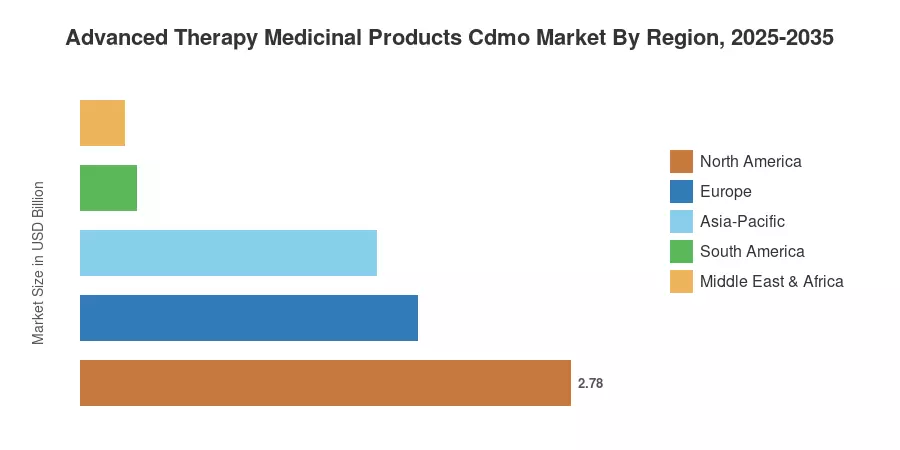
Geographically, North America holds 39.8% of 2025 revenue, built on FDA proximity and a dense Boston–Philadelphia–Research Triangle corridor. Asia-Pacific compounds fastest at 24.0% through 2035 [12]. Europe sits second, propelled by EMA's PRIME scheme and Ireland's advanced-biologics investment cluster. Expect the Advanced Therapy Medicinal Products CDMO Market to consolidate around a dozen platform-scale providers by 2030.


Key Report Takeaways

• By Therapy Type

  • Cell therapy commanded 56.0% of 2025 revenue in the Advanced Therapy Medicinal Products CDMO Market, reflecting the CAR-T commercial base
  • Gene therapy is the pace-setter at a 24.6% CAGR through 2035

• By Service Type

  • cGMP manufacturing generated USD 2.97 Billion in 2025, the single largest service pool
  • Regulatory and quality-assurance support advances at 25.0% CAGR, the fastest service line in the Advanced Therapy Medicinal Products CDMO Market
  • Analytical and testing services hold 17.3% share, pressured upward by potency-assay demands

• By Region

  • North America contributed USD 2.78 Billion in 2025
  • Asia-Pacific records a 24.0% CAGR, the fastest regional expansion
  • Europe accounts for 27.4% of global revenue


Market Size and Forecast (2021–2035)

Figures below blend bottom-up capacity modelling — suite counts, batch throughput, and published day-rate benchmarks across 60+ facilities — with top-down triangulation against sponsor R&D disclosures and regulatory filing volumes. Historical years are reconciled to audited segment revenue where CDMOs report separately. The Advanced Therapy Medicinal Products CDMO Market series is presented in constant 2025 U.S. dollars.
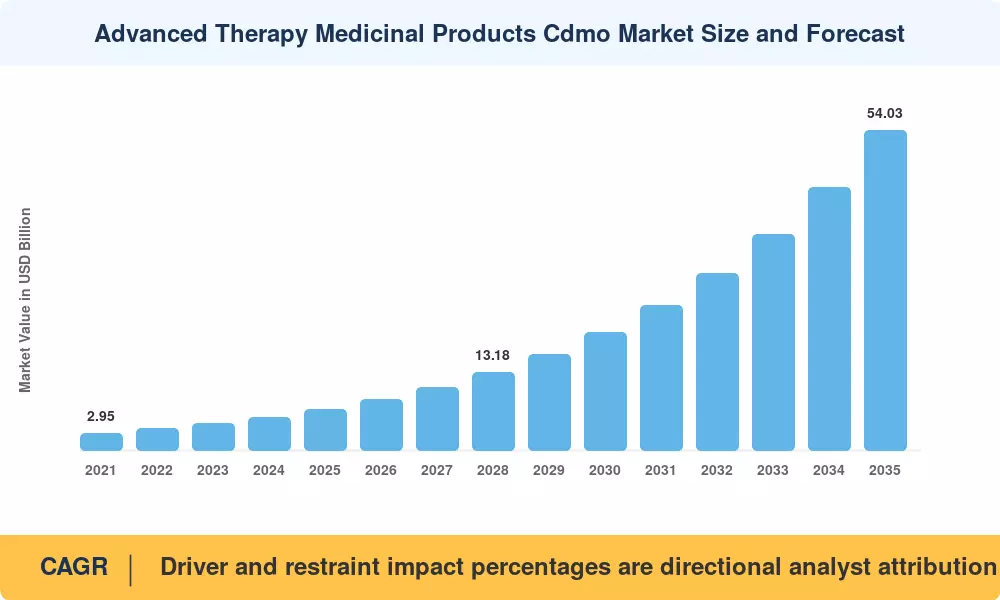
Advanced Therapy Medicinal Products Cdmo Market Size and Forecast
Our Impact
Enabled $4.3B Revenue Impact for Fortune 500 and Leading Multinationals
Partnering with 2000+ Global Organizations Each Year
30K+ Citations by Top-Tier Firms in the Industry

Driver Impact Analysis

Driver ~% Impact on CAGR Geographic Relevance Impact Timeline
Accelerating FDA and EMA ATMP approvals 4.8 Global Medium-term (2–4 yr)
Sponsor migration to outsourced capacity 4.1 North America, Europe Short-term (≤2 yr)
Vector suite capacity expansion 3.6 Global Medium-term (2–4 yr)
Closed, automated processing platforms 3.0 NA, Europe, APAC Medium-term (2–4 yr)
Expanding CAR-T and solid-tumour pipeline 2.7 Global Short-term (≤2 yr)
Asia-Pacific regulatory harmonisation 2.2 Asia-Pacific Long-term (≥4 yr)
Digital twins and real-time release testing 1.8 NA, Europe Long-term (≥4 yr)


Regulatory Throughput Is the Demand Engine

Pipelines become recurring batch revenue with approvals. In 2024 alone, the FDA approved several gene-modified cell products, and its Center for Biologics Evaluation and Research allocated almost USD 480 million for the review of therapeutic items that year [1]. A manufacturing partner is usually locked into a supply obligation for seven to ten years with each commercial clearance. In comparison to small-molecule contract manufacturing, the Advanced Therapy Medicinal Products CDMO Market has remarkably low customer churn because of this contractual stickiness.


Sponsors Have Given Up on Building In-House

It takes 36–48 months and USD 200–350 million to build a certified multi-product ATMP facility. That is too much for emerging biotechs, who filed about 62% of the industry's active INDs [2]. As a result, outsourcing penetration has surpassed 68% of clinical-stage volume [4].


Vector Supply Stopped Being the Bottleneck

Between 2021 and 2025, global suspension-based vector capacity roughly tripled [7]. Viral vector ATMP production now runs at 200–2,000 L scale with yields improved 3–5x, pulling per-dose cost down and unlocking indications with larger patient populations.

Automation Rewrites the Cost Curve

Closed processing platforms cut cleanroom footprint per batch by around 40% and reduce operator interventions by more than half [9]. BioPhorum member surveys attribute a 22% reduction in deviation rates to these systems [16].


Restraints Impact Analysis

Restraint ~% Impact on CAGR Geographic Relevance Impact Timeline
Cost-of-goods and payer pricing pressure -3.4 Global Medium-term (2–4 yr)
Scarcity of qualified process specialists -2.6 NA, Europe Short-term (≤2 yr)
Capacity overbuild and low suite utilisation -2.1 North America Medium-term (2–4 yr)
Analytical comparability complexity -1.7 Global Long-term (≥4 yr)
Reimbursement and HTA uncertainty -1.3 Europe, APAC Long-term (≥4 yr)


Cost of Goods Still Breaks Business Cases

The cost of producing autologous batches ranges from USD 90,000 to USD 180,000, and payers are strongly opposing list prices over USD 2 million [6]. In response, sponsors squeeze day rates. Margins for all Advanced Therapy Pharmaceuticals: Since 2022, the CDMO market has shrunk by 300–500 basis points, and a number of mid-tier companies have completely stopped doing clinical-only contracts.


Talent Is the Binding Constraint

The global pool is in the low tens of thousands, and a qualified upstream lead for viral-vector work requires five to seven years of GMP experience. In 2024, the average length of vacancies at all sites investigated was 4.8 months [16]. A 9% yearly wage inflation rate immediately follows.


Utilisation Gaps Punish Overbuilders

Aggressive 2021–2022 expansion left parts of the U.S. market running at 45–60% suite utilisation [4]. Fixed-cost absorption suffers, and discounting spreads.


Advanced Therapy Medicinal Products Cdmo Market Opportunities

Allogeneic Platforms Change the Unit Economics

Off-the-shelf donor-derived products convert one-batch-one-patient economics into batch-to-hundreds. Providers who qualify allogeneic platforms early will capture a disproportionate share of the Advanced Therapy Medicinal Products CDMO Market as those assets reach the pivotal stage.

Non-Viral Delivery Opens a Second Front

Transposon, electroporation, and lipid-nanoparticle approaches sidestep vector cost entirely. Roughly 18% of new gene-modified INDs in 2025 used non-viral delivery [3]. Vendors with plasmid and mRNA capability adjacent to their fill-finish lines convert this fastest.

Emerging-Market Capacity Arbitrage

India, South Korea, and China now host GMP suites at 40–55% of Western day rates [12]. India's National Biopharma Mission and Korea's K-Bio Vaccine Fund have jointly committed over USD 1.6 Billion to biologics infrastructure [14]. Sponsors targeting Asian patient populations increasingly manufacture locally.

Data and Platform Licensing as Revenue

Leading operators monetise process know-how directly — licensing validated analytical packages and platform master files rather than selling suite hours alone. Recurring, high-margin revenue of this kind is reshaping how the Advanced Therapy Medicinal Products CDMO Market is valued.

Decentralised and Point-of-Care Manufacturing

Hospital-adjacent automated units compress vein-to-vein time to under 10 days. Providers offering distributed quality oversight will own a service category that barely existed in 2022 [17].


Advanced Therapy Medicinal Products Cdmo Market Future Outlook

Machine Learning Moves From Analytics to Control

Model-predictive control over bioreactor critical parameters is entering GMP use. Early adopters report engineering-run reductions near 50% [15]. Across the Advanced Therapy Medicinal Products CDMO Market, AI-assisted deviation triage will become table stakes in supplier audits by 2029.

Platform Economics Reward Standardisation

Providers converging on a small number of validated process templates spread validation cost across many programmes. Expect gross margins to diverge by 800–1,200 basis points between platform operators and bespoke shops.

Regulatory Convergence Lowers Cross-Border Friction

ICH Q5A(R2) and emerging ATMP-specific harmonisation reduce duplicate comparability work [10]. Multi-region filings from one facility become the default, favouring large-footprint operators.

Sustainability Enters Sourcing Decisions

Single-use plastics dominate ATMP waste streams. Large sponsors now score suppliers on Scope 3 disclosure, and the Advanced Therapy Medicinal Products CDMO Market will see resin-recycling and energy-intensity metrics written into master service agreements by the early 2030s [19].


Advanced Therapy Medicinal Products Cdmo Market Segmentation

Segmentation in the Advanced Therapy Medicinal Products CDMO Market follows therapeutic modality, service scope, development stage, delivery vector, and cell origin.

By Therapy Type

Segment Metric Primary Demand Driver
Cell Therapy 56.0% share CAR-T commercial supply obligations
Gene Therapy 24.6% CAGR Rare-disease approvals
Tissue-Engineered Products USD 0.73 Billion Orthopaedic and dermal repair


Cell therapy dominates the Advanced Therapy Medicinal Products CDMO Market because approved autologous products require continuous, patient-specific batch execution rather than campaign runs. Gene therapy grows faster: each new AAV or lentiviral approval adds long-tail vector demand, and the durability of one-time treatments justifies premium day rates.

By Service Type

Segment Metric Primary Demand Driver
cGMP Manufacturing 42.6% share Commercial and pivotal batch supply
Process Development USD 1.73 Billion Scale-up and cost-of-goods work
Analytical & Testing 17.3% share Potency and identity assay burden
Fill-Finish 8.6% share Cryopreserved final containers
Regulatory & QA Support 25.0% CAGR Multi-region filing complexity


By Development Phase

Segment Metric Primary Demand Driver
Phase III 40.8% share Pivotal batch volume and validation
Phase I/II USD 2.19 Billion Broad early pipeline
Commercial 18.6% share Approved product supply
Pre-Clinical 25.2% CAGR IND-enabling surge


Phase III consumes the largest share because process validation demands consecutive conformance lots at commercial scale. Pre-clinical work grows fastest, reflecting the widening funnel of new INDs entering the Advanced Therapy Medicinal Products CDMO Market each year.

By Vector Type

Segment Metric Primary Demand Driver
AAV 34.2% share In-vivo rare-disease programmes
Lentiviral 24.8% CAGR Ex-vivo cell engineering
Adenoviral 14.6% share Oncolytic and vaccine work
Retroviral USD 0.79 Billion Legacy CAR-T processes
Non-Viral / Other 11.2% share Transposon and LNP delivery


The AAV segment dominated the market, accounting for 34.2% of the total market share, driven by its widespread adoption in gene therapy development and delivery applications. Meanwhile, Lentiviral is projected to be the fastest-growing segment, expanding at a 24.8% CAGR, supported by increasing applications in gene and cell therapy. Adenoviral accounted for 14.6% of the market share, while the Retroviral segment was valued at USD 0.79 billion. The Non-Viral / Other segment represented 11.2% of the market share.

By Cell Source

Segment Metric Primary Demand Driver
Autologous 51.9% share Approved patient-specific products
Allogeneic 25.5% CAGR Scalable donor-derived platforms


The Autologous segment dominated the market, accounting for 51.9% of the total market share, driven by the growing adoption of personalized cell and gene therapies using patients’ own cells. Meanwhile, the Allogeneic segment is projected to be the fastest-growing, expanding at a 25.5% CAGR, supported by the scalability, off-the-shelf potential, and increasing development of donor-derived therapies.

Regional Market Share Analysis

Region Metric (2025) Primary Investment Themes
North America 39.8% share Commercial-scale suites, vector capacity
Europe USD 1.91 Billion PRIME-aligned tech transfer, ATMP hubs
Asia-Pacific 24.0% CAGR (2026–2035) Cost-advantaged capacity, local filings
South America USD 0.32 Billion Clinical-stage services, oncology trials
Middle East & Africa 3.6% share Sovereign biotech funds, hospital nodes
Total USD 6.98 Billion

Regional demand in the Advanced Therapy Medicinal Products CDMO Market tracks regulatory density, clinical-trial concentration, and reimbursement willingness far more tightly than population.


North America

Country Metric Key Driver
US 88.4% of region FDA proximity, dense biotech cluster
Canada USD 0.21 Billion Genome Canada translational funding
Mexico 21.9% CAGR Nearshoring of clinical supply


The United States anchors the Advanced Therapy Medicinal Products CDMO Market through sheer pipeline density — over 1,100 active cell and gene INDs [1]. Regional Innovation Engines grants and state-level bioscience incentives in North Carolina and Maryland have subsidised suite construction. Canada's Adaptive Phase I network feeds early-stage volume southward.

Europe

Country Metric Key Driver
Germany 24.6% of region Paul-Ehrlich-Institut expertise
UK USD 0.39 Billion Cell and Gene Therapy Catapult network
France 13.8% of region France 2030 health innovation plan
Italy 9.1% of region Academic ATMP hospital exemptions
Spain 7.4% of region CAR-T academic programmes
Nordic Countries 21.5% CAGR Precision-medicine registries
Russia 2.6% of region Domestic biologics substitution
Rest of Europe USD 0.18 Billion Ireland and Switzerland fill-finish


EMA's PRIME designation has shortened review clocks for qualifying ATMPs, and the EU Hospital Exemption pathway keeps academic manufacturing alive as a feeder for commercial transfer [13]. Ireland's IDA has co-funded biologics projects exceeding EUR 800 Million since 2022.

Asia-Pacific

Country Metric Key Driver
China 33.8% of region NMPA breakthrough pathway volume
India 26.4% CAGR CDSCO ATMP guidelines, cost base
Japan 21.7% of region Sakigake conditional approval
South Korea USD 0.19 Billion K-Bio fund, Songdo cluster
ASEAN 6.3% of region Singapore contract capacity
Rest of Asia-Pacific 20.8% CAGR Australian trial incentives


Asia-Pacific is the structural growth story in the Advanced Therapy Medicinal Products CDMO Market. Japan's conditional-approval framework compresses time to first revenue, while India's indigenous CAR-T approval in 2023 proved a domestic product could reach patients at roughly one-tenth of Western pricing [14].

South America

Country Metric Key Driver
Brazil 68.2% of region ANVISA ATMP framework
Argentina USD 0.06 Billion Academic oncology trials
Rest of South America 19.4% CAGR Chilean and Colombian trial sites


Brazil's ANVISA established a dedicated advanced-therapy registration route in 2018 and has since cleared domestic academic products, giving regional operators a credible regulatory anchor [13].

Middle East & Africa

Country Metric Key Driver
Saudi Arabia 31.6% of region Vision 2030 biotech localisation
UAE USD 0.07 Billion Abu Dhabi genomics investment
South Africa 14.2% of region HIV and sickle-cell research base
Egypt 9.8% of region Regional clinical trial hub
Rest of MEA 22.1% CAGR Israeli translational spinouts


Saudi Arabia's National Biotechnology Strategy targets USD 34 billion in sector GDP contribution by 2040 and has funded localised biologics capacity [18]. Israel remains the region's densest source of licensable early-stage assets.


Advanced Therapy Medicinal Products Cdmo Market By Region, 2025-2035

Competitive Benchmarking

Concentration in the Advanced Therapy Medicinal Products CDMO Market is moderate. Estimated HHI sits near 780, with the top five providers holding roughly 41–46% of revenue. Below that tier, the field fragments into specialists — vector-only shops, plasmid houses, and regional clinical-supply operators — which is why acquisition activity remains brisk.

Company Est. Revenue Share Range Key Offerings for Advanced Therapy Medicinal Products CDMO Market Strategic Positioning
Lonza ~11–14% Autologous and allogeneic cGMP, vector, process development Scale leader, global multi-site network
Thermo Fisher Scientific ~8–11% Viral vector, plasmid, fill-finish, analytics Integrated supply-chain breadth
Catalent (Novo Holdings) ~6–9% Cell and vector manufacturing, cryogenic logistics Broad clinical-to-commercial coverage
WuXi Advanced Therapies ~6–9% Vector, testing, commercial-scale suites Cost-advantaged dual-continent model
Charles River Laboratories ~4–7% Plasmid, vector, cell banking, release testing Discovery-to-GMP continuum
Samsung Biologics ~3–6% Dedicated ATMP suites, large-scale biologics Rapid capacity deployment
Fujifilm Diosynth Biotechnologies ~3–6% Vector, process development, apheresis handling Heavy capital reinvestment
Merck KGaA ~3–5% Vector, testing services, raw-material integration Upstream materials leverage
Oxford Biomedica ~2–4% Lentiviral and AAV platform manufacturing Vector-focused pure play
Andelyn Biosciences ~2–4% AAV clinical and commercial supply Academic-origin technical depth
Center for Breakthrough Medicines ~1–3% Multi-modality clinical supply, testing Single-campus co-location model
Nikon CeLL innovation ~1–3% Automated cell processing, Japan-market supply Regional regulatory specialisation


Recent News & Developments

  • Lonza (March 2024): Opened expanded commercial cell-therapy capacity in Geleen, Netherlands, adding suites dedicated to approved autologous products and shortening European supply chains [4].
  • U.S. FDA (December 2023): Approved two sickle-cell gene therapies on the same day, validating both CRISPR and lentiviral routes and triggering immediate commercial capacity bookings [1].
  • Thermo Fisher Scientific (June 2024): Commissioned a Plainville, Massachusetts viral-vector facility, targeting suspension-based AAV at commercial scale [7].
  • Novo Holdings / Catalent (December 2024): Completed the USD 16.5 Billion Catalent acquisition, reshaping ownership of major ATMP suite capacity [5].
  • EMA (September 2024): Published revised guidance on potency-assay expectations for gene-modified cells, tightening comparability requirements across transfers [13].
  • Charles River Laboratories (February 2025): Expanded its Memphis cell-therapy site with additional cleanroom capacity for clinical and commercial supply [8].
  • Samsung Biologics (April 2025): Announced a dedicated ATMP business division with suites configured for both viral vector and cell processing [11].
  • India CDSCO (August 2024): Issued updated advanced-therapy regulatory guidance, formalising a national pathway and lowering entry friction for domestic manufacturing [14].


Advanced Therapy Medicinal Products Cdmo Market Report Scope

Parameter Detail
Market Scope Global outsourced development and manufacturing services for cell, gene, and tissue-engineered medicinal products
Study Period 2021–2035 (Historical 2021–2024; Base Year 2025; Forecast 2026–2035)
CAGR 22.6% (2026–2035)
Market Size Checkpoints USD 6.98 Billion (2025); USD 8.62 Billion (2026); USD 54.03 Billion (2035)
Fastest Growing Segments Gene therapy; regulatory and QA support; pre-clinical phase; lentiviral vectors; allogeneic sources
Companies Profiled 12 major providers across global and regional tiers
Valuation Currency USD Billion, constant 2025 dollars
CAGR Driver Disclaimer Driver and restraint impact percentages are directional analyst attributions, not additive components of the headline growth rate

FAQs

How should a sponsor audit a provider's tech-transfer record before signing?
Request completed transfer counts by modality, average time from kickoff to engineering run, and deviation rates on first GMP batches. Ask for two reference sponsors at a comparable stage. Providers in the Advanced Therapy Medicinal Products CDMO Market that decline these metrics usually lack them [9].
What contract structures are typical for reserved capacity?
Suite reservation agreements combine a monthly holding fee with committed minimum batch counts, usually over three to five years. Take-or-pay clauses are standard in the Advanced Therapy Medicinal Products CDMO Market. Negotiate release windows for programme discontinuation [4].
Is dual-sourcing worth the cost in the Advanced Therapy Medicinal Products CDMO Market?
For commercial products, yes — regulators increasingly expect supply-continuity plans. Expect USD 8–15 Million and 18 months to qualify a second site. Clinical-stage programmes rarely justify it [10].
How do potency-assay requirements affect vendor selection?
Providers must own validated, product-specific potency methods, not generic surrogates. EMA's 2024 guidance tightened this considerably. Prioritise partners with in-house bioassay development rather than those outsourcing analytics to third parties [13].
What integration challenges arise when moving work into the Advanced Therapy Medicinal Products CDMO Market from an academic site?
Academic processes typically use open manipulations and non-GMP reagents. Closing the process and re-sourcing materials adds six to twelve months. Budget for full comparability studies against clinical data already generated [17].
Do non-viral platforms reduce dependence on specialist vendors?
Partially. Transposon and electroporation approaches remove vector supply risk but introduce plasmid quality and electroporation-parameter validation demands. The Advanced Therapy Medicinal Products CDMO Market is adapting, though few providers yet offer end-to-end non-viral capability [3].
What cross-border regulatory nuance most often delays supply?
Import licensing for human-derived starting material differs sharply by jurisdiction, and cryogenic chain-of-identity documentation is scrutinised at customs. Build 60–90 days of buffer into first-shipment timelines for any new receiving country [13].    
Author
Author
Author Profile
Rahul Gotadki LinkedIn
Research Manager
He holds an experience of about 9+ years in Market Research and Business Consulting, working under the spectrum of Life Sciences and Healthcare domains. Rahul conceptualizes and implements a scalable business strategy and provides strategic leadership to the clients. His expertise lies in market estimation, competitive intelligence, pipeline analysis, customer assessment, etc.
Co-Author
Co-Author Profile
Satyendra Maurya LinkedIn
Research Analyst
An accomplished research analyst with high proficiency in market forecasting, data visualization, competitive benchmarking, and others. He holds a pronounced track record in research and consulting projects for sectors such as life sciences, medical devices, and healthcare IT. His capabilities in qualitative and quantitative analysis have resulted in positive client outcomes. Working on niche market trends, opportunities, sales, and forecasted value is part of his skill set.
Share::
Request Free Sample

Research Approach


Secondary Research

The secondary research process involved comprehensive analysis of regulatory databases, peer-reviewed scientific journals, clinical trial registries, and authoritative biotechnology organizations. Key sources included the US Food & Drug Administration (FDA) Center for Biologics Evaluation and Research (CBER), European Medicines Agency (EMA) Committee for Advanced Therapies (CAT), International Society for Cell & Gene Therapy (ISCT), Alliance for Regenerative Medicine (ARM), National Institutes of Health (NIH) National Center for Advancing Translational Sciences (NCATS), National Center for Biotechnology Information (NCBI/PubMed), ClinicalTrials.gov, WHO International Clinical Trials Registry Platform, EU Clinical Trials Register, Organisation for Economic Co-operation and Development (OECD) Biotechnology Statistics, Pharmaceutical Research and Manufacturers of America (PhRMA), European Federation of Pharmaceutical Industries and Associations (EFPIA), and national regulatory authority reports from key markets including Medicines and Healthcare products Regulatory Agency (MHRA-UK), Pharmaceuticals and Medical Devices Agency (PMDA-Japan), National Medical Products Administration (NMPA-China), and Health Canada.

Clinical trial landscape analysis, GMP facility certifications, manufacturing capacity statistics, competitive intelligence on CDMO service portfolios, and regulatory approval data for CAR-T therapies, gene therapies, and stem cell treatments were all gathered from these sources.


Primary Research

In order to gather both qualitative and quantitative insights, supply-side and demand-side stakeholders were interviewed during the primary research process. CEOs, Chief Technical Officers, Heads of Cell & Gene Therapy Manufacturing, Quality Assurance Directors, and Business Development Heads from ATMP-focused CDMOs, viral vector producers, and plasmid DNA providers were among the supply-side sources. Chief Scientific Officers, VPs of Technical Operations, Head of External Manufacturing, and procurement leads from biotechnology and pharmaceutical businesses creating tissue-engineered products, gene treatments, and cell therapies were examples of demand-side sources.

Primary research verified capacity expansion schedules and facility build-outs; validated market segmentation across vector manufacturing (lentiviral, AAV, retroviral), cell therapy processing (autologous, allogeneic), and analytical testing services; and acquired information on regulatory compliance tactics, pricing models for GMP manufacturing slots, and partnership structures between innovators and CDMOs.

Primary Respondent Breakdown:

By Designation: C-level Primaries (32%), Director Level (31%), Others (37%)

By Region: North America (38%), Europe (30%), Asia-Pacific (25%), Rest of World (7%)


Market Size Estimation

Manufacturing capacity analysis and service revenue mapping were used to determine the global market valuation. The methodology comprised:

Finding more than fifty important CDMOs in emerging markets, North America, Europe, and Asia-Pacific

Service mapping for the creation of plasmid DNA, cell treatment (CAR-T, stem cells, iPSCs), fill-finish services, and viral vectors (AAV, lentiviral, retroviral).

Analysis of annual revenues for ATMP manufacturing portfolios, both reported and modeled

Coverage of CDMOs accounting for 75–80% of the world's ATMP production capacity in 2024

Extrapolation of segment-specific valuations for gene therapy CDMO, cell therapy CDMO, and viral vector manufacturing markets using top-down (CDMO revenue validation against reported client pipelines) and bottom-up (number of clinical/commercial programs × average contract value by phase) approaches

Share::
Request Free Sample
Download Free Sample

Kindly complete the form below to receive a free sample of this Report

* Please use a valid business email

Share::
Request Free Sample
Download PDF ×

We do not share your information with anyone. However, we may send you emails based on your report interest from time to time. You may contact us at any time to opt-out.
















