Aerospace Fasteners Market Summary
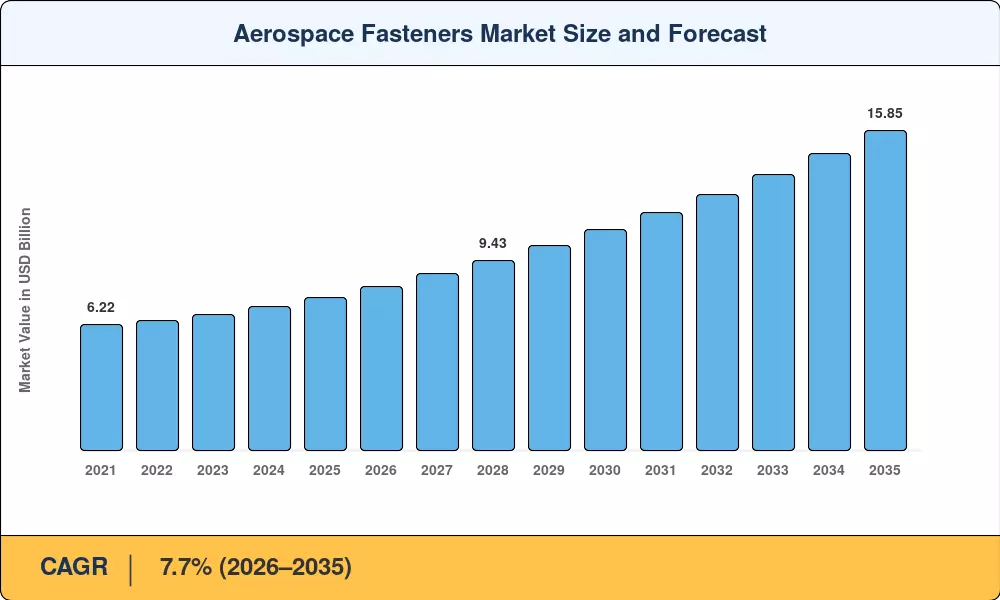
The Aerospace Fasteners Market reached USD 7.58 Billion in 2025 and is projected to grow from USD 8.13 Billion in 2026 to USD 15.85 Billion by 2035, registering a CAGR of 7.7% across the forecast window. Record single-aisle jet backlogs — exceeding 14,000 aircraft at Boeing and Airbus combined — have forced OEMs to accelerate assembly-line throughput, driving unprecedented demand for fastening hardware [1]. Concurrent defense procurement cycles, headlined by the U.S. DoD's USD 842 billion FY 2024 authorization, sustain military-grade component orders across NATO-aligned supply chains [2].
A technology shift is reshaping how airframes get built. Legacy hand-riveting stations are giving way to automated robotic fastening cells that improve placement accuracy to within 0.05 mm and cut cycle time by up to 40% on fuselage join operations [3]. Airbus's Hamburg A320 line and Boeing's Everett 777X facility both invested over USD 200 million in automated drilling-and-fastening systems between 2022 and 2024, signaling the pace of capital commitment to this transition [4]. Simultaneously, the push toward lighter airframes has elevated titanium and composite-compatible fasteners at the expense of traditional steel hardware.
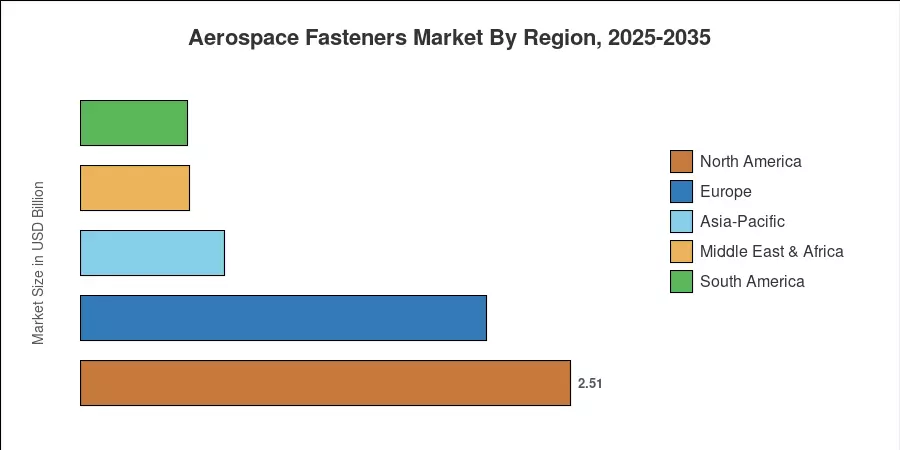
North America commands roughly 33.1% of the Aerospace Fasteners Market, anchored by U.S.-based OEM demand and a dense MRO ecosystem. Asia-Pacific is the fastest-growing region at a 9.7% CAGR through 2035, propelled by expanding production programs in China, India, and Japan. Europe holds the second-largest share at approximately 27.5%, underpinned by Airbus's continental supply chain and growing defense budgets in Germany and France. The decade ahead will see urban-air-mobility platforms and unmanned systems open entirely new fastener application categories.
Key Report Takeaways
• By Product Type
- Bolts and screws held a 32.7% share of the Aerospace Fasteners Market in 2025, reflecting their ubiquitous role in primary structural joints.
- Specialty and panel fasteners are forecast to advance at a 9.6% CAGR through 2035, driven by interior-cabin refresh cycles and eVTOL airframe designs.
• By Material
- Titanium-alloy fasteners captured approximately 35.0% of the Aerospace Fasteners Market share in 2025.
- Composite-compatible polymer fasteners represent the fastest-growing material category at a 9.6% CAGR, aligned with rising CFRP content in next-generation aircraft.
• By Application
- Commercial aviation accounted for 55.9% of the Aerospace Fasteners Market revenue in 2025.
• By End-User
- Commercial aviation accounted for 55.9% of Aerospace Fasteners Market revenue in 2025.
- The military end-user segment records the highest expected CAGR of 8.7% during 2026–2035, fueled by sixth-generation fighter and advanced trainer programs.
• By Region
- North America maintained the largest share of the Aerospace Fasteners Market at 33.1% in 2025.
- Asia-Pacific is set to grow the fastest at a 9.7% CAGR over the forecast period.
Aerospace Fasteners Market Size and Forecast (2021–2035)
Market Research Future's sizing methodology integrates bottom-up OEM production schedules, aftermarket MRO spend data, and trade-flow analysis across 25+ national markets. Historical figures draw on customs data and audited company filings, while forecast projections apply technology adoption curves and backlog-conversion rates validated through primary interviews with procurement executives at major airframers.