Agricultural Bactericides Market Size, Share, Industry Trend & Analysis Research ReportInformation By Type (Copper-Based Bactericides, Amide Bactericides, Dithiocarbamate Bactericides, And Others), By Form (Dry and Liquid), By Crop Type (Fruits & Vegetables, Cereals & Grains, Oilseeds & Pulses, And Others), And By Region (North America, Europe, Asia-Pacific, And Rest Of The World) – Forecast Till 2035
As per MRFR analysis, the Agriculture Bactericides Market Size was estimated at 10.72 USD Billion in 2024. The Agriculture Bactericides industry is projected to grow from 11.16 USD Billion in 2025 to 16.68 USD Billion by 2035, exhibiting a compound annual growth rate (CAGR) of 4.1% during the forecast period 2025 - 2035.
Key Market Trends & Highlights
The Agriculture Bactericides Market is experiencing a transformative shift towards sustainable practices and innovative solutions.
The rise of biopesticides is reshaping the Agriculture Bactericides Market, particularly in North America, which remains the largest market.
Technological advancements are driving efficiency and effectiveness in bactericide applications, especially in the fast-growing Asia-Pacific region.
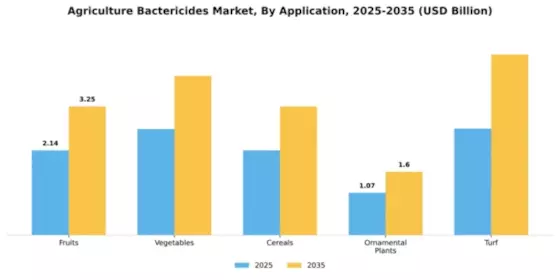
Fruits represent the largest segment in the market, while the vegetable segment is witnessing rapid growth due to increasing consumer demand.
The increasing demand for sustainable agriculture and rising incidence of crop diseases are key drivers propelling market expansion.
Market Size & Forecast
2024 Market Size
10.72 (USD Billion)
2035 Market Size
16.68 (USD Billion)
CAGR (2025 - 2035)
4.1%
Major Players
BASF SE (DE), Syngenta AG (CH), Bayer AG (DE), FMC Corporation (US), Corteva Agriscience (US), Nufarm Limited (AU), UPL Limited (IN), ADAMA Agricultural Solutions Ltd. (IL)
Our Impact
Enabled $4.3B Revenue Impact for Fortune 500 and Leading Multinationals
Partnering with 2000+ Global Organizations Each Year
30K+ Citations by Top-Tier Firms in the Industry
Agriculture Bactericides Market Trends
The Agriculture Bactericides Market is currently experiencing a notable transformation driven by various factors, including advancements in agricultural practices and increasing awareness regarding crop health. As farmers seek effective solutions to combat bacterial diseases, the demand for bactericides is on the rise. This market is characterized by a diverse range of products, including both synthetic and biological options, which cater to different agricultural needs. The growing emphasis on sustainable farming practices is also influencing the development of eco-friendly bactericides, which are perceived as safer alternatives to traditional chemicals.
In addition, the Agriculture Bactericides Market is witnessing a shift towards integrated pest management strategies. This approach not only focuses on the application of bactericides but also incorporates other methods to enhance crop resilience. As a result, manufacturers are investing in research and development to create innovative formulations that align with these holistic practices. Furthermore, regulatory frameworks are evolving, prompting companies to adapt their offerings to meet new standards. Overall, the Agriculture Bactericides Market appears poised for growth as it navigates these dynamic trends and responds to the changing needs of the agricultural sector.
Rise of Biopesticides
There is a growing trend towards the adoption of biopesticides within the Agriculture Bactericides Market. These products, derived from natural materials, are gaining traction due to their perceived safety and environmental benefits. Farmers are increasingly inclined to utilize biopesticides as part of their integrated pest management strategies, which aim to reduce reliance on synthetic chemicals.
Technological Advancements
Innovations in technology are significantly impacting the Agriculture Bactericides Market. The development of precision agriculture tools and smart farming techniques allows for more targeted application of bactericides. This not only enhances the effectiveness of treatments but also minimizes environmental impact, aligning with the industry's shift towards sustainability.
Regulatory Changes
The Agriculture Bactericides Market is influenced by evolving regulatory frameworks that govern the use of agricultural chemicals. Stricter regulations are prompting manufacturers to reformulate products to comply with safety standards. This trend may lead to the introduction of more environmentally friendly options, as companies strive to meet consumer demand for safer agricultural practices.
Agriculture Bactericides Market Drivers
Rising Demand for Sustainable Agriculture
The Global Agricultural Bactericides Market Industry is experiencing a notable shift towards sustainable agricultural practices. Farmers are increasingly adopting bactericides that are environmentally friendly and reduce chemical residues in crops. This trend is driven by consumer preferences for organic produce and regulatory pressures to minimize chemical usage. As a result, the market is projected to reach 10.7 USD Billion in 2024, reflecting a growing commitment to sustainability. The emphasis on sustainable farming practices is likely to bolster the demand for innovative bactericides that align with these principles, thereby enhancing the market's growth trajectory.
Market Segment Insights
By Application: Fruits (Largest) vs. Vegetables (Fastest-Growing)
In the Agriculture Bactericides Market, the application segment showcases a diverse array of uses, with Fruits currently holding the largest share due to the increasing demand for high-quality produce. The growing concerns regarding crop diseases and the need for sustainable agricultural practices have propelled the use of bactericides in this segment. In contrast, Vegetables are emerging as the fastest-growing segment, influenced by rising health consciousness among consumers and an uptick in organic farming practices that prioritize disease management without compromising environmental integrity.
Fruits (Dominant) vs. Vegetables (Emerging)
Fruits serve as the dominant application in the Agriculture Bactericides Market, driven by a substantial market presence and the necessity for effective disease control to ensure quality yield. This segment benefits from the high value placed on fresh fruits by consumers, thereby encouraging farmers to invest in advanced bactericidal solutions. Conversely, the Vegetable segment is rapidly emerging, characterized by its responsiveness to current market trends favoring healthy eating. The accelerating adoption of sustainable farming techniques has made bactericides integral to maintaining vegetable quality, thereby enhancing their market appeal.
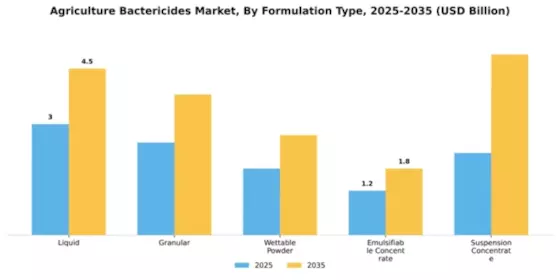
By Formulation Type: Liquid (Largest) vs. Granular (Fastest-Growing)
In the Agriculture Bactericides Market, the formulation type segment is characterized by a diverse range of products, with liquid formulations leading the share owing to their ease of application and effectiveness. Liquid bactericides are preferred for large-scale farming and industrial agriculture, dominating the market landscape. Following closely, granular formulations have gained substantial traction, especially among smallholder farmers due to their convenience and ability to release active ingredients slowly over time, ensuring prolonged protection against pathogens.
Liquid (Dominant) vs. Granular (Emerging)
Liquid bactericides are well-regarded for their high efficacy and swift action, making them the preferred choice for many agricultural applications. Their ease of use and versatility allow for adaptation across various crops and farming practices. On the other hand, granular formulations represent an emerging trend in the market. They provide a slower release of active ingredients, which is favorable for sustained crop protection. This formulation type is particularly attractive to farmers seeking convenience and long-lasting effects, positioning granular bactericides as a competitive alternative in the market.
By Mode of Action: Contact (Largest) vs. Systemic (Fastest-Growing)
In the Agriculture Bactericides Market, the mode of action segment showcases a diverse range of value distributions among its key components. The Contact action type leads the segment, primarily due to its widespread applicability and immediate impact on bacterial pathogens upon contact. Following closely are Systemic and Translaminar modes, which cater to specific crop needs by providing extended protection to plant tissues, thus enabling growth in varying agricultural conditions. Other modes, such as Residual and Preventive, highlight the important yet niche roles they play in augmenting the overall efficacy of bactericides.
Contact (Dominant) vs. Systemic (Emerging)
The Contact mode of action in the Agriculture Bactericides Market remains dominant, primarily due to its effectiveness in managing bacterial diseases in a wide range of crops. This method offers rapid action, making it a preferred choice for immediate treatment during bacterial outbreaks. In contrast, the Systemic mode is emerging as a significant player, thanks to advancements in formulation that enhance the penetration and mobility of active ingredients within the plant. This capability allows for thorough protection, and drives growth within this segment as agricultural practices increasingly focus on holistic disease management strategies.
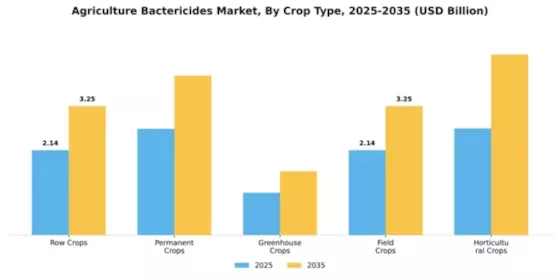
By Crop Type: Row Crops (Largest) vs. Greenhouse Crops (Fastest-Growing)
The Agriculture Bactericides Market is significantly influenced by the crop type, with Row Crops leading the market share among various segment values. Row Crops are planted in rows for easy cultivation and harvesting, and they have established a strong position in the market due to their widespread cultivation practices. Meanwhile, Greenhouse Crops represent the fastest-growing segment of this market, buoyed by technological advancements in controlled environment agriculture which enhance the productivity and profitability of these crops, making them increasingly popular among growers.
Row Crops (Dominant) vs. Greenhouse Crops (Emerging)
Row Crops are pivotal in the Agriculture Bactericides Market, serving as a key area for mitigation against various crop diseases. These crops, typically including staples like corn and soybeans, benefit from well-established pesticidal practices, ensuring their dominant status. In contrast, Greenhouse Crops have emerged as an innovative segment, leveraging advanced agricultural techniques and technologies. Their rapid expansion is driven by increasing demand for fresh produce year-round and higher price points for crops grown in controlled environments. Growers are increasingly adopting bactericides to protect their yield from pathogens, further cementing Greenhouse Crops as a vital and dynamic segment in the market.
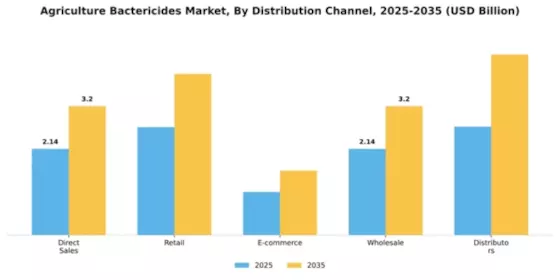
By Distribution Channel: Retail (Largest) vs. E-commerce (Fastest-Growing)
The Agriculture Bactericides Market is characterized by a diverse distribution channel landscape. Retail remains the largest channel, driven predominantly by traditional agricultural practices and local farm stores where farmers prefer purchasing directly visible and tangible products. E-commerce, on the other hand, has emerged with significant traction among tech-savvy agricultural producers and is witnessing rapid growth due to the convenience it offers and the increasing reliance on online solutions. With the rise of digital platforms, distributors are also tapping into online sales avenues to enhance their reach.
Retail (Dominant) vs. E-commerce (Emerging)
Retail stands as the dominant distribution channel for agriculture bactericides, providing farmers with direct access to essential products in their local areas, ensuring immediate availability and personal service. Meanwhile, E-commerce is emerging as a formidable competitor, with its ability to deliver products directly from manufacturers to consumers, thus reducing layers of distribution. The digital shift allows farmers to compare products easily, read reviews, and make informed decisions based on suitability and price. As online purchasing becomes more prevalent, stakeholders in agriculture are aiming to bolster their online presence, resulting in a dynamic and rapidly evolving market.
Get more detailed insights about Agriculture Bactericides MarketRequest Free Sample
Regional Insights
North America : Market Leader in Bactericides
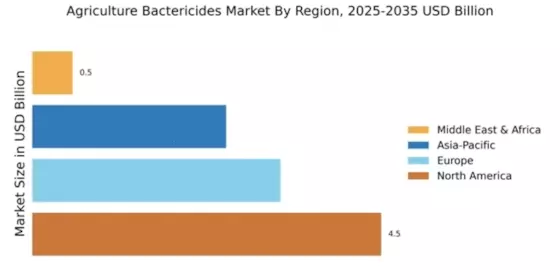
North America is poised to maintain its leadership in the Agriculture Bactericides Market, holding a significant market share of 4.5 in 2024. The region's growth is driven by increasing agricultural productivity demands, stringent regulations promoting sustainable practices, and advancements in biopesticide technologies. The rising awareness of food safety and environmental concerns further fuels the demand for effective bactericides.
The competitive landscape in North America is characterized by the presence of major players such as BASF SE, Bayer AG, and Corteva Agriscience. These companies are investing heavily in R&D to innovate and expand their product portfolios. The U.S. and Canada are the leading countries, with robust agricultural sectors that prioritize crop protection solutions. The regulatory environment is supportive, encouraging the adoption of new technologies and sustainable practices.
Europe : Regulatory-Driven Market Growth
Europe's Agriculture Bactericides Market is projected to grow significantly, with a market size of 3.2 by 2025. The region's growth is primarily driven by stringent EU regulations aimed at reducing chemical residues in food and promoting sustainable agricultural practices. The increasing consumer demand for organic produce and environmentally friendly solutions is also a key factor influencing market dynamics.
Leading countries in this region include Germany, France, and the Netherlands, where major players like Syngenta AG and BASF SE are actively engaged. The competitive landscape is marked by innovation and collaboration among stakeholders to develop effective bactericides that comply with regulatory standards. The European market is characterized by a strong emphasis on research and development, ensuring the availability of advanced agricultural solutions.
Asia-Pacific : Emerging Market Potential
The Asia-Pacific region is witnessing a burgeoning Agriculture Bactericides Market, with a projected size of 2.5 by 2025. The growth is driven by increasing agricultural activities, rising population demands, and the need for enhanced crop protection solutions. Countries like India and China are focusing on modernizing their agricultural practices, which is propelling the demand for effective bactericides to combat crop diseases.
In this region, the competitive landscape is evolving, with key players such as UPL Limited and ADAMA Agricultural Solutions Ltd. making significant inroads. The presence of diverse agricultural practices across countries presents both challenges and opportunities for market players. As governments promote initiatives to improve agricultural productivity, the demand for innovative bactericides is expected to rise, fostering a dynamic market environment.
Middle East and Africa : Untapped Agricultural Potential
The Middle East and Africa region, with a market size of 0.52, presents significant growth opportunities in the Agriculture Bactericides Market. The region's agricultural sector is gradually evolving, driven by increasing investments in agricultural technology and the need for improved crop yields. Factors such as climate change and water scarcity are pushing farmers to seek effective solutions for pest and disease management, thereby boosting the demand for bactericides.
Countries like South Africa and Kenya are at the forefront of this growth, with a rising number of local and international players entering the market. The competitive landscape is characterized by a mix of established companies and emerging startups focusing on innovative agricultural solutions. As awareness of sustainable practices grows, the market is expected to expand, offering new avenues for growth and development.
Key Players and Competitive Insights
The Agriculture Bactericides Market is currently characterized by a dynamic competitive landscape, driven by increasing agricultural productivity demands and the need for sustainable farming practices. Key players such as BASF SE (DE), Syngenta AG (CH), and Bayer AG (DE) are strategically positioned to leverage innovation and technological advancements. BASF SE (DE) focuses on developing environmentally friendly solutions, while Syngenta AG (CH) emphasizes digital agriculture and precision farming technologies. Bayer AG (DE) is actively pursuing mergers and acquisitions to enhance its product portfolio and market reach. Collectively, these strategies contribute to a competitive environment that is increasingly focused on sustainability and technological integration.In terms of business tactics, companies are localizing manufacturing to reduce costs and improve supply chain efficiency. The market structure appears moderately fragmented, with several key players holding substantial market shares. This fragmentation allows for a diverse range of products and solutions, fostering competition among major firms. The collective influence of these players shapes market dynamics, as they strive to meet the evolving needs of farmers and agricultural stakeholders.
In November Syngenta AG (CH) announced a partnership with a leading tech firm to enhance its digital agriculture platform. This collaboration aims to integrate advanced data analytics and AI into their bactericide offerings, potentially revolutionizing how farmers manage crop health. The strategic importance of this partnership lies in its potential to provide farmers with real-time insights, thereby improving decision-making and crop yields.
In October Bayer AG (DE) launched a new line of bio-based bactericides designed to minimize environmental impact. This initiative aligns with the growing consumer demand for sustainable agricultural practices. The introduction of these products not only strengthens Bayer's market position but also reflects a broader industry trend towards eco-friendly solutions, which may resonate well with environmentally conscious consumers.
In September FMC Corporation (US) expanded its production capabilities in Asia to meet the rising demand for bactericides in emerging markets. This strategic move is likely to enhance FMC's competitive edge by ensuring a steady supply of products to regions experiencing agricultural growth. The expansion underscores the importance of regional market dynamics and the need for companies to adapt to local demands.
As of December current competitive trends in the Agriculture Bactericides Market are increasingly defined by digitalization, sustainability, and AI integration. Strategic alliances are becoming more prevalent, as companies recognize the value of collaboration in enhancing their technological capabilities. Looking ahead, competitive differentiation is expected to evolve, shifting from price-based competition to a focus on innovation, technology, and supply chain reliability. This transition may ultimately redefine how companies position themselves in the market, emphasizing the importance of sustainable practices and advanced solutions.
Key Companies in the Agriculture Bactericides Market include
Industry Developments
December 2017 Greenspire Global Inc. has launched prosodic, an agricultural fungicide and bactericide that controls disease without synthetic chemicals. Our goal should be to preserve the variety of ornamental plants, fruits, and vegetables.
January 2020 BioSafe Systems has released Oxidate 5.0, a liquid bactericide based on peroxyacetic acid. In addition to controlling and treating pathogens on various crops, it also helps in preventing their spread.
Future Outlook
Agriculture Bactericides Market Future Outlook
The Agriculture Bactericides Market is projected to grow at a 4.1% CAGR from 2025 to 2035, driven by increasing agricultural productivity and sustainable farming practices.
New opportunities lie in:
Development of biobased bactericides for organic farming
Integration of precision agriculture technologies for targeted application
Expansion into emerging markets with tailored product offerings
By 2035, the market is expected to achieve robust growth, reflecting evolving agricultural needs.
Market Segmentation
Agriculture Bactericides Market Crop Type Outlook
Row Crops
Permanent Crops
Greenhouse Crops
Field Crops
Horticultural Crops
Agriculture Bactericides Market Application Outlook
Fruits
Vegetables
Cereals
Ornamental Plants
Turf
Agriculture Bactericides Market Mode of Action Outlook
Contact
Systemic
Translaminar
Residual
Preventive
Agriculture Bactericides Market Formulation Type Outlook
Liquid
Granular
Wettable Powder
Emulsifiable Concentrate
Suspension Concentrate
Agriculture Bactericides Market Distribution Channel Outlook
Direct Sales
Retail
E-commerce
Wholesale
Distributors
Report Scope
MARKET SIZE 2024
10.72(USD Billion)
MARKET SIZE 2025
11.16(USD Billion)
MARKET SIZE 2035
16.68(USD Billion)
COMPOUND ANNUAL GROWTH RATE (CAGR)
4.1% (2025 - 2035)
REPORT COVERAGE
Revenue Forecast, Competitive Landscape, Growth Factors, and Trends
BASE YEAR
2024
Market Forecast Period
2025 - 2035
Historical Data
2019 - 2024
Market Forecast Units
USD Billion
Key Companies Profiled
BASF SE (DE), Syngenta AG (CH), Bayer AG (DE), FMC Corporation (US), Corteva Agriscience (US), Nufarm Limited (AU), UPL Limited (IN), ADAMA Agricultural Solutions Ltd. (IL)
Segments Covered
Application, Formulation Type, Mode of Action, Crop Type, Distribution Channel
Key Market Opportunities
Adoption of biopesticides driven by sustainable agriculture practices in the Agriculture Bactericides Market.
Key Market Dynamics
Rising demand for sustainable agriculture drives innovation in bactericides, influencing competitive dynamics and regulatory frameworks.
What is the projected market valuation of the Agriculture Bactericides Market by 2035?
The Agriculture Bactericides Market is projected to reach a valuation of 16.68 USD Billion by 2035.
What was the market valuation of the Agriculture Bactericides Market in 2024?
In 2024, the Agriculture Bactericides Market was valued at 10.72 USD Billion.
What is the expected CAGR for the Agriculture Bactericides Market during the forecast period 2025 - 2035?
The expected CAGR for the Agriculture Bactericides Market during the forecast period 2025 - 2035 is 4.1%.
Which segment of the Agriculture Bactericides Market had the highest valuation in 2024?
In 2024, the Vegetables segment had the highest valuation at 2.68 USD Billion.
What is the projected valuation for the Turf segment by 2035?
The Turf segment is projected to reach a valuation of 4.56 USD Billion by 2035.
Which formulation type is expected to grow the most by 2035?
The Suspension Concentrate formulation type is expected to grow significantly, reaching 4.88 USD Billion by 2035.
What are the key players in the Agriculture Bactericides Market?
Key players in the Agriculture Bactericides Market include BASF SE, Syngenta AG, Bayer AG, and Corteva Agriscience.
How does the Direct Sales distribution channel perform compared to others in 2024?
In 2024, the Direct Sales distribution channel was valued at 2.14 USD Billion, indicating a competitive position.
What is the projected growth for the Systemic mode of action by 2035?
The Systemic mode of action is projected to grow to 4.8 USD Billion by 2035.
Which crop type segment is expected to see the most growth by 2035?
The Permanent Crops segment is expected to see substantial growth, reaching 4.02 USD Billion by 2035.
Author
Author
Snehal Singh
Manager - Research
High acumen in analyzing complex macro & micro markets with more than 6 years of work experience in the field of market research. By implementing her analytical skills in forecasting and estimation into market research reports, she has expertise in Packaging, Construction, and Equipment domains. She handles a team size of 20-25 resources and ensures smooth running of the projects, associated marketing activities, and client servicing.
read more
Co-Author
Sakshi Gupta
Team Lead - Research
Currently a Team Lead in consumer goods, FMCG, and F&B, she translates rigorous research into decisive strategy. She develops GTM roadmaps, pricing architectures, and competitive benchmarks for companies across Europe, the US, and APAC. She synthesize insights, align cross-functional teams, and drive execution from brief to measurable outcomes. She leads end-to-end engagements with crisp analysis, compelling storytelling, and a strong command of Power BI, Tableau, SQL, and advanced research platforms.
Research Methodology on Agriculture Bactericides Market
The research process adopted for putting together the report on the ‘Agriculture Bactericides Market’ was based on in-depth secondary research (market study database, textbooks, press releases of associations, paid databases, etc.), followed by primary research subject to parameters of relevance in the current study.
SECONDARY RESEARCH
In this process, comprehensive research was conducted by referring to industry forums and databases such as Hoovers, Bloomberg Business, Factiva, OneSource, and OECD, among others. Moreover, researchers referred to company websites and financial reports of various companies. Data was analyzed using the triangulation method i.e. a combination of demand-side and supply-side analysis was used to arrive at market estimates.
PRIMARY RESEARCH
Secondary research was complemented by primary research to further validate & refine the value proposition offered in the study. Market players, having a significant share in the market were contacted. For this purpose, various sources were used, such as industry associations, conferences, market players, interviews, and surveys. A thorough analysis of data and information collected through primary and secondary research processes was done, followed by proper validation & filtering, before it was included as a part of the research process.
APPROACHES USED
Extensive primary research undertaken for this report, with the help of the demand side and supply side, was based on the following approaches:
1. Bottom-Up Approach
It was used for deriving the overall market size of the global ‘Agriculture Bactericides Market’ from the revenues of the key players in the market. This was also used to estimate the overall market size at the regional level.
2. Top Down Approach
It was used for validating the size of the global ‘Agriculture Bactericides Market’ with the help of already available market size datasets.
3. Factor Analysis
It was employed to assess internal as well as external factors essential for this market study.
4. Time-Series Analysis
The historical data was tested for carrying out the future forecast.
5. Demand Side and Supply Side Data Triangulation
The demand-side and supply-side data was incorporated to determine the total market size of the global ‘Agriculture Bactericides Market’.
RESEARCH ASSUMPTIONS
A percentage split for geographic regions was used in the study to estimate the overall size of the global ‘Agriculture Bactericides Market’. This percentage split was derived from the secondary research conducted.
The prices used in the market study were derived from the pricing of the products and offerings of key players in the respective geographical region. This price was further compared and validated by industry experts.
The exchange rates for the USD against other currencies including GBP, INR, BRL, etc. are assumed to remain constant for the forecast period 2023 to 2030.
The forecast model relies on meticulous research methodologies and assumptions that are subject to the dynamic changes in the market and its impact on the global ‘Agriculture Bactericides Market’.
A thorough sales and revenue analysis was conducted for the market estimation.
MARKET ESTIMATION PROCESS
The analysis of the ‘Agriculture Bactericides Market’ entailed the triangulation of data collected through primary and secondary research to obtain estimates of the market and private players in specific regions.
DATA VALIDATION
Data triangulation methods were used to verify and validate the data gathered from primary research and secondary research. The continuous tracking of the global ‘Agriculture Bactericides Market’ helps identify the latest industry trends and growth opportunities.
SCOPE OF THE REPORT
Factors influencing the growth of the ‘Agriculture Bactericides Market’, such as drivers, restraints, and opportunities have been comprehensively covered in the report.
Analysis covers estimation and forecast of the ‘Agriculture Bactericides Market’ from 2023 to 2030.
Different market segmentations such as by ingredient type, product type, form, application, pest type, and target crop have been discussed in the report.
A comprehensive analysis of the key market players, current market trends and opportunities, and future outlook of the ‘Agriculture Bactericides Market’ have also been featured in the report.
Porter's five forces analysis has also been included to understand the market scenario better.
“This is really good guys. Excellent work on a tight deadline. I will continue to use you going forward and recommend you to others. Nice job”
Noah MalgeriCo-Founder
“Thanks. It’s been a pleasure working with you, please use me as reference with any other Intel employees.”
Joseph AguayoSales Operations & Pricing Manager
“Thanks for sending the report it gives us a good global view of the Betaïne market.”
Peter Groot koerkampAccount and Business Manager
“Thank you, this will be very helpful for OQS.”
La Terria DoddProgram Support Specialist
“We found the report very insightful! we found your research firm very helpful. I'm sending this email to secure our future business.”
Younghwan ChoiSenior Retail Manager
“I am very pleased with how market segments have been defined in a relevant way for my purposes (such as "Portable Freezers & refrigerators" and "last-mile").
In general the report is well structured. Thanks very much for your efforts.”
Mark IrwinManagement Consultant
“I have been reading the first document or the study, ,the Global HVAC and FP market report 2021 till 2026. Must say, good info! I have not gone in depth at all parts, but got a good indication of the data inside!”
Rob KooikerGroup Product Manager HVAC & Fire Protection GMA
“We got the report in time, we really thank you for your support in this process. I also thank to all of your team as they did a great job.”
Akif MorogluStrategy & Business Development Director
“The Automotive 48V ECU Components Procurement Intelligence Study” was a complex project, but the Market Research Future (MRFR) team handled it with quality, agility, and customer-centricity. They delivered all requested data on time and within the agreed scope. The team, including Shubhendra Anand and Rahul Gotadki, was always readily available to clarify questions and swiftly implement necessary adjustments, driving the project to a successful conclusion within a very demanding timeframe.
I would also like to specifically commend Akshay Agarwal for his responsiveness and support at every stage—from our initial inquiry on May 6th through to final delivery on June 18th. His dedication made the entire process seamless.”
Guilherme Gomes MartinsProduct Management Director