×
Request Free Sample ×

Kindly complete the form below to receive a free sample of this Report

* Please use a valid business email

Leading companies partner with us for data-driven Insights

clients tt-cursor
Hero Background

Agriculture Robots Market

ID: MRFR/SEM/8669-CR
200 Pages
Aarti Dhapte
March 2024

Agriculture Robots Market Research Report By Type (Single-Functioned Agriculture Robots { Weeding, Seeding, Spraying, Harvesting, Others}, By others - single-functioned agriculture robots type {Cultivating, Plowing, Tilling, Spreading, Others }), Multi-Functioned Agriculture Robots{ Seeding-Weeding-Fertilizing, Seeding-Watering-Fertilizing-Weeding-Monitoring, Field Analysis-Soil Levelling-Soil Moisture Analysis), By Region( US, Europe, Australia, South Korea) –Industry Forecast Till 2035

Share:
Download PDF ×

We do not share your information with anyone. However, we may send you emails based on your report interest from time to time. You may contact us at any time to opt-out.

Agriculture Robots Market Infographic
Purchase Options

Agriculture Robots Market Summary

As per MRFR analysis, the Agriculture Robots Market Size was estimated at 3665.6 USD Million in 2024. The Agriculture Robots industry is projected to grow from 4245.21 USD Million in 2025 to 18426.18 USD Million by 2035, exhibiting a compound annual growth rate (CAGR) of 15.81 during the forecast period 2025 - 2035.

Key Market Trends & Highlights

The agricultural robots market is experiencing robust growth driven by technological advancements and increasing demand for sustainable practices.

  • The market witnesses increased adoption of autonomous systems, particularly in North America, which remains the largest market.
  • Integration of artificial intelligence is becoming prevalent, enhancing the efficiency of crop monitoring and harvesting processes.
  • Sustainable practices are gaining traction, especially in the Asia-Pacific region, which is recognized as the fastest-growing market.
  • Rising labor costs and a focus on precision agriculture are key drivers propelling the demand for autonomous tractors and drones.

Market Size & Forecast

2024 Market Size 3665.6 (USD Million)
2035 Market Size 18426.18 (USD Million)
CAGR (2025 - 2035) 15.81%

Major Players

John Deere (US), AG Leader Technology (US), Trimble (US), CNH Industrial (GB), Yamaha Motor Co (JP), Harvest Automation (US), Blue River Technology (US), Naïo Technologies (FR), Octinion (BE)

Agriculture Robots Market Trends

The Agriculture Robots Market is currently experiencing a transformative phase, driven by advancements in technology and increasing demand for efficient farming practices. As agricultural producers seek to enhance productivity and reduce labor costs, the integration of robotics into farming operations appears to be a viable solution. This market encompasses a variety of robotic applications, including planting, harvesting, and monitoring crops, which collectively contribute to improved yield and sustainability. Furthermore, the growing emphasis on precision agriculture suggests that farmers are increasingly adopting automated systems to optimize resource utilization and minimize environmental impact. In addition to technological advancements, the Agriculture Robots Market is influenced by changing consumer preferences and regulatory frameworks. As consumers become more conscious of food quality and safety, there is a heightened focus on traceability and transparency in agricultural practices. This trend may encourage the adoption of robotics that facilitate better monitoring and data collection throughout the supply chain. Moreover, government initiatives aimed at promoting sustainable farming practices could further bolster the market, as they often provide incentives for the adoption of innovative technologies. Overall, the Agriculture Robots Market is poised for substantial growth, driven by a confluence of technological, economic, and environmental factors.

Increased Adoption of Autonomous Systems

The trend towards autonomous systems in agriculture is gaining momentum, as farmers seek to reduce reliance on manual labor. These systems, which include autonomous tractors and drones, offer enhanced efficiency and precision in various farming tasks. By automating routine operations, producers can allocate resources more effectively and improve overall productivity.

Integration of Artificial Intelligence

The incorporation of artificial intelligence into agricultural robotics is becoming increasingly prevalent. AI technologies enable robots to analyze data, make decisions, and adapt to changing conditions in real-time. This capability enhances the effectiveness of agricultural practices, allowing for more informed decision-making and optimized resource management.

Focus on Sustainable Practices

There is a growing emphasis on sustainability within the Agriculture Robots Market, as stakeholders recognize the importance of environmentally friendly practices. Robotics that promote efficient resource use, such as water and fertilizers, are gaining traction. This trend aligns with global efforts to reduce the ecological footprint of agriculture and ensure long-term food security.

Agriculture Robots Market Drivers

Labor Shortages

Labor shortages in the agricultural sector are a pressing issue that the Global Agriculture Robots Industry seeks to address. Many regions face declining numbers of agricultural workers, which can hinder productivity and crop yields. In response, farmers are increasingly turning to robotics to fill the gap. For example, robotic harvesters can efficiently gather crops, reducing reliance on manual labor. This trend is likely to accelerate as the industry anticipates reaching 18.4 USD Billion by 2035, driven by the need for innovative solutions to counteract labor shortages and maintain agricultural output.

Rising Food Demand

The Global Agricultural Robots Industry is significantly influenced by the rising global food demand driven by population growth and changing dietary preferences. As the world population is projected to reach approximately 9.7 billion by 2050, the pressure on agricultural systems to produce more food is intensifying. Robotics can enhance productivity and efficiency, enabling farmers to meet these demands. For example, automated planting and harvesting systems can increase crop yields while reducing labor costs. This growing necessity for increased food production is likely to propel the market forward, as stakeholders seek innovative solutions to ensure food security.

Sustainability Initiatives

Sustainability initiatives are becoming a focal point within the Global agricultural robots Industry, as consumers and governments alike demand more environmentally friendly practices. Agricultural robots can contribute to sustainable farming by optimizing resource usage, reducing chemical inputs, and minimizing soil disturbance. For instance, precision agriculture technologies allow for targeted application of fertilizers and pesticides, which can lead to lower environmental impact. As sustainability becomes increasingly prioritized, the market is expected to grow at a CAGR of 15.81% from 2025 to 2035, reflecting the industry's commitment to eco-friendly agricultural practices.

Technological Advancements

The Global Agriculture Robots Market Industry is experiencing rapid technological advancements that enhance efficiency and productivity. Innovations in robotics, artificial intelligence, and machine learning are enabling the development of sophisticated agricultural robots capable of performing various tasks such as planting, harvesting, and monitoring crops. For instance, autonomous tractors equipped with GPS technology can operate with minimal human intervention, optimizing resource use. As these technologies evolve, they are expected to drive the market's growth, with the industry projected to reach 3.67 USD Billion in 2024, indicating a strong demand for advanced agricultural solutions.

Government Support and Funding

Government support and funding play a crucial role in the development of the Global Agriculture Robots Industry. Many governments are recognizing the potential of agricultural robotics to enhance food production and sustainability. Initiatives such as grants, subsidies, and research funding are being implemented to encourage innovation in this sector. For instance, various countries are investing in research programs aimed at developing advanced agricultural technologies. This support is likely to foster growth within the industry, as it encourages the adoption of robotics and automation in farming practices.

Market Segment Insights

By Application: Crop Monitoring (Largest) vs. Harvesting (Fastest-Growing)

In the Agriculture Robots Market, the application segment is bifurcated into several critical functions. Crop Monitoring holds the largest market share, capturing a significant portion of investments geared towards automation in agricultural practices. This application benefits from advancements in sensor technology and imaging, enabling real-time data collection and analysis. On the other hand, Harvesting is recognized as the fastest-growing segment, fueled by increasing labor costs and the need for timely harvests to combat food waste. The sector is witnessing substantial technological innovations that enhance operational efficiency and productivity. The growth drivers for the application segment reflect a broader trend towards precision agriculture, which incorporates data-driven decision-making in farming practices. Demand for Soil Analysis and Weed Control is also increasing, as farmers seek solutions that optimize input usage and enhance crop yields. Moreover, initiatives promoting sustainable farming practices are propelling stakeholders to invest in robotics for maintenance tasks, fostering growth across all applications. As these robotic solutions become more affordable and accessible, their adoption rate is expected to increase significantly, reshaping farming landscapes.

Crop Monitoring (Dominant) vs. Soil Analysis (Emerging)

Crop Monitoring represents the dominant application in the agricultural robots market, characterized by its integral role in optimizing yield and resource management. It employs sophisticated imaging and sensor technology to track plant growth, hydration levels, and pest infestations, ultimately enabling data-driven decisions for farmers. As agriculture faces pressure from population growth and climate change, Crop Monitoring robots help streamline operations and minimize resource wastage. In contrast, Soil Analysis is deemed an emerging application, gaining traction due to its critical role in understanding soil health and nutrient management. While still in the growth phase, Soil Analysis solutions are increasingly recognized for their potential to enhance crop productivity by providing actionable insights into soil composition and moisture levels. Together, these segments highlight the industry’s shift towards automation and precision farming.

By Type: Autonomous Tractors (Largest) vs. Drones (Fastest-Growing)

In the Agriculture Robots Market, Autonomous Tractors hold the largest share, offering farmers an efficient solution for various operational tasks, such as plowing and planting. Drones are quickly gaining traction due to their versatility in crop monitoring and pesticide application. Robotic Harvesters, Weeding Robots, and Planting Robots also play significant roles but are relatively smaller in market distribution compared to these two leading types. Focus on precision agriculture has bolstered the adoption of these technologies, reflecting the changing dynamics of farm operations. The growth of the Agriculture Robots Market is primarily driven by advancements in automation and artificial intelligence, which enhance the efficiency of farming processes. Autonomous Tractors benefit from increased demand for mechanization in agriculture, while Drones, recognized for their ability to cover large areas quickly, are emerging as crucial tools for data collection and variable rate applications. The push for sustainable farming practices further accelerates the need for innovative solutions in this sector, fostering investment in Weeding and Planting Robots as well, which help in reducing chemical usage and enhancing crop yields.

Autonomous Tractors (Dominant) vs. Drones (Emerging)

Autonomous Tractors are considered the dominant force in the agricultural robots market due to their extensive application in modern farming practices. These vehicles automate traditional tasks like tilling, planting, and harvesting, leveraging advanced GPS and AI technologies to ensure high precision and efficiency. Their ability to operate continuously without fatigue makes them invaluable to large-scale farmers. In contrast, Drones are an emerging segment that is transforming agricultural practices with their innovative capabilities. They provide critical aerial imagery for crop health monitoring and are increasingly utilized for precision spraying of pesticides and fertilizers. Their rapid adoption can be attributed to their relatively low cost and significant time savings, enabling farmers to manage vast areas effectively.

By End Use: Farms (Largest) vs. Greenhouses (Fastest-Growing)

In the Agriculture Robots Market, the distribution of market share among end-use segments reveals that farms currently hold the largest portion, reflecting their significant reliance on automation for increasing efficiency and productivity. Greenhouses, while smaller in current share, are rapidly gaining traction due to the rising emphasis on controlled environments and precision agriculture practices that robots offer. The growth across these segments is largely attributed to the increasing demand for efficient farming solutions and advancements in robotic technology. Growth trends indicate that greenhouses are the fastest-growing segment in the agriculture robots market. This trend is driven by the increasing need for sustainable farming practices and the rise in greenhouse crop yields. Farmers are progressively adopting robotics solutions to enhance productivity, labor efficiency, and resource management, responding to the growing demands for food production in constrained land and environmental conditions. As technology evolves, the capabilities of robots in these settings are expected to expand, further driving their adoption.

Farms (Dominant) vs. Research Institutions (Emerging)

In the Agriculture Robots Market, farms are the dominant segment, leveraging automation to facilitate large-scale operations, optimize resource use, and address labor shortages effectively. Various types of robots, including autonomous tractors and crop-monitoring drones, are employed, enhancing operational efficiency and crop management practices. On the other hand, research institutions represent an emerging segment, focusing on the development and validation of innovative robotic technologies. These institutions are instrumental in driving advancements in agricultural robotics, often collaborating with private manufacturers to ensure that developed technologies are practical and effective for real-world applications. The collaboration between research and practical implementation is essential for addressing challenges faced by farmers today, positioning research institutions as pivotal players in future developments.

Get more detailed insights about Agriculture Robots Market

Regional Insights

North America : Innovation and Leadership Hub

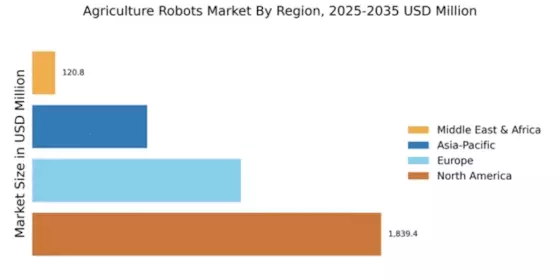
North America leads the Agriculture Robots Market with a share of 1839.36 million. The region's growth is driven by advanced technology adoption, increasing labor costs, and a strong focus on sustainable farming practices. Regulatory support for innovation and investment in agricultural technology further catalyze market expansion. The demand for precision agriculture solutions is rising, enhancing productivity and efficiency in farming operations. The United States is the primary market player, hosting key companies like John Deere, AG Leader Technology, and Trimble. These firms are at the forefront of developing cutting-edge agricultural robotics, contributing to the region's competitive landscape. The presence of significant investments and research initiatives fosters a robust ecosystem for agriculture technology, ensuring North America's continued leadership in this sector.

Europe : Emerging Market with Potential

Europe's Agriculture Robots Market is valued at 1099.68 million, driven by increasing demand for automation in farming and stringent environmental regulations. The region is witnessing a shift towards sustainable agricultural practices, supported by government initiatives aimed at enhancing food security and reducing carbon footprints. The adoption of robotics is seen as a key solution to address labor shortages and improve efficiency in agricultural operations. Leading countries like Germany, France, and the Netherlands are spearheading this transformation, with significant investments in agricultural technology. Key players such as CNH Industrial and Naïo Technologies are actively contributing to the market's growth. The competitive landscape is characterized by innovation and collaboration among various stakeholders, including research institutions and technology providers. "The European Union is committed to fostering innovation in agriculture to ensure sustainable food production," stated a recent EU report.

Asia-Pacific : Rapidly Growing Market

The Asia-Pacific Agriculture Robots Market, valued at 605.76 million, is experiencing rapid growth due to increasing agricultural productivity demands and technological advancements. Countries like Japan and China are leading the way, driven by the need to enhance food security and optimize resource use. Government initiatives promoting smart farming and automation are further propelling market growth, making agriculture more efficient and sustainable. The competitive landscape is evolving, with local and international players entering the market. Companies like Yamaha Motor Co and Harvest Automation are making significant strides in developing innovative agricultural solutions. The region's focus on integrating technology into traditional farming practices is creating new opportunities for growth and collaboration among stakeholders, ensuring a dynamic market environment.

Middle East and Africa : Emerging Opportunities Ahead

The Middle East & Africa Agriculture Robots Market is valued at 120.8 million, with significant potential for growth driven by increasing food production needs and technological adoption. The region faces challenges such as water scarcity and labor shortages, making automation a viable solution. Governments are recognizing the importance of modernizing agriculture to enhance food security and sustainability, leading to supportive policies and investments in agricultural technology. Countries like South Africa and the UAE are at the forefront of adopting agricultural robotics, with initiatives aimed at improving efficiency and productivity. The presence of key players, although limited, is gradually increasing, with companies exploring opportunities to introduce innovative solutions tailored to local needs. The market is poised for growth as stakeholders collaborate to address regional agricultural challenges.

Key Players and Competitive Insights

The agricultural robots market is currently characterized by a dynamic competitive landscape, driven by technological advancements and increasing demand for automation in farming practices. Key players such as John Deere (US), AG Leader Technology (US), and Trimble (US) are at the forefront, each adopting distinct strategies to enhance their market positioning. John Deere (US) emphasizes innovation through the integration of AI and machine learning into its robotic solutions, aiming to improve efficiency and yield. Meanwhile, AG Leader Technology (US) focuses on precision agriculture, leveraging data analytics to optimize farming operations. Trimble (US) is actively pursuing partnerships to expand its technological capabilities, particularly in GPS and mapping technologies, which are crucial for autonomous farming equipment. Collectively, these strategies contribute to a competitive environment that is increasingly reliant on technological differentiation and operational efficiency.

In terms of business tactics, companies are localizing manufacturing to reduce costs and enhance supply chain resilience. This approach is particularly relevant in a moderately fragmented market where smaller players also seek to carve out niches. The collective influence of major players shapes the market structure, as they set benchmarks for innovation and operational excellence, compelling smaller firms to adapt or innovate to remain competitive.

In November 2025, John Deere (US) announced a strategic partnership with a leading AI firm to develop next-generation autonomous tractors. This collaboration is expected to enhance the capabilities of their existing product line, allowing for more precise farming techniques and reduced labor costs. The strategic importance of this move lies in its potential to solidify John Deere's leadership position in the market by offering cutting-edge technology that meets the evolving needs of farmers.

In October 2025, AG Leader Technology (US) launched a new software platform designed to integrate seamlessly with its existing hardware, providing farmers with real-time data analytics. This initiative not only enhances user experience but also positions AG Leader as a comprehensive solution provider in precision agriculture. The significance of this launch is underscored by the growing demand for data-driven decision-making in farming, which is becoming increasingly critical for operational success.

In September 2025, Trimble (US) expanded its product offerings by acquiring a startup specializing in drone technology for crop monitoring. This acquisition is strategically important as it allows Trimble to diversify its portfolio and enhance its service offerings, particularly in the realm of aerial data collection. The integration of drone technology into their existing solutions could provide farmers with unprecedented insights into crop health and yield potential, thereby reinforcing Trimble's competitive edge.

As of December 2025, the Agriculture Robots Market is witnessing trends that emphasize digitalization, sustainability, and AI integration. Strategic alliances are increasingly shaping the competitive landscape, as companies recognize the value of collaboration in driving innovation. The shift from price-based competition to a focus on technological advancement and supply chain reliability is evident, suggesting that future competitive differentiation will hinge on the ability to innovate and adapt to changing market demands.

Key Companies in the Agriculture Robots Market market include

Industry Developments

  • Q2 2024: Agtonomy raises $22.5M Series A to scale autonomous farm equipment Agtonomy, a California-based startup developing autonomous and remote-operated farm machinery, secured $22.5 million in Series A funding to accelerate product development and expand commercial deployments.
  • Q2 2024: John Deere Unveils New Autonomous Sprayer at 2024 World Ag Expo John Deere launched its latest autonomous sprayer, designed to reduce chemical use and labor requirements, at the 2024 World Ag Expo, marking a significant product expansion in its agricultural robotics portfolio.
  • Q2 2024: Naïo Technologies secures €32 million to expand agricultural robot fleet French agri-robotics company Naïo Technologies raised €32 million in a new funding round to scale up production and accelerate international growth of its autonomous weeding and harvesting robots.
  • Q2 2024: CNH Industrial acquires Augmenta to boost precision agriculture automation CNH Industrial announced the acquisition of Augmenta, a provider of real-time precision farming solutions, to enhance its automation and robotics capabilities in the agricultural sector.

  • Q3 2024: Blue River Technology appoints new CEO to drive next phase of ag robotics growth Blue River Technology, a subsidiary of John Deere specializing in AI-powered agricultural robots, named a new CEO to lead the company’s expansion and product innovation strategy.
  • Q3 2024: Ecorobotix raises $48 million in Series C funding for AI-powered weeding robots Swiss agtech firm Ecorobotix closed a $48 million Series C round to accelerate the commercialization of its AI-driven weeding robots, which aim to reduce herbicide use and improve crop yields.
  • Q3 2024: Yanmar launches new strawberry-picking robot for Japanese market Yanmar, a Japanese machinery manufacturer, introduced a new autonomous robot designed specifically for strawberry harvesting, targeting labor shortages in Japan’s fruit farming sector.
  • Q4 2024: FarmWise partners with Driscoll’s to deploy autonomous weeding robots in berry fields FarmWise, a U.S.-based ag robotics company, announced a partnership with Driscoll’s to deploy its autonomous weeding robots across Driscoll’s berry farms, aiming to improve efficiency and sustainability.
  • Q4 2024: AGCO opens new robotics R&D center in Germany AGCO Corporation inaugurated a new research and development center in Germany focused on advancing agricultural robotics and automation technologies for European markets.
  • Q1 2025: John Deere acquires SmartAg for autonomous tractor technology John Deere completed the acquisition of SmartAg, a developer of autonomous tractor solutions, to strengthen its leadership in farm automation and robotics.
  • Q1 2025: Small Robot Company secures £15 million to scale commercial robot farming UK-based Small Robot Company raised £15 million in new funding to expand the deployment of its autonomous robots for precision weeding and crop monitoring on commercial farms.
  • Q2 2025: Kubota and Tevel partner to commercialize fruit-picking drones in Europe Kubota, a leading agricultural machinery manufacturer, announced a partnership with Israeli startup Tevel to bring autonomous fruit-picking drones to European orchards, addressing labor shortages and boosting productivity.

Future Outlook

Agriculture Robots Market Future Outlook

The agricultural robots market share is projected to grow at a 15.81% CAGR from 2024 to 2035, driven by technological advancements, labor shortages, and increasing demand for sustainable farming practices.

New opportunities lie in:

  • Development of autonomous weeding robots for precision agriculture.
  • Integration of AI-driven analytics for crop monitoring and yield prediction.
  • Expansion of robotic solutions for livestock management and health monitoring.

By 2035, the Agriculture Robots Market is expected to be a cornerstone of modern farming practices.

Market Segmentation

Agriculture Robots Market Type Outlook

  • Autonomous Tractors
  • Drones
  • Robotic Harvesters
  • Weeding Robots
  • Planting Robots

Agriculture Robots Market End Use Outlook

  • Farms
  • Greenhouses
  • Orchards
  • Vineyards
  • Research Institutions

Agriculture Robots Market Application Outlook

  • Crop Monitoring
  • Soil Analysis
  • Harvesting
  • Planting
  • Weed Control

Report Scope

MARKET SIZE 2024 3665.6(USD Million)
MARKET SIZE 2025 4245.21(USD Million)
MARKET SIZE 2035 18426.18(USD Million)
COMPOUND ANNUAL GROWTH RATE (CAGR) 15.81% (2024 - 2035)
REPORT COVERAGE Revenue Forecast, Competitive Landscape, Growth Factors, and Trends
BASE YEAR 2024
Market Forecast Period 2025 - 2035
Historical Data 2019 - 2024
Market Forecast Units USD Million
Key Companies Profiled John Deere (US), AG Leader Technology (US), Trimble (US), CNH Industrial (GB), Yamaha Motor Co (JP), Harvest Automation (US), Blue River Technology (US), Naïo Technologies (FR), Octinion (BE)
Segments Covered Application, Type, End Use
Key Market Opportunities Integration of artificial intelligence enhances efficiency and precision in the Agriculture Robots Market.
Key Market Dynamics Technological advancements drive competitive forces, enhancing efficiency and adoption of agriculture robots across diverse farming practices.
Countries Covered North America, Europe, APAC, South America, MEA

Market Highlights

Author
Aarti Dhapte
Team Lead - Research

She holds an experience of about 6+ years in Market Research and Business Consulting, working under the spectrum of Information Communication Technology, Telecommunications and Semiconductor domains. Aarti conceptualizes and implements a scalable business strategy and provides strategic leadership to the clients. Her expertise lies in market estimation, competitive intelligence, pipeline analysis, customer assessment, etc.

Leave a Comment

FAQs

How much is the Agriculture Robots Market?

The Agriculture Robots Market size is expected to be valued at USD 3665.60 billion in 2024.

What is the growth rate of the Agriculture Robots Market?

The global market is projected to grow at a CAGR of 15.81 % during the forecast period, 2025 to 2035.

Which region held the largest market share in the Agriculture Robots Market?

Europe had the largest share of the global market.

Who are the key players in the Agriculture Robots Market?

The key players in the market include XMACHINES, FFRobotics, Naïo Technologies, Nexus Robotics, Ecorobotix SA, ROBOTICS PLUS, Automato Robotics, Advanced Farms Technologies, Inc, AgXeed B.V., Agrobot, Korechi Innovations, FarmDroid.

Which Type led the Agriculture Robots Market?

The Single-Functioned Agriculture Robots category dominated the market in 2022.

Download Free Sample

Kindly complete the form below to receive a free sample of this Report

Compare Licence

×
Features License Type
Single User Multiuser License Enterprise User
Price $4,950 $5,950 $7,250
Maximum User Access Limit 1 User Upto 10 Users Unrestricted Access Throughout the Organization
Free Customization
Direct Access to Analyst
Deliverable Format
Platform Access
Discount on Next Purchase 10% 15% 15%
Printable Versions