×
Request Free Sample ×

Kindly complete the form below to receive a free sample of this Report

* Please use a valid business email

Leading companies partner with us for data-driven Insights

clients tt-cursor
Hero Background

Ai Healthcare Payer Market

ID: MRFR/HC/29534-HCR
128 Pages
Rahul Gotadki
October 2025

AI For Healthcare Payer Market Size, Growth Research Report By AI Technology (Machine Learning, Natural Language Processing, Robotic Process Automation, Predictive Analytics), By Application Area (Claims Processing, Fraud Detection, Patient Engagement, Cost Management, Health Analytics), By Deployment Model (Cloud-Based, On-Premise), By End User (Health Insurance Companies, Managed Care Organizations, Government Programs, Employers) and By Regional (North America, Europe, South America, Asia Pacific, Middle East and Africa) - Competitor In... read more

Share:
Download PDF ×

We do not share your information with anyone. However, we may send you emails based on your report interest from time to time. You may contact us at any time to opt-out.

Ai Healthcare Payer Market Infographic
Purchase Options

Ai Healthcare Payer Market Summary

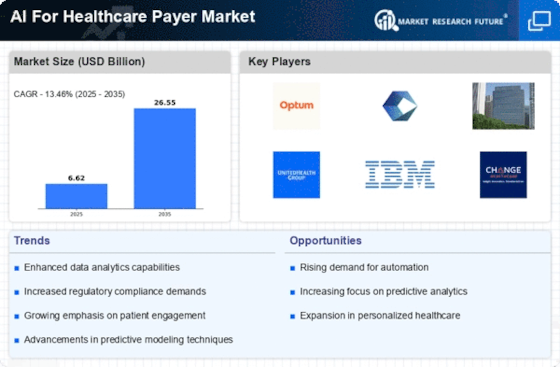
As per MRFR analysis, the AI For Healthcare Payer Market Size was estimated at 6.617 USD Billion in 2024. The AI For Healthcare Payer industry is projected to grow from 7.508 USD Billion in 2025 to 26.55 USD Billion by 2035, exhibiting a compound annual growth rate (CAGR) of 13.46 during the forecast period 2025 - 2035.

Key Market Trends & Highlights

The AI for Healthcare Payer Market is experiencing robust growth driven by technological advancements and increasing demand for efficiency.

  • North America remains the largest market for AI in healthcare payers, showcasing a strong adoption of advanced technologies.
  • The Asia-Pacific region is emerging as the fastest-growing market, fueled by increasing investments in healthcare technology.
  • Machine Learning continues to dominate the market, while Natural Language Processing is rapidly gaining traction as a key growth segment.
  • Key market drivers include improved operational efficiency and enhanced data analytics capabilities, which are essential for optimizing claims processing and fraud detection.

Market Size & Forecast

2024 Market Size 6.617 (USD Billion)
2035 Market Size 26.55 (USD Billion)
CAGR (2025 - 2035) 13.46%

Major Players

Optum (US), Cognizant (US), Anthem (US), UnitedHealth Group (US), IBM (US), Change Healthcare (US), Molina Healthcare (US), Cigna (US), Aetna (US)

Ai Healthcare Payer Market Trends

The AI For Healthcare Payer Market is currently experiencing a transformative phase, driven by advancements in technology and the increasing demand for efficient healthcare solutions. Payers are increasingly adopting artificial intelligence to streamline operations, enhance decision-making processes, and improve patient outcomes. This shift appears to be influenced by the need for cost reduction and the desire to provide personalized care. As a result, AI applications are being integrated into various aspects of healthcare payer operations, including claims processing, fraud detection, and patient engagement. Moreover, the competitive landscape is evolving, with numerous players entering the market, each offering innovative solutions tailored to the unique challenges faced by healthcare payers. This dynamic environment suggests that collaboration between technology providers and healthcare organizations is likely to intensify, fostering an ecosystem that prioritizes data-driven insights and operational efficiency. The ongoing development of regulatory frameworks may also play a crucial role in shaping the future of the AI For Healthcare Payer Market, as stakeholders seek to navigate compliance while leveraging the benefits of artificial intelligence.

Enhanced Claims Processing

AI technologies are being utilized to automate and optimize claims processing, reducing the time and resources required for manual reviews. This trend indicates a shift towards more efficient workflows, allowing payers to focus on strategic initiatives.

Fraud Detection and Prevention

The integration of AI in fraud detection systems is becoming increasingly prevalent. By analyzing patterns and anomalies in claims data, AI can help identify potential fraudulent activities, thereby safeguarding financial resources.

Personalized Patient Engagement

AI is facilitating more personalized interactions between payers and patients. Through data analysis, payers can tailor communication and services to meet individual needs, enhancing overall patient satisfaction and engagement.

Ai Healthcare Payer Market Drivers

Improved Patient Outcomes

The focus on improving patient outcomes is a significant driver in the AI For Healthcare Payer Market. AI technologies facilitate personalized care by analyzing patient data to tailor treatment plans. This personalized approach not only enhances patient satisfaction but also leads to better health outcomes. Studies indicate that healthcare payers utilizing AI-driven solutions report higher rates of patient engagement and adherence to treatment protocols. As the industry shifts towards value-based care, the emphasis on outcomes will likely propel the adoption of AI technologies, making them integral to the future of healthcare delivery.

Cost Reduction Initiatives

Cost reduction remains a primary driver in the AI For Healthcare Payer Market. Healthcare payers are under constant pressure to lower operational costs while maintaining high-quality services. AI technologies offer innovative solutions that can lead to substantial cost savings. For example, predictive analytics can help in identifying high-risk patients, allowing for targeted interventions that reduce unnecessary expenditures. Reports suggest that implementing AI can lead to a reduction in costs by approximately 20 to 30% over time. As payers seek to balance cost efficiency with quality care, the integration of AI solutions is likely to become a standard practice.

Improved Operational Efficiency

The AI For Healthcare Payer Market is witnessing a surge in demand for solutions that enhance operational efficiency. By automating routine tasks such as claims processing and data entry, AI technologies can significantly reduce administrative burdens. According to recent estimates, AI-driven automation can decrease processing times by up to 30%, allowing healthcare payers to allocate resources more effectively. This efficiency not only streamlines operations but also improves the overall patient experience, as quicker claims processing leads to faster reimbursements. As healthcare payers increasingly adopt AI solutions, the industry is likely to see a transformation in how services are delivered, ultimately leading to cost savings and improved service quality.

Enhanced Data Analytics Capabilities

In the AI For Healthcare Payer Market, the ability to analyze vast amounts of data is becoming increasingly critical. AI technologies enable healthcare payers to harness data analytics for better decision-making and predictive modeling. For instance, advanced algorithms can identify trends in patient behavior and treatment outcomes, which can inform policy adjustments and risk management strategies. The market for healthcare analytics is projected to grow significantly, with estimates suggesting a compound annual growth rate of over 25% in the coming years. This growth indicates a strong inclination towards data-driven strategies, which are essential for optimizing healthcare delivery and improving patient outcomes.

Regulatory Compliance and Risk Management

The AI For Healthcare Payer Market is also influenced by the need for stringent regulatory compliance and effective risk management. As regulations evolve, healthcare payers are increasingly turning to AI solutions to ensure adherence to complex compliance requirements. AI can assist in monitoring transactions and identifying potential compliance issues before they escalate. This proactive approach not only mitigates risks but also enhances the payer's reputation in the market. With the healthcare landscape becoming more regulated, the demand for AI-driven compliance solutions is expected to rise, indicating a pivotal shift in how payers manage regulatory challenges.


Market Segment Insights

By AI Technology: Machine Learning (Largest) vs. Natural Language Processing (Fastest-Growing)

In the AI For Healthcare Payer Market, Machine Learning stands out as the largest segment, owing to its extensive applicability and effectiveness in processing vast amounts of healthcare data. Natural Language Processing, while relatively smaller in market share, is emerging rapidly as a vital tool for analyzing unstructured data, such as clinical notes and patient records, enhancing its relevance in healthcare decision-making processes.

Technology: Machine Learning (Dominant) vs. Natural Language Processing (Emerging)

Machine Learning has established itself as a dominant force in the AI For Healthcare Payer Market, excelling in predictive modeling, risk stratification, and improving patient outcomes through tailored treatment plans. Its robustness in handling diverse datasets makes it indispensable for payers in evaluating claims and optimizing healthcare operations. On the other hand, Natural Language Processing is gaining traction as an emerging technology, offering innovative solutions for tasks like sentiment analysis and automated transcription. This technology's ability to interpret and generate human language facilitates better communication between healthcare providers and payers, making it crucial for enhancing patient engagement and satisfaction.

By Application Area: Claims Processing (Largest) vs. Fraud Detection (Fastest-Growing)

In the AI for Healthcare Payer Market, Claims Processing dominates the application area segment, boasting the largest market share. This segment benefits from the extensive reliance on AI technologies to streamline administrative tasks, reduce error rates, and enhance the overall efficiency of claims handling. Meanwhile, Fraud Detection is rapidly emerging as a crucial area of investment, driven by the increasing need for payers to combat fraudulent activities that cost the industry significantly. The adoption of AI-based solutions in fraud detection is on the rise as payers seek to enhance their risk management strategies. Moreover, the growth trends within this segment are being propelled by advancements in machine learning algorithms, which enable more precise detection of anomalies and suspicious patterns in claims data, along with regulatory pressures mandating greater transparency and security in transactions.

Claims Processing (Dominant) vs. Patient Engagement (Emerging)

Claims Processing remains a dominant segment within the AI for Healthcare Payer Market due to its essential role in automating tedious processes and ensuring faster reimbursements. By leveraging AI technologies, payers can enhance accuracy and reduce the time associated with traditional claims workflows. On the other hand, Patient Engagement represents an emerging segment driven by the shift towards value-based care, emphasizing patient involvement in their health journey. As healthcare organizations increasingly recognize the value of patient satisfaction and outcomes, AI tools that facilitate communication and personalized interactions are becoming crucial. Both segments showcase the transformative impact of AI, tailoring functions to improve operational efficiencies and patient experiences, respectively.

By Deployment Model: Cloud-Based (Largest) vs. On-Premise (Fastest-Growing)

In the AI For Healthcare Payer Market, the cloud-based deployment model currently holds the largest share. This preference is largely due to its scalability, cost-effectiveness, and ease of integration with existing healthcare systems. On-premise solutions, while more traditional, are less favored due to their higher maintenance costs and complexity. However, they still hold a significant portion of the market as organizations with strict regulatory demands and data security concerns lean towards this model.

Deployment Model: Cloud-Based (Dominant) vs. On-Premise (Emerging)

The cloud-based deployment model is dominant in the AI For Healthcare Payer Market, favored for its ability to provide flexible and scalable solutions that adapt to the varying needs of healthcare organizations. It allows for seamless updates, easy collaboration across teams, and enhanced data accessibility. Conversely, the on-premise model, while considered emerging in this context, is characterized by a strong focus on data security and control. Organizations opting for on-premise solutions often prioritize compliance and regulatory adherence, which drives their decision to maintain proprietary hardware and software.

By End User: Health Insurance Companies (Largest) vs. Managed Care Organizations (Fastest-Growing)

The AI For Healthcare Payer Market showcases a diverse distribution of market share among its primary end users. Health insurance companies dominate the landscape, taking a significant portion of market share due to their established infrastructure and existing data resources. In contrast, managed care organizations are emerging rapidly, capitalizing on the integration of AI technologies to enhance efficiency and patient outcomes. This dynamic distribution indicates shifting trends within the industry as more players adopt AI to stay competitive.

Health Insurance Companies (Dominant) vs. Managed Care Organizations (Emerging)

Health insurance companies are well-established players in the AI For Healthcare Payer Market, leveraging expansive databases and customer interactions to integrate AI solutions effectively. Their dominance stems from a lengthy history of customer engagement and claims processing, allowing them to tailor AI applications to improve operational efficiency and patient interaction. In contrast, managed care organizations, classified as the emerging segment, are increasingly adopting AI to streamline operations and reduce costs in healthcare delivery. With a focus on patient-centered care, they are implementing AI-driven analytics to assess patient populations, manage chronic diseases, and optimize care pathways, making them a key driver for innovation within the sector.

Get more detailed insights about Ai Healthcare Payer Market

Regional Insights

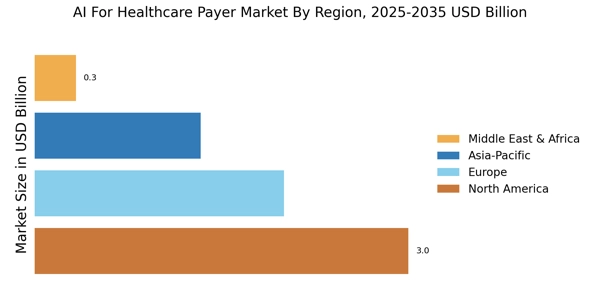
The AI For Healthcare Payer Market is poised to witness significant growth across various regions, driven by increasing demand for advanced healthcare solutions and digital transformation. By 2032, the overall market is expected to reach a valuation of 16.0 USD Billion, up from 5.14 USD Billion in 2023, indicating a robust Compound Annual Growth Rate (CAGR) of 13.46% from 2024 to 2032. North America continues to dominate the market, benefiting from substantial investments in artificial intelligence technologies and a well-established healthcare infrastructure.

In addition, the sub-segment of Machine Learning in this region is projected to grow from 1.54 USD Billion in 2023 to 5.0 USD Billion by 2032. Europe follows closely, with Natural Language Processing expected to expand from 1.2 USD Billion in 2023 to 3.8 USD Billion by 2032, reflecting strong regulatory support and increasing healthcare digitization. The APAC region is gaining momentum, focusing on Robotic Process Automation, projected to increase from 0.8 USD Billion in 2023 to 2.5 USD Billion by 2032.

Meanwhile, Predictive Analytics, valued at 1.6 USD Billion in 2023, is anticipated to grow to 4.7 USD Billion by 2032.

South America and MEA are emerging as key markets with potential for growth driven by rising healthcare investments and technology adoption. The AI For Healthcare Payer Market statistics indicate various opportunities and challenges across these regions, highlighting the need for tailored approaches to harness the potential of AI in healthcare payer systems effectively.

Source Primary Research, Secondary Research, Market Research Future Database and Analyst Review

Ai Healthcare Payer Market Regional Image

Key Players and Competitive Insights

The AI For Healthcare Payer Market is witnessing rapid growth and transformation as the integration of artificial intelligence technologies continues to reshape various facets of healthcare services. Market participants are increasingly leveraging AI-driven solutions to enhance operational efficiencies, reduce costs, and improve patient outcomes. As more healthcare payers recognize the value of AI in streamlining processes such as claims management, fraud detection, and patient engagement, competition within this sector intensifies. 

The presence of innovative startups and established corporations creates a dynamic environment where differentiation through technology and strategic partnerships becomes critical for success. Analyzing competitive insights in this evolving landscape reveals key trends, challenges, and opportunities that healthcare payers must navigate to maintain a competitive edge.Anthem, a prominent entity in the AI For Healthcare Payer Market, stands out due to its robust emphasis on technology and analytics. The company excels in implementing advanced AI solutions that enhance claims processing and risk assessment, thereby enabling more accurate predictions and improved decision-making.

Anthem's strengths lie in its significant investment in data analytics infrastructure, which enables the company to provide personalized healthcare services and optimize resource allocation. 

Furthermore, Anthem’s strategic initiatives focus on interoperability and collaboration with other technology providers, allowing for seamless integration of AI tools into existing systems. This positions Anthem at the forefront as it continuously innovates to address the evolving needs of its members and the healthcare industry as a whole.Philips Healthcare is another key player in the AI For Healthcare Payer Market, recognized for its advancements in health technology and data-driven solutions. The company emphasizes a patient-centric approach, utilizing AI to enhance patient flow management and operational processes within healthcare facilities. 

Philips Healthcare's strength is highlighted by its emphasis on predictive analytics, which aids payers in identifying potential health risks before they escalate into more serious conditions. The integration of AI into Philips Healthcare's solutions also fosters enhanced communication between healthcare providers and payers, further streamlining processes and reducing administrative burdens. 

With a commitment to innovation and quality, Philips Healthcare continues to carve out a significant presence in the payer market, helping organizations to improve efficiency while promoting better health outcomes for patients.

Key Companies in the Ai Healthcare Payer Market market include

Industry Developments

The AI For Healthcare Payer Market continues to witness significant advancements, with notable developments shaping its future landscape. Recent collaborations between technology firms and healthcare payers have focused on integrating AI-driven solutions for claims processing and fraud detection, enhancing operational efficiency and reducing costs. Innovations in predictive analytics are helping payers better manage patient outcomes and streamline their services, ultimately improving the quality of care delivered. Additionally, regulatory changes are encouraging the adoption of AI technologies within payer organizations as stakeholders recognize the potential of AI to transform healthcare delivery. 

Investments in telehealth and remote patient monitoring have surged, further integrating AI capabilities to optimize care pathways. As the market prepares for substantial growth, driven by a projected CAGR of 13.46%, industry players are prioritizing data security and privacy in their AI implementations, aiming to build trust with consumers while maximizing the benefits of technology in healthcare. 

This vibrant ecosystem of collaboration, innovation, and regulatory support is set to propel the AI For Healthcare Payer Market forward, responding dynamically to the evolving needs and expectations of stakeholders across the healthcare spectrum.

Future Outlook

Ai Healthcare Payer Market Future Outlook

The AI for Healthcare Payer Market is projected to grow at a 13.46% CAGR from 2024 to 2035, driven by technological advancements, regulatory support, and increasing demand for cost efficiency.

New opportunities lie in:

  • Integration of AI-driven predictive analytics for risk assessment
  • Development of personalized healthcare plans using AI insights
  • Implementation of automated claims processing systems to enhance efficiency

By 2035, the market is expected to be robust, driven by innovation and strategic investments.

Market Segmentation

Ai Healthcare Payer Market End User Outlook

  • Health Insurance Companies
  • Managed Care Organizations
  • Government Programs
  • Employers

Ai Healthcare Payer Market AI Technology Outlook

  • Machine Learning
  • Natural Language Processing
  • Robotic Process Automation
  • Predictive Analytics

Ai Healthcare Payer Market Application Area Outlook

  • Claims Processing
  • Fraud Detection
  • Patient Engagement
  • Cost Management
  • Health Analytics

Ai Healthcare Payer Market Deployment Model Outlook

  • Cloud-Based
  • On-Premise

Report Scope

MARKET SIZE 20246.617(USD Billion)
MARKET SIZE 20257.508(USD Billion)
MARKET SIZE 203526.55(USD Billion)
COMPOUND ANNUAL GROWTH RATE (CAGR)13.46% (2024 - 2035)
REPORT COVERAGERevenue Forecast, Competitive Landscape, Growth Factors, and Trends
BASE YEAR2024
Market Forecast Period2025 - 2035
Historical Data2019 - 2024
Market Forecast UnitsUSD Billion
Key Companies ProfiledMarket analysis in progress
Segments CoveredMarket segmentation analysis in progress
Key Market OpportunitiesIntegration of advanced analytics for enhanced claims processing and fraud detection in the AI For Healthcare Payer Market.
Key Market DynamicsRising adoption of artificial intelligence enhances operational efficiency and cost management in healthcare payer organizations.
Countries CoveredNorth America, Europe, APAC, South America, MEA

Leave a Comment

FAQs

What is the projected market valuation for the AI For Healthcare Payer Market in 2035?

The projected market valuation for the AI For Healthcare Payer Market in 2035 is 26.55 USD Billion.

What was the market valuation for the AI For Healthcare Payer Market in 2024?

The market valuation for the AI For Healthcare Payer Market in 2024 was 6.617 USD Billion.

What is the expected CAGR for the AI For Healthcare Payer Market from 2025 to 2035?

The expected CAGR for the AI For Healthcare Payer Market during the forecast period 2025 - 2035 is 13.46%.

Which AI technology segment is projected to have the highest valuation by 2035?

The Machine Learning segment is projected to reach 10.5 USD Billion by 2035.

What are the key application areas driving growth in the AI For Healthcare Payer Market?

Key application areas include Claims Processing, Fraud Detection, and Health Analytics, with projected valuations of 6.5, 5.0, and 5.5 USD Billion respectively by 2035.

How does the deployment model impact the AI For Healthcare Payer Market?

The Cloud-Based deployment model is expected to grow significantly, reaching 14.0 USD Billion by 2035.

Which end user segment is anticipated to dominate the AI For Healthcare Payer Market by 2035?

Health Insurance Companies are anticipated to dominate, with a projected valuation of 10.5 USD Billion by 2035.

What role do key players like Optum and Anthem play in the market?

Key players such as Optum and Anthem are likely to lead innovations and drive market growth through advanced AI solutions.

What is the projected growth for the Robotic Process Automation segment by 2035?

The Robotic Process Automation segment is projected to reach 4.0 USD Billion by 2035.

How does the AI For Healthcare Payer Market compare across different segments?

The market shows varied growth across segments, with AI Technology and Application Areas both indicating substantial increases in valuation by 2035.

Download Free Sample

Kindly complete the form below to receive a free sample of this Report

Compare Licence

×
Features License Type
Single User Multiuser License Enterprise User
Price $4,950 $5,950 $7,250
Maximum User Access Limit 1 User Upto 10 Users Unrestricted Access Throughout the Organization
Free Customization
Direct Access to Analyst
Deliverable Format
Platform Access
Discount on Next Purchase 10% 15% 15%
Printable Versions