Download Free Sample
Kindly complete the form below to receive a free sample of this Report
AI & Robotics System Maintenance Services Market Research Report By End Use (Manufacturing, Healthcare, Aerospace, Automotive), By Technology (Machine Learning, Computer Vision, Natural Language Processing, Robotic Process Automation), By Application (Predictive Maintenance, Corrective Maintenance, Preventive Maintenance, Remote Monitoring), By Service Type (Software Maintenance, Hardware Maintenance, System Integration, Technical Support), By Customer Type (Small Enterprises, Medium Enterprises, Large Enterprises) And By Region (North America, Europe, Asia-Pacific, And Rest Of The World) – Market Forecast Till 2035.
As per MRFR analysis, the AI & Robotics System Maintenance Services Market was estimated at 35.0 USD Billion in 2024. The AI & Robotics industry is projected to grow from 38.32 USD Billion in 2025 to 95.0 USD Billion by 2035, exhibiting a compound annual growth rate (CAGR) of 9.5% during the forecast period 2025 - 2035.
The AI and Robotics System Maintenance Services Market is experiencing robust growth driven by technological advancements and increasing demand for predictive solutions.
| 2024 Market Size | 35.0 (USD Billion) |
| 2035 Market Size | 95.0 (USD Billion) |
| CAGR (2025 - 2035) | 9.5% |
IBM (US), Siemens (DE), General Electric (US), Honeywell (US), Rockwell Automation (US), ABB (CH), Fanuc (JP), KUKA (DE), Yaskawa Electric (JP)
Our Impact
Enabled $4.3B Revenue Impact for Fortune 500 and Leading Multinationals
Partnering with 2000+ Global Organizations Each Year
30K+ Citations by Top-Tier Firms in the Industry
The AI & Robotics System Maintenance Services Market is currently experiencing a transformative phase, characterized by rapid advancements in technology and increasing reliance on automated systems across various industries. Organizations are recognizing the necessity of maintaining these sophisticated systems to ensure optimal performance and longevity. As a result, there is a growing demand for specialized maintenance services that can address the unique challenges posed by artificial intelligence and robotics. This trend is likely to continue as businesses seek to enhance efficiency and reduce downtime, thereby maximizing their return on investment. Moreover, the integration of predictive maintenance techniques is becoming more prevalent within the AI & Robotics System Maintenance Services Market. By leveraging data analytics and machine learning, service providers can anticipate potential failures and address issues before they escalate. This proactive approach not only minimizes operational disruptions but also fosters a culture of continuous improvement. As industries evolve, the emphasis on tailored maintenance solutions that cater to specific operational needs is expected to gain traction, further shaping the landscape of this market.
The AI & Robotics System Maintenance Services Market is witnessing a notable shift towards predictive maintenance strategies. By utilizing advanced analytics and machine learning, service providers can forecast potential system failures, allowing for timely interventions. This proactive approach enhances system reliability and reduces unexpected downtimes.
There is a growing trend towards the customization of maintenance services within the AI & Robotics System Maintenance Services Market. Organizations are increasingly seeking tailored solutions that align with their specific operational requirements. This trend reflects a broader recognition of the diverse needs across different sectors.
The integration of Internet of Things (IoT) technology is becoming increasingly prevalent in the AI & Robotics System Maintenance Services Market. IoT-enabled devices facilitate real-time monitoring and data collection, enabling service providers to optimize maintenance schedules and improve overall system performance.
The increasing adoption of automation across various industries appears to be a primary driver for the AI & Robotics System Maintenance Services Market. As organizations strive to enhance operational efficiency and reduce labor costs, the integration of AI and robotics into their processes has surged. This trend necessitates robust maintenance services to ensure optimal performance and longevity of automated systems. According to recent data, the automation market is projected to grow significantly, with a compound annual growth rate (CAGR) of over 10% in the coming years. Consequently, the demand for specialized maintenance services tailored to AI and robotic systems is likely to expand, creating lucrative opportunities for service providers in the AI & Robotics System Maintenance Services Market.
The growing focus on safety and compliance regulations is a significant driver for the AI & Robotics System Maintenance Services Market. As industries increasingly rely on AI and robotics, ensuring that these systems adhere to safety standards and regulatory requirements becomes paramount. Organizations are compelled to invest in maintenance services that not only enhance system performance but also ensure compliance with industry regulations. This trend is particularly evident in sectors such as manufacturing and healthcare, where safety is critical. Data suggests that companies are allocating substantial budgets to maintenance services to mitigate risks associated with non-compliance, thereby fueling growth in the AI & Robotics System Maintenance Services Market.
Increased investment in smart manufacturing is propelling the AI & Robotics System Maintenance Services Market forward. As manufacturers adopt smart technologies, including AI and robotics, to optimize production processes, the complexity of these systems necessitates specialized maintenance services. The smart manufacturing market is projected to witness substantial growth, with investments in AI-driven solutions expected to reach billions in the next few years. This trend indicates a rising demand for maintenance services that can ensure the reliability and efficiency of AI and robotic systems. Consequently, service providers in the AI & Robotics System Maintenance Services Market are likely to benefit from this influx of investment, as manufacturers seek to maintain their competitive edge.
The emergence of predictive maintenance solutions is transforming the AI & Robotics System Maintenance Services Market. By leveraging AI and data analytics, organizations can anticipate equipment failures before they occur, thereby minimizing downtime and maintenance costs. This proactive approach to maintenance is gaining traction across various sectors, as companies recognize the financial benefits of reducing unplanned outages. Market analysis indicates that predictive maintenance solutions are expected to grow at a rapid pace, with a significant portion of maintenance budgets being allocated to these services. As organizations increasingly adopt predictive maintenance strategies, the demand for specialized services in the AI & Robotics System Maintenance Services Market is likely to rise, creating new opportunities for service providers.
Technological advancements in AI and robotics are driving the evolution of the AI & Robotics System Maintenance Services Market. Innovations such as machine learning, computer vision, and advanced sensors are enhancing the capabilities of robotic systems, thereby increasing their complexity. As these technologies advance, the need for specialized maintenance services that can address the unique challenges posed by sophisticated AI and robotic systems becomes apparent. Market data indicates that the AI and robotics sectors are experiencing rapid growth, with investments in research and development reaching unprecedented levels. This trend suggests that maintenance services must evolve concurrently to keep pace with technological advancements, ensuring that AI and robotic systems operate efficiently and effectively.
In the AI & Robotics System Maintenance Services Market, the application segment is primarily divided into Predictive Maintenance, Corrective Maintenance, Preventive Maintenance, and Remote Monitoring. Among these, Predictive Maintenance holds the largest market share due to its ability to forecast potential failures and reduce downtime. Corrective Maintenance follows but at a smaller share, often being used reactively post-failure. Preventive Maintenance is prevalent due to its structured approach to regular upkeep, while Remote Monitoring is gaining traction rapidly, attributed to advancements in IoT and connected systems that allow for real-time inspections and diagnostics. The growth trends within this segment reveal an increasing shift towards Predictive and Remote Monitoring applications as organizations seek to enhance efficiency and prolong equipment lifespan. The integration of AI technologies into Predictive Maintenance is driving robust demand, as they provide precise data analytics capabilities. Moreover, the growth in connectivity options and the shift toward automation in factories and warehouses are propelling Remote Monitoring to emerge as a crucial player, catering to the growing need for fleet management and automated oversight of robotic systems.
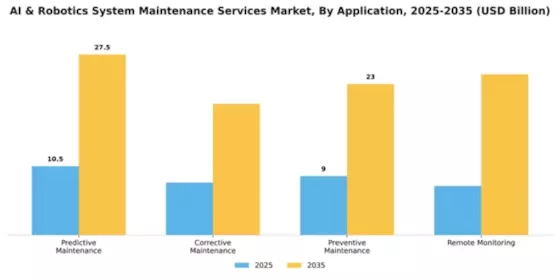
Predictive Maintenance (Dominant) vs. Corrective Maintenance (Emerging)
Predictive Maintenance has established itself as the dominant force in the AI & Robotics System Maintenance Services Market due to its proactive approach in maintaining operational efficiency. By utilizing algorithms and machine learning, it forecasts device failures before they occur, resulting in significant cost savings and reduced downtime. This segment is characterized by advanced analytics, making it a preferred choice for industries that rely heavily on robotics and automation. In contrast, Corrective Maintenance, while historically essential, is increasingly being viewed as less efficient. It operates on a reactive basis, leading to unplanned disruptions and higher repair costs. As organizations prioritize uptime and efficiency, Corrective Maintenance is becoming an emerging option, often supplemented by AI-driven insights to improve overall effectiveness.
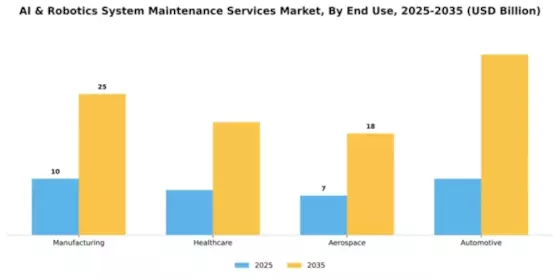
In the AI & Robotics System Maintenance Services Market, the end-use segment reflects varied adoption rates across different industries. Manufacturing has established itself as the largest user of maintenance services due to its extensive reliance on advanced robotics and AI systems for automation. This segment significantly benefits from continuous innovations in robotics, which enhance operational efficiency and reduce downtime. In contrast, healthcare has emerged as a pivotal sector, leveraging AI and robotics for patient care and operational efficiencies. This sector's rapid growth signifies increasing adoption of AI-driven solutions for medical diagnostics, surgical assistance, and patient management, showcasing the transformative potential of technology in enhancing healthcare delivery. The growth trends in the AI & Robotics System Maintenance Services Market are profoundly influenced by technological advancements and changing consumer demands. The manufacturing sector is expected to maintain its dominance as industries seek smarter automation solutions to boost productivity and reduce costs. Meanwhile, the healthcare sector, marked by an accelerated adoption of AI tools, is on an impressive growth trajectory driven by the need for improved patient outcomes and operational efficiency. Emerging technologies are prompting healthcare organizations to integrate AI-assisted robotics into their processes, leading to reductions in operational inefficiencies and driving competitive advantage.
Manufacturing (Dominant) vs. Healthcare (Emerging)
The manufacturing sector stands as the dominant force in the AI & Robotics System Maintenance Services Market, characterized by its vast deployment of robotic systems, which optimize production processes. With a focus on achieving lean operations and reduced operational costs, manufacturers are increasingly utilizing AI to predict maintenance needs and address issues proactively, boosting system efficiency. In contrast, the healthcare sector, while emerging, exhibits tremendous potential for growth. This segment harnesses AI and robotics to revolutionize patient care, making operations faster and more precise. Innovations such as robotic-assisted surgeries and AI-powered diagnostics are driving the shift in the healthcare landscape, suggesting a promising trajectory for maintenance services as they adapt to the unique requirements of this critical sector.
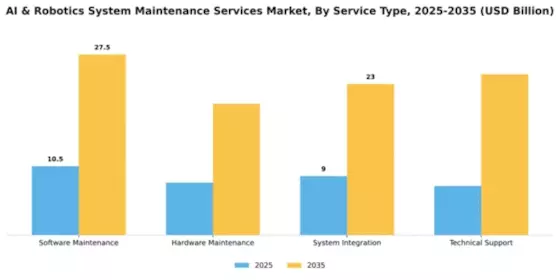
In the AI & Robotics System Maintenance Services Market, Software Maintenance holds the largest market share among the various service types. It remains critical for ensuring system functionality and longevity, as organizations increasingly rely on AI and robotics for their operations. On the other hand, Hardware Maintenance is emerging as the fastest-growing segment, driven by the rising demand for physical maintenance and upgrades of robotic systems, which are now complex and integral to business operations.
Software Maintenance (Dominant) vs. Hardware Maintenance (Emerging)
Software Maintenance is the dominant segment in the AI & Robotics System Maintenance Services Market, characterized by regular updates, patches, and troubleshooting of software applications used in robotics and AI. This ensures that systems remain compatible and efficient amid rapidly evolving technology. In contrast, Hardware Maintenance is an emerging segment, gaining traction due to the increased use of robotic machinery in various industries. The need for proactive maintenance strategies, such as predictive and preventive measures, is driving growth in this area, as businesses seek to minimize downtime and enhance the performance and reliability of their hardware.
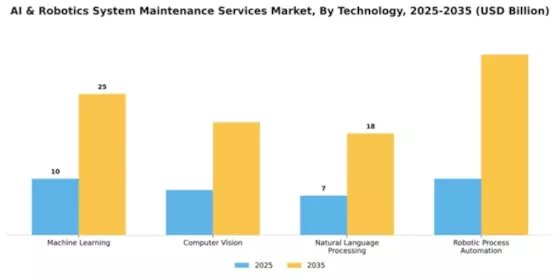
In the AI & Robotics System Maintenance Services Market, the technology segment is led primarily by Machine Learning, which has established itself as the largest contributor due to its broad applications in predictive maintenance and anomaly detection. Following closely are Computer Vision and Natural Language Processing, both of which play critical roles in enhancing the efficiency and effectiveness of service operations, although they represent a smaller portion of the market share compared to Machine Learning and Robotic Process Automation. As industries increasingly adopt intelligent technologies, growth trends indicate that Robotic Process Automation is amongst the fastest-growing segments within this market. This surge is fueled by the increasing demand for automated operational processes among businesses looking to improve efficiency. Additionally, advancements in AI algorithms and the growing integration of machine learning capabilities in robotic systems are driving the expansion of Computer Vision and Natural Language Processing, making them significant contributors to the overall market growth and diversification.
Machine Learning (Dominant) vs. Robotic Process Automation (Emerging)
Machine Learning stands out as the dominant force within the technology segment in the AI & Robotics System Maintenance Services Market, providing essential capabilities for predictive analytics and maintenance scheduling. Its robust algorithms allow for continuous improvement in service delivery and reliability, making it the go-to technology for many enterprises. In contrast, Robotic Process Automation is emerging at a rapid pace, offering organizations the ability to automate repetitive tasks and streamline workflows with minimal human intervention. This technology enhances efficiency, reduces operational costs, and allows businesses to reallocate human resources to more strategic tasks. The combination of these two technologies is redefining the landscape of maintenance services, with Machine Learning setting the groundwork and Robotic Process Automation carving out its niche.
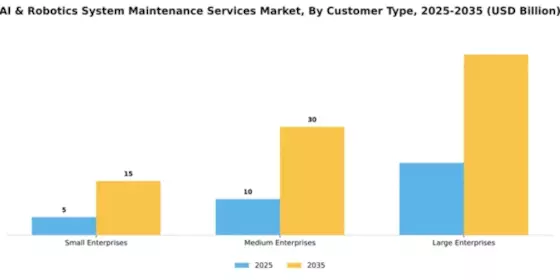
In the AI & Robotics System Maintenance Services Market, the customer type segment reveals a distinctive hierarchy in market share distribution. Large Enterprises are the predominant players in this segment, leveraging advanced technologies and budgets that allow for extensive maintenance services. Conversely, Medium Enterprises are emerging with increasing market share, driven by their adaptability in adopting new technologies that enhance their operational efficiencies and competitiveness.
Large Enterprises (Dominant) vs. Medium Enterprises (Emerging)
Large Enterprises in the AI & Robotics System Maintenance Services Market are characterized by their substantial investments in technology and comprehensive maintenance frameworks, ensuring seamless operations and minimal disruptions. Their purchasing power allows them to access the most advanced and reliable services available. In comparison, Medium Enterprises are rapidly becoming the fastest-growing segment within the market as they strive to optimize their processes through advanced robotics systems. This is facilitated by their agility and willingness to adopt innovative solutions at a quicker pace compared to larger corporations, allowing them to compete effectively against larger rivals.
Get more detailed insights about AI & Robotics System Maintenance Services Market Request Free Sample
North America is poised to maintain its dominance in the AI & Robotics System Maintenance Services market, holding a significant market share of 17.5% as of 2024. The region's growth is driven by rapid technological advancements, increased automation across industries, and supportive government regulations promoting innovation. The demand for efficient maintenance solutions is further fueled by the rising complexity of robotic systems and the need for operational efficiency. The competitive landscape in North America is robust, featuring key players such as IBM, General Electric, and Honeywell. These companies are at the forefront of developing cutting-edge maintenance solutions, leveraging AI to enhance service delivery. The U.S. leads the market, followed by Canada, with a strong emphasis on R&D and strategic partnerships. This environment fosters a vibrant ecosystem for AI and robotics, ensuring sustained growth and innovation.
Europe is emerging as a significant player in the AI & Robotics System Maintenance Services market, with a market size of €10.5 billion. The region benefits from a strong regulatory framework that encourages technological innovation and investment in automation. Key drivers include the increasing adoption of AI technologies across various sectors and a growing focus on sustainability, which is pushing companies to optimize their operations through advanced maintenance solutions. Leading countries in Europe include Germany, France, and the UK, where companies like Siemens and ABB are making substantial contributions to the market. The competitive landscape is characterized by a mix of established firms and innovative startups, all vying for a share of the growing demand for AI-driven maintenance services. The European market is expected to continue its upward trajectory, supported by favorable policies and a skilled workforce.
The Asia-Pacific region is witnessing rapid growth in the AI & Robotics System Maintenance Services market, with a market size of $5.5 billion. This growth is driven by increasing industrial automation, a burgeoning manufacturing sector, and rising investments in AI technologies. Countries like Japan and China are leading the charge, supported by government initiatives aimed at boosting technological advancements and enhancing operational efficiencies across industries. In this competitive landscape, key players such as Fanuc and Yaskawa Electric are making significant strides in providing innovative maintenance solutions. The region's focus on smart manufacturing and Industry 4.0 is further propelling demand for AI-driven maintenance services. As companies seek to improve productivity and reduce downtime, the Asia-Pacific market is set for continued expansion, driven by both local and international players.
The Middle East and Africa (MEA) region is gradually emerging in the AI & Robotics System Maintenance Services market, with a market size of $1.5 billion. The growth is primarily driven by increasing investments in technology and infrastructure, alongside a rising demand for automation in various sectors such as manufacturing and logistics. Governments in the region are also promoting digital transformation initiatives, which are expected to catalyze market growth in the coming years. Leading countries in the MEA region include the UAE and South Africa, where local firms are beginning to adopt AI technologies for maintenance services. The competitive landscape is still developing, with opportunities for both established companies and new entrants. As the region continues to invest in technology and innovation, the AI & Robotics System Maintenance Services market is poised for significant growth.
The AI & Robotics System Maintenance Services Market is currently characterized by a dynamic competitive landscape, driven by rapid technological advancements and increasing demand for automation across various sectors. Key players such as IBM (US), Siemens (DE), and General Electric (US) are strategically positioning themselves through innovation and partnerships, which collectively shape the competitive environment. IBM (US) focuses on integrating AI capabilities into its maintenance services, enhancing predictive maintenance solutions, while Siemens (DE) emphasizes digital transformation initiatives to optimize operational efficiency. General Electric (US) is leveraging its extensive industrial IoT ecosystem to provide comprehensive maintenance solutions, thereby reinforcing its market presence.The market structure appears moderately fragmented, with a mix of established players and emerging companies vying for market share. Key business tactics include localizing manufacturing to reduce costs and optimizing supply chains to enhance service delivery. The collective influence of these major players is significant, as they not only set industry standards but also drive innovation through competitive practices.In November Siemens (DE) announced a strategic partnership with a leading AI firm to enhance its robotics maintenance services. This collaboration aims to integrate advanced machine learning algorithms into Siemens' existing systems, potentially improving predictive maintenance capabilities and reducing downtime for clients. Such strategic moves indicate a clear focus on leveraging cutting-edge technology to maintain a competitive edge in the market.In October General Electric (US) launched a new suite of AI-driven maintenance tools designed to streamline operations in manufacturing facilities. This initiative is expected to significantly reduce maintenance costs and improve equipment reliability, showcasing GE's commitment to innovation in the AI & Robotics System Maintenance Services Market. The introduction of these tools reflects a broader trend towards automation and efficiency in industrial operations.In September ABB (CH) expanded its service offerings by acquiring a robotics maintenance startup, which specializes in AI-based diagnostics. This acquisition is likely to enhance ABB's capabilities in providing tailored maintenance solutions, thereby strengthening its competitive position. The integration of AI diagnostics into ABB's existing portfolio could lead to improved service delivery and customer satisfaction.As of December current trends in the market include a pronounced shift towards digitalization, sustainability, and the integration of AI technologies. Strategic alliances are increasingly shaping the competitive landscape, as companies recognize the value of collaboration in driving innovation. Looking ahead, competitive differentiation is expected to evolve, with a greater emphasis on technological advancements and supply chain reliability, rather than solely on price. This shift underscores the importance of innovation as a key driver of success in the AI & Robotics System Maintenance Services Market.





The AI & Robotics System Maintenance Services Market is projected to grow at a 9.5% CAGR from 2025 to 2035, driven by technological advancements and increasing automation.
New opportunities lie in:
By 2035, the market is expected to be robust, reflecting substantial growth and innovation.
| MARKET SIZE 2024 | 35.0(USD Billion) |
| MARKET SIZE 2025 | 38.32(USD Billion) |
| MARKET SIZE 2035 | 95.0(USD Billion) |
| COMPOUND ANNUAL GROWTH RATE (CAGR) | 9.5% (2025 - 2035) |
| REPORT COVERAGE | Revenue Forecast, Competitive Landscape, Growth Factors, and Trends |
| BASE YEAR | 2024 |
| Market Forecast Period | 2025 - 2035 |
| Historical Data | 2019 - 2024 |
| Market Forecast Units | USD Billion |
| Key Companies Profiled | IBM (US), Siemens (DE), General Electric (US), Honeywell (US), Rockwell Automation (US), ABB (CH), Fanuc (JP), KUKA (DE), Yaskawa Electric (JP) |
| Segments Covered | Application, End Use, Service Type, Technology, Customer Type |
| Key Market Opportunities | Integration of predictive maintenance technologies enhances efficiency in the AI and Robotics System Maintenance Services Market. |
| Key Market Dynamics | Rising demand for advanced maintenance solutions driven by technological advancements and increasing automation across various industries. |
| Countries Covered | North America, Europe, APAC, South America, MEA |
The market is projected to reach a valuation of 95.0 USD Billion by 2035.
The overall market valuation was 35.0 USD Billion in 2024.
The expected CAGR during the forecast period 2025 - 2035 is 9.5%.
Predictive Maintenance is expected to grow from 10.5 USD Billion in 2024 to 27.5 USD Billion by 2035.
Remote Monitoring services are projected to increase from 7.5 USD Billion in 2024 to 24.5 USD Billion by 2035.
Manufacturing and Automotive sectors are leading, with projected valuations of 25.0 USD Billion and 32.0 USD Billion respectively by 2035.
Large Enterprises are likely to dominate, with a projected market size of 50.0 USD Billion by 2035.
Software Maintenance is expected to grow from 10.5 USD Billion in 2024 to 27.5 USD Billion by 2035.
Key players include IBM, Siemens, General Electric, Honeywell, and Rockwell Automation.
Machine Learning and Robotic Process Automation are projected to grow significantly, reaching 25.0 USD Billion and 32.0 USD Billion respectively by 2035.



Kindly complete the form below to receive a free sample of this Report

“This is really good guys. Excellent work on a tight deadline. I will continue to use you going forward and recommend you to others. Nice job”


“Thanks. It’s been a pleasure working with you, please use me as reference with any other Intel employees.”


“Thanks for sending the report it gives us a good global view of the Betaïne market.”


“Thank you, this will be very helpful for OQS.”


“We found the report very insightful! we found your research firm very helpful. I'm sending this email to secure our future business.”


“I am very pleased with how market segments have been defined in a relevant way for my purposes (such as "Portable Freezers & refrigerators" and "last-mile"). In general the report is well structured. Thanks very much for your efforts.”


“I have been reading the first document or the study, ,the Global HVAC and FP market report 2021 till 2026. Must say, good info! I have not gone in depth at all parts, but got a good indication of the data inside!”


“We got the report in time, we really thank you for your support in this process. I also thank to all of your team as they did a great job.”


“The Automotive 48V ECU Components Procurement Intelligence Study” was a complex project, but the Market Research Future (MRFR) team handled it with quality, agility, and customer-centricity. They delivered all requested data on time and within the agreed scope. The team, including Shubhendra Anand and Rahul Gotadki, was always readily available to clarify questions and swiftly implement necessary adjustments, driving the project to a successful conclusion within a very demanding timeframe.
I would also like to specifically commend Akshay Agarwal for his responsiveness and support at every stage—from our initial inquiry on May 6th through to final delivery on June 18th. His dedication made the entire process seamless.”



