Aircraft Auxiliary Power Unit Market Summary
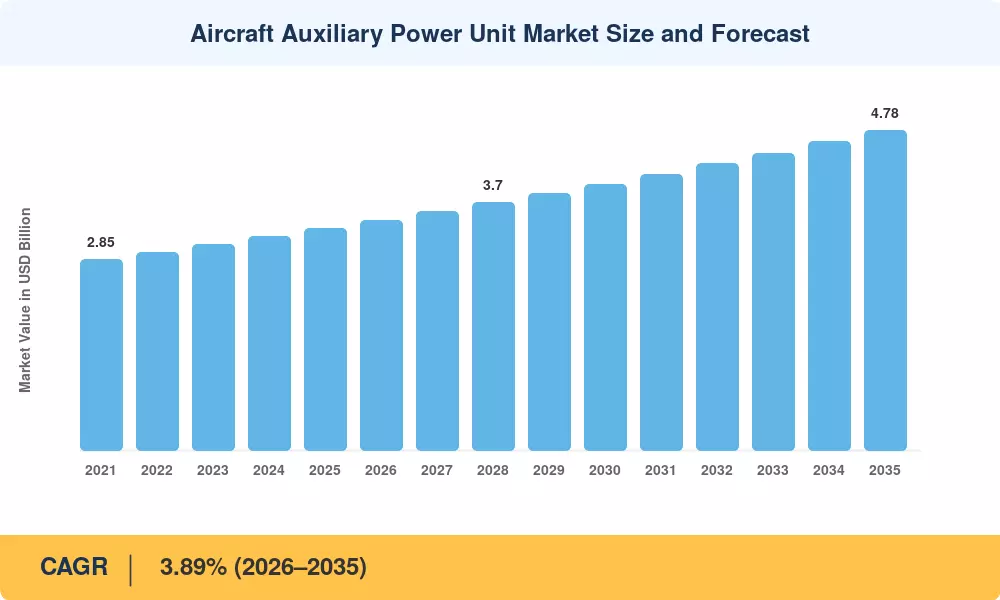
The Aircraft Auxiliary Power Unit Market reached an estimated USD 3.32 billion in 2025, with the forecast period opening at USD 3.45 billion in 2026 and climbing to USD 4.78 billion by 2035 at a 3.89% CAGR. Two catalysts are reshaping spending patterns: ICAO's updated Committee on Aviation Environmental Protection standards pushing airlines to cut gate-side emissions by 45% before 2030, and a combined USD 2.8 billion in defense modernization funding earmarked across NATO allies for next-generation onboard aircraft power generation systems [2]. These policy and procurement forces ensure that turbine APU maintenance budgets and new-unit deliveries remain on an upward trajectory through the mid-2030s.
A technology transformation is underway as conventional turboshaft APUs face competition from battery-electric and fuel-cell alternatives. Airbus committed EUR 1.5 billion between 2024 and 2028 to validate hydrogen-ready APU architectures on its ZEROe demonstrator fleet, while Honeywell secured FAA approval for 100% sustainable aviation fuel compatibility across its 131-9 product line [3]. These moves signal that APU fuel efficiency improvement is no longer optional—airlines operating under the EU Emissions Trading System face carbon costs exceeding USD 90 per tonne, making every kilowatt-hour of aircraft ground energy systems a line-item savings opportunity.
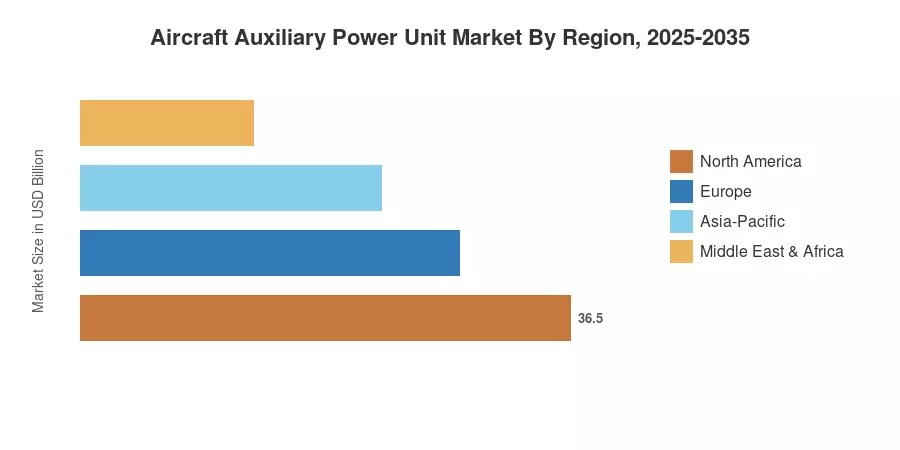
North America held roughly 35% of revenue in 2025, anchored by a dense MRO ecosystem and the U.S. Air Force's turbine APU maintenance cycle on legacy transport fleets. Asia-Pacific is advancing fastest at a 5.68% CAGR, propelled by COMAC C919 deliveries and India's USD 12 billion fleet expansion under the UDAN regional connectivity scheme [4]. Europe remains the second-largest contributor, accounting for about 28% of 2025 revenue, driven by Lufthansa Technik and Safran's joint investments in APU ground power aviation infrastructure. The Aircraft Auxiliary Power Unit Market is set for a decade of incremental yet structurally significant growth.
Key Report Takeaways
• By Technology
- Conventional turboshaft systems captured approximately 83% of Aircraft Auxiliary Power Unit Market revenue in 2025, reflecting the installed base of over 28,000 active narrowbody APUs worldwide
- Fuel-cell APU solutions are pacing the field at a 6.52% CAGR through 2035, as hydrogen demonstration programs accelerate certification timelines for onboard aircraft power generation
• By Platform
- Commercial aviation commanded a 63% share of the Aircraft Auxiliary Power Unit Market in 2025, driven by single-aisle delivery backlogs exceeding 14,000 aircraft across Airbus and Boeing
- The military segment is projected to expand at a 4.92% CAGR to 2035, supported by rotary-wing fleet upgrades and UAV procurement programs
• By Geography
- North America led with USD 1.16 billion in 2025 revenue, supported by dense APU ground power aviation MRO networks
- Asia-Pacific is forecast to grow at a 5.68% CAGR, the fastest among all regions, as Indian and Chinese carriers scale their fleets
Aircraft Auxiliary Power Unit Market Size and Forecast (2021-2035)
MRFR's proprietary estimation framework combines bottom-up OEM shipment tracking with top-down fleet census data from IATA and national civil aviation authorities. Historical figures (2021–2024) are reconciled against audited annual reports from Honeywell, Safran, and Pratt & Whitney Canada. Forecast projections (2026–2035) apply the calibrated 3.89% CAGR with adjustments for identified demand shocks and regulatory milestones.