Request Free Sample ×

Kindly complete the form below to receive a free sample of this Report

* Please use a valid business email

Leading companies partner with us for data-driven Insights

clients tt-cursor
Hero Background

Aircraft Auxiliary Power Unit Market

ID: MRFR/AD/4544-HCR
100 Pages
Shubham Munde
Last Updated: May 27, 2026
Aircraft Auxiliary Power Unit Market Size, Share, Industry Trend & Analysis report information by Aircraft Type (Fixed-Wing, Rotary-Wing), By Power Rating (Less Than 50 kVA, 50 to 150 kVA, More Than 150 kVA), By Technology (Conventional Turboshaft, Battery-Electric, Fuel-Cell), By Geography (North America, Europe, Asia-Pacific, South America, Middle East & Africa) - Forecast till 2035
Download PDF ×

We do not share your information with anyone. However, we may send you emails based on your report interest from time to time. You may contact us at any time to opt-out.

  1. 1 Market Overview |
    1. 1.1 Study Assumptions & Market Definition |
    2. 1.2 Scope of the Study |
    3. 1.3 Research Methodology
  2. 2 Market Summary & Key Takeaways
  3. 3 Market Dynamics |
    1. 3.1 Market Drivers Analysis | |
      1. 3.1.1 Single-Aisle Delivery Backlog Expansion | |
      2. 3.1.2 Gate-Emission Regulations and APU-Off Mandates | |
      3. 3.1.3 Military Rotary-Wing Fleet Modernization | |
      4. 3.1.4 Sustainable Aviation Fuel Compatibility Programs | |
      5. 3.1.5 Hydrogen and Fuel-Cell APU R&D Investment | |
      6. 3.1.6 UAV and Unmanned Platform Procurement | |
      7. 3.1.7 Airport Electrification and Ground Power Upgrades |
    2. 3.2 Market Restraints Analysis | |
      1. 3.2.1 Airport Fixed Ground-Power Substitution | |
      2. 3.2.2 Rare-Earth Supply Chain Constraints | |
      3. 3.2.3 High Certification Costs for Novel Technologies | |
      4. 3.2.4 Extended Engine-Bleed Alternatives Reducing APU Reliance | |
      5. 3.2.5 Pilot and Technician Workforce Shortages |
    3. 3.3 Market Opportunity Analysis | |
      1. 3.3.1 Hydrogen-Ready APU Architectures | |
      2. 3.3.2 Micro-APU Demand from UAV Proliferation | |
      3. 3.3.3 Predictive Maintenance and Data Monetization | |
      4. 3.3.4 Emerging-Market Fleet Expansion in South and Southeast Asia | |
      5. 3.3.5 Retrofit and Aftermarket Upgrades for SAF Compatibility |
    4. 3.4 Industry Value Chain Analysis |
    5. 3.5 Porter's Five Forces Analysis
  4. 4 Global Aircraft Auxiliary Power Unit Market Size & Forecast (2021–2035) |
    1. 4.1 Historical Market Size (2021–2025) |
    2. 4.2 Current & Forecast Market Size (2026–2035) |
    3. 4.3 Market Size by Revenue (USD Billion) |
    4. 4.4 Year-over-Year Growth Analysis
  5. 5 Segmentation Analysis |
    1. 5.1 By Platform | |
      1. 5.1.1 Commercial | |
      2. 5.1.2 Military | |
      3. 5.1.3 General Aviation |
    2. 5.2 By Aircraft Type | |
      1. 5.2.1 Fixed-Wing | |
      2. 5.2.2 Rotary-Wing |
    3. 5.3 By Power Rating | |
      1. 5.3.1 Less Than 50 kVA | |
      2. 5.3.2 50 to 150 kVA | |
      3. 5.3.3 More Than 150 kVA |
    4. 5.4 By Technology | |
      1. 5.4.1 Conventional Turboshaft | |
      2. 5.4.2 Battery-Electric | |
      3. 5.4.3 Fuel-Cell
  6. 6 Regional Analysis |
    1. 6.1 North America | |
      1. 6.1.1 United States | |
      2. 6.1.2 Canada | |
      3. 6.1.3 Mexico |
    2. 6.2 Europe | |
      1. 6.2.1 Germany | |
      2. 6.2.2 United Kingdom | |
      3. 6.2.3 France | |
      4. 6.2.4 Italy | |
      5. 6.2.5 Spain | |
      6. 6.2.6 Nordic Countries | |
      7. 6.2.7 Russia | |
      8. 6.2.8 Rest of Europe |
    3. 6.3 Asia-Pacific | |
      1. 6.3.1 China | |
      2. 6.3.2 India | |
      3. 6.3.3 Japan | |
      4. 6.3.4 South Korea | |
      5. 6.3.5 ASEAN | |
      6. 6.3.6 Rest of Asia-Pacific |
    4. 6.4 South America | |
      1. 6.4.1 Brazil | |
      2. 6.4.2 Argentina | |
      3. 6.4.3 Rest of South America |
    5. 6.5 Middle East & Africa | |
      1. 6.5.1 Saudi Arabia | |
      2. 6.5.2 UAE | |
      3. 6.5.3 South Africa | |
      4. 6.5.4 Egypt | |
      5. 6.5.5 Rest of MEA
  7. 7 Competitive Landscape |
    1. 7.1 Market Share Analysis (2025) |
    2. 7.2 Competitive Benchmarking Matrix |
    3. 7.3 Company Profiles | |
      1. 7.3.1 Honeywell Aerospace | |
      2. 7.3.2 Safran Power Units | |
      3. 7.3.3 Pratt & Whitney Canada | |
      4. 7.3.4 Collins Aerospace (RTX) | |
      5. 7.3.5 Aeronautical Engineers Inc. (AEI) | |
      6. 7.3.6 Liebherr-Aerospace | |
      7. 7.3.7 Microturbo (Safran Group) | |
      8. 7.3.8 PBS Velká Bíteš | |
      9. 7.3.9 AECC (Aero Engine Corporation of China) | |
      10. 7.3.10 Hamilton Sundstrand (RTX Legacy)
  8. 8 Future Outlook & Strategic Recommendations (2026–2035) |
    1. 8.1 Electrification Supercycle and Hybrid-Electric APU Integration |
    2. 8.2 AI-Driven Predictive Maintenance and Digital Twins |
    3. 8.3 ESG Reporting and Carbon-Linked Procurement |
    4. 8.4 Defense Autonomous Systems and Micro-APU Demand
  9. 9 Recent Developments & News
  10. 10 Frequently Asked Questions (FAQs)
  11. 11 Report Scope & Methodology |
    1. 11.1 Study Period & Base Year |
    2. 11.2 Data Sources & Citations |
    3. 11.3 Abbreviations
  12. 12 LIST OF TABLES |
  13. TABLE 1 Global Aircraft Auxiliary Power Unit Market Size & Forecast, by Revenue (USD Billion), 2021–2035 |
  14. TABLE 2 Global Aircraft Auxiliary Power Unit Market — Year-over-Year Growth Analysis, 2021–2035 |
  15. TABLE 3 Market Driver Impact Analysis, 2026–2035 |
  16. TABLE 4 Market Restraint Impact Analysis, 2026–2035 |
  17. TABLE 5 Regional Market Summary — Aircraft Auxiliary Power Unit Market, 2025 |
  18. TABLE 6 North America Aircraft Auxiliary Power Unit Market Size, by Country, 2021–2035 (USD Billion) |
  19. TABLE 7 Europe Aircraft Auxiliary Power Unit Market Size, by Country, 2021–2035 (USD Billion) |
  20. TABLE 8 Asia-Pacific Aircraft Auxiliary Power Unit Market Size, by Country, 2021–2035 (USD Billion) |
  21. TABLE 9 South America Aircraft Auxiliary Power Unit Market Size, by Country, 2021–2035 (USD Billion) |
  22. TABLE 10 Middle East & Africa Aircraft Auxiliary Power Unit Market Size, by Country, 2021–2035 (USD Billion) |
  23. TABLE 11 Global Aircraft Auxiliary Power Unit Market Size, by Platform, 2021–2035 (USD Billion) |
  24. TABLE 12 Global Aircraft Auxiliary Power Unit Market Size, by Aircraft Type, 2021–2035 (USD Billion) |
  25. TABLE 13 Global Aircraft Auxiliary Power Unit Market Size, by Power Rating, 2021–2035 (USD Billion) |
  26. TABLE 14 Global Aircraft Auxiliary Power Unit Market Size, by Technology, 2021–2035 (USD Billion) |
  27. TABLE 15 Competitive Benchmarking Matrix — Aircraft Auxiliary Power Unit Market, 2025 |
  28. TABLE 16 Company Profiles — Key Players, Aircraft Auxiliary Power Unit Market |
  29. TABLE 17 Recent Developments & Strategic Announcements, 2023–2025 |
  30. TABLE 18 Report Scope & Methodology Summary |
  31. TABLE 19 Detailed Sources and Citations
  32. 13 LIST OF FIGURES |
  33. FIGURE 1 Aircraft Auxiliary Power Unit Market Dynamics — Drivers, Restraints, and Opportunities |
  34. FIGURE 2 Industry Value Chain Analysis — Aircraft Auxiliary Power Unit Market |
  35. FIGURE 3 Porter's Five Forces Analysis — Aircraft Auxiliary Power Unit Market |
  36. FIGURE 4 Global Aircraft Auxiliary Power Unit Market Size Trend (USD Billion), 2021–2035 |
  37. FIGURE 5 Aircraft Auxiliary Power Unit Market Share, by Platform, 2025 |
  38. FIGURE 6 Aircraft Auxiliary Power Unit Market Share, by Aircraft Type, 2025 |
  39. FIGURE 7 Aircraft Auxiliary Power Unit Market Share, by Power Rating, 2025 |
  40. FIGURE 8 Aircraft Auxiliary Power Unit Market Share, by Technology, 2025 |
  41. FIGURE 9 Aircraft Auxiliary Power Unit Market Share, by Region, 2025 |
  42. FIGURE 10 North America Aircraft Auxiliary Power Unit Market — Country Share, 2025 |
  43. FIGURE 11 Europe Aircraft Auxiliary Power Unit Market — Country Share, 2025 |
  44. FIGURE 12 Asia-Pacific Aircraft Auxiliary Power Unit Market — Country Share, 2025 |
  45. FIGURE 13 South America Aircraft Auxiliary Power Unit Market — Country Share, 2025 |
  46. FIGURE 14 Middle East & Africa Aircraft Auxiliary Power Unit Market — Country Share, 2025 |
  47. FIGURE 15 Competitive Landscape — Market Concentration and Top-5 Revenue Share, 2025

Segmentation Quick Reference

Dimension Sub-Segments Dominant Segment Fastest Growing Segment
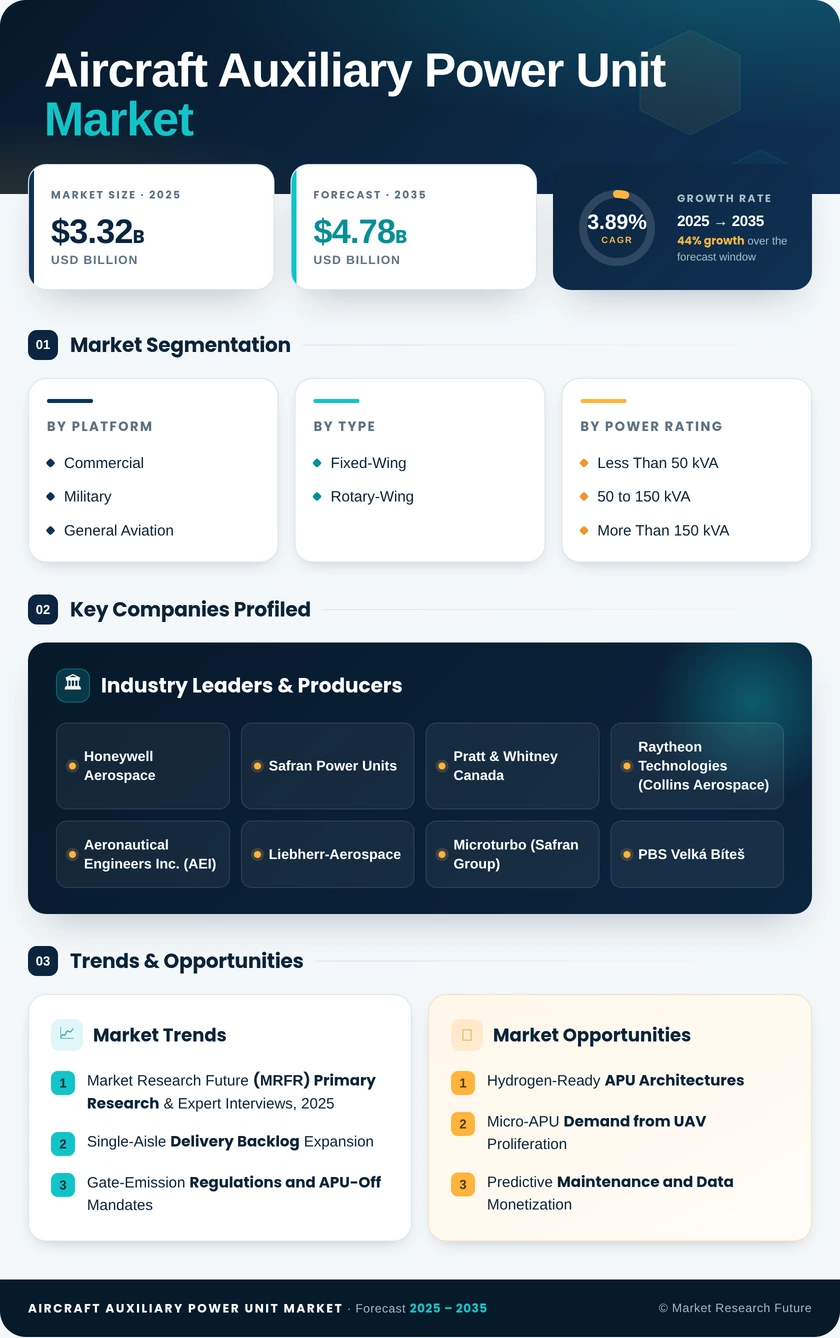
Platform Commercial, Military, General Aviation Commercial (63.0% share, 2025) Military (4.92% CAGR)
Aircraft Type Fixed-Wing, Rotary-Wing Fixed-Wing (74.5% share, 2025) Rotary-Wing (4.12% CAGR)
Power Rating Less Than 50 kVA, 50 to 150 kVA, More Than 150 kVA 50 to 150 kVA (53.8% share, 2025) Less Than 50 kVA (5.65% CAGR)
Technology Conventional Turboshaft, Battery-Electric, Fuel-Cell Conventional Turboshaft (83.2% share, 2025) Fuel-Cell (6.52% CAGR)
Geography North America, Europe, Asia-Pacific, South America, Middle East & Africa North America (35.0% share, 2025) Asia-Pacific (5.68% CAGR)


Market Segmentation Overview

By Platform

Sub-Segment Key Trend
Commercial Single-aisle backlog sustains OEM and aftermarket demand through 2035
Military Rotary-wing upgrades and UAV procurement drive above-average growth
General Aviation Business-jet fleet expansion supports steady niche demand


Commercial aviation remains the revenue backbone of the Aircraft Auxiliary Power Unit Market, accounting for the majority of both new-unit installations and aftermarket overhaul cycles. Military demand, while smaller in absolute terms, is rising as defense forces integrate higher-capability APUs into next-generation rotorcraft and autonomous platforms.

By Aircraft Type

Sub-Segment Key Trend
Fixed-Wing Dominates on narrowbody and widebody fleet volumes
Rotary-Wing Military modernization programs drive faster growth rates


Fixed-wing platforms generate the bulk of APU demand through sheer fleet volume, while rotary-wing applications are gaining momentum as military operators invest in upgraded aircraft ground energy systems for enhanced mission capability.

By Power Rating

Sub-Segment Key Trend
Less Than 50 kVA UAV proliferation and light helicopter demand fuel rapid expansion
50 to 150 kVA Aligns with A320/737 family APU specifications, largest segment
More Than 150 kVA Widebody and military transport platforms drive premium-unit demand


The 50 to 150 kVA class tracks directly with single-aisle commercial production rates, while the sub-50 kVA category is the fastest-growing segment as unmanned and light rotary-wing platforms expand globally.

By Technology

Sub-Segment Key Trend
Conventional Turboshaft Mature installed base and certification heritage sustain dominance
Battery-Electric Emerging pilots for silent gate operations on regional aircraft
Fuel-Cell Hydrogen aviation programs position this as the long-term growth leader


Conventional turboshaft technology retains its dominant position through deep MRO ecosystem integration, but fuel-cell and battery-electric alternatives are advancing as airlines and OEMs pursue APU fuel efficiency improvement and emissions reduction targets ahead of 2035 regulatory milestones.