Hero Background

Aircraft Lightning Protection Market

ID: MRFR/AD/8747-HCR
168 Pages
Abbas Raut
Last Updated: May 25, 2026
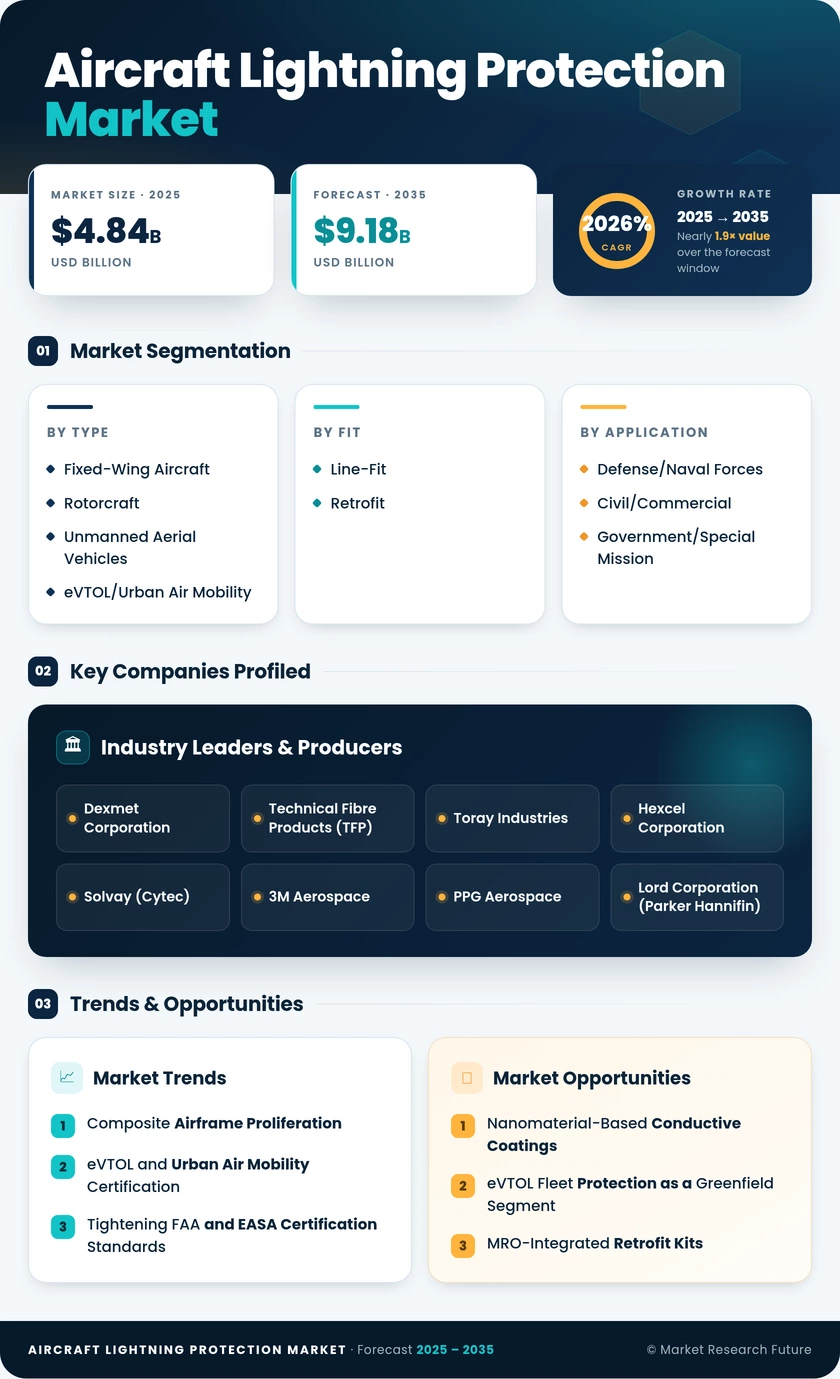
Aircraft Lightning Protection Market Size, Share, Industry Trend & Analysis Overview & Research Report By Product Type (Expanded Metal Foils, Interwoven Wire Fabrics, Plated Carbon Fiber, Other), By Aircraft Type (Fixed-Wing Aircraft, Rotorcraft, Unmanned Aerial Vehicles, eVTOL/Urban Air Mobility), By Fit (Line-Fit, Retrofit), By End User (Defense/Naval Forces, Civil/Commercial, Government/Special Mission), By Geography (North America, Europe, Asia-Pacific, South America, Middle East & Africa) - Forecast to 2035.
Download PDF ×

We do not share your information with anyone. However, we may send you emails based on your report interest from time to time. You may contact us at any time to opt-out.

  1. 1 Market Overview |
    1. 1.1 Study Assumptions & Market Definition |
    2. 1.2 Scope of the Study |
    3. 1.3 Research Methodology
  2. 2 Market Summary & Key Takeaways
  3. 3 Market Dynamics |
    1. 3.1 Market Drivers Analysis | |
      1. 3.1.1 Composite Airframe Proliferation | |
      2. 3.1.2 eVTOL and Urban Air Mobility Certification Requirements | |
      3. 3.1.3 Tightening FAA and EASA Lightning Certification Standards | |
      4. 3.1.4 Asia-Pacific Fleet Expansion | |
      5. 3.1.5 Defense Aircraft Modernization Budgets | |
      6. 3.1.6 Retrofit/MRO Airworthiness Directives | |
      7. 3.1.7 Nanomaterial Coating Innovation |
    2. 3.2 Market Restraints Analysis | |
      1. 3.2.1 High Qualification and Certification Costs | |
      2. 3.2.2 Specialty Metal Supply-Chain Constraints | |
      3. 3.2.3 Slow Retrofit Adoption in Price-Sensitive Markets | |
      4. 3.2.4 Limited Standardization Across OEM Platforms | |
      5. 3.2.5 Weight Penalty of Legacy Protection Systems |
    3. 3.3 Market Opportunity Analysis | |
      1. 3.3.1 Nanomaterial-Based Conductive Coatings | |
      2. 3.3.2 eVTOL Fleet Protection as a Greenfield Segment | |
      3. 3.3.3 MRO-Integrated Retrofit Kits | |
      4. 3.3.4 Data-Driven Lightning Strike Analytics | |
      5. 3.3.5 Emerging Market Defense Modernization |
    4. 3.4 Industry Value Chain Analysis |
    5. 3.5 Porter's Five Forces Analysis
  4. 4 Global Aircraft Lightning Protection Market Size & Forecast (2021–2035) |
    1. 4.1 Historical Market Size (2021–2025) |
    2. 4.2 Current & Forecast Market Size (2026–2035) |
    3. 4.3 Market Size by Revenue (USD Billion) |
    4. 4.4 Year-over-Year Growth Analysis
  5. 5 Segmentation Analysis |
    1. 5.1 By Product Type | |
      1. 5.1.1 Expanded Metal Foils | |
      2. 5.1.2 Interwoven Wire Fabrics | |
      3. 5.1.3 Plated Carbon Fiber | |
      4. 5.1.4 Other (Nanomaterial Coatings, Conductive Paints) |
    2. 5.2 By Aircraft Type | |
      1. 5.2.1 Fixed-Wing Aircraft | |
      2. 5.2.2 Rotorcraft | |
      3. 5.2.3 Unmanned Aerial Vehicles | |
      4. 5.2.4 eVTOL/Urban Air Mobility |
    3. 5.3 By Fit | |
      1. 5.3.1 Line-Fit | |
      2. 5.3.2 Retrofit |
    4. 5.4 By End User | |
      1. 5.4.1 Defense/Naval Forces | |
      2. 5.4.2 Civil/Commercial | |
      3. 5.4.3 Government/Special Mission
  6. 6 Regional Analysis |
    1. 6.1 North America | |
      1. 6.1.1 United States | |
      2. 6.1.2 Canada | |
      3. 6.1.3 Mexico |
    2. 6.2 Europe | |
      1. 6.2.1 Germany | |
      2. 6.2.2 United Kingdom | |
      3. 6.2.3 France | |
      4. 6.2.4 Italy | |
      5. 6.2.5 Spain | |
      6. 6.2.6 Nordic Countries | |
      7. 6.2.7 Russia | |
      8. 6.2.8 Rest of Europe |
    3. 6.3 Asia-Pacific | |
      1. 6.3.1 China | |
      2. 6.3.2 India | |
      3. 6.3.3 Japan | |
      4. 6.3.4 South Korea | |
      5. 6.3.5 ASEAN | |
      6. 6.3.6 Rest of Asia-Pacific |
    4. 6.4 South America | |
      1. 6.4.1 Brazil | |
      2. 6.4.2 Argentina | |
      3. 6.4.3 Rest of South America |
    5. 6.5 Middle East & Africa | |
      1. 6.5.1 Saudi Arabia | |
      2. 6.5.2 UAE | |
      3. 6.5.3 South Africa | |
      4. 6.5.4 Egypt | |
      5. 6.5.5 Rest of MEA
  7. 7 Competitive Landscape |
    1. 7.1 Market Share Analysis (2025) |
    2. 7.2 Competitive Benchmarking Matrix |
    3. 7.3 Company Profiles | |
      1. 7.3.1 Dexmet Corporation | |
      2. 7.3.2 Technical Fibre Products (TFP) | |
      3. 7.3.3 Toray Industries | |
      4. 7.3.4 Hexcel Corporation | |
      5. 7.3.5 Solvay (Cytec) | |
      6. 7.3.6 3M Aerospace | |
      7. 7.3.7 PPG Aerospace | |
      8. 7.3.8 Lord Corporation (Parker Hannifin) | |
      9. 7.3.9 Nanocomp Technologies | |
      10. 7.3.10 Henkel AG
  8. 8 Future Outlook & Strategic Recommendations (2026–2035) |
    1. 8.1 Electrification and the Composite Supercycle |
    2. 8.2 Autonomous Operations and Certification Evolution |
    3. 8.3 Digital Twin and Predictive Maintenance Integration |
    4. 8.4 Sustainability and Circular Materials
  9. 9 Recent Developments & News
  10. 10 Frequently Asked Questions (FAQs)
  11. 11 Report Scope & Methodology |
    1. 11.1 Study Period & Base Year |
    2. 11.2 Data Sources & Citations |
    3. 11.3 Abbreviations
  12. 12 LIST OF TABLES |
  13. TABLE 1 Global Aircraft Lightning Protection Market Size & Forecast, by Revenue (USD Billion), 2021–2035 |
  14. TABLE 2 Global Aircraft Lightning Protection Market — Year-over-Year Growth Analysis, 2021–2035 |
  15. TABLE 3 Global Aircraft Lightning Protection Market — Driver Impact Analysis |
  16. TABLE 4 Global Aircraft Lightning Protection Market — Restraint Impact Analysis |
  17. TABLE 5 Global Aircraft Lightning Protection Market Size, by Product Type, 2021–2035 (USD Billion) |
  18. TABLE 6 Global Aircraft Lightning Protection Market Size, by Aircraft Type, 2021–2035 (USD Billion) |
  19. TABLE 7 Global Aircraft Lightning Protection Market Size, by Fit, 2021–2035 (USD Billion) |
  20. TABLE 8 Global Aircraft Lightning Protection Market Size, by End User, 2021–2035 (USD Billion) |
  21. TABLE 9 Global Aircraft Lightning Protection Market Size, by Region, 2021–2035 (USD Billion) |
  22. TABLE 10 North America Aircraft Lightning Protection Market Size, by Country, 2021–2035 (USD Billion) |
  23. TABLE 11 Europe Aircraft Lightning Protection Market Size, by Country, 2021–2035 (USD Billion) |
  24. TABLE 12 Asia-Pacific Aircraft Lightning Protection Market Size, by Country, 2021–2035 (USD Billion) |
  25. TABLE 13 South America Aircraft Lightning Protection Market Size, by Country, 2021–2035 (USD Billion) |
  26. TABLE 14 Middle East & Africa Aircraft Lightning Protection Market Size, by Country, 2021–2035 (USD Billion) |
  27. TABLE 15 Competitive Benchmarking Matrix — Global Aircraft Lightning Protection Market, 2025 |
  28. TABLE 16 Company Profiles — Key Players, Global Aircraft Lightning Protection Market |
  29. TABLE 17 Recent Developments & Strategic Announcements, 2023–2025 |
  30. TABLE 18 Report Scope & Methodology Summary |
  31. TABLE 19 Detailed Sources and Citations
  32. 13 LIST OF FIGURES |
  33. FIGURE 1 Aircraft Lightning Protection Market Dynamics — Drivers, Restraints, and Opportunities |
  34. FIGURE 2 Industry Value Chain Analysis — Aircraft Lightning Protection Market |
  35. FIGURE 3 Porter's Five Forces Analysis — Aircraft Lightning Protection Market |
  36. FIGURE 4 Global Aircraft Lightning Protection Market Size Trend (USD Billion), 2021–2035 |
  37. FIGURE 5 Aircraft Lightning Protection Market Share, by Product Type, 2025 |
  38. FIGURE 6 Aircraft Lightning Protection Market Share, by Aircraft Type, 2025 |
  39. FIGURE 7 Aircraft Lightning Protection Market Share, by Fit, 2025 |
  40. FIGURE 8 Aircraft Lightning Protection Market Share, by End User, 2025 |
  41. FIGURE 9 Aircraft Lightning Protection Market Share, by Region, 2025 |
  42. FIGURE 10 North America Aircraft Lightning Protection Market Size (USD Billion), 2021–2035 |
  43. FIGURE 11 Europe Aircraft Lightning Protection Market Size (USD Billion), 2021–2035 |
  44. FIGURE 12 Asia-Pacific Aircraft Lightning Protection Market Size (USD Billion), 2021–2035 |
  45. FIGURE 13 South America Aircraft Lightning Protection Market Size (USD Billion), 2021–2035 |
  46. FIGURE 14 Middle East & Africa Aircraft Lightning Protection Market Size (USD Billion), 2021–2035 |
  47. FIGURE 15 Competitive Landscape — Market Share Distribution, 2025

Segmentation Quick Reference

Dimension Sub-Segments Dominant Segment Fastest Growing Segment
Product Type Expanded Metal Foils, Interwoven Wire Fabrics, Plated Carbon Fiber, Other Expanded Metal Foils Plated Carbon Fiber
Aircraft Type Fixed-Wing Aircraft, Rotorcraft, Unmanned Aerial Vehicles, eVTOL/Urban Air Mobility Fixed-Wing Aircraft eVTOL/Urban Air Mobility
Fit Line-Fit, Retrofit Line-Fit Retrofit
End User Defense/Naval Forces, Civil/Commercial, Government/Special Mission Defense/Naval Forces Civil/Commercial
Geography North America, Europe, Asia-Pacific, South America, Middle East & Africa North America Asia-Pacific


Market Segmentation Overview

By Product Type

Sub-Segment Key Trend
Expanded Metal Foils Mature technology with broadest OEM qualification base; copper and aluminum variants dominate line-fit applications
Interwoven Wire Fabrics Preferred for complex geometries in rotorcraft and military platforms requiring conformability
Plated Carbon Fiber Fastest-growing product type offering integrated structural and conductive properties for weight-sensitive airframes
Other (Nanomaterial Coatings, Conductive Paints) Emerging R&D pipeline; CNT and graphene coatings advancing toward OEM qualification for eVTOL platforms


Product type selection is driven primarily by OEM qualification status and structural integration requirements. Expanded metal foils retain dominance due to decades of certification history, while plated carbon fiber gains share as new-generation composite programs enter production.

By Aircraft Type

Sub-Segment Key Trend
Fixed-Wing Aircraft Largest revenue contributor driven by commercial backlog fulfillment and defense fleet renewal programs
Rotorcraft Steady demand from military and offshore energy operations requiring all-weather composite blade protection
Unmanned Aerial Vehicles Growing compliance requirements as BVLOS operations expand into commercial airspace
eVTOL/Urban Air Mobility Fastest-growing segment as type certification mandates trigger full lightning qualification programs


Fixed-wing platforms drive the majority of absolute demand, while eVTOL certification activities create concentrated, high-value procurement cycles for protection hardware.

By Fit

Sub-Segment Key Trend
Line-Fit Dominant installation mode; integrated during initial aircraft assembly for maximum structural access
Retrofit Accelerating as aging fleet operators comply with updated airworthiness directives for in-service aircraft


Line-fit installations benefit from lower per-unit costs and superior integration quality, while retrofit demand is driven by regulatory enforcement cycles targeting aging fleets.

By End User

Sub-Segment Key Trend
Defense/Naval Forces Largest end-user segment; all-weather operational requirements drive premium protection specifications
Civil/Commercial Fastest-growing end user driven by record commercial aircraft deliveries and eVTOL fleet procurement
Government/Special Mission Niche segment encompassing head-of-state transport, coast guard, and special mission aircraft


Defense procurement cycles provide stable baseline demand, while civil/commercial growth reflects the compounding effect of composite aircraft deliveries and new platform certifications.

By Geography

Sub-Segment Key Trend
North America Dominant region anchored by Boeing OEM ecosystem and U.S. defense spending
Europe Second-largest region driven by Airbus production ramp-ups and EASA regulatory tightening
Asia-Pacific Fastest-growing region propelled by China's airport expansion and India's indigenous defense programs
South America Modest but growing market led by Embraer E-Jet production and Brazilian defense sustainment
Middle East & Africa Emerging demand driven by defense localization programs and airline fleet renewal


Regional dynamics are shaped by the interplay of OEM production concentrations, defense budget cycles, and fleet expansion trajectories across both developed and emerging aviation markets.