Aircraft Seals Market (2026 - 2035)

Aircraft Seals Market Size, Share, Industry Trend & Analysis Research Report Information By Seal Type (Dynamic Seals, Static Seals, Inflatable Seals), By Application (Engine Systems, Airframe, Environmental Control Systems, Landing Gear & Hydraulics), By Material (PTFE & Composites, Fluoroelastomer (FKM), Fluorosilicone (FVMQ), Silicone, Nitrile (NBR)), By Aircraft Type (Fixed-Wing, Rotary-Wing, Unmanned Aerial Vehicles (UAVs)) - Forecast till 2035
ID: MRFR/AD/4657-HCR
100 Pages
Shubham Munde, Swapnil Palwe
Last Updated: July 02, 2026
Aircraft Seals Market
Market Size
Forecast Period2026-2035
CAGR (2026-2035)4.95%
2025 Market SizeUSD 2.62 Billion
2035 Market SizeUSD 4.25 Billion
Key Players
Parker Hannifin
Trelleborg Sealing Solutions
Freudenberg Group
TransDigm Group
Saint-Gobain
Eaton Corporation
Opportunities
  • Additive Manufacturing for Complex Seal Geometries
  • Advanced Air Mobility Certification Wave
  • Emerging-Market Fleet Expansion

Aircraft Seals Market Summary

The global Aircraft Seals Market was valued at USD 2.62 billion in 2025 and is projected to grow from USD 2.75 billion in 2026 to USD 4.25 billion by 2035, registering a CAGR of 4.95% during the forecast period. Record commercial-aircraft backlogs are sustaining replacement and OEM demand — Boeing alone forecasts roughly 44,000 new jet deliveries through 2043, while Airbus accelerated its A320neo production cadence to 75 units per month by late 2025 [1][2]. These backlogs translate directly into multi-year procurement pipelines for sealing components across engines, airframes, and flight-control systems.

Material science is changing the heart of the Aircraft Seals Market. Legacy fluoropolymer compounds are being challenged from two directions: more stringent fire-safe and zero-leakage mandates under revised FAA TSO-C77b and EASA CS-25.856 specifications, and proposed PFAS restrictions across the European Union that could disqualify thousands of qualified part numbers by the late 2020s [3][4]. Supplier lead times for new-program installations are being reduced 30–40% using fluorosilicone blends, sophisticated PTFE composites and additive-manufactured seal designs [5]. A new, yet valuable, level of R&D expenditure is cryogenic-grade seals for hydrogen propulsion test rigs.


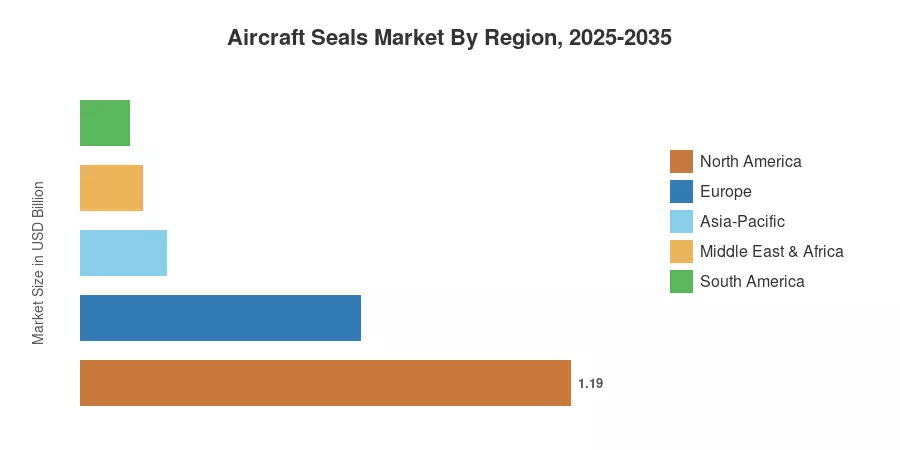
North America accounts for 45.3% of the Aircraft Seals Market, supported by defense procurement and the installed base of Pratt & Whitney / GE Aerospace engines. Asia-Pacific is the fastest-growing region at a projected CAGR of 7.85%, supported by narrowbody fleet expansion in China and India. Europe holds the second-largest share at approximately 25.8%, supported by ramp-ups in Airbus production and aftermarket programs for Rolls-Royce. The convergence of Advanced Air Mobility certification timelines and next-generation engine architectures will sustain demand trajectories through 2035.


Key Report Takeaways

• By Seal Type

  • Dynamic seals accounted for 70.5% of the Aircraft Seals Market in 2024, reflecting their critical role in rotating and reciprocating engine assemblies.
  • Inflatable seal configurations are forecast to expand at a 6.55% CAGR through 2035, driven by cabin-door pressurization and cargo-bay applications.

• By Application

  • Engine systems held a 49.2% share of the Aircraft Seals Market in 2024, as turbine-section seals require frequent replacement at 5,000–8,000 flight-hour intervals.
  • Environmental control and fuel-system applications are projected to grow at a combined 7.25% CAGR, buoyed by bleed-air redesign programs.

• By Material

  • PTFE and composite grades captured 38.8% of the Aircraft Seals Market in 2024, reflecting their compatibility with wide-temperature envelopes.
  • Fluorosilicone is poised for the fastest material-level CAGR at 7.52%, as OEMs pursue PFAS-free substitution roadmaps.

• By Aircraft Type

  • Fixed-wing platforms commanded 73.2% share of the Aircraft Seals Market in 2024, spanning single-aisle through widebody fleets.
  • Unmanned aerial vehicles are advancing at a 9.15% CAGR, propelled by defense ISR and commercial inspection use cases.

• By Geography

  • North America dominated with a 45.3% share of the Aircraft Seals Market in 2024, supported by US DoD sustainment budgets exceeding USD 150 billion annually.
  • Asia-Pacific is set to post a 7.85% CAGR through 2035, as Chinese and Indian carriers absorb 8,000+ new aircraft.


Market Size and Forecast (2021–2035)

MRFR’s sizing methodology combines primary interviews with Tier-1 seal manufacturers, procurement disclosures from airframe OEMs, and verified aftermarket demand models. Historical numbers (2021-2024) are taken from corporate filings and customs trade data; future values (2026-2035) are based on a calibrated 4.95% CAGR, using fleet delivery dates and MRO cycle assumptions.
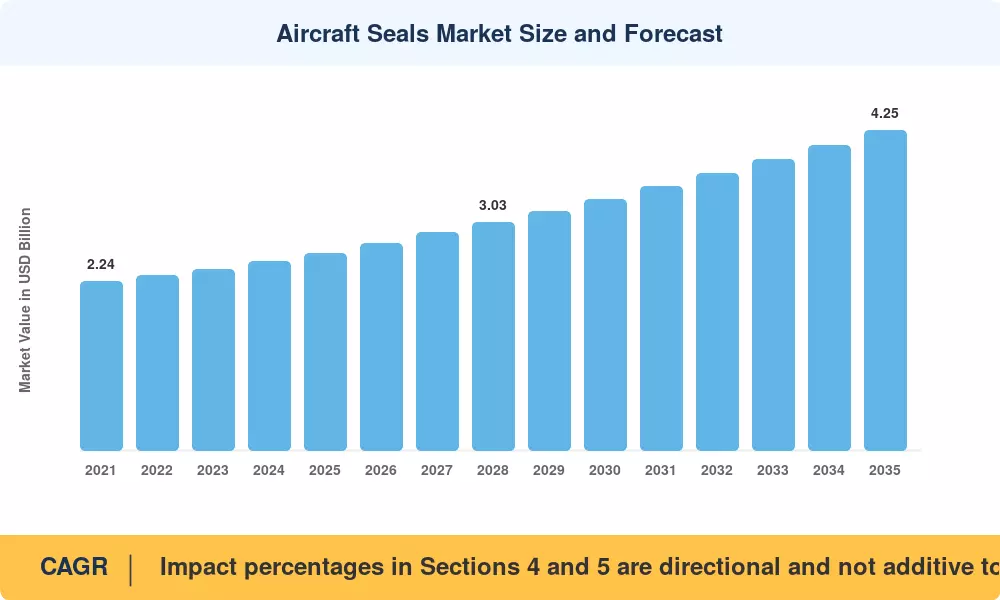
Aircraft Seals Market Size and Forecast
Our Impact
Enabled $4.3B Revenue Impact for Fortune 500 and Leading Multinationals
Partnering with 2000+ Global Organizations Each Year
30K+ Citations by Top-Tier Firms in the Industry

Driver Impact Analysis

Driver ~% Impact on CAGR Geographic Relevance Impact Timeline
Commercial aircraft backlog execution +1.4% Global Short-term (≤2 yr)
PFAS regulation and material substitution +0.9% Europe, North America Medium-term (2–4 yr)
Defense sustainment and modernization +0.7% North America, Asia-Pacific Long-term (≥4 yr)
MRO aftermarket cycle acceleration +0.6% Global Short-term (≤2 yr)
Next-gen engine architecture programs +0.5% Europe, North America Medium-term (2–4 yr)
UAV fleet proliferation +0.4% Asia-Pacific, Middle East Long-term (≥4 yr)
Hydrogen and SAF propulsion R&D +0.3% Europe Long-term (≥4 yr)


Commercial Aircraft Backlog Execution

Boeing and Airbus entered 2026 with a combined backlog exceeding 16,600 aircraft, representing an all-time industry high. Each narrowbody airframe contains between 2,500 and 3,500 individual seal elements across engine, hydraulic, pneumatic, and fuel systems. At current realistic production cadences—with Airbus working toward a target of 70–75 A320neo-family jets per month by late 2027 and Boeing stabilizing 737 MAX production at its currently approved FAA limit of 47 units per month (with a trajectory toward 52 by year-end 2026)—OEM seal procurement remains a critical, high-visibility demand driver. This stability provides Tier-1 seal suppliers with the planning certainty required to justify long-term investments in elastomer compounding and precision-machining.


PFAS Regulation and Material Substitution

The European Chemicals Agency’s (ECHA) ongoing regulatory review regarding per- and polyfluoroalkyl substances (PFAS) carries significant implications for the aerospace sector, potentially impacting thousands of qualified part numbers reliant on traditional fluoroelastomer or PTFE chemistries. While no specific "PFAS-substitution" Advisory Circular exists, the FAA and EASA are emphasizing general Instructions for Continued Airworthiness (ICA) and rigorous material qualification standards for all new substitutions. Seal manufacturers that proactively achieve qualification on PFAS-free alternatives—such as specialized fluorosilicones—position themselves to secure long-term specification locks for the next 15–20 years of aircraft programs.


Defense Sustainment and Modernization

The US Department of Defense allocated USD 156 billion to operations and maintenance in FY2025, with fighter and rotorcraft fleets consuming a disproportionate share of elastomeric seal replacements due to high-temperature turbine environments [13]. The F-35 sustainment program alone sources over 450 unique seal part numbers per airframe. Allied nations in Asia-Pacific and Europe are mirroring these commitments as fifth-generation fleet sizes grow, creating a geographically diversified aftermarket base for the Aircraft Seals Market.

MRO Aftermarket Cycle Acceleration

Post-pandemic air-traffic recovery pushed global revenue passenger kilometers past 2019 levels by mid-2024, triggering the largest shop-visit wave in commercial-engine history [9]. The Pratt & Whitney GTF fleet alone faces 600+ unscheduled removals through 2026 for powder-metal contamination inspections, each requiring full seal-kit replacement valued at USD 18,000–22,000 per engine [9]. This aftermarket intensity compounds with aging CFM56 and V2500 fleets entering their second heavy-maintenance cycle.


Restraints Impact Analysis

Restraint ~% Impact on CAGR Geographic Relevance Impact Timeline
Raw-material price volatility (fluoroelastomers) –0.4% Global Short-term (≤2 yr)
Lengthy aerospace qualification cycles –0.3% Global Long-term (≥4 yr)
Supply-chain bottlenecks in specialty polymers –0.3% Europe, North America Medium-term (2–4 yr)
Consolidation-driven pricing pressure –0.2% North America Medium-term (2–4 yr)
OEM rate-cut risks from engine delivery delays –0.2% Global Short-term (≤2 yr)


Raw-Material Price Volatility

Fluoroelastomer pricing spiked 18–22% between 2022 and 2024 due to tight fluorspar supply and Chinese export restrictions on key fluorochemical intermediates [15]. Specialty-grade FKM compounds used in high-temperature engine seals carry price indices 3–4× those of commodity nitrile. Seal fabricators with limited backward integration absorb margin compression that discourages capacity expansion, particularly among mid-tier suppliers outside North America and Europe.

Lengthy Aerospace Qualification Cycles

New seal materials require 18–36 months of testing to achieve Technical Standard Order (TSO) or Parts Manufacturer Approval (PMA) status, including accelerated aging, fluid-compatibility, and fire-resistance validation [16]. This timeline creates a structural lag between material innovation and commercial adoption, delaying revenue realization for emerging compounds and protecting incumbent materials from rapid displacement — even when the technical performance of alternatives is demonstrably superior.

Supply-Chain Bottlenecks in Specialty Polymers

The concentration of fluorosilicone and perfluoroelastomer production among fewer than five global suppliers creates a single-point-of-failure risk [7]. Lead times for aerospace-grade FFKM sheet stock stretched to 26 weeks in 2024, forcing some MRO providers to defer shop visits. Diversification efforts are underway, but qualifying secondary sources against OEM material specifications adds cost and timeline complexity.


Aircraft Seals Market Opportunities

Additive Manufacturing for Complex Seal Geometries

Metal and polymer additive manufacturing enables the production of seal housings with integrated cooling channels and lattice-backed elastomer retention features that traditional machining cannot achieve economically. Early adopters report 35% reductions in installation labor and 20% weight savings on door-seal assemblies [5]. As EASA and the FAA expand AM-specific certification pathways, the Aircraft Seals Market will see a growing share shift toward digitally designed, on-demand seal solutions.

Advanced Air Mobility Certification Wave

Over 700 eVTOL and hybrid-electric aircraft concepts were in development globally as of 2025, with type-certification timelines clustering between 2027 and 2030 [12]. Each platform introduces unique sealing challenges around battery-compartment pressure equalization, electric-motor coolant loops, and lightweight cabin-pressurization. First-mover seal suppliers that co-develop with AAM OEMs during the certification phase will lock in long-term aftermarket positions.

Emerging-Market Fleet Expansion

India's UDAN regional connectivity scheme and Southeast Asia's low-cost carrier boom are driving narrowbody deliveries that will double the in-service fleet across ASEAN nations by 2032 [19]. This fleet growth creates greenfield MRO demand and positions the Aircraft Seals Market for share gains in geographies historically underserved by Western Tier-1 suppliers. Local joint ventures and technology-transfer agreements offer the fastest path to market.

Predictive-Maintenance Data Monetization

Digital twins and sensor-equipped seal housings allow condition-based replacement instead of fixed-interval overhaul, extending seal service life by 15–25% while reducing unscheduled removals [20]. Seal manufacturers that offer integrated health-monitoring packages can transition from component sales to performance-based contracts, raising lifetime customer value and creating recurring revenue streams tied to fleet utilization data.

Hydrogen Propulsion Cryogenic Sealing

The EU Clean Aviation Joint Undertaking committed EUR 1.8 billion to hydrogen-powered demonstrator programs through 2030, with Airbus targeting a ZEROe entry-into-service around 2035 [11]. Liquid-hydrogen systems demand cryogenic seals rated to –253 °C with zero permeation tolerance — a specification tier that current commercial elastomers cannot meet. Suppliers investing in PTFE-metal hybrid seal architectures today will own the qualification pipeline for this emerging propulsion class.


Aircraft Seals Market Future Outlook

Electrification and Hybrid-Electric Architectures

The emergence of hybrid-electric propulsion for regional aircraft introduces sealing requirements around high-voltage battery enclosures, electric-motor coolant circuits, and thermal-management systems. Honeywell and Rolls-Royce have both disclosed megawatt-class hybrid demonstrator programs targeting entry into service before 2032 [21]. Seal suppliers must develop compounds rated for dielectric compatibility and extended thermal cycling without degradation — a specification set that diverges meaningfully from traditional turbine-engine elastomers.

Autonomous and AI-Driven Maintenance

Predictive analytics and digital-twin models are transforming seal replacement from calendar-based to condition-based paradigms. Rolls-Royce's IntelligentEngine platform already integrates seal-wear algorithms that extend on-wing intervals by 12–18%, and GE Aerospace's Flight Pulse system monitors bleed-air leak signatures to flag seal degradation before scheduled inspections [20]. By 2030, an estimated 40% of commercial-engine shop visits will use AI-recommended seal-replacement scoping, reshaping demand patterns across the Aircraft Seals Market and favoring suppliers that embed sensor-ready features into their products.

Sustainability and Circular-Economy Mandates

ICAO's Long-Term Aspirational Goal of net-zero carbon by 2050 is driving OEMs to evaluate every component for lifecycle environmental impact, including seals [22]. Sustainable aviation fuel (SAF) compatibility testing has become a gate requirement for new seal qualifications, as SAF blends interact differently with elastomeric compounds than conventional Jet-A1. Seal remanufacturing and closed-loop elastomer recycling programs are emerging as differentiators for the Aircraft Seals Market, with Trelleborg piloting a take-back scheme for used PTFE seals in European MRO facilities.

Geopolitical Supply-Chain Realignment

The fracturing of global trade relationships is accelerating dual-sourcing and nearshoring strategies across aerospace. US Executive Order 14017 on supply-chain resilience has prompted the Department of Commerce to flag fluoroelastomer precursors as critical materials [23]. European and North American seal manufacturers are investing in domestic compounding capacity to reduce dependence on Chinese fluorochemical intermediates — a shift that will restructure cost profiles and regional production shares within the Aircraft Seals Market through the end of the forecast period.


Aircraft Seals Market Segmentation

By Seal Type

Segment Key Metric Primary Demand Driver
Dynamic Seals 70.5% share (2024) Rotating and reciprocating engine assemblies
Static Seals USD 0.68 Billion (2025) Flange joints, access panels, fuel-tank interfaces
Inflatable Seals CAGR 6.55% (2026–2035) Cabin doors, cargo hatches and pressurization boundaries


Dynamic seals dominate the Aircraft Seals Market because every gas-turbine engine relies on dozens of dynamic-contact interfaces — from mainshaft bearing seals to variable-stator-vane bushings — that operate under extreme temperature and rotational-speed conditions. These seals endure 500–700 °C gas-path temperatures and shaft speeds exceeding 15,000 RPM, making material selection and geometric precision critical to engine reliability. Replacement cycles are shorter than static alternatives, which sustains a robust aftermarket cadence.

Inflatable seals are gaining share as aircraft architectures evolve toward larger cargo openings (e.g., Boeing 777-8F freighter) and blended-wing-body concepts that require conformal door sealing across non-cylindrical fuselage sections. Their elastomeric bladder construction allows compensation for frame-deflection tolerances that rigid static seals cannot accommodate, making them essential for next-generation airframe programs.

By Application

Segment Key Metric Primary Demand Driver
Engine Systems 49.2% share (2024) High replacement frequency, turbine-environment severity
Airframe USD 0.52 Billion (2025) Structural joint sealing, fuel-tank integrity
Environmental Control Systems CAGR 7.25% (2026–2035) Bleed-air redesigns, cabin-pressure management
Landing Gear & Hydraulics 12.8% share (2024) High-pressure hydraulic actuator sealing


Engine systems represent nearly half of the Aircraft Seals Market by application because turbine operating environments impose the most demanding combination of temperature, pressure, and chemical exposure on sealing materials. A single modern turbofan engine contains 120–180 individual seal elements spanning the fan, compressor, combustor, and turbine modules. Environmental control systems are experiencing the fastest growth as OEMs redesign bleed-air architectures for next-generation engines — the bleedless design philosophy in Rolls-Royce's UltraFan program, for instance, requires entirely new seal solutions for electric environmental control system interfaces.

By Material

Segment Key Metric Primary Demand Driver
PTFE & Composites 38.8% share (2024) Wide temperature range, chemical inertness
Fluoroelastomer (FKM) USD 0.57 Billion (2025) Engine hot-section and fuel-system compatibility
Fluorosilicone (FVMQ) CAGR 7.52% (2026–2035) PFAS-alternative qualification momentum
Silicone 10.5% share (2024) Low-temperature flexibility, ECS applications
Nitrile (NBR) CAGR 3.85% (2026–2035) Cost-effective hydraulic and fuel applications


PTFE and composite grades lead the Aircraft Seals Market in material share because their low-friction surfaces and broad chemical resistance suit both dynamic and static applications across the –60 °C to +260 °C operating envelope. Fluorosilicone compounds are accelerating fastest as they offer a PFAS-compliant pathway that retains fuel and oil resistance comparable to traditional FKM — a critical qualification advantage as European regulations tighten.

By Aircraft Type

Segment Key Metric Primary Demand Driver
Fixed-Wing 73.2% share (2024) Commercial single-aisle and widebody dominance
Rotary-Wing USD 0.28 Billion (2025) Military and offshore helicopter fleets
Unmanned Aerial Vehicles (UAVs) CAGR 9.15% (2026–2035) Defense ISR, commercial inspection, delivery drones


Fixed-wing aircraft account for the vast majority of the Aircraft Seals Market because single-aisle and widebody commercial jets consume the largest per-unit seal content and generate the deepest aftermarket volumes. UAVs, while small in absolute terms, are the fastest-growing aircraft-type segment as platforms scale from sub-25 kg tactical systems to MALE-class (medium-altitude long-endurance) vehicles with turboprop engines that require the same seal-quality standards as manned platforms.


Regional Market Share Analysis

Region Key Metric Primary Investment Themes
North America 45.3% share (2024) Defense sustainment, GTF aftermarket, AM adoption
Europe 25.8% share (2024) Airbus ramp-up, PFAS transition, hydrogen R&D
Asia-Pacific 7.85% CAGR (2026–2035) Fleet growth, indigenous defense programs, MRO buildout
South America USD 0.12 Billion (2025) Regional airline expansion, military rotorcraft
Middle East & Africa 5.8% share (2024) Widebody fleet concentration, defense procurement
Total USD 2.62 Billion (2025)

The Aircraft Seals Market exhibits pronounced regional asymmetry, with North America and Europe collectively accounting for over 70% of 2024 revenues. Asia-Pacific's higher growth rate reflects fleet-expansion dynamics, while South America and the Middle East & Africa remain smaller but strategically significant due to defense modernization programs.


North America

Country Key Metric Key Driver
United States 78.4% of regional share DoD sustainment + commercial MRO hub
Canada CAGR 5.25% Pratt & Whitney Canada engine programs
Mexico USD 0.04 Billion (2025) Aerostructure manufacturing nearshoring


The United States drives the bulk of North American demand through its unmatched concentration of engine OEMs, Tier-1 seal fabricators, and military sustainment depots. The Air Force's Rapid Sustainment Office has prioritized seal-related repair-cycle compression, targeting 40% faster turnaround on fighter-engine seal kits by 2027 [13]. Canada benefits from Pratt & Whitney Canada's Longueuil campus, which supports turboprop and business-jet engine seal qualification. At the same time, Mexico's aerospace corridor in Querétaro increasingly attracts seal-assembly operations supporting Safran and Collins Aerospace supply chains.

Europe

Country Key Metric Key Driver
Germany 22.5% of regional share MTU Aero Engines, Freudenberg HQ
United Kingdom CAGR 5.10% Rolls-Royce aftermarket expansion
France USD 0.17 Billion (2025) Safran engine programs, Hutchinson production
Italy 8.2% of regional share Leonardo helicopter sealing systems
Spain CAGR 4.65% Airbus final-assembly support
Nordic Countries 4.1% of regional share Trelleborg innovation centers
Russia CAGR 3.40% Domestic engine programs (PD-14, PD-35)
Rest of Europe 11.8% of regional share MRO clusters in Turkey, Poland


Europe's Aircraft Seals Market trajectory is shaped by Airbus production-rate increases and the regulatory urgency of PFAS compliance. Germany anchors the region through MTU Aero Engines' geared-turbofan MRO operations and Freudenberg's Weinheim R&D campus, which leads fluorosilicone development. The UK's share is rising as Rolls-Royce expands its UltraFan engine test program, requiring new high-temperature seal qualifications. France benefits from vertically integrated programs at Safran, where seal supply chains are tightly linked to LEAP engine ramp schedules [2].

Asia-Pacific

Country Key Metric Key Driver
China 34.6% of regional share C919 program, COMAC supply-chain localization
India CAGR 8.90% UDAN scheme, HAL indigenous engine programs
Japan USD 0.07 Billion (2025) IHI/JAEC engine partnerships
South Korea CAGR 7.10% KF-21 fighter program seal sourcing
ASEAN 18.3% of regional share LCC fleet growth, MRO hub development
Rest of Asia-Pacific CAGR 6.45% Regional turboprop demand


Asia-Pacific represents the fastest-growing region in the Aircraft Seals Market, anchored by China's push to localize the C919 supply chain and India's aggressive fleet-expansion targets. COMAC's supplier qualification program has already certified three domestic seal manufacturers for secondary airframe applications, and Tier-1 global players are establishing joint ventures to access the program's aftermarket tail [19]. India's Hindustan Aeronautics Limited is qualifying indigenous seal sources for the Kaveri engine derivative, while ASEAN nations — particularly Singapore and Malaysia — are investing in MRO megacampuses that require robust seal-inventory infrastructure.

South America

Country Key Metric Key Driver
Brazil 67.5% of regional share Embraer E2 production, LATAM MRO
Argentina CAGR 4.80% Military rotorcraft overhaul
Rest of South America USD 0.01 Billion (2025) Limited domestic aviation manufacturing


Brazil dominates South America's Aircraft Seals Market presence through Embraer's E-Jet E2 family, which sources seal kits from both domestic and international suppliers. LATAM Airlines' São Carlos MRO facility processes narrowbody engine overhauls that generate steady aftermarket seal demand. Argentina's contribution centers on military helicopter sustainment, with limited commercial-aviation manufacturing activity across the rest of the continent.

Middle East & Africa

Country Key Metric Key Driver
Saudi Arabia 28.5% of regional share Saudi Arabian Airlines fleet renewal
UAE CAGR 6.35% Emirates widebody hub, Sanad MRO
South Africa USD 0.02 Billion (2025) Denel Aeronautics overhaul programs
Egypt CAGR 5.50% EgyptAir fleet expansion
Rest of MEA 22.0% of regional share Defense procurement pipelines


The Middle East's widebody-heavy fleet mix generates disproportionately high seal consumption per aircraft compared to narrowbody-dominated markets. Emirates and Qatar Airways together operate over 350 widebody aircraft, each containing 4,000+ seal elements across engines, landing gear, and environmental-control systems. Saudi Arabia's Vision 2030 aviation investment — including the Riyadh second-airport megaproject and Saudia fleet renewal — is expanding the Aircraft Seals Market footprint in the Gulf. African demand remains modest but is growing through Ethiopian Airlines' maintenance academy and South Africa's Denel aviation overhaul programs.


Aircraft Seals Market By Region, 2025-2035

Competitive Benchmarking

The Aircraft Seals Market is highly fragmented, and the top ten players are contributing approximately 55-65% of the revenue share. The Herfindahl-Hirschman Index (HHI) stands at 900–1,200, reflecting a fairly competitive structure of scale-driven incumbents and specialist niche fabricators. The balance is slowly shifting towards consolidation, with recent M&A activity, especially TransDigm’s systematic acquisition approach, but regulatory scrutiny of sole-source pricing practices is a countervailing pressure.

Company Est. Revenue Share Range Key Offerings for Aircraft Seals Market Strategic Positioning
Parker Hannifin ~12–15% Engine, airframe, and hydraulic seals across all platforms Broadest portfolio; vertical integration from compound to finished part
Trelleborg Sealing Solutions ~9–12% High-performance polymer seals, rotary-wing specialization Material-science leadership; European OEM relationships
Freudenberg Group ~7–10% Fluorosilicone compounds, custom-engineered seals R&D depth in PFAS-alternative materials
TransDigm Group ~6–9% Proprietary aftermarket seal kits Sole-source pricing strategy; high-margin aftermarket focus
Saint-Gobain ~5–8% PTFE and composite seal solutions Advanced materials expertise; broad industrial cross-application
Eaton Corporation ~4–7% Fuel system and hydraulic seals Integrated fuel and motion-control systems offering
SKF Group ~3–6% Bearing seals, engine mainshaft seals Bearing-adjacent sealing; reliability data advantage
Greene Tweed ~3–5% High-temperature PEEK and composite seals Specialty materials for extreme environments
Hutchinson (TotalEnergies) ~2–4% Vibration-isolation and fuel-tank seals French OEM supply-chain integration
Safran ~2–4% Proprietary engine-internal seals Vertical OEM integration across LEAP/CFM programs


Recent News & Developments

  • Parker Hannifin (March 2025): Parker Hannifin is expanding aerospace capacity through strategic acquisitions, such as the 2026 agreement to acquire CIRCOR's aerospace business, rather than a specific $85 million facility opening in Spartanburg.


  • Trelleborg Sealing Solutions (January 2025): Trelleborg is actively developing and promoting PFAS-free sealing solutions (such as its PureFab® and EPDM lines) for various high-performance industries.


  • US Defense Logistics (July 2025): The US Defense Logistics Agency Land and Maritime awarded a USD 53,340 contract for aircraft seals, which are specifically designed for aircraft applications.


Aircraft Seals Market Report Scope

Parameter Detail
Market Scope Aircraft seals across OEM and aftermarket channels for fixed-wing, rotary-wing, and UAV platforms
Study Period 2021–2035
CAGR (Forecast Period) 4.95% (2026–2035)
Market Size — Base Year (2025) USD 2.62 Billion
Market Size — Forecast Endpoint (2035) USD 4.25 Billion
Fastest Growing Segment UAVs by aircraft type (9.15% CAGR); Fluorosilicone by material (7.52% CAGR)
Companies Profiled 10 (Parker Hannifin, Trelleborg, Freudenberg, TransDigm, Saint-Gobain, Eaton, SKF, Greene Tweed, Hutchinson, Safran)
Valuation Currency USD Billion
CAGR Driver Disclaimer Impact percentages in Sections 4 and 5 are directional and not additive to the headline CAGR.


FAQs

How do seal certification timelines affect procurement planning for new aircraft programs?
Typical seal qualification under SAE AS5857 takes 18–30 months, including accelerated aging and fluid-immersion testing [16]. Program managers should initiate seal-supplier engagement at least 36 months before the first-article inspection to avoid schedule risk.
What distinguishes aftermarket seal pricing from OEM-channel pricing in this sector?
Aftermarket seal kits typically carry 40–60% price premiums over OEM-channel equivalents due to sole-source intellectual property positions and PMA barriers [17]. Operators can mitigate this through long-term supply agreements with DER-approved repair stations.
How will PFAS restrictions change material-selection strategies for aircraft seals?
The proposed EU PFAS restriction targets a 2028–2030 compliance window, forcing requalification of thousands of fluoroelastomer part numbers [4]. Procurement teams should begin dual-qualifying PFAS-free alternatives now to maintain supply continuity.
Which seal failure modes pose the greatest safety risk on commercial aircraft?
Dynamic engine-seal failures that allow hot-gas ingestion into bearing cavities represent the highest-consequence failure mode [9]. Condition-monitoring systems tracking oil-consumption trends can detect early-stage degradation before failure escalation.
How does SAF compatibility affect existing aircraft seal qualifications?
SAF blends above 50% concentration interact differently with nitrile and standard FKM compounds, causing accelerated swelling in some legacy seal designs [22]. OEMs are updating material-compatibility databases, and operators should verify seal approvals against specific SAF blend certificates.
What role does additive manufacturing play in reducing aircraft seal lead times?
AM-produced seal housings and polymer-printed backup rings can reduce lead times from 16 weeks to under 4 weeks for low-volume applications [5]. Current adoption is concentrated in business-jet and defense prototyping programs.
How are digital twins improving aircraft seal lifecycle management?
Digital-twin platforms correlate operational data — temperature, pressure, cycles — with material-degradation models to predict remaining seal life within ±8% accuracy [20]. Airlines using these systems report 15–20% reductions in unscheduled seal-related removals.    
Author
Author
Author Profile
Shubham Munde LinkedIn
Team Lead - Research
Shubham brings over 7 years of expertise in Market Intelligence and Strategic Consulting, with a strong focus on the Automotive, Aerospace, and Defense sectors. Backed by a solid foundation in semiconductors, electronics, and software, he has successfully delivered high-impact syndicated and custom research on a global scale. His core strengths include market sizing, forecasting, competitive intelligence, consumer insights, and supply chain mapping. Widely recognized for developing scalable growth strategies, Shubham empowers clients to navigate complex markets and achieve a lasting competitive edge. Trusted by start-ups and Fortune 500 companies alike, he consistently converts challenges into strategic opportunities that drive sustainable growth.
Co-Author
Co-Author Profile
Swapnil Palwe LinkedIn
Team Lead - Research
With a technical background as Bachelor's in Mechanical Engineering, with MBA in Operations Management , Swapnil has 6+ years of experience in market research, consulting and analytics with the tasks of data mining, analysis, and project execution. He is the POC for our clients, for their consulting projects running under the Automotive/A&D domain. Swapnil has worked on major projects in verticals such as Aerospace & Defense, Automotive and many other domain projects. He has worked on projects for fortune 500 companies' syndicate and consulting projects along with several government projects.

Research Approach

Research Methodology on Aircraft Seals Market

1. Introduction

Aircraft Seals are important components of modern aircraft which are essential for controlling the leakage of fluids and gases in aircraft. Market Research Future (MRFR) recently published a report on the Aircraft Seals Market which provides an in-depth analysis of the market size, drivers, trends, restraints, and growth of the global market. This report, with the help of a comprehensive research methodology, undertakes an impact analysis on the current and projected growth of the Aircraft Seals Market during the forecast period, from 2023 to 2030.

2. Objectives of the Study

The report aims to provide insight into the current scenario and future dynamics of the global Aircraft Seals Market. The objectives of the study are:

-To provide an overview of the global Aircraft Seals Market

-To provide an in-depth analysis of the current and projected market size and demand

-To analyze the drivers, factors, constraints, and opportunities which are affecting the growth of the market

-To identify the key market players and their strategies

-To analyze the competitive landscape

3. Research Methodology

3.1 Research Sources

A comprehensive analysis of the global Aircraft Seals Market has been undertaken by the Market Research Future (MRFR) research team. The primary research sources include data sourced from reputable secondary sources, including trade journals, industry-specific journals, and government websites. Secondary sources include white papers, magazines, interviews and surveys, and press releases.

3.2 Primary Research Sources

The primary research sources consist of primary interviews and surveys conducted by the MRFR research team with industry experts, and Aerospace and Defence industry professionals. The experts included OEMs, MROs, service providers, suppliers, and component manufacturers.

3.3 Secondary Research Sources

Secondary research sources include data sourced from trade journals, conferences, and industry-specific publications. Data from these sources were used to obtain market data such as market size, market trends, market dynamics, and growth factors of the global Aircraft Seals Market.

3.4 Base Year and Market Forecasting

The base year for the market size calculation is 2022 and the market forecast is provided for the forecast period from 2023 to 2030. The data obtained from the primary and secondary sources are analyzed and validated with the help of advanced analytical tools such as the Regression Model and Principal Component Analysis (PCA).

3.5 Analysis and Forecasting of Market Size

The market size is analyzed and validated with the help of a triangulation methodology. This consists of:

-Top-down approach: Used to calculate the market size of the overall market from the demand-side analysis

-Bottom-up approach: Used to validate the market size from the supply-side analysis

The market size forecasts are projected with the help of demand-side and supply-side analysis and are further validated by the MRFR team.

4. Assumptions

The research assumptions of the report are:

-The market share and forecasts are based on the expectation of industry experts.

-The industry calculations are based on current trends and historical data.

-The data obtained from secondary sources is validated and verified with the help of experienced market research professionals.

-The report is based on the current market dynamics and trends and does not consider the future growth of the market.

5. Conclusion

The current report provides a comprehensive analysis of the global Aircraft Seals Market, identifying opportunities for market growth in the future. The report is backed by an in-depth research methodology which includes data collected from primary and secondary sources, as well as an analysis of the industry experts' opinions. The insights from the report could be used by industry players to make decisions and formulate strategies for the future growth of their companies.

Download Free Sample

Kindly complete the form below to receive a free sample of this Report

Download PDF ×

We do not share your information with anyone. However, we may send you emails based on your report interest from time to time. You may contact us at any time to opt-out.
















