Aircraft Seals Market (2026 - 2035)

ID: MRFR/AD/4657-HCR
100 Pages
Shubham Munde
Last Updated: July 02, 2026
Aircraft Seals Market Size, Share, Industry Trend & Analysis Research Report Information By Seal Type (Dynamic Seals, Static Seals, Inflatable Seals), By Application (Engine Systems, Airframe, Environmental Control Systems, Landing Gear & Hydraulics), By Material (PTFE & Composites, Fluoroelastomer (FKM), Fluorosilicone (FVMQ), Silicone, Nitrile (NBR)), By Aircraft Type (Fixed-Wing, Rotary-Wing, Unmanned Aerial Vehicles (UAVs)) - Forecast till 2035
Aircraft Seals Market
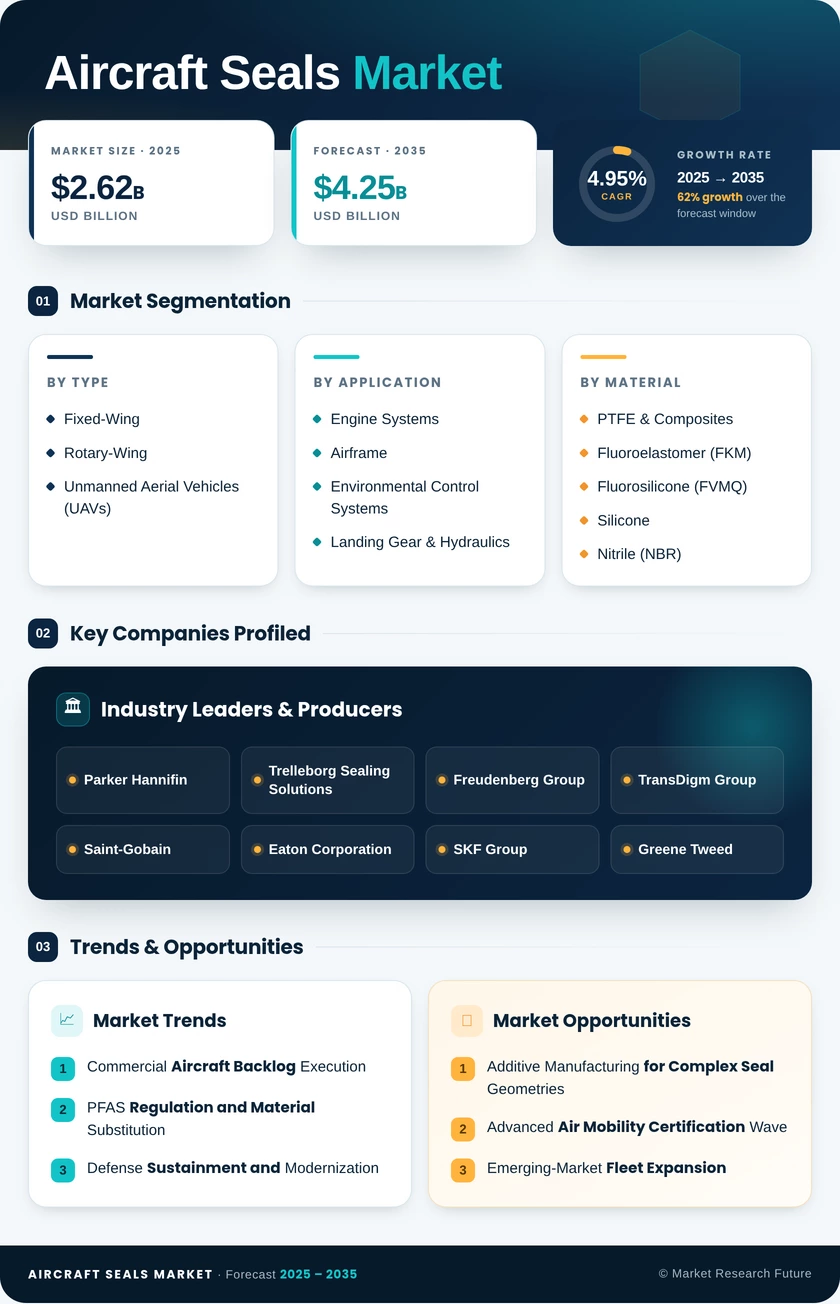
Market Size
Forecast Period2026-2035
CAGR (2026-2035)4.95%
2025 Market SizeUSD 2.62 Billion
2035 Market SizeUSD 4.25 Billion
Key Players
Parker Hannifin
Trelleborg Sealing Solutions
Freudenberg Group
TransDigm Group
Saint-Gobain
Eaton Corporation
Opportunities
  • Additive Manufacturing for Complex Seal Geometries
  • Advanced Air Mobility Certification Wave
  • Emerging-Market Fleet Expansion
  1. 1 Market Overview |
    1. 1.1 Study Assumptions & Market Definition |
    2. 1.2 Scope of the Study |
    3. 1.3 Research Methodology
  2. 2 Market Summary & Key Takeaways
  3. 3 Market Dynamics |
    1. 3.1 Market Drivers Analysis | |
      1. 3.1.1 Commercial Aircraft Backlog Execution | |
      2. 3.1.2 PFAS Regulation and Material Substitution | |
      3. 3.1.3 Defense Sustainment and Modernization | |
      4. 3.1.4 MRO Aftermarket Cycle Acceleration | |
      5. 3.1.5 Next-Generation Engine Architecture Programs | |
      6. 3.1.6 UAV Fleet Proliferation | |
      7. 3.1.7 Hydrogen and SAF Propulsion R&D |
    2. 3.2 Market Restraints Analysis | |
      1. 3.2.1 Raw-Material Price Volatility (Fluoroelastomers) | |
      2. 3.2.2 Lengthy Aerospace Qualification Cycles | |
      3. 3.2.3 Supply-Chain Bottlenecks in Specialty Polymers | |
      4. 3.2.4 Consolidation-Driven Pricing Pressure | |
      5. 3.2.5 OEM Rate-Cut Risks from Engine Delivery Delays |
    3. 3.3 Market Opportunity Analysis | |
      1. 3.3.1 Additive Manufacturing for Complex Seal Geometries | |
      2. 3.3.2 Advanced Air Mobility Certification Wave | |
      3. 3.3.3 Emerging-Market Fleet Expansion | |
      4. 3.3.4 Predictive-Maintenance Data Monetization | |
      5. 3.3.5 Hydrogen Propulsion Cryogenic Sealing |
    4. 3.4 Industry Value Chain Analysis |
    5. 3.5 Porter's Five Forces Analysis
  4. 4 Global Aircraft Seals Market Size & Forecast (2021–2035) |
    1. 4.1 Historical Market Size (2021–2025) |
    2. 4.2 Current & Forecast Market Size (2026–2035) |
    3. 4.3 Market Size by Revenue (USD Billion) |
    4. 4.4 Year-over-Year Growth Analysis
  5. 5 Segmentation Analysis |
    1. 5.1 By Seal Type | |
      1. 5.1.1 Dynamic Seals | |
      2. 5.1.2 Static Seals | |
      3. 5.1.3 Inflatable Seals |
    2. 5.2 By Application | |
      1. 5.2.1 Engine Systems | |
      2. 5.2.2 Airframe | |
      3. 5.2.3 Environmental Control Systems | |
      4. 5.2.4 Landing Gear & Hydraulics |
    3. 5.3 By Material | |
      1. 5.3.1 PTFE & Composites | |
      2. 5.3.2 Fluoroelastomer (FKM) | |
      3. 5.3.3 Fluorosilicone (FVMQ) | |
      4. 5.3.4 Silicone | |
      5. 5.3.5 Nitrile (NBR) |
    4. 5.4 By Aircraft Type | |
      1. 5.4.1 Fixed-Wing | |
      2. 5.4.2 Rotary-Wing | |
      3. 5.4.3 Unmanned Aerial Vehicles (UAVs)
  6. 6 Regional Analysis |
    1. 6.1 North America | |
      1. 6.1.1 United States | |
      2. 6.1.2 Canada | |
      3. 6.1.3 Mexico |
    2. 6.2 Europe | |
      1. 6.2.1 Germany | |
      2. 6.2.2 United Kingdom | |
      3. 6.2.3 France | |
      4. 6.2.4 Italy | |
      5. 6.2.5 Spain | |
      6. 6.2.6 Nordic Countries | |
      7. 6.2.7 Russia | |
      8. 6.2.8 Rest of Europe |
    3. 6.3 Asia-Pacific | |
      1. 6.3.1 China | |
      2. 6.3.2 India | |
      3. 6.3.3 Japan | |
      4. 6.3.4 South Korea | |
      5. 6.3.5 ASEAN | |
      6. 6.3.6 Rest of Asia-Pacific |
    4. 6.4 South America | |
      1. 6.4.1 Brazil | |
      2. 6.4.2 Argentina | |
      3. 6.4.3 Rest of South America |
    5. 6.5 Middle East & Africa | |
      1. 6.5.1 Saudi Arabia | |
      2. 6.5.2 UAE | |
      3. 6.5.3 South Africa | |
      4. 6.5.4 Egypt | |
      5. 6.5.5 Rest of MEA
  7. 7 Competitive Landscape |
    1. 7.1 Market Share Analysis (2024) |
    2. 7.2 Competitive Benchmarking Matrix |
    3. 7.3 Company Profiles | |
      1. 7.3.1 Parker Hannifin | |
      2. 7.3.2 Trelleborg Sealing Solutions | |
      3. 7.3.3 Freudenberg Group | |
      4. 7.3.4 TransDigm Group | |
      5. 7.3.5 Saint-Gobain | |
      6. 7.3.6 Eaton Corporation | |
      7. 7.3.7 SKF Group | |
      8. 7.3.8 Greene Tweed | |
      9. 7.3.9 Hutchinson (TotalEnergies) | |
      10. 7.3.10 Safran
  8. 8 Future Outlook & Strategic Recommendations (2026–2035) |
    1. 8.1 Electrification and Hybrid-Electric Architectures |
    2. 8.2 Autonomous and AI-Driven Maintenance |
    3. 8.3 Sustainability and Circular-Economy Mandates |
    4. 8.4 Geopolitical Supply-Chain Realignment
  9. 9 Recent Developments & News
  10. 10 Frequently Asked Questions (FAQs)
  11. 11 Report Scope & Methodology |
    1. 11.1 Study Period & Base Year |
    2. 11.2 Data Sources & Citations |
    3. 11.3 Abbreviations
  12. 12 LIST OF TABLES |
  13. TABLE 1 Global Aircraft Seals Market Size & Forecast, by Revenue (USD Billion), 2021–2035 |
  14. TABLE 2 Global Aircraft Seals Market — Year-over-Year Growth Analysis, 2021–2035 |
  15. TABLE 3 Global Aircraft Seals Market — Driver Impact Analysis |
  16. TABLE 4 Global Aircraft Seals Market — Restraints Impact Analysis |
  17. TABLE 5 Global Aircraft Seals Market — Regional Summary Table |
  18. TABLE 6 North America Aircraft Seals Market Size, by Country, 2021–2035 (USD Billion) |
  19. TABLE 7 Europe Aircraft Seals Market Size, by Country, 2021–2035 (USD Billion) |
  20. TABLE 8 Asia-Pacific Aircraft Seals Market Size, by Country, 2021–2035 (USD Billion) |
  21. TABLE 9 South America Aircraft Seals Market Size, by Country, 2021–2035 (USD Billion) |
  22. TABLE 10 Middle East & Africa Aircraft Seals Market Size, by Country, 2021–2035 (USD Billion) |
  23. TABLE 11 Global Aircraft Seals Market Size, by Seal Type, 2021–2035 (USD Billion) |
  24. TABLE 12 Global Aircraft Seals Market Size, by Application, 2021–2035 (USD Billion) |
  25. TABLE 13 Global Aircraft Seals Market Size, by Material, 2021–2035 (USD Billion) |
  26. TABLE 14 Global Aircraft Seals Market Size, by Aircraft Type, 2021–2035 (USD Billion) |
  27. TABLE 15 Competitive Benchmarking Matrix — Global Aircraft Seals Market, 2024 |
  28. TABLE 16 Company Profiles — Key Players, Global Aircraft Seals Market |
  29. TABLE 17 Recent Developments & Strategic Announcements, 2023–2025 |
  30. TABLE 18 Report Scope & Methodology Summary |
  31. TABLE 19 Detailed Sources and Citations |
  32. TABLE 20 North America Aircraft Seals Market Size, by Seal Type, 2021–2035 (USD Billion) |
  33. TABLE 21 North America Aircraft Seals Market Size, by Application, 2021–2035 (USD Billion) |
  34. TABLE 22 North America Aircraft Seals Market Size, by Material, 2021–2035 (USD Billion) |
  35. TABLE 23 North America Aircraft Seals Market Size, by Aircraft Type, 2021–2035 (USD Billion) |
  36. TABLE 24 Europe Aircraft Seals Market Size, by Seal Type, 2021–2035 (USD Billion) |
  37. TABLE 25 Europe Aircraft Seals Market Size, by Application, 2021–2035 (USD Billion) |
  38. TABLE 26 Europe Aircraft Seals Market Size, by Material, 2021–2035 (USD Billion) |
  39. TABLE 27 Europe Aircraft Seals Market Size, by Aircraft Type, 2021–2035 (USD Billion) |
  40. TABLE 28 Asia-Pacific Aircraft Seals Market Size, by Seal Type, 2021–2035 (USD Billion) |
  41. TABLE 29 Asia-Pacific Aircraft Seals Market Size, by Application, 2021–2035 (USD Billion) |
  42. TABLE 30 Asia-Pacific Aircraft Seals Market Size, by Material, 2021–2035 (USD Billion) |
  43. TABLE 31 Asia-Pacific Aircraft Seals Market Size, by Aircraft Type, 2021–2035 (USD Billion) |
  44. TABLE 32 South America Aircraft Seals Market Size, by Seal Type, 2021–2035 (USD Billion) |
  45. TABLE 33 South America Aircraft Seals Market Size, by Application, 2021–2035 (USD Billion) |
  46. TABLE 34 South America Aircraft Seals Market Size, by Material, 2021–2035 (USD Billion) |
  47. TABLE 35 South America Aircraft Seals Market Size, by Aircraft Type, 2021–2035 (USD Billion) |
  48. TABLE 36 Middle East & Africa Aircraft Seals Market Size, by Seal Type, 2021–2035 (USD Billion) |
  49. TABLE 37 Middle East & Africa Aircraft Seals Market Size, by Application, 2021–2035 (USD Billion) |
  50. TABLE 38 Middle East & Africa Aircraft Seals Market Size, by Material, 2021–2035 (USD Billion) |
  51. TABLE 39 Middle East & Africa Aircraft Seals Market Size, by Aircraft Type, 2021–2035 (USD Billion) |
  52. TABLE 40 United States Aircraft Seals Market Size, by Seal Type, 2021–2035 (USD Billion) |
  53. TABLE 41 United States Aircraft Seals Market Size, by Application, 2021–2035 (USD Billion) |
  54. TABLE 42 United States Aircraft Seals Market Size, by Material, 2021–2035 (USD Billion) |
  55. TABLE 43 United States Aircraft Seals Market Size, by Aircraft Type, 2021–2035 (USD Billion) |
  56. TABLE 44 China Aircraft Seals Market Size, by Seal Type, 2021–2035 (USD Billion) |
  57. TABLE 45 China Aircraft Seals Market Size, by Application, 2021–2035 (USD Billion) |
  58. TABLE 46 China Aircraft Seals Market Size, by Material, 2021–2035 (USD Billion) |
  59. TABLE 47 China Aircraft Seals Market Size, by Aircraft Type, 2021–2035 (USD Billion) |
  60. TABLE 48 India Aircraft Seals Market Size, by Seal Type, 2021–2035 (USD Billion) |
  61. TABLE 49 India Aircraft Seals Market Size, by Application, 2021–2035 (USD Billion) |
  62. TABLE 50 India Aircraft Seals Market Size, by Material, 2021–2035 (USD Billion) |
  63. TABLE 51 India Aircraft Seals Market Size, by Aircraft Type, 2021–2035 (USD Billion) |
  64. TABLE 52 Germany Aircraft Seals Market Size, by Seal Type, 2021–2035 (USD Billion) |
  65. TABLE 53 Germany Aircraft Seals Market Size, by Application, 2021–2035 (USD Billion) |
  66. TABLE 54 Germany Aircraft Seals Market Size, by Material, 2021–2035 (USD Billion) |
  67. TABLE 55 Germany Aircraft Seals Market Size, by Aircraft Type, 2021–2035 (USD Billion) |
  68. TABLE 56 United Kingdom Aircraft Seals Market Size, by Seal Type, 2021–2035 (USD Billion) |
  69. TABLE 57 United Kingdom Aircraft Seals Market Size, by Application, 2021–2035 (USD Billion) |
  70. TABLE 58 United Kingdom Aircraft Seals Market Size, by Material, 2021–2035 (USD Billion) |
  71. TABLE 59 United Kingdom Aircraft Seals Market Size, by Aircraft Type, 2021–2035 (USD Billion) |
  72. TABLE 60 Japan Aircraft Seals Market Size, by Seal Type, 2021–2035 (USD Billion) |
  73. TABLE 61 Japan Aircraft Seals Market Size, by Application, 2021–2035 (USD Billion) |
  74. TABLE 62 Japan Aircraft Seals Market Size, by Material, 2021–2035 (USD Billion) |
  75. TABLE 63 Japan Aircraft Seals Market Size, by Aircraft Type, 2021–2035 (USD Billion) |
  76. TABLE 64 Brazil Aircraft Seals Market Size, by Seal Type, 2021–2035 (USD Billion) |
  77. TABLE 65 Brazil Aircraft Seals Market Size, by Application, 2021–2035 (USD Billion) |
  78. TABLE 66 Brazil Aircraft Seals Market Size, by Material, 2021–2035 (USD Billion) |
  79. TABLE 67 Brazil Aircraft Seals Market Size, by Aircraft Type, 2021–2035 (USD Billion) |
  80. TABLE 68 UAE Aircraft Seals Market Size, by Seal Type, 2021–2035 (USD Billion) |
  81. TABLE 69 UAE Aircraft Seals Market Size, by Application, 2021–2035 (USD Billion) |
  82. TABLE 70 UAE Aircraft Seals Market Size, by Material, 2021–2035 (USD Billion) |
  83. TABLE 71 UAE Aircraft Seals Market Size, by Aircraft Type, 2021–2035 (USD Billion)
  84. 13 LIST OF FIGURES |
  85. FIGURE 1 Aircraft Seals Market Dynamics Overview (Drivers, Restraints, Opportunities) |
  86. FIGURE 2 Aircraft Seals Market — Value Chain Analysis |
  87. FIGURE 3 Aircraft Seals Market — Porter's Five Forces Analysis |
  88. FIGURE 4 Global Aircraft Seals Market Size & Forecast Trend (USD Billion), 2021–2035 |
  89. FIGURE 5 Aircraft Seals Market Share, by Seal Type, 2024 |
  90. FIGURE 6 Aircraft Seals Market Share, by Application, 2024 |
  91. FIGURE 7 Aircraft Seals Market Share, by Material, 2024 |
  92. FIGURE 8 Aircraft Seals Market Share, by Aircraft Type, 2024 |
  93. FIGURE 9 Aircraft Seals Market Share, by Region, 2024 |
  94. FIGURE 10 North America Aircraft Seals Market Size Trend (USD Billion), 2021–2035 |
  95. FIGURE 11 Europe Aircraft Seals Market Size Trend (USD Billion), 2021–2035 |
  96. FIGURE 12 Asia-Pacific Aircraft Seals Market Size Trend (USD Billion), 2021–2035 |
  97. FIGURE 13 South America Aircraft Seals Market Size Trend (USD Billion), 2021–2035 |
  98. FIGURE 14 Middle East & Africa Aircraft Seals Market Size Trend (USD Billion), 2021–2035 |
  99. FIGURE 15 Competitive Landscape — Market Share Analysis, 2024 |
  100. FIGURE 16 Competitive Positioning Matrix — Aircraft Seals Market, 2024

Segmentation Quick Reference

DimensionSub-SegmentsDominant SegmentFastest Growing Segment
Seal TypeDynamic Seals, Static Seals, Inflatable SealsDynamic SealsInflatable Seals
ApplicationEngine Systems, Airframe, Environmental Control Systems, Landing Gear & HydraulicsEngine SystemsEnvironmental Control Systems
MaterialPTFE & Composites, Fluoroelastomer (FKM), Fluorosilicone (FVMQ), Silicone, Nitrile (NBR)PTFE & CompositesFluorosilicone (FVMQ)
Aircraft TypeFixed-Wing, Rotary-Wing, Unmanned Aerial Vehicles (UAVs)Fixed-WingUAVs


Market Segmentation Overview

By Seal Type

Sub-SegmentKey Trend
Dynamic SealsDominant category driven by rotating engine interfaces and high aftermarket replacement frequency
Static SealsStable demand from flange, access-panel, and fuel-tank sealing across all airframe programs
Inflatable SealsFastest growth driven by next-gen cargo-door and cabin-pressurization architectures


Dynamic seals continue to lead the Aircraft Seals Market in absolute terms due to the high number of dynamic-contact interfaces in modern turbofan engines and flight-control actuators. Inflatable seals are gaining momentum as OEMs design larger cargo openings and non-cylindrical fuselage geometries that demand conformal, pressure-adaptive sealing solutions.

By Application

Sub-SegmentKey Trend
Engine SystemsLargest application segment; replacement cycles of 5,000–8,000 flight hours sustain aftermarket volumes
AirframeStructural joint and fuel-tank integrity sealing; growing with composite-fuselage adoption
Environmental Control SystemsFastest growth; bleedless engine architectures require entirely new seal-system designs.
Landing Gear & HydraulicsStable demand tied to high-pressure hydraulic actuation across all aircraft types


Engine systems dominate this dimension because turbine operating environments impose the most severe combination of temperature, chemical, and pressure demands on seal materials. Environmental control systems represent the highest-growth application as next-generation engine designs shift from bleed-air to electrically driven cabin-pressurization architectures.

By Material

Sub-SegmentKey Trend
PTFE & CompositesLeading material grade; broad temperature and chemical compatibility
Fluoroelastomer (FKM)Core engine and fuel-system material; faces PFAS regulatory headwinds
Fluorosilicone (FVMQ)Fastest growth; positioned as PFAS-compliant alternative with retained fuel resistance
SiliconeLow-temperature ECS applications; cost-effective for non-critical seals
Nitrile (NBR)Mature segment; commodity-grade hydraulic and fuel-system applications


PTFE and composite materials lead due to their unmatched chemical inertness and low-friction characteristics. Fluorosilicone is capturing qualification momentum across European and North American OEM programs as PFAS-restriction timelines crystallize, positioning it as the material innovation story of this forecast period.

By Aircraft Type

Sub-SegmentKey Trend
Fixed-WingDominant category encompassing single-aisle, widebody, and military jet platforms
Rotary-WingStable demand from military and offshore helicopter operations
Unmanned Aerial Vehicles (UAVs)Fastest growth; scaling from tactical to MALE-class platforms with turbine-grade seal requirements


Fixed-wing aircraft drive the majority of seal demand because commercial single-aisle jets — the highest-volume production programs in aviation — each contain thousands of individual seal elements. UAVs represent the fastest growth vector as larger unmanned platforms adopt turboprop and turbojet engines that require the same material and qualification standards as manned aircraft sealing systems.


 

Download PDF ×

We do not share your information with anyone. However, we may send you emails based on your report interest from time to time. You may contact us at any time to opt-out.