×
Request Free Sample ×

Kindly complete the form below to receive a free sample of this Report

* Please use a valid business email

Leading companies partner with us for data-driven Insights

clients tt-cursor
Hero Background

Aircraft Synthetic Vision System Market

ID: MRFR/AD/0844-CR
103 Pages
Swapnil Palwe
October 2016

Aircraft Synthetic Vision System Market Report: Information by Display System (Primary Flight Display, Navigation Display, Head-Up Helmet Mounted Display Others), by Aircraft Type (Fixed-Wing Rotary-Wing), by Application & by Region - Forecast to 2032

Share:
Download PDF ×

We do not share your information with anyone. However, we may send you emails based on your report interest from time to time. You may contact us at any time to opt-out.

Aircraft Synthetic Vision System Market Infographic
Purchase Options

Aircraft Synthetic Vision System Market Summary

As per MRFR analysis, the Aircraft Synthetic Vision System Market Size was estimated at 32.3 USD Million in 2024. The Aircraft Synthetic Vision System industry is projected to grow from 34.2 USD Million in 2025 to 60.1 USD Million by 2035, exhibiting a compound annual growth rate (CAGR) of 5.8 during the forecast period 2025 - 2035.

Key Market Trends & Highlights

The Aircraft Synthetic Vision System Market is poised for substantial growth driven by technological advancements and regulatory support.

  • North America remains the largest market for Aircraft Synthetic Vision Systems, driven by a robust aviation sector.
  • The Asia-Pacific region is emerging as the fastest-growing market, reflecting increasing investments in aviation infrastructure.
  • Commercial aviation continues to dominate the market, while military aviation is experiencing rapid growth due to modernization efforts.
  • Technological advancements and regulatory support for enhanced safety are key drivers propelling market expansion.

Market Size & Forecast

2024 Market Size 32.3 (USD Million)
2035 Market Size 60.1 (USD Million)
CAGR (2025 - 2035) 5.8%

Major Players

Honeywell (US), Rockwell Collins (US), Garmin (US), Thales (FR), L3Harris Technologies (US), Northrop Grumman (US), BAE Systems (GB), Elbit Systems (IL), Saab (SE)

Aircraft Synthetic Vision System Market Trends

The Aircraft Synthetic Vision System Market is currently experiencing a transformative phase, driven by advancements in technology and increasing demand for enhanced safety in aviation. This market encompasses systems that provide pilots with a computer-generated view of the external environment, integrating data from various sensors and databases. As the aviation industry continues to prioritize safety and efficiency, the adoption of synthetic vision systems is likely to rise, reflecting a shift towards more sophisticated navigation aids. Furthermore, regulatory bodies are increasingly advocating for the implementation of such systems, which may further propel market growth. In addition to safety enhancements, the Aircraft Synthetic Vision System Market is also influenced by the growing trend of automation in aviation. As aircraft become more automated, the need for intuitive and reliable visual systems becomes paramount. This trend suggests that manufacturers are focusing on developing systems that not only improve situational awareness but also integrate seamlessly with other cockpit technologies. The future of this market appears promising, with ongoing innovations and a commitment to improving pilot experience and operational efficiency.

Technological Advancements

The Aircraft Synthetic Vision System Market is witnessing rapid technological advancements, particularly in sensor integration and data processing capabilities. These innovations enhance the accuracy and reliability of synthetic vision systems, making them more appealing to operators. As technology evolves, systems are becoming more user-friendly, which may encourage broader adoption across various aircraft types.

Regulatory Support

Regulatory bodies are increasingly recognizing the importance of synthetic vision systems in enhancing aviation safety. This support may lead to new mandates or incentives for operators to equip their aircraft with these systems. Such regulatory backing could significantly influence market dynamics, driving growth as compliance becomes a priority for aviation stakeholders.

Focus on Pilot Training

There is a growing emphasis on pilot training programs that incorporate synthetic vision systems. This trend indicates a shift towards ensuring that pilots are well-versed in utilizing these advanced technologies effectively. Enhanced training initiatives may improve overall safety and operational efficiency, thereby positively impacting the Aircraft Synthetic Vision System Market.

Market Segment Insights

By Application: Commercial Aviation (Largest) vs. Military Aviation (Fastest-Growing)

In the Aircraft Synthetic Vision System Market, the distribution of applications reveals that Commercial Aviation holds the largest market share. This dominance is attributed to the extensive adoption of synthetic vision systems in passenger jets and cargo aircraft, enhancing safety and operational efficiency. On the other hand, Military Aviation is witnessing rapid growth, driven by increasing defense budgets and the need for advanced navigational tools in complex combat environments. Such advancements are pivotal for mission success, hence generating significant interest in synthetic vision systems. Growth trends in the segment are indicative of a technological arms race, especially within Military Aviation, where innovations such as enhanced image processing and integration with augmented reality are becoming essential. The demand for Unmanned Aerial Vehicles (UAVs) is also on the rise, owing to their deployment in surveillance and reconnaissance missions. General Aviation and Helicopters continue to grow steadily as well, facilitating personal and business travel with improved situational awareness and safety features.

Commercial Aviation (Dominant) vs. Unmanned Aerial Vehicles (Emerging)

Commercial Aviation remains the dominant segment within the Aircraft Synthetic Vision System Market, primarily due to its critical role in passenger safety and navigation enhancements. The sector benefits from substantial investments aimed at integrating cutting-edge technologies that improve pilot awareness and reduce accident rates. In contrast, Unmanned Aerial Vehicles (UAVs) represent an emerging segment, fueled by the growing demand for automated and remote-operated missions across various industries, including agriculture, surveillance, and logistics. UAVs are increasingly incorporating synthetic vision systems to enhance safety and navigation precision in environments where traditional visual cues may be unreliable. The complementary development in these segments highlights the broader trend of technological integration aimed at improving operational effectiveness in aviation.

By Technology: 3D Synthetic Vision System (Largest) vs. Enhanced Vision System (Fastest-Growing)

The Aircraft Synthetic Vision System Market is segmented into 2D Synthetic Vision Systems, 3D Synthetic Vision Systems, Enhanced Vision Systems, and Integrated Vision Systems. Among these, the 3D Synthetic Vision System commands the largest market share due to its ability to provide pilots with a comprehensive view of their surroundings through enhanced graphical representations. This segment is followed by the Enhanced Vision System, which is becoming increasingly popular due to advancements in sensor technology that improve visibility in challenging weather conditions.

Synthetic Vision Systems: 3D (Dominant) vs. Enhanced (Emerging)

The 3D Synthetic Vision System is characterized by its ability to deliver high-fidelity, three-dimensional representations of the terrain and obstacles, making it the preferred choice for many modern aircraft. This technology significantly enhances situational awareness, allowing pilots to make more informed decisions during flight. On the other hand, the Enhanced Vision System is emerging rapidly, driven by innovations in infrared and other advanced sensing technologies. This system excels in low-visibility conditions and is increasingly being integrated into commercial and military aircraft, driven by heightened safety and operational efficiency requirements.

By End Use: Original Equipment Manufacturer (Largest) vs. Training and Simulation (Fastest-Growing)

The Aircraft Synthetic Vision System Market is primarily divided into four end-use segments: Original Equipment Manufacturer (OEM), Aftermarket, Maintenance Repair and Overhaul (MRO), and Training and Simulation. Among these, the OEM segment holds the largest share, significantly dominating the market landscape as manufacturers prioritize integrating advanced synthetic vision technologies into new aircraft. Meanwhile, the Training and Simulation segment is emerging rapidly, driven by increasing demand for enhanced pilot training solutions that utilize advanced visual aids to improve navigation and situational awareness in various flight environments.

End Use: OEM (Dominant) vs. Training and Simulation (Emerging)

The Original Equipment Manufacturer (OEM) segment remains dominant in the Aircraft Synthetic Vision System Market due to its strong influence on aircraft design and initial integration of synthetic vision technologies. OEMs have a vested interest in enhancing safety and performance features, which directly translates to more incorporated advanced systems within new aircraft models. In contrast, the Training and Simulation sector is rapidly increasing as more educational institutions and training centers adopt synthetic vision tools to simulate realistic flight conditions. This trend is propelled by the rising importance of safe flight operations and regulatory requirements for pilot training, leading to innovations in immersive training environments that significantly enhance learning outcomes.

Get more detailed insights about Aircraft Synthetic Vision System Market

Regional Insights

North America : Market Leader in Innovation

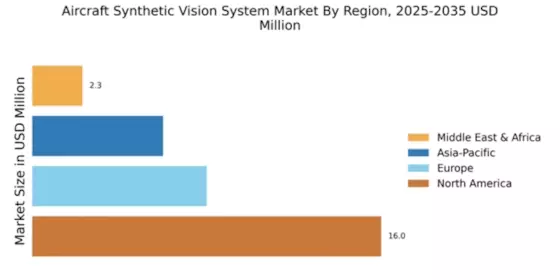
North America is poised to maintain its leadership in the Aircraft Synthetic Vision System market, holding a significant market share of 16.0 in 2024. The region's growth is driven by increasing demand for advanced avionics, stringent safety regulations, and technological innovations. The presence of major players like Honeywell and Rockwell Collins further fuels market expansion, supported by government initiatives promoting aviation safety and modernization. The competitive landscape in North America is robust, with key players such as Garmin and L3Harris Technologies leading the charge. The U.S. remains the largest market, benefiting from substantial investments in aerospace technology and a strong regulatory framework. The focus on enhancing pilot situational awareness and reducing operational risks is driving the adoption of synthetic vision systems across commercial and military aviation sectors.

Europe : Emerging Market with Growth Potential

Europe's Aircraft Synthetic Vision System market is projected to grow significantly, with a market size of 8.0 by 2025. The region benefits from stringent aviation regulations and a strong emphasis on safety, which are key drivers for the adoption of advanced synthetic vision technologies. European regulatory bodies are actively promoting the integration of these systems to enhance flight safety and operational efficiency, creating a favorable environment for market growth. Leading countries in Europe, such as France and Germany, are home to major players like Thales and BAE Systems. The competitive landscape is characterized by innovation and collaboration among industry stakeholders. The European market is increasingly focusing on developing next-generation systems that meet evolving regulatory standards, ensuring that the region remains competitive in the global market.

Asia-Pacific : Rapidly Growing Aviation Sector

The Asia-Pacific region is witnessing rapid growth in the Aircraft Synthetic Vision System market, with a projected size of 6.0 by 2025. This growth is fueled by increasing air traffic, rising disposable incomes, and a growing emphasis on aviation safety. Governments in the region are investing heavily in modernizing their aviation infrastructure, which is expected to drive demand for advanced synthetic vision systems in both commercial and military applications. Countries like China and India are leading the charge, with significant investments in aerospace technology and partnerships with global players. The competitive landscape is evolving, with local manufacturers emerging alongside established companies like Northrop Grumman and Elbit Systems. The focus on enhancing pilot training and operational efficiency is driving the adoption of these systems across the region.

Middle East and Africa : Untapped Market with Opportunities

The Middle East and Africa region presents a unique opportunity in the Aircraft Synthetic Vision System market, with a market size of 2.3 by 2025. The growth is driven by increasing investments in aviation infrastructure and a rising number of air travelers. Governments are recognizing the importance of advanced technologies in enhancing safety and operational efficiency, leading to a gradual shift towards adopting synthetic vision systems in the aviation sector. Countries like the UAE and South Africa are at the forefront of this transformation, with initiatives aimed at modernizing their aviation capabilities. The competitive landscape is still developing, with both local and international players vying for market share. The focus on improving pilot training and safety standards is expected to drive further adoption of these systems in the coming years.

Key Players and Competitive Insights

The Aircraft Synthetic Vision System Market is currently characterized by a dynamic competitive landscape, driven by technological advancements and increasing demand for enhanced safety features in aviation. Key players such as Honeywell (US), Rockwell Collins (US), and Garmin (US) are strategically positioned to leverage innovation and partnerships to maintain their competitive edge. Honeywell (US) focuses on integrating advanced analytics and artificial intelligence into its systems, while Rockwell Collins (US) emphasizes partnerships with airlines to enhance user experience. Garmin (US) is known for its commitment to user-friendly interfaces and robust customer support, which collectively shapes a competitive environment that prioritizes technological sophistication and customer-centric solutions.

The market structure appears moderately fragmented, with several players vying for market share through localized manufacturing and supply chain optimization. Companies are increasingly localizing their production to reduce costs and improve responsiveness to regional demands. This strategy not only enhances operational efficiency but also allows for tailored solutions that meet specific regulatory requirements in different markets. The collective influence of these key players fosters a competitive atmosphere where innovation and adaptability are paramount.

In November 2025, Honeywell (US) announced the launch of its latest synthetic vision system, which incorporates machine learning algorithms to enhance terrain awareness and obstacle detection. This strategic move is significant as it positions Honeywell (US) at the forefront of technological innovation, potentially setting new industry standards for safety and operational efficiency. The integration of machine learning is likely to attract a broader customer base, particularly among commercial airlines seeking to enhance their safety protocols.

In October 2025, Rockwell Collins (US) entered into a strategic partnership with a leading airline to develop customized synthetic vision solutions tailored to specific operational needs. This collaboration underscores Rockwell Collins' (US) commitment to enhancing user experience and operational efficiency. By aligning with a major airline, the company not only strengthens its market position but also gains valuable insights into customer preferences, which could inform future product development.

In September 2025, Garmin (US) expanded its product line by introducing a new synthetic vision system designed specifically for small aircraft. This strategic expansion reflects Garmin's (US) focus on diversifying its offerings to capture a larger segment of the market. By catering to the needs of smaller operators, Garmin (US) is likely to enhance its competitive positioning and drive revenue growth in a niche segment of the market.

As of December 2025, current trends in the Aircraft Synthetic Vision System Market indicate a strong emphasis on digitalization, sustainability, and the integration of artificial intelligence. Strategic alliances are increasingly shaping the competitive landscape, enabling companies to pool resources and expertise to drive innovation. The shift from price-based competition to a focus on technological advancement and supply chain reliability is evident, suggesting that future competitive differentiation will hinge on the ability to innovate and deliver superior solutions that meet evolving customer needs.

Key Companies in the Aircraft Synthetic Vision System Market market include

Industry Developments

Recent advancements in Aircraft Synthetic Vision Systems (SVS) have significantly enhanced aviation safety and operational efficiency. These systems provide pilots with real-time, three-dimensional representations of terrain, obstacles, and runway environments, especially beneficial during low-visibility conditions.

In November 2024

, Collins Aerospace's Pro Line Fusion avionics suite, featuring an advanced SVS, received certification from the European Aviation Safety Agency (EASA) for installation in Cessna Citation CJ3 aircraft registered in Europe. This certification marks a significant milestone, as the Pro Line Fusion system has already been integrated into approximately 32 aircraft in the United States. The system offers 3D terrain mapping, infrared vision, and interactive displays, enhancing situational awareness for pilots operating in challenging environments.

In August 2024

, a market analysis projected that the global Aircraft Synthetic Vision Systems market, valued at USD 8.2 billion in 2023, is expected to reach USD 14.3 billion by 2033. This growth, at a compound annual rate of 5.72%, underscores the increasing adoption of SVS technologies across various aircraft categories, including business jets, turboprops, and regional airliners.  Gulfstream Aerospace has been a pioneer in integrating synthetic vision technology into business jets. The company achieved a significant milestone by conducting a flight using an experimental business jet equipped with both synthetic and enhanced vision systems, demonstrating the potential of these technologies to improve flight safety and operational capabilitie

Competitive Landscape 

The synthetic vision system market is less competitive. It is a high-end technology market with plenty of market developments. During the forecast period, the key players are enhancing portfolio and product awareness. Also, the promotion of underwater synthetic vision system sensor will be more. The arenado synthetic vision system and bombardier synthetic vision system are two crucial products in the landscape.  All these strategies will offer plenty of growth prospects to the market. 

The key players of the synthetic vision system market are 

  • Rockwell Collins
  • Honeywell International
  • SAAB Sensis
  • Garmin Ltd
  • ForeFlight
  • Hilton Software
  • Aspen Avionics
  • Rockwell Collins
  • Multi Electric Manufacturing Inc
  • Astronics Corporation
  • Universal Avionics System
  • L-3 Avionics Systems

Segment Overview 

By display system 

  • Head up and helmet based display system
  • Primary flight display 
  • Navigation display 
  • Other types of displays 

By aircraft type  

  • The rotary-wing aircraft 
  • Fixed-wing aircraft 

By application 

  • Military aviation 
  • Civil aviation 

By region 

  • Europe 
  • Asia pacific 
  • North America 

End users 

  • Aerospace companies 
  • Regulatory bodies
  • Aircraft manufactures 
  • Defence companies 
  • Defence organisations 
  • Aerospace companies 

Regional Analysis 

North America will outgrow the synthetic vision system market in the forecast period. The defence and aerospace sector are the crucial drivers of this market. The well-developed market players are taking plenty of measures to improve production. Europe is another region with a significant synthetic vision market share. In Europe, the government initiative to increase aircraft safety is increasing the market growth. Also, product and technological enhancements are other factors that propel market growth. The Asia Pacific region will witness an exponential growth rate in the forecast year 2023. The market expansion rate is massive in Asia pacific.

China, India, Japan and South Korea are contributors to the global market. The entry of new market players will enable more growth opportunities for the market. 

Recent Developments 

A solid aviation infrastructure supports the region's mature aerospace sector. The area's regional and international airline carriers have purchased multiple aircraft due to increased air traffic. Boeing, one of the major US-based aircraft OEMs, creates a significant demand for airplane fire prevention systems.


Future Outlook

Aircraft Synthetic Vision System Market Future Outlook

The Aircraft Synthetic Vision System Market is projected to grow at a 5.8% CAGR from 2024 to 2035, driven by technological advancements, increasing safety regulations, and rising demand for enhanced situational awareness.

New opportunities lie in:

  • Development of AI-driven predictive maintenance solutions for aircraft systems.
  • Integration of augmented reality features in synthetic vision displays.
  • Expansion into emerging markets with tailored synthetic vision solutions.

By 2035, the market is expected to be robust, reflecting substantial growth and innovation.

Market Segmentation

Aircraft Synthetic Vision System Market End Use Outlook

  • Original Equipment Manufacturer
  • Aftermarket
  • Maintenance Repair and Overhaul
  • Training and Simulation

Aircraft Synthetic Vision System Market Technology Outlook

  • 2D Synthetic Vision System
  • 3D Synthetic Vision System
  • Enhanced Vision System
  • Integrated Vision System

Aircraft Synthetic Vision System Market Application Outlook

  • Commercial Aviation
  • Military Aviation
  • General Aviation
  • Unmanned Aerial Vehicles
  • Helicopters

Report Scope

MARKET SIZE 202432.3(USD Million)
MARKET SIZE 202534.2(USD Million)
MARKET SIZE 203560.1(USD Million)
COMPOUND ANNUAL GROWTH RATE (CAGR)5.8% (2024 - 2035)
REPORT COVERAGERevenue Forecast, Competitive Landscape, Growth Factors, and Trends
BASE YEAR2024
Market Forecast Period2025 - 2035
Historical Data2019 - 2024
Market Forecast UnitsUSD Million
Key Companies ProfiledHoneywell (US), Rockwell Collins (US), Garmin (US), Thales (FR), L3Harris Technologies (US), Northrop Grumman (US), BAE Systems (GB), Elbit Systems (IL), Saab (SE)
Segments CoveredApplication, Technology, End Use
Key Market OpportunitiesIntegration of advanced artificial intelligence enhances situational awareness in the Aircraft Synthetic Vision System Market.
Key Market DynamicsTechnological advancements and regulatory changes drive the adoption of Aircraft Synthetic Vision Systems in aviation.
Countries CoveredNorth America, Europe, APAC, South America, MEA

Market Highlights

Author
Swapnil Palwe
Team Lead - Research

With a technical background as Bachelor's in Mechanical Engineering, with MBA in Operations Management , Swapnil has 6+ years of experience in market research, consulting and analytics with the tasks of data mining, analysis, and project execution. He is the POC for our clients, for their consulting projects running under the Automotive/A&D domain. Swapnil has worked on major projects in verticals such as Aerospace & Defense, Automotive and many other domain projects. He has worked on projects for fortune 500 companies' syndicate and consulting projects along with several government projects.

Leave a Comment

FAQs

How The aircraft Synthetic Vision System Market Growing Globally ?

Aircraft Synthetic Vision System Market registering a CAGR of 4.31% during 2024-2032

What does the competitive landscape of the market look like?

The global aircraft Synthetic Vision System Market is highly competitive. There exists strong rivalry and competition among the existing vendors; in terms of cost, product quality, reliability, and market share. To survive and succeed in such an intensely competitive environment, it is crucial for the vendors to provide cost-effective and high-quality aircraft synthetic vision systems.

What can be a major factor fostering market growth?

A major factor fostering market growth can be the rising acceptance and use of SVS for aviation applications along with the improving regulatory scenario.

Why are business aircrafts gaining traction in the market?

Business aircrafts are in the forefront for adoption of the technology. In the present global economy, business jets quickly move personnel from one location to another around the world, anytime, and any place. Therefore, they are gaining high traction in the market in light of rising adoption.

What is the primary use of the SVS system?

The primary use of the SVS system includes boosting the situational awareness by providing a intuitive and natural view of the external environment, despite low-visibility conditions as well as night time. SVS features help improve the operational capacity of the aircraft at different weather conditions and also help bring down the chances of accidents.

What can be a significant market trend in the coming years?

Rising use of military aircraft and rotorcraft across various emerging countries can be a significant market trend in the coming years.

Download Free Sample

Kindly complete the form below to receive a free sample of this Report

Compare Licence

×
Features License Type
Single User Multiuser License Enterprise User
Price $4,950 $5,950 $7,250
Maximum User Access Limit 1 User Upto 10 Users Unrestricted Access Throughout the Organization
Free Customization
Direct Access to Analyst
Deliverable Format
Platform Access
Discount on Next Purchase 10% 15% 15%
Printable Versions