×
Request Free Sample ×

Kindly complete the form below to receive a free sample of this Report

* Please use a valid business email

Leading companies partner with us for data-driven Insights

clients tt-cursor
Hero Background

Airless Packaging Market

ID: MRFR/PCM/3892-CR
185 Pages
Snehal Singh
December 2019

Airless Packaging Market Research Report Information by Material (Plastic, Glass, And Others), Packaging Type (Bottles & Jars, Bags & Pouches And Tubes), Dispenser Type (Pumps, Dropper, And Twist & Click), End-Use (Personal Care & Home Care, Pharmaceutical And Food & Beverages) and Region (North America, Europe, Asia-Pacific, Rest of the World) - Forecast to 2035

Share:
Download PDF ×

We do not share your information with anyone. However, we may send you emails based on your report interest from time to time. You may contact us at any time to opt-out.

Airless Packaging Market Infographic
Purchase Options

Airless Packaging Market Summary

As per MRFR analysis, the Airless Packaging Market Size was estimated at 7.33 USD Billion in 2024. The Airless Packaging industry is projected to grow from 7.72 USD Billion in 2025 to 13.04 USD Billion by 2035, exhibiting a compound annual growth rate (CAGR) of 5.38 during the forecast period 2025 - 2035.

Key Market Trends & Highlights

The Airless Packaging Market is experiencing robust growth driven by sustainability and technological advancements.

  • The market is witnessing a pronounced shift towards sustainable packaging solutions, particularly in North America.
  • Technological innovations are enhancing the functionality and appeal of airless packaging, especially in the cosmetics segment.
  • Hygiene and safety concerns are propelling demand for airless packaging in the pharmaceuticals sector, particularly in the Asia-Pacific region.
  • Rising demand for sustainable packaging solutions and regulatory support for eco-friendly practices are key drivers of market expansion.

Market Size & Forecast

2024 Market Size 7.33 (USD Billion)
2035 Market Size 13.04 (USD Billion)
CAGR (2025 - 2035) 5.38%

Major Players

AptarGroup Inc (US), Albea S.A. (FR), HCP Packaging (SG), Silgan Holdings Inc (US), Quadpack Industries (ES), Cosmogen (FR), Mölnlycke Health Care AB (SE), Lameplast S.p.A. (IT), Graham Packaging Company (US)

Airless Packaging Market Trends

The Airless Packaging Market is currently experiencing a notable transformation, driven by increasing consumer demand for sustainable and efficient packaging solutions. This market segment is characterized by its innovative designs that prevent air exposure, thereby preserving product integrity and extending shelf life. As environmental concerns gain prominence, manufacturers are increasingly adopting eco-friendly materials and production processes, which aligns with the broader trend of sustainability in various industries. Furthermore, the rise of e-commerce has necessitated packaging that not only protects products during transit but also enhances user experience, leading to a surge in the adoption of airless packaging technologies. In addition to sustainability, the Airless Packaging Market is witnessing advancements in technology that facilitate the development of more sophisticated packaging systems. These innovations include features such as precise dispensing mechanisms and customizable designs that cater to diverse consumer preferences. The growing awareness of hygiene and safety, particularly in sectors like cosmetics and pharmaceuticals, further propels the demand for airless packaging solutions. As the market evolves, it appears poised for continued growth, with potential opportunities emerging from new applications and market segments that prioritize both functionality and environmental responsibility.

Sustainability Focus

The Airless Packaging Market is increasingly oriented towards sustainable practices, with manufacturers prioritizing eco-friendly materials and processes. This trend reflects a broader societal shift towards environmental consciousness, as consumers demand products that minimize ecological impact.

Technological Advancements

Innovations in airless packaging technology are enhancing product functionality and user experience. Features such as precise dispensing and customizable designs are becoming more prevalent, catering to diverse consumer needs and preferences.

Hygiene and Safety Concerns

The heightened awareness of hygiene and safety, particularly in the cosmetics and pharmaceutical sectors, is driving demand for airless packaging solutions. These systems effectively prevent contamination and preserve product integrity, aligning with consumer expectations for safety.

Airless Packaging Market Drivers

Market Growth Projections

The Global Airless Packaging Market Industry is projected to experience substantial growth over the coming years. With an estimated market value of 7.33 USD Billion in 2024, the industry is on track to reach approximately 13.0 USD Billion by 2035. This growth trajectory suggests a compound annual growth rate (CAGR) of 5.37% from 2025 to 2035. Such projections indicate a robust demand for airless packaging solutions across various sectors, including cosmetics, pharmaceuticals, and food. The increasing recognition of the benefits associated with airless packaging, such as enhanced product preservation and sustainability, is likely to drive this growth, making it a focal point for industry stakeholders.

Technological Advancements in Packaging

Technological advancements play a crucial role in the expansion of the Global Airless Packaging Market Industry. Innovations in materials and design have led to the development of more efficient airless packaging systems that preserve product integrity and extend shelf life. For instance, advancements in pump technology and barrier materials enhance the functionality of airless containers, making them more appealing to manufacturers and consumers alike. As a result, the market is expected to grow significantly, with a projected value of 13.0 USD Billion by 2035. This growth underscores the importance of continuous innovation in meeting the evolving needs of various industries, including cosmetics and pharmaceuticals.

Increasing Focus on Product Preservation

The Global Airless Packaging Market Industry is driven by an increasing focus on product preservation across various sectors. Airless packaging systems are designed to minimize exposure to air, thereby reducing oxidation and contamination, which is particularly vital for sensitive products such as cosmetics and pharmaceuticals. This emphasis on preservation not only enhances product quality but also extends shelf life, making airless packaging an attractive option for manufacturers. As the market evolves, the demand for packaging solutions that ensure product integrity is likely to rise, contributing to a projected CAGR of 5.37% from 2025 to 2035. This trend highlights the critical role of airless packaging in maintaining product efficacy.

Growth in the Cosmetics and Personal Care Sector

The cosmetics and personal care sector significantly influences the Global Airless Packaging Market Industry. With consumers increasingly prioritizing high-quality and effective products, brands are turning to airless packaging to enhance the user experience. Airless containers not only provide a luxurious feel but also ensure that formulations remain uncontaminated and effective until the last drop. This trend is evidenced by the sector's growth, which is expected to drive the airless packaging market forward. As brands recognize the benefits of airless packaging, the industry is poised for expansion, aligning with the overall market growth projections.

Rising Demand for Sustainable Packaging Solutions

The Global Airless Packaging Market Industry experiences a notable surge in demand for sustainable packaging solutions. As consumers become increasingly environmentally conscious, brands are seeking packaging options that minimize waste and enhance recyclability. Airless packaging, which often utilizes materials that are more sustainable than traditional options, aligns with these consumer preferences. This shift is reflected in the market's projected growth, with an estimated value of 7.33 USD Billion in 2024, indicating a robust response to sustainability trends. Companies that adopt airless packaging not only cater to consumer demands but also contribute to broader environmental goals, positioning themselves favorably in the competitive landscape.

Regulatory Support for Innovative Packaging Solutions

Regulatory support for innovative packaging solutions is emerging as a key driver for the Global Airless Packaging Market Industry. Governments worldwide are increasingly implementing regulations that encourage the adoption of sustainable and efficient packaging methods. This regulatory landscape fosters innovation, prompting manufacturers to explore airless packaging as a viable alternative to traditional options. As regulations evolve, companies that invest in airless packaging technologies may find themselves at a competitive advantage. This supportive environment is likely to contribute to the market's growth trajectory, reinforcing the importance of compliance and innovation in the packaging sector.
Market Segment Insights

By Application: Cosmetics (Largest) vs. Pharmaceuticals (Fastest-Growing)

The Airless Packaging Market is significantly segmented across various applications, with cosmetics commanding the largest share due to the high demand for airless designs that preserve product integrity and shelf life. The market for pharmaceuticals is witnessing rapid growth as well, driven by the need for precise dosages and contamination-free packaging. Household products and food and beverages also contribute to the market but to a lesser extent, focusing on convenience and sustainability in packaging solutions.

Cosmetics: Dominant vs. Pharmaceuticals: Emerging

In the Airless Packaging Market, cosmetics emerge as the dominant segment, driven by consumer preferences for high-quality formulations in airless containers, which protect sensitive ingredients from oxidation. Brands are increasingly adopting airless technology to enhance product longevity and user experience. On the other hand, the pharmaceuticals segment is considered emerging, experiencing the fastest growth due to increasing regulatory standards demanding high hygiene levels and product safety. This segment is characterized by a surge in innovative package designs that cater to the specific needs of healthcare products, ensuring the integrity and efficacy of medications.

By Material Type: Plastic (Largest) vs. Glass (Fastest-Growing)

In the Airless Packaging Market, the Material Type segment exhibits a diverse distribution, with Plastic holding the largest share due to its cost-effectiveness and versatility. Glass is emerging as a significant player, attracting a dedicated consumer base drawn by its premium feel and sustainability credentials. Metal and Paper, although less dominant, are making strides in niche markets, appealing to environmentally conscious consumers looking for alternatives to traditional packaging materials. Collectively, these materials cater to a wide range of consumer preferences, with brands increasingly offering varied options. Growth in the Material Type segment is primarily driven by consumer demand for more sustainable and eco-friendly packaging alternatives. The rise of e-commerce and the need for longer shelf lives are contributing to the popularity of airless packaging solutions, offering protection against contamination and oxidation. As companies innovate and focus on modernizing their product offerings, the materials used in packaging are evolving to meet both aesthetic preferences and functional requirements, ensuring a competitive edge in the marketplace.

Plastic (Dominant) vs. Glass (Emerging)

Plastic is the dominant material in the Airless Packaging Market, favored for its lightweight nature, durability, and adaptability across various product ranges. Most manufacturers utilize advanced plastic formulations designed to enhance barrier properties and extend shelf life without compromising product integrity. In contrast, Glass is considered an emerging material due to its robust appeal among environmentally focused brands and consumers. The aesthetic value of glass packaging, combined with its recyclability, positions it as a preferred option for higher-end products, particularly in cosmetics and skincare. As consumers become more eco-conscious, the demand for glass continues to grow, pushing brands to innovate in design and functionality while maintaining a commitment to sustainability.

By Product Type: Pumps (Largest) vs. Tubes (Fastest-Growing)

In the Airless Packaging Market, the 'Pumps' segment leads in market share, owing to their extensive application across various industries such as cosmetics, pharmaceuticals, and personal care. These packaging solutions are highly favored for their ability to dispense products without exposure to air, preserving the integrity of sensitive formulations. Following Pumps, the 'Bottles' and 'Jars' segments also hold significant shares, but Tubes, being the new entrant with advanced design features, are gaining momentum. The growth trends in this segment are being driven by a shift towards sustainable packaging solutions that enhance user convenience. Consumers are increasingly prioritizing products with innovative packaging that provides better functionality and product preservation. The Tubes segment, in particular, is witnessing rapid growth as brands seek versatile, lightweight, and travel-friendly packaging options that cater to on-the-go lifestyles, positioning them to become a central focus in airless packaging innovations.

Pumps (Dominant) vs. Tubes (Emerging)

The Pumps segment dominates the Airless Packaging Market, primarily because of its widespread acceptance in various applications ranging from cosmetics to pharmaceuticals. They provide a reliable mechanism for dispensing formulations without air exposure, making them ideal for preserving the quality and longevity of products. Customers favor pumps for their ease of use and consistent delivery, making them a staple in many product lines. Conversely, the Tubes segment is emerging as a significant contender, favored for their lightweight and user-friendly design. The focus on sustainability has also played a crucial role in their rise, as they often utilize recyclable materials, appealing to eco-conscious consumers. As brands adapt to changing consumer preferences, the Tubes segment is expected to capture an increasing market share.

By End Use: Personal Care (Largest) vs. Healthcare (Fastest-Growing)

The airless packaging market is significantly influenced by its diverse end use segments, predominantly personal care. Personal care holds the largest market share, driven by the growing demand for high-quality cosmetic products that require protected, hygienic packaging solutions. Following closely, healthcare products, which encompass pharmaceuticals and topical treatments, have shown remarkable growth due to the increasing emphasis on hygiene and extended shelf-life required for medical applications. Additionally, the food industry and home care products contribute appreciably, yet their market shares remain comparatively smaller. As the demand for sustainable and convenient packaging surges, the airless packaging segment for healthcare is emerging as the fastest-growing category. Enhanced awareness surrounding product integrity in pharmaceuticals and skincare drives innovation in airless designs. Meanwhile, personal care continues to thrive with the constant launch of new products catering to consumer preferences for efficacy and safety. The globalization of brands further amplifies these trends, with a marked increase in airless technology adoption across various regions.

Personal Care (Dominant) vs. Healthcare (Emerging)

Personal care segment is widely recognized as the dominant player in the airless packaging market, reflecting consumers' preference for convenience and the preservation of product integrity. Items such as lotions, serums, and creams benefit from airless technology, minimizing contamination and extending shelf life. The innovative designs resonate with consumers seeking effective anti-aging and skincare solutions. Conversely, the healthcare segment, although emerging, is gaining traction due to heightened awareness regarding hygiene and product safety. Medical products like ointments and topical solutions increasingly rely on airless packaging to maintain their efficacy and avoid contamination. This shift towards airless systems promotes compliance with healthcare standards, making them integral to modern healthcare solutions.

Get more detailed insights about Airless Packaging Market

Regional Insights

North America : Market Leader in Airless Packaging

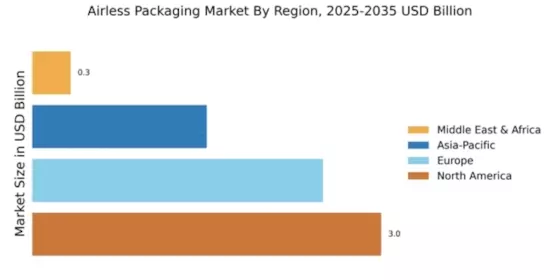
North America is poised to maintain its leadership in the airless packaging market, holding a significant share of 3.0 in 2025. The region's growth is driven by increasing consumer demand for sustainable and innovative packaging solutions, alongside stringent regulations promoting eco-friendly practices. The rise in e-commerce and the beauty and personal care sectors further fuel this demand, as brands seek to enhance product longevity and user experience. The competitive landscape in North America is robust, featuring key players such as AptarGroup Inc, Silgan Holdings Inc, and Graham Packaging Company. These companies are investing in R&D to develop advanced airless packaging technologies that cater to diverse industries, including cosmetics and pharmaceuticals. The U.S. remains the largest market, supported by a strong manufacturing base and a focus on sustainability, ensuring continued growth in this sector.

Europe : Emerging Trends in Sustainability

Europe's airless packaging market is projected to reach a size of 2.5 by 2025, driven by a growing emphasis on sustainability and eco-friendly packaging solutions. Regulatory frameworks, such as the EU's Circular Economy Action Plan, are catalyzing innovation in packaging technologies. The demand for airless packaging is particularly strong in the cosmetics and personal care sectors, where product preservation and user convenience are paramount. Leading countries in this region include France, Germany, and Italy, where companies like Albea S.A. and Cosmogen are at the forefront of innovation. The competitive landscape is characterized by a mix of established players and emerging startups, all striving to meet the increasing consumer demand for sustainable products. The focus on reducing plastic waste and enhancing recyclability is shaping the future of airless packaging in Europe.

Asia-Pacific : Rapid Growth in Emerging Markets

The Asia-Pacific airless packaging market is expected to grow significantly, reaching a size of 1.5 by 2025. This growth is fueled by rising disposable incomes, urbanization, and a shift towards premium products in the beauty and personal care sectors. Regulatory support for sustainable packaging practices is also enhancing market dynamics, as consumers increasingly prefer eco-friendly options. Countries like China, Japan, and South Korea are leading the charge, with companies such as HCP Packaging and Quadpack Industries making substantial investments in innovative packaging solutions. The competitive landscape is evolving, with both local and international players vying for market share. The region's diverse consumer base and increasing demand for high-quality packaging are key drivers of growth in the airless packaging market.

Middle East and Africa : Emerging Market Opportunities

The Middle East and Africa (MEA) airless packaging market is relatively nascent, with a projected size of 0.33 by 2025. However, the region presents significant growth opportunities driven by increasing consumer awareness of product quality and sustainability. The demand for airless packaging is gaining traction in sectors such as cosmetics and pharmaceuticals, where product integrity is crucial. Countries like South Africa and the UAE are emerging as key markets, with local manufacturers beginning to adopt airless packaging technologies. The competitive landscape is still developing, with opportunities for both established companies and new entrants. As the region's economy diversifies and consumer preferences evolve, the airless packaging market is expected to expand rapidly, supported by investments in technology and innovation.

Key Players and Competitive Insights

The Airless Packaging Market is currently characterized by a dynamic competitive landscape, driven by increasing consumer demand for sustainable and efficient packaging solutions. Key players are actively engaging in innovation and strategic partnerships to enhance their market positioning. For instance, AptarGroup Inc (US) has been focusing on developing advanced airless dispensing systems that cater to the cosmetic and pharmaceutical sectors, thereby reinforcing its commitment to sustainability and user convenience. Similarly, Albea S.A. (FR) is leveraging its expertise in sustainable materials to create eco-friendly airless packaging solutions, which aligns with the growing consumer preference for environmentally responsible products. These strategies collectively contribute to a competitive environment that emphasizes innovation and sustainability as primary growth drivers.

In terms of business tactics, companies are increasingly localizing manufacturing to reduce lead times and enhance supply chain efficiency. This approach appears to be particularly effective in a moderately fragmented market, where the collective influence of key players shapes overall market dynamics. The focus on optimizing supply chains and local production capabilities allows companies to respond swiftly to changing consumer preferences and market demands, thereby maintaining a competitive edge.

In November 2025, HCP Packaging (SG) announced a strategic partnership with a leading skincare brand to develop a new line of airless packaging solutions tailored for sensitive skin products. This collaboration is significant as it not only expands HCP's product offerings but also positions the company as a key player in the niche market of sensitive skincare, which is experiencing robust growth. The partnership underscores the importance of aligning product development with consumer needs, thereby enhancing brand loyalty and market share.

In October 2025, Silgan Holdings Inc (US) launched a new range of airless packaging solutions designed specifically for the food and beverage sector. This move is noteworthy as it reflects a strategic diversification into a high-demand market segment, potentially increasing Silgan's revenue streams. The introduction of these innovative packaging solutions is likely to attract environmentally conscious consumers, further solidifying Silgan's market presence.

In September 2025, Quadpack Industries (ES) unveiled a new line of airless packaging products that utilize recycled materials, emphasizing its commitment to sustainability. This initiative is particularly relevant in the current market context, where consumers are increasingly prioritizing eco-friendly products. By integrating recycled materials into their packaging solutions, Quadpack not only enhances its brand image but also meets the growing regulatory pressures for sustainable practices in packaging.

As of December 2025, the competitive trends in the Airless Packaging Market are increasingly defined by digitalization, sustainability, and the integration of AI technologies. Strategic alliances among key players are shaping the landscape, fostering innovation and enhancing operational efficiencies. The shift from price-based competition to a focus on technological advancement and supply chain reliability is evident, suggesting that future competitive differentiation will hinge on the ability to innovate and adapt to evolving consumer expectations.

Key Companies in the Airless Packaging Market market include

Industry Developments

In March 2022, Quadpack invested over 6 million at its Germany manufacturing facilities in Kierspe will help create a decoration center as well as expand its plastic injection molding and assembly capacity.

Quadpack’s Kierspe plant is growing due to rising demand for non-airing packages.In November 2022, Embelia introduced a new refillable version of the Baia pouch airless system, while Lablabo designed the new airless system specialized in pouch technologies.-In February 2020 Ren Clean Skincare announced that it would put its skincare product into an airless bottle made out of recycled plastic.In December 2021, Qosmedix announced the expansion of their broad collection of stock airless packaging and launched a one oz., 30 ml (about 1.01 oz), 50% PCR white jar manufactured with 50% PCR airless pumps and clear over caps.In May 2020, Aptar Beauty + Home announced the first-ever certified recycled plastic beauty packaging solution.

The firm unveiled an eco-designed airless bottle for the cosmetics industry made from postconsumer plastic using certified circular polymers.

Future Outlook

Airless Packaging Market Future Outlook

The Airless Packaging Market is projected to grow at a 5.38% CAGR from 2024 to 2035, driven by sustainability trends, consumer demand for product integrity, and technological advancements.

New opportunities lie in:

  • Development of eco-friendly airless packaging solutions
  • Integration of smart technology for product tracking
  • Expansion into emerging markets with tailored packaging solutions

By 2035, the Airless Packaging Market is expected to achieve substantial growth, driven by innovation and strategic market positioning.

Market Segmentation

Airless Packaging Market End Use Outlook

  • Personal Care
  • Healthcare
  • Food Industry
  • Home Care

Airless Packaging Market Application Outlook

  • Cosmetics
  • Pharmaceuticals
  • Food and Beverages
  • Household Products

Airless Packaging Market Product Type Outlook

  • Pumps
  • Bottles
  • Jars
  • Tubes

Airless Packaging Market Material Type Outlook

  • Plastic
  • Glass
  • Metal
  • Paper

Report Scope

MARKET SIZE 20247.33(USD Billion)
MARKET SIZE 20257.72(USD Billion)
MARKET SIZE 203513.04(USD Billion)
COMPOUND ANNUAL GROWTH RATE (CAGR)5.38% (2024 - 2035)
REPORT COVERAGERevenue Forecast, Competitive Landscape, Growth Factors, and Trends
BASE YEAR2024
Market Forecast Period2025 - 2035
Historical Data2019 - 2024
Market Forecast UnitsUSD Billion
Key Companies ProfiledAptarGroup Inc (US), Albea S.A. (FR), HCP Packaging (SG), Silgan Holdings Inc (US), Quadpack Industries (ES), Cosmogen (FR), Mölnlycke Health Care AB (SE), Lameplast S.p.A. (IT), Graham Packaging Company (US)
Segments CoveredApplication, Material Type, Product Type, End Use
Key Market OpportunitiesGrowing demand for sustainable packaging solutions drives innovation in the Airless Packaging Market.
Key Market DynamicsRising consumer demand for sustainable packaging solutions drives innovation in airless packaging technologies and materials.
Countries CoveredNorth America, Europe, APAC, South America, MEA

Market Highlights

Author
Snehal Singh
Assistant Manager - Research

High acumen in analyzing complex macro & micro markets with more than 6 years of work experience in the field of market research. By implementing her analytical skills in forecasting and estimation into market research reports, she has expertise in Packaging, Construction, and Equipment domains. She handles a team size of 20-25 resources and ensures smooth running of the projects, associated marketing activities, and client servicing.

Leave a Comment

FAQs

How much is the Airless Packaging market?

In 2024, the Airless Packaging Marketfor airless packaging was estimated to be worth USD 7.33 billion.

What is the growth rate of the Airless Packaging market?

Airless Packaging Market is projected to grow at a CAGR of 5.38% during the forecast period, 2025-2035

Which region held the largest market share in the Airless Packaging market?

North America held the largest Airless Packaging Market share.

Who are the key players in the Airless Packaging market?

The key players in the market are Fusion PKG (Texas), Albea S.A. (France), HCP Packaging (Shanghai), Quadpack (Spain), Lumson S.p.An (Italy), Silgan Holdings Inc. (US), APC Packaging (Florida), and Aptar Group INC. (US).

Which Packaging type led the Airless Packaging market?

The Bottles & Jars category dominated the Airless Packaging Market in 2024.

Which Material possessed the highest market share in the airless packaging sector?

Plastic had the largest share of the Airless Packaging Market

Download Free Sample

Kindly complete the form below to receive a free sample of this Report

Compare Licence

×
Features License Type
Single User Multiuser License Enterprise User
Price $4,950 $5,950 $7,250
Maximum User Access Limit 1 User Upto 10 Users Unrestricted Access Throughout the Organization
Free Customization
Direct Access to Analyst
Deliverable Format
Platform Access
Discount on Next Purchase 10% 15% 15%
Printable Versions