×
Request Free Sample ×

Kindly complete the form below to receive a free sample of this Report

* Please use a valid business email

Leading companies partner with us for data-driven Insights

clients tt-cursor
Hero Background

ALCOHOLIC DRINKS PACKAGING MARKET

ID: MRFR/PCM/9580-HCR
111 Pages
Snehal Singh
October 2025

Alcoholic Drinks Packaging Market Research Report By Type of Packaging (Bottles, Cans, Kegs, Pouches), By Material (Glass, Plastic, Metal, Paper), By Closure Type (Caps, Taps, Screw-on Lids, Cork), By End Use (Beer, Wine, Spirits) and By Regional (North America, Europe, South America, Asia Pacific, Middle East and Africa) - Forecast to 2035.

Share:
Download PDF ×

We do not share your information with anyone. However, we may send you emails based on your report interest from time to time. You may contact us at any time to opt-out.

ALCOHOLIC DRINKS PACKAGING MARKET Infographic
Purchase Options

ALCOHOLIC DRINKS PACKAGING MARKET Summary

As per MRFR analysis, the Alcoholic Drinks Packaging Market was estimated at 34.18 USD Billion in 2024. The Alcoholic Drinks Packaging industry is projected to grow from 36.06 USD Billion in 2025 to 61.61 USD Billion by 2035, exhibiting a compound annual growth rate (CAGR) of 5.5 during the forecast period 2025 - 2035.

Key Market Trends & Highlights

The alcoholic drinks packaging market is experiencing a dynamic shift towards sustainability and premiumization.

  • North America remains the largest market for alcoholic drinks packaging, driven by consumer demand for quality and sustainability.
  • The Asia-Pacific region is emerging as the fastest-growing market, reflecting a rising interest in diverse alcoholic beverages and innovative packaging solutions.
  • Glass packaging continues to dominate the market, while plastic packaging is rapidly gaining traction due to its lightweight and cost-effective nature.
  • Sustainability initiatives and e-commerce influence are key drivers propelling the market forward, as consumers increasingly seek eco-friendly and convenient packaging options.

Market Size & Forecast

2024 Market Size 34.18 (USD Billion)
2035 Market Size 61.61 (USD Billion)
CAGR (2025 - 2035) 5.5%

Major Players

Amcor (AU), Ball Corporation (US), Crown Holdings (US), Owens-Illinois (US), Ardagh Group (IE), Mondi Group (GB), Silgan Holdings (US), Sonoco Products Company (US)

ALCOHOLIC DRINKS PACKAGING MARKET Trends

The The alcoholic drinks packaging market is currently experiencing a dynamic evolution, driven by various factors including sustainability, consumer preferences, and technological advancements. As environmental concerns gain prominence, manufacturers are increasingly adopting eco-friendly materials and practices. This shift not only addresses regulatory pressures but also aligns with the growing consumer demand for sustainable products. Additionally, the rise of e-commerce has transformed distribution channels, necessitating innovative packaging solutions that ensure product integrity during transit. Moreover, the market is witnessing a surge in premiumization, where consumers are gravitating towards high-quality, artisanal beverages. This trend influences packaging design, as brands seek to convey luxury and craftsmanship through their packaging choices. The integration of smart technology, such as QR codes and augmented reality, is also becoming prevalent, enhancing consumer engagement and providing additional product information. Overall, the ALCOHOLIC DRINKS PACKAGING MARKET is poised for continued growth, adapting to the evolving landscape of consumer expectations and environmental considerations.

Sustainability Initiatives

The ALCOHOLIC DRINKS PACKAGING MARKET is increasingly focusing on sustainable practices. Companies are exploring biodegradable materials and recyclable options to minimize environmental impact. This trend reflects a broader commitment to reducing carbon footprints and appealing to eco-conscious consumers.

E-commerce Influence

The rise of online shopping is reshaping packaging requirements in the ALCOHOLIC DRINKS PACKAGING MARKET. Brands are developing packaging that ensures safe delivery and maintains product quality during transit. This shift necessitates innovative designs that cater to the unique challenges of e-commerce.

Premiumization and Craftsmanship

Consumers are showing a preference for premium alcoholic beverages, influencing packaging aesthetics in the ALCOHOLIC DRINKS PACKAGING MARKET. Brands are investing in high-quality materials and sophisticated designs to convey luxury and craftsmanship, enhancing the overall consumer experience.

ALCOHOLIC DRINKS PACKAGING MARKET Drivers

Regulatory Compliance

Regulatory compliance is a critical driver in the Global Alcoholic Drinks Packaging Market Industry. Governments worldwide are implementing stringent regulations regarding labeling, safety, and environmental impact of packaging materials. Compliance with these regulations is essential for manufacturers to avoid penalties and maintain market access. For example, the European Union has introduced directives aimed at reducing single-use plastics, compelling companies to innovate in their packaging strategies. This regulatory landscape not only influences material choices but also encourages investment in sustainable packaging solutions, thereby shaping the future of the industry.

Market Growth Projections

The Global Alcoholic Drinks Packaging Market Industry is poised for substantial growth, with projections indicating a market size of 41.6 USD Billion in 2024 and an anticipated increase to 55.4 USD Billion by 2035. This growth trajectory suggests a compound annual growth rate of 2.64% from 2025 to 2035. Such figures underscore the resilience and adaptability of the industry in response to evolving consumer demands and regulatory landscapes. The market's expansion is likely to be fueled by innovations in packaging technologies, sustainability initiatives, and the increasing globalization of alcoholic beverages.

Sustainability Initiatives

The Global Alcoholic Drinks Packaging Market Industry is increasingly influenced by sustainability initiatives. Consumers are gravitating towards eco-friendly packaging options, prompting manufacturers to adopt biodegradable materials and recyclable designs. This shift not only addresses environmental concerns but also aligns with regulatory pressures aimed at reducing plastic waste. For instance, brands are exploring plant-based plastics and lightweight glass alternatives, which can significantly lower carbon footprints. As a result, the market is projected to reach 41.6 USD Billion in 2024, reflecting a growing commitment to sustainable practices in packaging.

Technological Advancements

Technological advancements play a pivotal role in shaping the Global Alcoholic Drinks Packaging Market Industry. Innovations such as smart packaging, which incorporates QR codes and NFC technology, enhance consumer engagement and provide product information. These technologies enable brands to connect with consumers on a deeper level, fostering brand loyalty. Moreover, automation in packaging processes increases efficiency and reduces costs. As the industry embraces these technologies, it is anticipated that the market will experience a compound annual growth rate of 2.64% from 2025 to 2035, indicating a robust evolution driven by technological integration.

Changing Consumer Preferences

Changing consumer preferences significantly impact the Global Alcoholic Drinks Packaging Market Industry. There is a noticeable trend towards premiumization, with consumers willing to pay more for high-quality, aesthetically pleasing packaging. This shift is evident in the craft beer and artisanal spirits segments, where unique packaging designs serve as a key differentiator. Additionally, the rise of e-commerce has necessitated packaging solutions that ensure product safety during transit while maintaining visual appeal. As these preferences evolve, the market is expected to grow to 55.4 USD Billion by 2035, reflecting the importance of packaging in consumer decision-making.

Globalization of Alcoholic Beverages

The globalization of alcoholic beverages significantly influences the Global Alcoholic Drinks Packaging Market Industry. As brands expand their reach into international markets, packaging becomes a crucial element in appealing to diverse consumer bases. Packaging must not only comply with local regulations but also resonate with cultural preferences and aesthetics. This globalization trend has led to an increase in demand for versatile packaging solutions that can cater to various markets. Consequently, the industry is witnessing a surge in innovative designs and materials that enhance product visibility and appeal, further driving market growth.
Market Segment Insights

By Material Type: Glass (Largest) vs. Plastic (Fastest-Growing)

In the alcoholic drinks packaging market, glass remains the largest material type, favored for its premium perception and ability to preserve flavor. Plastic, while traditionally less preferred, has gained significant traction due to its lightweight nature and cost-effectiveness. The market share distribution illustrates a clear preference among consumers for glass bottles, especially in premium segments, while plastic is increasingly recognized for its versatility and adaptability in modern packaging solutions.

Glass (Dominant) vs. Plastic (Emerging)

Glass containers dominate the alcoholic drinks packaging market due to their aesthetic appeal and effectiveness in protecting the beverage's integrity. They are often associated with higher-end products, contributing to their enduring popularity among manufacturers looking to enhance brand image. In contrast, plastic is emerging as a flexible and cost-efficient alternative, quickly becoming favored for its lightweight properties and recyclability. The trend towards sustainability is also pushing brands to explore innovative plastic solutions. As consumer behaviors evolve, the acceptance of plastic for both convenience and environmental considerations suggests significant growth potential for this segment.

By Closure Type: Screw Cap (Largest) vs. Cork (Fastest-Growing)

In the alcoholic drinks packaging market, the closure type segment is diversifying, with the screw cap leading in market share. The screw cap offers a blend of convenience and effective sealing, making it particularly popular in wine and spirits packaging. In contrast, cork stoppers, notably for premium wines, maintain a strong share, appealing to consumers seeking tradition and quality. Snap-on caps, flip-top caps, and crown caps delve into niche markets, each catering to specific consumer needs and preferences. Growth trends indicate a shift towards more sustainable and convenient packaging solutions. The screw cap's dominance is supported by sustainability initiatives and changing consumer preferences for ready-to-drink products. On the other hand, cork is witnessing a resurgence as eco-conscious consumers value its natural sourcing. The trend towards sustainable packaging could enhance demand for biodegradable options like cork, while screw caps continue to thrive due to their practicality and ease of use.

Screw Cap (Dominant) vs. Cork (Emerging)

Screw caps have solidified their position as the dominant closure type in the alcoholic drinks packaging market. Renowned for their convenience, they ensure a tight seal, preventing oxidation and retaining product freshness, making them indispensable for producers of ready-to-drink beverages. Meanwhile, cork serves as an emerging choice, particularly in high-end wine markets where heritage and craftsmanship are valued. Its biodegradable nature aligns with the growing demand for sustainable packaging, attracting environmentally conscious consumers. Furthermore, cork's ability to allow controlled aging in wines enhances its appeal, positioning it favorably between luxury and sustainability. As consumer preferences evolve, both screw caps and cork are likely to thrive, appealing to distinct market segments.

By Packaging Type: Bottles (Largest) vs. Cans (Fastest-Growing)

In the alcoholic drinks packaging market, bottles continue to dominate the packaging type segment, holding significant market share due to their traditional appeal and perception as premium packaging. The versatility of bottles, which cater to various alcoholic beverages from wines to spirits, reinforces their position as a preferred choice among consumers and manufacturers alike. Meanwhile, cans have emerged as the fastest-growing segment, appealing to younger demographics seeking convenience and portability. Their lightweight nature and recyclability make them increasingly popular for ready-to-drink cocktails and craft beers, contributing to their rapid ascendance in the market.

Bottles (Dominant) vs. Pouches (Emerging)

Bottles, as the dominant packaging type in the alcoholic drinks sector, are synonymous with quality and branding. They are seen as ideal for a range of alcoholic beverages, offering an aesthetic appeal that enhances the consumer experience. In contrast, pouches are emerging as a novel contender in the market, especially for alcoholic beverages like cocktails aimed at on-the-go consumers. Their flexible design and lightweight nature make them a cost-effective solution for brands targeting environmentally conscious consumers. As the market evolves, pouches are expected to carve a niche among consumers looking for alternative, convenient packaging options.

By End Use: Beer (Largest) vs. Ready-to-Drink (Fastest-Growing)

The alcoholic drinks packaging market is predominantly influenced by the beer segment, which commands the largest share due to its widespread popularity and consumption across various demographics. This segment has been a staple in many cultures, and traditional packaging materials like glass bottles and cans have become synonymous with beer. Wine and spirits also hold significant market shares, with wine recognized for its diverse packaging options, ranging from bottles to cartons, while spirits packaging adapts to premium market demands. In contrast, the ready-to-drink category is witnessing rapid growth, appealing particularly to younger consumers who prefer convenience and innovative flavors. The growth trends within the alcoholic drinks packaging market indicate a notable shift towards ready-to-drink beverages, driven by changing consumer preferences for convenience and on-the-go consumption. This segment is evolving, with brands increasingly experimenting with packaging designs and formats to attract a younger audience seeking instant gratification. Additionally, the premiumization trend in wines and spirits is boosting demand for more sophisticated and aesthetically pleasing packaging solutions, aligning with consumers' desire for quality and enhancements that elevate the overall drinking experience. The rising trend of health-conscious consumers is also influencing packaging innovations, resulting in lighter bottles and sustainable materials.

Beer (Dominant) vs. Ready-to-Drink (Emerging)

The beer segment remains dominant in the alcoholic drinks packaging market, characterized by its vast selection of brews and innovative packaging solutions. Traditional glass bottles and aluminum cans are the mainstays, as they not only preserve beverage quality but also enhance brand visibility. Craft beer trends have further pushed demand for unique and sustainable packaging, allowing brands to differentiate themselves in a crowded market. In contrast, the ready-to-drink segment is emerging rapidly, driven by convenience-oriented demographics. These products, often available in ready-to-consume formats, attract younger consumers seeking flavorful yet accessible options. As this segment grows, the focus on creative packaging and eye-catching design becomes crucial, appealing to impulse buyers and enhancing brand identity.

By Design Type: Labeling (Largest) vs. Shrink Sleeves (Fastest-Growing)

The alcoholic drinks packaging market demonstrates a diverse range of design types, with labeling emerging as the largest segment. This design type captures a significant portion of market share due to its essential function in brand recognition and consumer engagement. Following labeling, shrink sleeves have gained notable traction, showing remarkable growth as brands shift towards more versatile and visually appealing packaging solutions that enhance product visibility. The growing preference for sustainable practices further reinforces the need for effective labeling and innovative design formats in the market.

Labeling (Dominant) vs. Shrink Sleeves (Emerging)

Labeling is recognized as the dominant design type in the alcoholic drinks packaging market, primarily due to its crucial role in conveying product information and branding appeal. Its extensive use is supported by regulatory requirements that demand clear labeling, allowing consumers to make informed choices. Meanwhile, shrink sleeves are emerging as a dynamic packaging solution, favored for their ability to conform to various shapes and sizes while providing full-body decoration. This adaptability, combined with advancements in printing technology, enables brands to deliver vibrant designs and improve shelf appeal. As consumer preferences lean toward eye-catching designs, shrink sleeves are positioned to capture growing market interest, offering a unique advantage in creating standout packaging.

Get more detailed insights about ALCOHOLIC DRINKS PACKAGING MARKET

Regional Insights

North America : Market Leader in Packaging

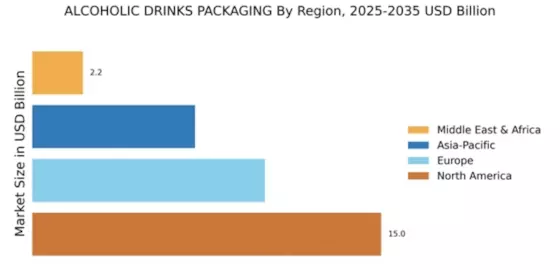
North America is poised to maintain its leadership in the alcoholic drinks packaging market, holding a significant market share of 15.0 in 2024. The region's growth is driven by increasing consumer demand for premium alcoholic beverages and innovative packaging solutions. Regulatory support for sustainable packaging practices further enhances market dynamics, encouraging companies to adopt eco-friendly materials and technologies. The competitive landscape in North America is robust, featuring key players such as Amcor, Ball Corporation, and Crown Holdings. These companies are investing heavily in R&D to develop advanced packaging solutions that cater to evolving consumer preferences. The U.S. remains the largest market, supported by a strong distribution network and a diverse range of alcoholic products, from craft beers to premium spirits.

Europe : Emerging Trends in Sustainability

Europe's alcoholic drinks packaging market is valued at 10.0, reflecting a growing trend towards sustainable packaging solutions. Regulatory frameworks, such as the EU's Circular Economy Action Plan, are catalyzing the shift towards recyclable and biodegradable materials. This focus on sustainability is not only meeting consumer demand but also aligning with governmental initiatives aimed at reducing environmental impact. Leading countries in this region include Germany, France, and the UK, where major players like Ardagh Group and Mondi Group are innovating to meet these demands. The competitive landscape is characterized by a mix of established companies and emerging startups, all striving to enhance their product offerings while adhering to stringent regulations. This dynamic environment is expected to foster further growth in the coming years.

Asia-Pacific : Rapid Growth in Emerging Markets

The Asia-Pacific region, with a market size of 7.0, is witnessing rapid growth in the alcoholic drinks packaging sector. Factors such as rising disposable incomes, urbanization, and changing consumer preferences are driving demand for innovative packaging solutions. Additionally, regulatory support for sustainable practices is encouraging manufacturers to adopt eco-friendly materials, aligning with global trends. Countries like China, India, and Japan are leading the charge, with significant investments from key players such as Silgan Holdings and Sonoco Products Company. The competitive landscape is evolving, with both local and international companies vying for market share. As the region continues to develop, the focus on quality and sustainability will shape the future of the alcoholic drinks packaging market.

Middle East and Africa : Untapped Market Opportunities

The Middle East and Africa region, with a market size of 2.18, presents untapped opportunities in the alcoholic drinks packaging market. Factors such as increasing urbanization, a young population, and rising disposable incomes are driving demand for packaged alcoholic beverages. Regulatory frameworks are gradually evolving to support market growth, particularly in countries like South Africa and the UAE. Key players are beginning to establish a presence in this region, with companies exploring local partnerships to enhance distribution networks. The competitive landscape is still developing, but the potential for growth is significant as consumer preferences shift towards premium and innovative packaging solutions. This region is expected to attract more investments as market dynamics evolve.

Key Players and Competitive Insights

The alcoholic drinks packaging market is currently characterized by a dynamic competitive landscape, driven by innovation, sustainability, and strategic partnerships. Key players such as Amcor (AU), Ball Corporation (US), and Crown Holdings (US) are actively shaping the market through their operational focuses. Amcor (AU) emphasizes sustainable packaging solutions, aligning with global trends towards eco-friendliness. Ball Corporation (US) is enhancing its production capabilities through technological advancements, while Crown Holdings (US) is pursuing strategic acquisitions to expand its market share. Collectively, these strategies foster a competitive environment that prioritizes sustainability and technological innovation.

In terms of business tactics, companies are increasingly localizing manufacturing to reduce supply chain vulnerabilities and optimize logistics. The market structure appears moderately fragmented, with several key players exerting considerable influence. This fragmentation allows for niche players to thrive, while larger corporations leverage economies of scale to enhance their competitive positioning.

In November 2025, Amcor (AU) announced a partnership with a leading beverage manufacturer to develop a new line of biodegradable packaging. This strategic move not only reinforces Amcor's commitment to sustainability but also positions the company as a frontrunner in eco-friendly packaging solutions. The collaboration is expected to enhance brand loyalty among environmentally conscious consumers, thereby driving sales growth.

In October 2025, Ball Corporation (US) unveiled a state-of-the-art manufacturing facility in Europe, aimed at increasing its production capacity for aluminum cans. This facility is significant as it reflects Ball's strategy to meet the rising demand for sustainable packaging options in the beverage sector. The investment is likely to bolster Ball's competitive edge by ensuring timely delivery and reduced carbon footprint, aligning with global sustainability goals.

In September 2025, Crown Holdings (US) completed the acquisition of a regional packaging firm, enhancing its product portfolio and market reach. This acquisition is indicative of Crown's strategy to consolidate its position in the market and expand its operational capabilities. By integrating the new firm's technologies and expertise, Crown is poised to offer innovative packaging solutions that cater to evolving consumer preferences.

As of December 2025, the competitive trends in the alcoholic drinks packaging market are increasingly defined by digitalization, sustainability, and the integration of AI technologies. Strategic alliances are becoming more prevalent, allowing companies to pool resources and expertise to innovate more effectively. Looking ahead, the competitive differentiation is likely to shift from price-based competition to a focus on innovation, technology, and supply chain reliability, as companies strive to meet the demands of a more discerning consumer base.

Key Companies in the ALCOHOLIC DRINKS PACKAGING MARKET market include

Industry Developments

  • Q2 2024: Ardagh Glass Packaging to invest $95 million in new glass furnace at Bridgeton, New Jersey facility Ardagh Glass Packaging announced a $95 million investment to build a new glass furnace at its Bridgeton, New Jersey facility, aimed at increasing production capacity for sustainable glass bottles used in the alcoholic drinks sector.
  • Q1 2024: O-I Glass Appoints New Chief Sustainability Officer to Drive Eco-Friendly Packaging Initiatives O-I Glass, a major supplier of glass packaging for alcoholic beverages, appointed a new Chief Sustainability Officer to accelerate the company's transition to more sustainable packaging solutions.
  • Q2 2024: Heineken launches 100% recycled plastic shrink wrap for multipack beer packaging in Europe Heineken introduced a new shrink wrap made entirely from recycled plastic for its multipack beer packaging in several European markets, marking a significant step in sustainable alcoholic drinks packaging.
  • Q1 2024: Ball Corporation opens new aluminum beverage can plant in the UK Ball Corporation opened a new aluminum can manufacturing facility in the UK to meet growing demand for recyclable packaging in the alcoholic drinks market.
  • Q2 2024: Diageo partners with Pulpex to launch first paper-based spirits bottle Diageo, the maker of Johnnie Walker, announced a partnership with Pulpex to launch the world's first paper-based spirits bottle, targeting a reduction in plastic use for its alcoholic beverage packaging.
  • Q1 2024: Carlsberg Group unveils new fiber bottle for beer in pilot market launch Carlsberg Group launched a pilot of its new fiber-based beer bottle, made from sustainably sourced wood fibers, as part of its commitment to innovative and eco-friendly packaging.
  • Q2 2024: Constellation Brands completes acquisition of glass packaging facility in Mexico Constellation Brands completed the acquisition of a glass packaging facility in Mexico to secure supply and enhance control over packaging quality for its beer and spirits brands.
  • Q1 2024: Amcor launches new lightweight PET bottle for wine and spirits Amcor introduced a new lightweight PET bottle designed for wine and spirits, offering a more sustainable and cost-effective packaging solution for alcoholic beverage producers.
  • Q2 2024: Crown Holdings expands beverage can production capacity in Brazil Crown Holdings announced the expansion of its beverage can production capacity in Brazil to meet rising demand for canned alcoholic drinks in the region.
  • Q1 2024: Suntory launches 100% recycled PET bottle for ready-to-drink alcoholic beverages in Japan Suntory introduced a 100% recycled PET bottle for its ready-to-drink alcoholic beverages in Japan, advancing its sustainability goals in packaging.
  • Q2 2024: Verallia acquires Portuguese glass packaging company Vidrala’s Spanish operations Verallia, a leading glass packaging producer for the alcoholic drinks industry, acquired Vidrala’s Spanish operations to strengthen its presence in Southern Europe.
  • Q1 2024: Smurfit Kappa opens new Bag-in-Box packaging plant in Poland Smurfit Kappa opened a new Bag-in-Box packaging plant in Poland to serve the growing demand for innovative wine and spirits packaging solutions in Eastern Europe.

Future Outlook

ALCOHOLIC DRINKS PACKAGING MARKET Future Outlook

The alcoholic drinks packaging market is projected to grow at a 5.5% CAGR from 2024 to 2035, driven by sustainability trends, premiumization, and innovative packaging technologies.

New opportunities lie in:

  • Expansion of eco-friendly packaging solutions
  • Development of smart packaging with QR codes
  • Investment in lightweight materials for cost reduction

By 2035, the market is expected to achieve robust growth, driven by innovation and sustainability.

Market Segmentation

ALCOHOLIC DRINKS PACKAGING MARKET End Use Outlook

  • Beer
  • Wine
  • Spirits
  • Ready-to-Drink
  • Cocktails

ALCOHOLIC DRINKS PACKAGING MARKET Design Type Outlook

  • Labeling
  • Printing
  • Embossing
  • Screen Printing
  • Shrink Sleeves

ALCOHOLIC DRINKS PACKAGING MARKET Closure Type Outlook

  • Screw Cap
  • Cork
  • Snap-On Cap
  • Flip-Top Cap
  • Crown Cap

ALCOHOLIC DRINKS PACKAGING MARKET Material Type Outlook

  • Glass
  • Plastic
  • Metal
  • Paper
  • Composite

ALCOHOLIC DRINKS PACKAGING MARKET Packaging Type Outlook

  • Bottles
  • Cans
  • Kegs
  • Pouches
  • Tetra Packs

Report Scope

MARKET SIZE 202434.18(USD Billion)
MARKET SIZE 202536.06(USD Billion)
MARKET SIZE 203561.61(USD Billion)
COMPOUND ANNUAL GROWTH RATE (CAGR)5.5% (2024 - 2035)
REPORT COVERAGERevenue Forecast, Competitive Landscape, Growth Factors, and Trends
BASE YEAR2024
Market Forecast Period2025 - 2035
Historical Data2019 - 2024
Market Forecast UnitsUSD Billion
Key Companies ProfiledAmcor (AU), Ball Corporation (US), Crown Holdings (US), Owens-Illinois (US), Ardagh Group (IE), Mondi Group (GB), Silgan Holdings (US), Sonoco Products Company (US)
Segments CoveredMaterial Type, Closure Type, Packaging Type, End Use, Design Type
Key Market OpportunitiesAdoption of sustainable materials and smart packaging technologies in the ALCOHOLIC DRINKS PACKAGING MARKET.
Key Market DynamicsRising consumer demand for sustainable packaging drives innovation and competition in the alcoholic drinks packaging market.
Countries CoveredNorth America, Europe, APAC, South America, MEA

Market Highlights

Author
Snehal Singh
Assistant Manager - Research

High acumen in analyzing complex macro & micro markets with more than 6 years of work experience in the field of market research. By implementing her analytical skills in forecasting and estimation into market research reports, she has expertise in Packaging, Construction, and Equipment domains. She handles a team size of 20-25 resources and ensures smooth running of the projects, associated marketing activities, and client servicing.

Leave a Comment

FAQs

What was the market size of the Alcoholic Drinks Packaging Market in 2024?

The Alcoholic Drinks Packaging Market was valued at 41.58 USD Billion in 2024.

What will be the market value of the Alcoholic Drinks Packaging Market by 2035?

By 2035, the Alcoholic Drinks Packaging Market is projected to be valued at 55.4 USD Billion.

What is the expected CAGR for the Alcoholic Drinks Packaging Market from 2025 to 2035?

ALCOHOLIC DRINKS PACKAGING MARKET is projected to grow at a CAGR of 5.5% during the forecast period, 2025-2035

Which region held the largest market value in 2024 for the Alcoholic Drinks Packaging Market?

In 2024, North America held the largest market value at 15.5 USD Billion.

What is the market size of the Cans segment in the Alcoholic Drinks Packaging Market in 2024?

The Cans segment was valued at 12.0 USD Billion in 2024.

How much is the Kegs segment expected to be valued by 2035?

The Kegs segment is projected to reach a value of 12.0 USD Billion by 2035.

Who are the key players in the Alcoholic Drinks Packaging Market?

Major players include Ardagh Group, Mondi Group, Greif, and Owens-Illinois among others.

What was the market value of Europe in the Alcoholic Drinks Packaging Market for 2024?

Europe's market value was valued at 12.8 USD Billion in 2024.

What growth is anticipated for the Pouches segment from 2024 to 2035?

The Pouches segment is expected to grow from 5.58 USD Billion in 2024 to 7.4 USD Billion in 2035.

How is the Alcoholic Drinks Packaging Market expected to be impacted by regional demand?

The market dynamics are influenced by various factors including consumer preferences and economic conditions unique to each region.

Download Free Sample

Kindly complete the form below to receive a free sample of this Report

Compare Licence

×
Features License Type
Single User Multiuser License Enterprise User
Price $4,950 $5,950 $7,250
Maximum User Access Limit 1 User Upto 10 Users Unrestricted Access Throughout the Organization
Free Customization
Direct Access to Analyst
Deliverable Format
Platform Access
Discount on Next Purchase 10% 15% 15%
Printable Versions