Request Free Sample ×

Kindly complete the form below to receive a free sample of this Report

* Please use a valid business email

Leading companies partner with us for data-driven Insights

clients tt-cursor
Hero Background

Alfalfa Hay Market

ID: MRFR/Agri/21366-HCR
100 Pages
Snehal Singh
Last Updated: June 01, 2026
Alfalfa Hay Market Size, Share, Industry Trend & Analysis Research Report By Type (Grass Hay, Legume Hay, Mixed Hay), By Cut (First Cut, Second Cut, Third Cut, Fourth Cut and Above), By Quality (Premium, Good, Fair, Poor), By End Use (Animal Feed, Bedding, Mulch, Erosion Control) and By Regional (North America, Europe, South America, Asia Pacific, Middle East and Africa) - Forecast to 2035
Download PDF ×

We do not share your information with anyone. However, we may send you emails based on your report interest from time to time. You may contact us at any time to opt-out.

  1. 1 Market Overview |
    1. 1.1 Study Assumptions & Market Definition |
    2. 1.2 Scope of the Study |
    3. 1.3 Research Methodology
  2. 2 Market Summary & Key Takeaways
  3. 3 Market Dynamics |
    1. 3.1 Market Drivers Analysis | |
      1. 3.1.1 Dairy Herd Expansion & Intensification | |
      2. 3.1.2 Middle East Food-Security Mandates | |
      3. 3.1.3 Solar-Assisted Dehydration Technology | |
      4. 3.1.4 E-Commerce & Direct-to-Consumer Channels | |
      5. 3.1.5 Pelletized Format Logistics Savings | |
      6. 3.1.6 Equine & Pet-Food Nutrition Premiumization | |
      7. 3.1.7 Water-Scarcity-Driven Acreage Consolidation |
    2. 3.2 Market Restraints Analysis | |
      1. 3.2.1 Water Scarcity & Irrigation Curtailments | |
      2. 3.2.2 Freight Cost Volatility & Shipping Bottlenecks | |
      3. 3.2.3 Competition from Alternative Forages | |
      4. 3.2.4 Alfalfa Hay Price Commodity Volatility | |
      5. 3.2.5 Phytosanitary & SPS Trade Barriers |
    3. 3.3 Market Opportunity Analysis | |
      1. 3.3.1 Pelletized & Compressed Format Expansion | |
      2. 3.3.2 Precision Irrigation & Water-Smart Cultivation | |
      3. 3.3.3 E-Commerce & Subscription Models for Premium Segments | |
      4. 3.3.4 Emerging-Market Dairy Infrastructure | |
      5. 3.3.5 Carbon-Credit & ESG-Linked Forage Programs |
    4. 3.4 Industry Value Chain Analysis |
    5. 3.5 Porter's Five Forces Analysis
  4. 4 Global Alfalfa Hay Market Size & Forecast (2021–2035) |
    1. 4.1 Historical Market Size (2021–2025) |
    2. 4.2 Current & Forecast Market Size (2026–2035) |
    3. 4.3 Market Size by Revenue (USD Billion) |
    4. 4.4 Year-over-Year Growth Analysis
  5. 5 Segmentation Analysis |
    1. 5.1 By Product Type | |
      1. 5.1.1 Bales | |
      2. 5.1.2 Cubes | |
      3. 5.1.3 Dehydrated Pellets | |
      4. 5.1.4 Chopped/Loose |
    2. 5.2 By Grade | |
      1. 5.2.1 Supreme (RFV >185) | |
      2. 5.2.2 Premium (RFV 170–185) | |
      3. 5.2.3 Good (RFV 150–170) | |
      4. 5.2.4 Fair/Utility ( |
    3. 5.3 By Processing Technology | |
      1. 5.3.1 Field-Dried Conventional | |
      2. 5.3.2 Solar-Assisted Dehydration | |
      3. 5.3.3 Drum/Rotary Dehydration | |
      4. 5.3.4 Controlled-Atmosphere Systems |
    4. 5.4 By Distribution Channel | |
      1. 5.4.1 Export Trading Houses | |
      2. 5.4.2 Direct Farm Gate | |
      3. 5.4.3 Cooperative/Dealer Networks | |
      4. 5.4.4 E-Commerce Platforms |
    5. 5.5 By Livestock Application | |
      1. 5.5.1 Dairy Cattle Feed | |
      2. 5.5.2 Beef Cattle Feed | |
      3. 5.5.3 Equine | |
      4. 5.5.4 Small Ruminant (Sheep/Goat) | |
      5. 5.5.5 Camel & Other |
    6. 5.6 By End-Use Sector | |
      1. 5.6.1 Commercial Farms | |
      2. 5.6.2 Smallholder/Family Farms | |
      3. 5.6.3 Pet-Food & Specialty
  6. 6 Regional Analysis |
    1. 6.1 North America | |
      1. 6.1.1 United States | |
      2. 6.1.2 Canada | |
      3. 6.1.3 Mexico |
    2. 6.2 Europe | |
      1. 6.2.1 Germany | |
      2. 6.2.2 United Kingdom | |
      3. 6.2.3 France | |
      4. 6.2.4 Italy | |
      5. 6.2.5 Spain | |
      6. 6.2.6 Nordic Countries | |
      7. 6.2.7 Russia | |
      8. 6.2.8 Rest of Europe |
    3. 6.3 Asia-Pacific | |
      1. 6.3.1 China | |
      2. 6.3.2 India | |
      3. 6.3.3 Japan | |
      4. 6.3.4 South Korea | |
      5. 6.3.5 ASEAN | |
      6. 6.3.6 Rest of Asia-Pacific |
    4. 6.4 South America | |
      1. 6.4.1 Brazil | |
      2. 6.4.2 Argentina | |
      3. 6.4.3 Rest of South America |
    5. 6.5 Middle East & Africa | |
      1. 6.5.1 Saudi Arabia | |
      2. 6.5.2 UAE | |
      3. 6.5.3 South Africa | |
      4. 6.5.4 Egypt | |
      5. 6.5.5 Rest of MEA
  7. 7 Competitive Landscape |
    1. 7.1 Market Share Analysis (2025) |
    2. 7.2 Competitive Benchmarking Matrix |
    3. 7.3 Company Profiles | |
      1. 7.3.1 AL Dahra | |
      2. 7.3.2 ACX Global Inc. | |
      3. 7.3.3 Standlee Premium Products, LLC | |
      4. 7.3.4 Riverina Stockfeeds | |
      5. 7.3.5 Green Prairie International Inc. | |
      6. 7.3.6 Border Valley Trading | |
      7. 7.3.7 Anderson Hay & Grain | |
      8. 7.3.8 Bailey Farms | |
      9. 7.3.9 SL Hay Company | |
      10. 7.3.10 Grupo Osés
  8. 8 Future Outlook & Strategic Recommendations (2026–2035) |
    1. 8.1 Precision Agriculture & IoT-Driven Harvest Optimization |
    2. 8.2 Supply-Chain Digitization & Blockchain Traceability |
    3. 8.3 Water Reallocation & Climate Adaptation |
    4. 8.4 ESG Integration & Sustainable Forage Certification
  9. 9 Recent Developments & News
  10. 10 Frequently Asked Questions (FAQs)
  11. 11 Report Scope & Methodology |
    1. 11.1 Study Period & Base Year |
    2. 11.2 Data Sources & Citations |
    3. 11.3 Abbreviations
  12. 12 LIST OF TABLES |
  13. TABLE 1 Global Alfalfa Hay Market Size & Forecast, by Revenue (USD Billion), 2021–2035 |
  14. TABLE 2 Global Alfalfa Hay Market – Year-over-Year Growth Analysis, 2021–2035 |
  15. TABLE 3 Global Alfalfa Hay Market – Driver Impact Analysis, 2026–2035 |
  16. TABLE 4 Global Alfalfa Hay Market – Restraint Impact Analysis, 2026–2035 |
  17. TABLE 5 Global Alfalfa Hay Market Size, by Product Type, 2021–2035 (USD Billion) |
  18. TABLE 6 Global Alfalfa Hay Market Size, by Grade, 2021–2035 (USD Billion) |
  19. TABLE 7 Global Alfalfa Hay Market Size, by Processing Technology, 2021–2035 (USD Billion) |
  20. TABLE 8 Global Alfalfa Hay Market Size, by Distribution Channel, 2021–2035 (USD Billion) |
  21. TABLE 9 Global Alfalfa Hay Market Size, by Livestock Application, 2021–2035 (USD Billion) |
  22. TABLE 10 Global Alfalfa Hay Market Size, by End-Use Sector, 2021–2035 (USD Billion) |
  23. TABLE 11 Global Alfalfa Hay Market Size, by Region, 2021–2035 (USD Billion) |
  24. TABLE 12 North America Alfalfa Hay Market Size, by Country, 2021–2035 (USD Billion) |
  25. TABLE 13 Europe Alfalfa Hay Market Size, by Country, 2021–2035 (USD Billion) |
  26. TABLE 14 Asia-Pacific Alfalfa Hay Market Size, by Country, 2021–2035 (USD Billion) |
  27. TABLE 15 South America Alfalfa Hay Market Size, by Country, 2021–2035 (USD Billion) |
  28. TABLE 16 Middle East & Africa Alfalfa Hay Market Size, by Country, 2021–2035 (USD Billion) |
  29. TABLE 17 Competitive Benchmarking Matrix – Global Alfalfa Hay Market, 2025 |
  30. TABLE 18 Company Profiles – Key Players, Global Alfalfa Hay Market |
  31. TABLE 19 Recent Developments & Strategic Announcements, 2023–2025 |
  32. TABLE 20 Report Scope & Methodology Summary |
  33. TABLE 21 Detailed Sources and Citations
  34. 13 LIST OF FIGURES |
  35. FIGURE 1 Global Alfalfa Hay Market Dynamics — Drivers, Restraints, and Opportunities |
  36. FIGURE 2 Value Chain Analysis — Alfalfa Hay Market |
  37. FIGURE 3 Porter's Five Forces Analysis — Global Alfalfa Hay Market |
  38. FIGURE 4 Global Alfalfa Hay Market Size Trend (USD Billion), 2021–2035 |
  39. FIGURE 5 Global Alfalfa Hay Market Share, by Product Type, 2025 |
  40. FIGURE 6 Global Alfalfa Hay Market Share, by Grade, 2025 |
  41. FIGURE 7 Global Alfalfa Hay Market Share, by Processing Technology, 2025 |
  42. FIGURE 8 Global Alfalfa Hay Market Share, by Distribution Channel, 2025 |
  43. FIGURE 9 Global Alfalfa Hay Market Share, by Livestock Application, 2025 |
  44. FIGURE 10 Global Alfalfa Hay Market Share, by End-Use Sector, 2025 |
  45. FIGURE 11 Global Alfalfa Hay Market Share, by Region, 2025 |
  46. FIGURE 12 North America Alfalfa Hay Market Share, by Country, 2025 |
  47. FIGURE 13 Europe Alfalfa Hay Market Share, by Country, 2025 |
  48. FIGURE 14 Asia-Pacific Alfalfa Hay Market Share, by Country, 2025 |
  49. FIGURE 15 South America Alfalfa Hay Market Share, by Country, 2025 |
  50. FIGURE 16 Middle East & Africa Alfalfa Hay Market Share, by Country, 2025 |
  51. FIGURE 17 Competitive Landscape — Market Share Analysis, 2025

Segmentation Quick Reference

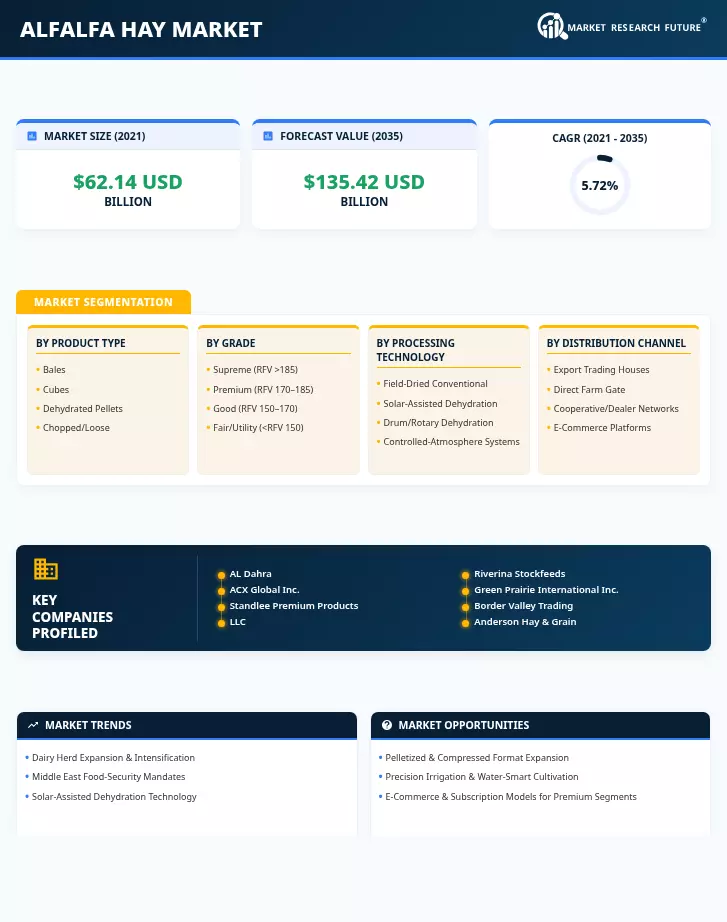
Dimension Sub-Segments Dominant Segment Fastest Growing Segment
Product Type Bales, Cubes, Dehydrated Pellets, Chopped/Loose Bales Dehydrated Pellets
Grade Supreme (RFV >185), Premium (RFV 170–185), Good (RFV 150–170), Fair/Utility ( Premium (RFV 170–185) Supreme (RFV >185)
Processing Technology Field-Dried Conventional, Solar-Assisted Dehydration, Drum/Rotary Dehydration, Controlled-Atmosphere Systems Field-Dried Conventional Solar-Assisted Dehydration
Distribution Channel Export Trading Houses, Direct Farm Gate, Cooperative/Dealer Networks, E-Commerce Platforms Export Trading Houses E-Commerce Platforms
Livestock Application Dairy Cattle Feed, Beef Cattle Feed, Equine, Small Ruminant, Camel & Other Dairy Cattle Feed Equine
End-Use Sector Commercial Farms, Smallholder/Family Farms, Pet-Food & Specialty Commercial Farms Pet-Food & Specialty
Geography North America, Europe, Asia-Pacific, South America, Middle East & Africa North America Asia-Pacific


Market Segmentation Overview

By Product Type

Sub-Segment Key Trend
Bales Large-square bales dominate commercial trade; small-square bales serve equine and hobby channels.
Cubes Steady demand from feedlots and equine buyers valuing portion-controlled feeding
Dehydrated Pellets Fastest-growing format driven by export logistics efficiency and e-commerce retail
Chopped/Loose Used primarily in total mixed ration (TMR) blending by commercial dairies


Bales continue to anchor conventional supply chains, but format innovation is the defining trend in product-type segmentation. Pelletized and cubed formats are capturing share from loose and baled hay as buyers prioritize shipping density, shelf stability, and dust-free handling — particularly in cross-border alfalfa hay export-import routes.

By Grade

Sub-Segment Key Trend
Supreme (RFV >185) Premium pricing driven by high-performance dairy and equine nutrition demands
Premium (RFV 170–185) Mainstream standard for dairy cow alfalfa forage programs globally
Good (RFV 150–170) Workhorse grade for beef cattle and general livestock operations
Fair/Utility ( Declining share; used in biomass, erosion control, and budget feed blends


Grade differentiation is intensifying as analytical testing becomes more accessible and buyers demand tighter nutritional specifications. The shift toward Supreme and Premium grades reflects the broader industry move toward precision nutrition and higher milk-per-ton feed efficiency.

By Processing Technology

Sub-Segment Key Trend
Field-Dried Conventional Still dominant but losing share to technology-enhanced methods
Solar-Assisted Dehydration Fastest-growing technology; superior nutrient retention at lower energy cost
Drum/Rotary Dehydration Established in European cooperatives, high throughput, gas-dependent
Controlled-Atmosphere Systems Emerging technology for premium-grade preservation and export readiness


Processing technology is a key differentiator for producers seeking to capture premium pricing. Solar-assisted systems represent the convergence of sustainability and quality, reducing energy costs while preserving the sun-cured alfalfa hay nutrition profiles that high-value buyers demand.

By Distribution Channel

Sub-Segment Key Trend
Export Trading Houses Dominant channel for cross-border trade; long-term offtake contracts growing
Direct Farm Gate Regional procurement for nearby dairies and feedlots
Cooperative/Dealer Networks Aggregation model serving mid-size buyers across diverse geographies
E-Commerce Platforms Rapidly growing channel for premium alfalfa hay bale retail, subscription models


E-commerce is the most disruptive channel trend, bringing lab-tested, traceable products to small-lot buyers who were previously underserved by traditional bulk distribution networks.

By Livestock Application

Sub-Segment Key Trend
Dairy Cattle Feed Largest segment: driven by global dairy intensification and TMR adoption
Beef Cattle Feed Stable demand in finishing and backgrounding rations
Equine Fastest-growing application; sport-horse and recreational markets driving premiumization
Small Ruminant (Sheep/Goat) Niche growth in artisanal and Mediterranean dairy operations
Camel & Other Gulf region demand for camel nutrition and zoo/wildlife applications


Dairy cattle feed remains the volume anchor, while equine and pet-food applications drive margin expansion and premium alfalfa hay bale innovation across the alfalfa hay market.

By End-Use Sector

Sub-Segment Key Trend
Commercial Farms Dominant buyer segment: large-scale procurement, cost-optimized sourcing
Smallholder/Family Farms Growing segment in developing markets as organized dairy scales up
Pet-Food & Specialty Fastest-growing sector: rabbit, guinea pig, and specialty animal nutrition


Commercial farms set the baseline for global demand. Still, the pet-food and specialty sector is introducing new quality standards, packaging formats, and direct-to-consumer business models that are reshaping competitive dynamics across the alfalfa hay market.